Volume 27, Number 3
Francesc M. Esteve-Mon1, Anna Sánchez-Caballé1, María Ángeles Llopis Nebot1, Virginia Viñoles Cosentino1, and Jose Cela-Ranilla2
1Universitat Jaume I, Spain; 2Universidad de Valladolid, Spain
In the context of widespread digitalization in higher education, enhancing teacher digital competence (TDC) has become a critical priority. However, institutional efforts to advance TDC, including the development of open educational resources (OER), are often hindered by the prevalence of training models that lack pedagogical depth and rely on transmissive methods. Current literature on open educational practices (OEP) has highlighted the transformative potential of openness in teaching, yet it also suggests a disconnect between the availability of resources and their actual adoption. Building upon this gap, this article describes the creation of a theoretical framework intended to guide the design of OER-based training that effectively integrates OEP for faculty development. The method employed was a qualitative, exploratory approach, constituting the first phase of a design-based research (DBR) project. The framework was constructed in two stages: first, defining its conceptual foundations through a rigorous literature review, and second, validating and refining these elements through input from experts in educational technology. The primary result is a validated theoretical framework for OER-based digital training. The conclusions emphasize that this framework is distinct from others because it serves as a meta-reflective element, focusing directly on the teacher’s own professional development and practice, rather than only on student-facing teaching processes. While the framework can guide institutional digital transformation, its initial design was developed within a specific university context, following the DBR approach. Future research will involve implementing, revising, and validating the framework in other contexts.
Keywords: teacher digital competence, open educational resources, OER, theoretical framework, open educational practices, OEP
Integrating technologies into higher education is a process that has been going on for several decades but has accelerated significantly in recent years. This critical turning point is a response to various institutional digital transformation initiatives that seek to take advantage of the opportunities and challenges posed by emerging technologies and to redefine educational paradigms (Esteve-Mon et al., 2023).
However, the COVID-19 health crisis critically highlighted a dual need. On the one hand, it is necessary to have a robust technological infrastructure, and on the other, more pressingly, there is the need to develop adequate digital training for the entire university community, especially faculty (Crawford et al., 2020). In this context, teacher digital competence (TDC) has been consolidated as a key aspect, as highlighted by various experts (Falloon, 2020). While frameworks such as DigCompEdu (Redecker & Punie, 2017) have been fundamental in defining and even assessing TDC, they can be excessively fragmented and instrumental, offering little guidance on the pedagogical processes for TDC development (Hidalgo, 2024).
At the European level, and in response to the COVID-19 pandemic, various administrations have promoted policies to strengthen the digitalization of higher education, with the support of NextGenerationEU funds. Specifically, in Spain, the context of this research, thanks to the Recovery, Transformation, and Resilience Plan, various projects have emerged to improve TDC through the production of open educational resources (OER; Sánchez-Caballé et al., 2025).
However, these initiatives often remain limited to creating materials for enhancing digital competence, maintaining overly transmissive training models (Viñoles-Cosentino et al., 2022). Such models generally focus on the creation, exchange, and reuse of OER, failing to leverage the full potential of open pedagogies to propose open educational practices (OEP) with more constructivist, collaborative, situated, and open approaches (Cronin, 2017; Koseoglu et al., 2020).
This paper describes the process of creating a theoretical framework that serves as a reference for the design of OER-based training actions, enabling the full potential of OEP to be harnessed for the digital training of university professors. In other words, this framework offers the elements to shift from a vision excessively focused on the linear transmission of knowledge and object repositories toward embedding these into teacher training processes and professional development through OEP.
The professional development of university teaching staff has become a central concern in higher education in recent decades, reflecting the growing need to prepare faculty for increasingly complex and changing technological and pedagogical environments (Buils et al., 2024). Traditionally, the training of university teaching staff has focused primarily on research, giving it greater weight and neglecting pedagogical training or relegating it to informal or mandatory spaces. However, in recent decades, awareness has grown regarding the importance of supporting and training faculty not only in their disciplinary knowledge but also in their pedagogical and teaching practices (Buils et al., 2024; Más-Torelló, 2011; Rué Domingo, 2015).
This shift towards greater recognition of teaching as a complex and situated practice has led to the development of various initiatives and institutional frameworks aimed at improving teaching and learning processes in the university setting (Sánchez-Tarazaga et al., 2022). Considering the impact that digitalization has had in recent decades, special emphasis has been placed on strategies that enable teachers to develop the skills necessary to teach in a world increasingly mediated by digital technology (Basilotta-Gómez-Pablos et al., 2022; Castañeda et al., 2024; Fernández-Batanero et al., 2022). The impact of the COVID-19 pandemic has further highlighted the need for the comprehensive development of TDC (Bartolic et al., 2022; Crawford et al., 2020; García-Peñalvo & Corell, 2020). The sudden shift from in-person to emergency remote learning highlighted gaps in pedagogical integration and emphasized the importance of preparing teachers not only to use digital tools but also to adapt teaching strategies to ever-evolving contexts (Castañeda et al., 2023; Crawford et al., 2020; García-Peñalvo & Corell, 2020).
In this regard, various initiatives have been implemented at the European level. The European Commission, for example, has emphasized the need to integrate pedagogical and technological innovation into higher education through policies such as the Digital Education Action Plan 2021–2027, which prioritizes the professional development of teachers at all educational levels and promotes digital transformation as an institutional objective (European Commission, 2020). Likewise, the European Commission’s Joint Research Center has developed frameworks such as DigCompEdu to promote the development of teachers’ digital skills (Redecker & Punie, 2017).
In the Spanish context, this growing interest in teaching quality has been reinforced by initiatives such as the NextGenerationEU Recovery Plan, which has prioritized improving the digital skills of teaching staff as part of broader modernization and digitalization efforts (Castañeda et al., 2023). These funds have supported national plans such as Unidigital, aimed at modernizing university campuses and fostering digital and pedagogical innovation. These initiatives reflect the recognition of the digital transformation of higher education not only as a technological challenge, but also as a pedagogical and cultural one, requiring coordinated efforts at multiple levels of the university system (Viñoles Cosentino et al., 2025).
However, despite these advances, several studies highlight persistent gaps and challenges in the professional development of university professors, particularly regarding the integration of digital technologies into pedagogical practices (Castañeda et al., 2018; García-Peñalvo & Corell, 2020; Mercader & Gairín, 2020). Although universities increasingly offer training in digital tools and platforms and aim to develop the digital competences of their faculty, these initiatives are still often fragmented or disconnected from broader institutional strategies, which limits their impact on sustainable change (Oliveira et al., 2021; Viñoles Cosentino, 2025). In this sense, it is necessary to go beyond purely technical training to address the pedagogical and critical dimensions of digital competence, which are essential for promoting transformative and student-centered learning environments. More holistic, collaborative, and contextualized approaches to teacher development are needed (Biesta et al., 2015; Castañeda et al., 2018).
Scientific literature highlights the need to align teacher professional development with broader institutional policies and strategies, fostering not only technical skills but also pedagogical agency and reflexivity (Castañeda et al., 2018; Esteve-Mon et al., 2023; Stenalt et al., 2023). In this sense, competency development should be understood as a shared responsibility within universities, encompassing institutional frameworks, training programs, and the development of supportive environments that foster experimentation and critical engagement (Inamorato dos Santos et al., 2023; Viñoles-Cosentino et al., 2022).
Strategies such as the use of OER and OEP can offer scaffolding opportunities to support the development of teachers’ digital competence within a broader framework that considers professional growth and institutional transformation.
OER are a key innovation in education, facilitating free access to teaching, learning, and research materials. The OER concept was introduced by UNESCO, referring to materials in the public domain or under open licenses that allow their use, adaptation, and redistribution with minimal restrictions (UNESCO, 2002, 2012). The distinctive feature of OER is their openness, supported by the five freedoms proposed by Wiley and Hilton (2018): retain, reuse, revise, remix, and redistribute. These freedoms foster participatory, collaborative, and personalized learning. UNESCO (2019) has actively promoted the incorporation of OER into educational systems in recent years, considering that their use can contribute to building more inclusive knowledge-based societies and meeting the Sustainable Development Goals (SDGs) and the 2030 Agenda. Furthermore, OER serve as “boundary objects” that enable faculty to collaborate, remix content, and, consequently, reflect on their own pedagogy (McBride & Abramovich, 2022; Wiley & Hilton, 2018).
Linked to OER are OEP, which include both the use and creation of open resources, as well as participatory teaching methodologies and approaches (Blomgren, 2018). Indeed, some authors contend that OER have focused excessively on content (Cronin, 2017), resulting in a limited impact on learning; consequently, they necessitate additional pedagogical practices (Tlili et al., 2023; Zou et al., 2025). Cronin (2017) defined OEP as a broad set of practices ranging from the use of OER to the adoption of open pedagogies. In higher education, UNESCO has highlighted the transformative role of OER and OEP, promoting teaching models focused on student autonomy, pedagogical innovation, and personalized learning (Inamorato dos Santos, 2019; Weller, 2013).
From a constructivist perspective, following Paskevicius (2017), OEP are articulated around four essential components: (a) designing of personalized learning; (b) creating resources, which enhances creativity and performance; (c) implementing of innovative teaching-learning activities; and (d) using collaborative assessment strategies that involve students in the generation of new resources. However, several authors highlight the need to carefully evaluate the pedagogical quality of these resources (Bournissen et al., 2019; Lemos de Carvalho et al., 2019). Deng et al. (2020) asserted that for meaningful learning to take place with OEP, it is necessary to develop motivating resources, adopt teaching methods that encourage students’ intellectual commitment, and implement integrated technological and human strategies for evaluation and feedback.
Research on open education in the university context has focused primarily on its adoption at the institutional level, identifying the key factors that facilitate and hinder its practice. Following Stagg (2014, p. 4), faculty members do not appear to be familiar with the use of these types of resources due to various reasons such as a lack of investment in open education or a lack of time to explore OER. This is also due to other reasons related to the need to develop a culture of open creation, such as a lack of awareness of intellectual property issues, the level of TDC, and the need to adapt current teaching practices to open practices (Koseoglu & Bozkurt, 2018).
Al Albri et al. (2022) proposed design principles that promote the integration of OER use and creation in higher education. Essentially, they recommended that open resources be integrated throughout the course using constructivist pedagogical models that place students at the center of the process and establish an intertwined connection between the knowledge and skills learned during the course.
Moving toward a more open model in higher education entails a profound transformation in the way we understand learning, integrating key elements such as technology, pedagogy, and the values of equity and collaboration, advancing toward a more inclusive, innovative, and sustainable university.
This research is part of an R & D project aimed at promoting the development of OER to improve the digital competence of teaching staff at Jaume I University (Ref: CIGE/2023/18). This university, founded in the 1990s, offers various digitalization and teaching services to support the use of digital technologies in the educational context. Since 2020, it has launched a new digital transformation plan. As a result of this plan and the European NextGeneration grants for digitalization resulting from the COVID-19 pandemic, the university coordinated a regional initiative for the development of OER that fosters digital competence.
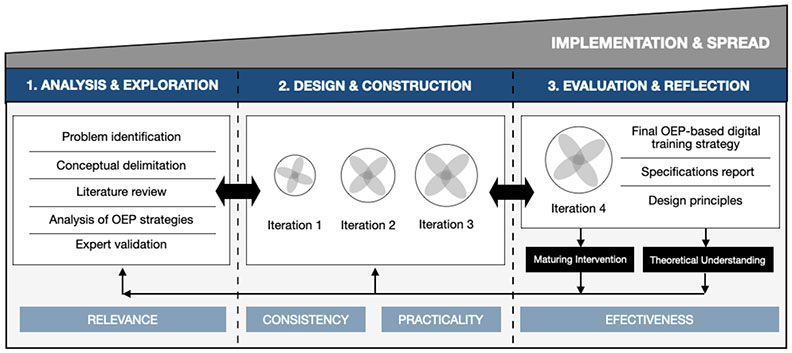
The methodological approach adopted follows design-based research (DBR), a systematic methodology characterized by iterative cycles of design, implementation, analysis, and redesign, with a dual focus on refining both theory and practice (Bakker, 2018; Hoadley & Campos, 2022; Wang & Hannafin, 2005). The objective of this approach is not only to provide solutions to a complex educational problem but also to generate a series of design principles that can be applied to similar contexts (Plomp & Nieveen, 2009; Van den Akker et al., 2006). Following the model of McKenney and Reeves (2013), the project is structured around three main phases: (a) analysis and exploration, (b) design and construction, and (c) evaluation and reflection. These phases are iterative, and each cycle generates insights that inform subsequent refinements (Figure 1).
Figure 1
Main Phases of DBR Process in the Research Project
Note. DBR = design-based research; OEP = open educational practices. See McKenny & Reeves (2013) for further discussion about DBR.
This article reports on the first phase—analysis and exploration—which focuses on understanding the problem, reviewing existing knowledge, and developing a preliminary conceptual framework that will underpin the subsequent design and implementation cycles.
This paper uses a fundamentally qualitative approach with an exploratory focus that pursues a deep and exhaustive description of the phenomenon it analyzes—in this case, constructing a theoretical framework that serves as a reference for the design of OER-based training actions. This approach was selected due to its suitability for capturing the complexity, contextual nature, and multidimensionality of open pedagogical practices in digital learning environments.
This exploratory process was carried out in two phases: the first phase was to define the basic framework based on scientific literature, and the second phase was to contrast and validate it with input from experts. This two-phase design enabled an iterative refinement of the framework, combining theoretical grounding with expert-informed validation to enhance its coherence, relevance, and analytical robustness.
The initial framework was developed through a structured mapping and synthesis process. Three key studies (Al Abri et al., 2022; Paskevicius, 2017; Stagg, 2014) were selected for their complementary perspectives on open pedagogies. Key elements were extracted, compared in a matrix to identify overlaps and gaps, and iteratively synthesized by the research team into six general categories, with consensus ensured through researcher triangulation.
In the first phase, which focused on the initial conceptualization of the reference model based on existing literature (Booth et al., 2022), a set of key dimensions of open pedagogy was used to structure the analysis: (a) pedagogical principles; (b) learning outcomes; (c) teaching and learning activities; (d) teaching and learning resources; (e) assessment systems; and (f) institutional support.
For the second phase of testing and validation, two focus groups were held with technical and educational experts in teacher training, open pedagogies, and educational technology. A total of 13 experts (54% men and 46% women) from six different universities in Spain and Portugal participated. Participants were selected through purposive sampling, using specific criteria relevant to the research, such as the type of institution they attended, their roles, and the diversity of their professional profiles.
Before the sessions, participants received an information sheet outlining the study objectives, framework, and discussion topics. The sessions were organized into three blocks, aligned with the components of the framework, and were moderated using open-ended questions to encourage critical evaluation and suggestions. With informed consent, the discussions were audio-recorded and transcribed verbatim for analysis.
The sessions were conducted via Google Meet and lasted between 90 and 120 minutes each. They were led by a moderator following a semi-structured approach, which fostered an environment of active participation.
The sessions were recorded and transcribed, with prior informed consent from the participants and authorization from the university’s ethics committee (Ref.: CEISH/91/2004). An inductive approach was adopted to analyze the data, using a system of categories designed from the research objectives and the conceptual framework generated in the preliminary phase, presented below. The analytical strategy used allowed the framework to be progressively refined through close engagement with the empirical material, ensuring alignment between the data, the analytical categories, and the study’s objectives.
Qualitative software Atlas.ti (Version 25; https://atlasti.com/) was used for coding and analysis, and strategies such as triangulation of researchers and verification by various members of the research team were carried out to ensure the quality of the analysis. Following Cisterna (2005), triangulation in qualitative research was understood as a process of cross-checking, comparing, and dialectically interpreting information obtained from different sources, instruments, and analytical perspectives, with the aim of constructing a deeper, more coherent, and well-grounded understanding of the phenomenon under study. Specifically, credibility was strengthened through researcher triangulation and iterative discussions of coding decisions; dependability and confirmability were supported by maintaining a transparent audit trail of analytical procedures; and transferability was addressed by providing detailed descriptions of the analytical process and context.
The results are presented in two phases, as defined in the section “Participants and Instruments.” The first phase identifies the conceptual foundations of the framework, and the second delves into the basic elements of these foundations.
As illustrated in Figure 2, this framework, grounded in the literature (Al Abri et al., 2022; Paskevicius, 2017; Stagg, 2014), identifies the main elements and interrelationships that are expected when working with open pedagogies. The selection and organization of these elements respond to their recurrent presence in prior research and to their conceptual relevance for explaining how open pedagogical practices are designed, implemented, and sustained in digital learning contexts. These elements are: (a) pedagogical principles; (b) learning outcomes; (c) teaching and learning activities; (d) teaching and learning resources; (e) assessment systems; and (f) institutional support.
Figure 2
Network of the Main Concepts That Make up the Conceptual Foundation of the Framework
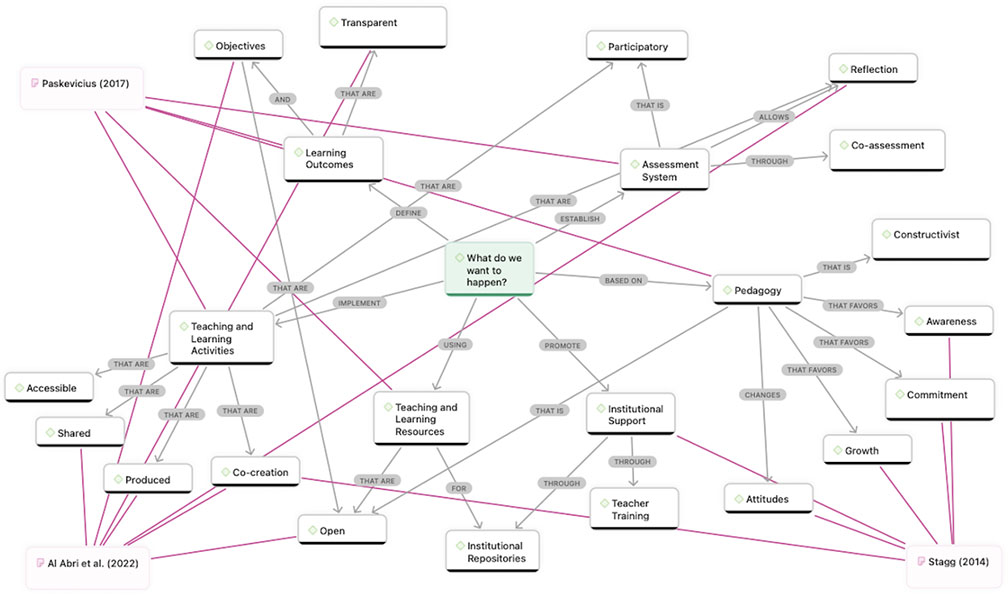
Note. The lines in pink represent a relationship that is grounded in the cited literature, while the lines in grey indicate the interrelationships between the main elements of the framework.
Based on these foundations and their interrelations, the first version of the framework was generated with a checklist-like organization, which took as its structural reference the vision of teachers, students (in this case, teachers who participate as students or trainees in the courses), and the educational institution itself.
This phase describes the in-depth analysis conducted by the experts, in which they contrasted the theoretically defined foundations and validated their relevance in the debate generated in the focus groups. Through this process, the experts examined the extent to which the proposed components of the OEP framework were reflected in practice, discussed their coherence with prior research, and identified areas of convergence and refinement. The result of this expert dialogue is presented, organized around three elements: (a) pedagogical principles and learning outcomes; (b) teaching-learning and assessment activities; and (c) institutional resources and support.
One element that emerged as central is the need for a pedagogical model focused on transferability and applicability, in which learning activities are meaningfully and relevantly connected to the real-life context of the preservice teachers’ practice. Participants emphasized the importance of ensuring that content and activities are not perceived as mere formalities but as relevant proposals for their professional development.
Another key principle is the emphasis on collaborative knowledge building. The experts emphasized the importance of fostering peer-to-peer learning dynamics, in which participants share practices, experiences, and reflections to build collective understanding, as seen in the following excerpt from our focus group discussions.
I think all of this is much more effective collaboratively, right? Especially when we’re thinking about these open educational resources. Subjects aren’t managed individually; rather, it’s desirable for them to be managed by teams of university professors.
Likewise, critical reflection and the integration of OEP are seen as tools for more conscious and committed teaching, although the importance of addressing potential resistance, such as beliefs, was emphasized.
One of the things I see as important when promoting these open educational resources is that educators address the issue of beliefs.... We see that the main obstacles are often beliefs.
In this regard, a clear alignment between expected learning outcomes, activities, and assessment is proposed to ensure didactic coherence and transparency, as we will discuss in more detail in the following section.
One of the most reiterated points was the importance of designing activities in training courses that are transferable to participants’ different areas of knowledge, that are also editable and reusable in their own subjects, and that, in turn, are based on real-life cases, avoiding fictitious situations without direct application. In this regard, it is important not to use and share these resources only among teachers, but rather to use and co-create them with students.
Create open educational resources with students and have university faculty develop strategies so that students in our undergraduate and master’s programs can co-create this content. [The challenge will be] how to involve students in these processes.
Emphasis was also placed on the design of collective activities, such as forums or guided debates, that allow for the exchange of perspectives and the building of knowledge among peers.
Regarding evaluation in these courses, the importance of formative assessment focused on developmental feedback, rather than immediate numerical grades, was emphasized. A model of initial, continuous, and final assessment was proposed to facilitate more precise monitoring of the learning process.
Likewise, peer assessment was recognized and highlighted as a relevant practice, both for learning and for creating communities of practice.
I believe that incorporating into one’s own teaching practice a component of openness, transparency, sharing, co-creation, or that openness... would be very useful. And so, when you design, you’re thinking that you’re making something you want to share, not something you want to lock away.
Among the most frequently expressed ideas in relation to this third element was the necessary active commitment that educational institutions must demonstrate in the promotion and sustainability of OER. Along these lines, various initiatives were mentioned, such as calls for projects or workshops.
At the institutional level, one idea is to promote it by incentivizing requests for certain projects or initiatives, or through events to disseminate open educational resources.
It was also highlighted that these practices will only be sustainable through institutional support, and to achieve this, it is essential that they be recognized within academic career structures and adequately incentivized, enabling their gradual integration into faculty members’ practice.
Ideally, it should end up being an intrinsic element, meaning I do it because I’m convinced I have to, but maybe even at the beginning, because that external reward mechanism is a bit necessary.
Furthermore, the role and involvement of university services such as libraries and resource centers, teaching innovation units, and educational technology were highlighted in supporting faculty in the use and creation of OER. Emphasis was also placed on the need for stable and secure infrastructures for resource curation, publication, and reuse, such as institutional repositories and interoperable metadata systems.
Ensuring the quality of shared resources was another reiterated aspect of this element. To achieve this, it was suggested to work through ex ante evaluation systems, such as rubrics or indicators, and other systems, such as peer review or public scoring systems, were proposed.
Finally, it was noted that artificial intelligence is an emerging tool for the co-creation and adaptation of materials, as well as for content curation, which must be taken into account now in an active, ethical, and critical manner.
This article examines current issues in the digital training of university professors. Despite the institutional drive to improve TDC, transmissive training models persist, failing to fully harness the potential of open pedagogy. In response, this paper describes the process of developing a theoretical framework that underpins the design of training initiatives that overcome current limitations by effectively integrating the potential of OEP.
First, the conceptual foundations of the framework were identified through a literature review (Al Abri et al., 2022; Paskevicius, 2017; Stagg, 2014), and then, the core elements of these foundations were further explored through expert input. The elements that comprise the framework for OER-based digital training are detailed in Table 1, following the design and validation process.
Table 1
Elements of the Framework for OER-Based Digital Training
| Core elements according to type of stakeholder |
| Teachers |
| Transparency in objectives, learning outcomes, and assessment. Clearly communicate course objectives, expected learning outcomes, and assessment criteria. |
| Open learning outcomes. Define learning outcomes that allow students to explore and construct knowledge in an open and collaborative manner. |
| Co-creation of learning outcomes. Include students in the process of defining learning outcomes so they are committed to the course objectives. |
| Pedagogical flexibility. Adapt teaching strategies to students’ needs and interests, maintaining an open and flexible approach. |
| Professional collaboration and peer assessment. Promote collaboration between teachers and other professionals to share materials and resources, as well as implement peer assessment processes. |
| Participatory and reflective assessment. Design assessment mechanisms in which students actively participate and reflect on their own learning process. |
| Focus on constructivist pedagogy. Focus on a constructivist pedagogy that encourages collaborative work, knowledge creation, and active student production of materials. |
| Share open materials. Provide access to teaching materials under open licenses, encouraging students to use, adapt, and share them. |
| Participation in communities of practice. Collaborate with other educators through communities of practice to share experiences and resources on OEP. |
| Students (or teachers participating as students or trainees) |
| Co-creation of learning outcomes. Actively participate in defining learning outcomes to align them with one’s interests and goals. |
| Collaborative production. Working together with other students to produce knowledge, teaching materials, or projects that can be shared openly and freely. |
| Share and peer-review open materials. Publish one’s work and materials under open licenses and participate in peer-review processes with peers. |
| Active and reflective participation in assessment. Contribute to the assessment of one’s own learning process and that of peers through self-reflection and open dialogue with the teacher. |
| Awareness of the use of open resources. Learn to locate, use, and create OER, taking into account open licenses and the sustainability of collaborative learning. |
| Motivation. Taking the course should be motivating for the student in such a way that it fosters engagement in the learning process. |
| Institution |
| Institutionalizing support for OEP. Develop policies that promote OEP, including the use of OER and co-creation practices. |
| Institutional commitment to OEP. Promote a clear institutional vision of commitment to OEP, highlighting the importance of adopting open practices for educational innovation. |
| Promoting and recognizing open source work. Recognize and value the open source work of faculty and students, such as the production of open source materials and participation in communities of practice. |
| Provide tools and training in OER and TDC. Offer ongoing training and technological tools to facilitate the creation, use, and distribution of open materials, as well as for the development of TDC. |
| Sustainable perspective. Ensure that OEP-related initiatives are sustainable in the long term, both economically and technologically. |
| Institutional repository of open materials. Create and maintain repositories of open educational materials that can be used, modified, and shared by the entire educational community. |
| Promote a change in teacher attitudes. Promote changes in teachers’ attitudes toward OEP by offering incentives and support for the transformation toward an open pedagogical model. |
This framework conceives openness as a transversal attribute of professional practices rather than a mere characteristic of resources (Cronin, 2017). It shifts the focus from the availability of materials to the transformation of the dynamics of pedagogical design, collaboration, agency, and teaching reflection (Allman et al., 2024; Koseoglu & Bozkurt, 2018). Consistent with this framework, previous literature has also highlighted that implementing OEP in professional development programs encompasses not only the creation and use of OER, but also collaborative processes, participatory pedagogies, and teaching practices that transform the relationship between teaching and learning (Cronin & MacLaren, 2018).
Although there are different reference frameworks and indicators for promoting OER and OEP (Brandenburger, 2022; UNESCO, 2019), the present work presents a differential element: this framework directly informs teaching practice and digital training, rather than focusing exclusively on student-centered teaching and learning processes. By doing so, this study effectively bridges the previously identified gap between the mere technical availability of resources and the actual implementation of open pedagogy. This contribution advances current research by operationalizing OEP as a catalyst for professional identity and long-term pedagogical change.
Its meta-reflective approach is a significant contribution, as it positions teachers as learners, authors, and agents of pedagogical transformation (de Almeida & Amiel, 2023). Furthermore, it can serve as a reference framework for the institutional promotion of digital transformation processes (Esteve-Mon et al., 2023).
From a theoretical perspective, this work proposes a broader understanding of OEP by placing them in the context of teacher professional development, moving beyond their limited consideration as mere teaching strategy. In terms of training design, the framework suggests that digital training programs be structured around processes of co-creation, open production, peer review, and systematic reflection on practice, rather than focusing exclusively on proficiency in technological tools (Cronin & MacLaren, 2018).
While this framework is grounded in international literature and expert validation, its design was developed in a specific context and focused on a single university, which is essential in DBR studies. However, this contextualization implies that the framework reflects certain organizational cultures, levels of digital maturity, and openness policies specific to that environment. This contextualization, although necessary to ensure its initial relevance, is a limitation to its transferability. Consistent with the DBR methodology outlined, future work will advance to the subsequent phases of design and evaluation. This focus on implementation and revision will not only allow for refining and consolidating the proposal through successive iterative cycles but will also strengthen its validation and adaptation to other university contexts. The potential for broader institutional change in open and digital learning ecosystems will be explored, contributing to a deeper understanding of how OEP can sustain long-term educational digital transformation processes.
This work was supported by the Department of Education, Culture and Universities of the Valencian Government (Spain) under Grant CIGE/2023/18. The authors used Gemini Pro and the services of a professional translator to improve the readability and language of the manuscript. The authors confirm that they have written and reviewed the manuscript and take full responsibility for its content.
Al Albri, M. H., Bannan, B., & Dabbagh, N. (2022). The design and development of an open educational resources intervention in a college course that manifests in open educational practices: A design‐based research study. Journal of Computing in Higher Education, 34, 154-188. https://doi.org/10.1007/s12528-021-09285-z
Allman, B., Kimmons, R., Dickson-Deane, C., Bozkurt, A., Warr, M., Stefaniak, J., & Dash, M., & Bondah, F. E. (2024). EdTechnica: A vision of an educational publishing community of practice that is accessible, flexible, and just. International Journal of Educational Technology in Higher Education, 21, Article 37. https://doi.org/10.1186/s41239-024-00466-1
Bakker, A. (2018). Design research in education: A practical guide for early career researchers. Taylor & Francis.
Bartolic, S. K., Boud, D., Agapito, J., Verpoorten, D., Williams, S., Lutze-Mann, L., Matzat, U., Moreno, M. M., Polly, P., Tai, J., Marsh, H. L., Lin, L., Burgess, J. L., Habtu, S., Rodrigo, M. M. M., Roth, M., Heap, T., & Guppy, N. (2022). A multi-institutional assessment of changes in higher education teaching and learning in the face of COVID-19. Educational Review, 74(3), 517-533. https://doi.org/10.1080/00131911.202 1.1955830
Basilotta-Gómez-Pablos, V., Matarranz, M., Casado-Aranda, L.-A., & Otto, A. (2022). Teachers’ digital competencies in higher education: A systematic literature review. International Journal of Educational Technology in Higher Education, 19(1), Article 8. https://doi.org/10.1186/s41239-021-00312-8
Biesta, G., Priestley, M., & Robinson, S. (2015). The role of beliefs in teacher agency. Teachers and Teaching, 21(6), 624-640. https://doi.org/10.1080/13540602.2015.1044325
Blomgren, C. (2018). OER awareness and use: The affinity between higher education and K–12. The International Review of Research in Open and Distributed Learning, 19(2). https://doi.org/10.19173/irrodl.v19i2.3431
Booth, A., Sutton A., Clowes, M., & Martyn-St James, M. (2022). Systematic approaches to a successful literature review. SAGE.
Bournissen, J., Tumino, M. C., & Carrión, F. (2019). MOOC: Evaluación y medición de la calidad percibida [MOOC: Evaluation and measurement of perceived quality]. International Journal of Educational Research and Innovation (IJERI), 11, 18-32. https://www.upo.es/revistas/index.php/IJERI/article/view/2899/2946
Brandenburger, B. (2022). A multidimensional and analytical perspective on Open Educational Practices in the 21st century. Frontiers in Education, 7, Article 990675. https://doi.org/10.3389/feduc.2022.990675
Buils, S., Viñoles-Cosentino, V., Esteve-Mon, F. M., & Sánchez-Tarazaga, L. (2024). Digital training in university teaching induction programmes in Spain: A comparative analysis based on DigComp and DigCompEdu. Educación XX1, 27(2), 37-64. https://doi.org/10.5944/educxx1.38652
Castañeda, L., Esteve, F. & Adell, J. (2018). ¿Por qué es necesario repensar la competencia docente para el mundo digital? [Why rethinking teaching competence for the digital world?]. RED. Revista de Educación a Distancia, 56(6). http://dx.doi.org/10.6018/red/56/6
Castañeda, L., Vanaclocha, N., Velasco Pérez, J. R., Ruiz Martínez,, P. M., Hartillo Hermoso, M. I., Pereira González, E., & Ruiz Martínez, A. (2023). Marco de competencia digital docente universitario. Creación y validación [Framework of digital competence for university teachers. Creation and validation]. Proyecto UNIDIGITAL DigCompEdu-FYA. http://hdl.handle.net/10201/136836
Castañeda, L., Viñoles, V., Concannon, F., Pedersen, A., Al-Hmiedat, P., & Lobato, N. (2024). The CUTE CANVAS: developing a design tool for planning strategic actions for institutional of digital competencies. Journal of Decision Systems, 33(1), 30-52. https://doi.org/10.1080/12460125.2023.2167274
Cisterna, F. (2005). Categorización y triangulación como procesos de validación del conocimiento en investigación cualitativa [Categorization and triangulation as knowledge validation processes in qualitative research]. Theoria, 14(1), 61-71.
Crawford, J., Butler-Henderson, K., Rudolph, J., Malkawi, B., Glowatz, M., Burton, R., Magni, P. A., & Lam, S. (2020). COVID-19: 20 countries’ higher education intra-period digital pedagogy responses. Journal of Applied Teaching and Learning (JALT), 3(1), 9-28. https://doi.org/10.37074/jalt.2020.3.1.7
Cronin, C. (2017). Openness and praxis: Exploring the use of open educational practices in higher education. The International Review of Research in Open and Distributed Learning, 18(5), 15-34. https://doi.org/10.19173/irrodl.v18i5.3096
Cronin, C., & MacLaren, I. (2018). Conceptualising OEP: A review of theoretical and empirical literature in Open Educational Practices. Open Praxis, 10(2), p. 127-143. https://doi.org/10.5944/openpraxis.10.2.825
de Almeida Sousa, J., & Amiel, T. (2023). Prácticas Educativas Abiertas desde la perspectiva de educadores abiertos: Aportaciones a la formación del profesorado [Open educational practices from the perspective of open educators: Contributions to teacher professional development]. Edutec, Revista Electrónica De Tecnología Educativa, 85, 85-102. https://doi.org/10.21556/edutec.2023.85.2853
Deng, R., Benckendorff, P., & Gannaway, D. (2020). Linking learner factors, teaching context, and engagement patterns with MOOC learning outcomes. Journal of Computer Assisted Learning, 36(5), 688-708. https://doi.org/10.1111/jcal.12437
Esteve-Mon, F. M., Postigo, A. Y., & Castañeda, L. (2023). A strategic approach of the crucial elements for the implementation of digital tools and processes in Higher Education. Higher Education Quarterly, 77(3), 558-573. https://doi.org/10.1111/hequ.12411
European Commission. (2020). Digital education action plan 2021–2027. Resetting education and training for the digital age. https://ec.europa.eu/education/sites/education/files/document-library-docs/deap-communication-sept2020_en.pdf
Falloon, G. (2020). From digital literacy to digital competence: The teacher digital competency (TDC) framework. Educational Technology Research and Development, 68, 2449-2472. https://doi.org/10.1007/s11423-020-09767-4
Fernández-Batanero, J. M., Montenegro-Rueda, M., Fernández-Cerero, J., & García-Martínez, I. (2022). Digital competences for teacher professional development. Systematic review. European Journal of Teacher Education, 45(4), 513-531. https://doi.org/10.1080/02619768.2020.1827389
García-Peñalvo, F. J., & Corell, A. (2020). La COVID-19: ¿enzima de la transformación digital de la docencia o reflejo de una crisis metodológica y competencial en la educación superior? [COVID-19: The enzyme of the digital transformation of teaching or the reflection of a methodological and competence crisis in higher education?]. Campus Virtuales, 9(2), 83-98. http://uajournals.com/ojs/index.php/campusvirtuales/article/view/740
Hidalgo, M. (2024). Análisis del concepto de Competencia Digital Docente: una revisión sistemática de la literatura [Analysis of the concept of Digital Teaching Competence: A systematic literature review]. RELATEC: Revista Latinoamericana de Tecnología Educativa, 23(1), 25-41. https://doi.org/10.17398/1695-288X.23.1.25
Hoadley, C., & Campos, F. C. (2022). Design-based research: What it is and why it matters to studying online learning. Educational Psychologist, 57(3), 207-220. https://doi.org/10.1080/00461520.2022.2079128
Inamorato dos Santos, A. (2019). Practical guidelines on open education for academics: Modernising higher education via open educational practices. European Union. https://doi.org/10.2760/55923
Inamorato dos Santos, A., Chinkes, E., Carvalho, M. A. G., Solórzano, C. M. V., & Marroni, L. S. (2023). The digital competence of academics in higher education: Is the glass half empty or half full? International Journal of Educational Technology in Higher Education, 20, Article 9. https://doi.org/10.1186/s41239-022-00376-0
Koseoglu, S., & Bozkurt, A. (2018). An exploratory literature review on open educational practices. Distance Education, 39(4), 441-461. https://doi.org/10.1080/01587919.2018.1520042
Koseoglu, S., Bozkurt, A., & Havemann, L. (2020). Critical questions for open educational practices. Distance Education, 41(2), 153-155. http://dx.doi.org/10.1080/01587919.2020.1775341
Lemos de Carvalho, G., Jr., Cebrián Robles, D., Cebrián De La Serna, M., & Raposo Rivas, M. (2019). Comparative study SPOC vs. MOOC for socio-technical contents from usability and user satisfaction. Turkish Online Journal of Distance Education, 20(2), 4-20. https://doi.org/10.17718/tojde.557726
Mas Torelló, Ò. (2011). El profesor universitario: Sus competencias y formación [The university teacher: His competences and his training]. Profesorado. Revista de Currículum y Formación de Profesorado, 15(3), 195-211. http://www.redalyc.org/articulo.oa?id=56722230013
McBride, M. & Abramovich, S. (2022). Crossing the boundaries through OER adoption: Considering open educational resources (OER) as boundary objects in higher education. Library & Information Science Research, 44(2), Article 101154. https://doi.org/10.1016/j.lisr.2022.101154
McKenney, S., & Reeves, T. C. (2013). Systematic review of design-based research progress: Is a little knowledge a dangerous thing? Educational Researcher, 42(2), 97-100. https://doi.org/10.3102/0013189X12463781
Mercader, C., & Gairín, J. (2020). University teachers’ perception of barriers to the use of digital technologies: The importance of academic discipline. International Journal of Educational Technology in Higher Education, 17, Article 4. https://doi.org/10.1186/s41239-020-0182-x
Oliveira, G., Grenha Teixeira, J., Torres, A. & Morais, C. (2021). An exploratory study on the emergency remote education experience of higher education students and teachers during the COVID-19 pandemic. British Journal of Educational Technology, 52(4), 1357-1376. https://doi.org/10.1111/bjet.13112
Paskevicius, M. (2017). Conceptualizing open educational practices through the lens of constructive alignment. Open Praxis, 9(2), 125-140. https://doi.org/10.5944/openpraxis.9.2.519
Plomp, T., & Nieveen, N. (Eds.) (2009). An introduction to educational design research. Netherlands Institute for Curriculum Development (SLO). https://ris.utwente.nl/ws/portalfiles/portal/14472302/Introduction_20to_20education_20design_20research.pdf
Redecker, C., & Punie Y. (2017). European framework for the digital competence of educators: DigCompEdu. European Union. https://doi.org/10.2760/159770
Rué Domingo, J. (2015). El desarrollo profesional docente en Educación Superior: agenda, referentes y propuestas para su adopción [The professional development in teaching in higher education: Agenda, its frame and proposals for its adoption]. REDU. Revista de Docencia Universitaria, 13(3), 217-236. https://doi.org/10.4995/redu.2015.5461
Sánchez-Caballé, A., Llopis-Nebot, M.A., & Esteve-Mon, F.M. (2025). Analysis of Digital Competence and Digital Teaching Competence Training Platform Designed by Five Valencian Universities. In E. Trepulè (Ed.), EDEN Annual Conference Proceedings (pp. 150-151).
Sánchez-Tarazaga, L., Ruiz-Bernardo, P., Viñoles Cosentino, V., & Esteve-Mon, F. M. (2022). University teaching induction programmes: A systematic literature review. Professional Development in Education, 50(2), 279-295. https://doi.org/10.1080/19415257.2022.2147577
Stagg, A. (2014). OER adoption: A continuum for practice. RUSC. Universities and Knowledge Society Journal, 11(3), 151-164. http://dx.doi.org/10.7238/rusc.v11i3.2102
Stenalt, M. H., Johnson, M. W., & Aagaard, J. (2023). Reclaiming the teacher perspective in digital education — An analysis of university teachers’ agency. Interactive Learning Environments, 32(8), 4109-4121. https://doi.org/10.1080/10494820.2023.2194930.
Tlili, A., Garzón, J., Salha, S., Huang, R., Xu, L., Burgos, D., Denden, M., Farrel, O., Farrow, R., Bozkurt, A., Amiel, T., McGreal, R., López-Serrano, A & Wiley, D. (2023). Are open educational resources (OER) and practices (OEP) effective in improving learning achievement? A meta-analysis and research synthesis. International Journal of Educational Technology in Higher Education, 20, Article 54. https://doi.org/10.1186/s41239-023-00424-3
UNESCO. (2002). Forum on the impact of open courseware for higher education in developing countries. Final report. https://r.issu.edu.do/n2
UNESCO. (2012). Declaración de París de 2012 sobre los REA [2012 Paris OER declaration]. Congreso Mundial sobre los Recursos Educativos Abiertos (REA). https://unesdoc.unesco.org/ark:/48223/pf0000246687_spa
UNESCO. (2019). Recommendation on open educational resources (OER). https://r.issu.edu.do/mWf
Van den Akker, J. J. H., Gravemeijer, K., McKenney, S., & Nieveen, N. (2006). Educational design research. Routledge. https://doi.org/10.4324/9780203088364
Viñoles Cosentino, V., Esteve-Mon, F. M., & Adell-Segura, J. (2025). Design and development of a digital transformation plan for a Spanish university based on an EDR process. UTE. Teaching & Technology, Universitas Tarraconsensis, 2025(2). https://doi.org/10.17345/ute.2025.4161
Viñoles-Cosentino, V., Sánchez-Caballé, A. y Esteve-Mon, F.M. (2022). Desarrollo de la competencia digital docente en contextos universitarios. Una revisión sistemática. REICE. Revista Iberoamericana sobre Calidad, Eficacia y Cambio en Educación, 20(2). http://doi.org/10.15366/reice2022.20.2.001
Wang, F., & Hannafin, M. J. (2005). Design-based research and technology-enhanced learning environments. Educational Technology Research and Development, 53(4), 5-23. https://doi.org/10.1007/BF02504682
Weller, M. (2013). The battle for open—A perspective. Journal of Interactive Media in Education, 2013(3), Article 15. https://doi.org/10.5334/2013-15
Wiley, D., & Hilton, J. L., III (2018). Defining OER-enabled pedagogy. The International Review of Research in Open and Distributed Learning, 19(4). https://doi.org/10.19173/irrodl.v19i4.3601
Zou, R., Jiang, L., & Wider, W. (2025). Bibliometric insights into the open education landscape. The International Review of Research in Open and Distributed Learning, 26(1), 283-309. https://doi.org/10.19173/irrodl.v26i1.7953

Building a Framework to Guide the Design and Development of Open Educational Practices for the Digital Training of University Professors by Francesc M. Esteve-Mon, Anna Sánchez-Caballé, María Ángeles Llopis Nebot, Virginia Viñoles Cosentino, and Jose Cela-Ranilla is licensed under a Creative Commons Attribution 4.0 International License.