Volume 27, Number 3
Jajang Dede Mulyani1, Aisyah Apriliciciliana Aryani2, and Kuat Leksono1
1Department of Physical Education, Faculty of Health Sciences, Universitas Jenderal Soedirman, Purwokerto, Indonesia; 2Department of Public Health, Faculty of Health Sciences, Universitas Jenderal Soedirman, Purwokerto, Indonesia
This study explores the decline in student enrollment in rural elementary schools in Banyumas Regency, Indonesia, as a pressing challenge for educational equity in the digital era. Using a qualitative descriptive design, data were collected through interviews with principals, teachers, parents, and community leaders, as well as through classroom observations and document analysis. Thematic analysis with NVivo 15 identified three primary determinants of enrollment decline: demographic shifts due to declining birth rates and outward migration; structural disadvantages, including remote locations and limited infrastructure; and parental preferences for private or religious schools, which are perceived as superior in academic and technological readiness. While small class sizes offered more personalized instruction, negative consequences predominated, including decreased motivation, reduced pedagogical diversity, and heightened risks of school mergers or closures. The digital divide further intensified inequities, making rural schools less attractive than better-connected institutions. The findings highlight that declining enrollment reflects not only demographic change but also systemic digital inequity, requiring targeted policies to expand digital infrastructure and promote distributed learning.
Keywords: rural education, student enrollment, digital divide, educational equity, distributed learning
The sustainability of rural elementary schools has become a global concern. Across diverse contexts, schools in rural or remote areas struggle with declining student numbers, limited resources, and difficulties in maintaining educational quality comparable to urban schools. These challenges have intensified in the digital era, where competitiveness increasingly depends not only on demographic stability but also on access to information and communication technologies (ICT), digital literacy, and the adoption of open and distributed learning (ODL) systems.
Global demographic shifts contribute substantially to declines in rural school enrollment. The Organisation for Economic Co-operation and Development (OECD, 2022) has reported that fertility rates in many countries have fallen below replacement levels, resulting in shrinking school-age populations. Countries such as Japan and South Korea have consolidated or closed rural schools due to depopulation, while similar patterns are evident in sub-Saharan Africa and Latin America, where outward migration has reduced the number of children in remote villages (Adedeji & Olaniyan, 2011).
Indonesia shows comparable trends. The country’s Central Bureau of Statistics (Badan Pusat Statistik, 2022) reports a steady decline in fertility rates alongside rapid urbanization. In Central Java, particularly Banyumas Regency, many rural elementary schools now enroll fewer than 100 students across six grades and have experienced consistent declines during the 2020–2025 period, placing them at risk of school merger or closure. Teachers and principals express concerns about reduced peer interaction, fewer extracurricular activities, and a diminishing school identity.
Beyond demographic pressures, structural disadvantages further reduce the competitiveness of rural schools. Remote locations, poor road access, and limited facilities make them less attractive to parents. As a result, families increasingly move their children to private or religious schools, which are perceived as academically stronger and technologically more advanced.
A critical dimension shaping these trends is the widening digital divide. As education systems integrate ICT and adopt blended or online learning, rural schools without reliable internet access, adequate devices, or digitally competent teachers fall further behind. UNESCO has identified digital inequity as a major barrier to achieving Sustainable Development Goal 4 (International Commission on the Futures of Education, 2021), while studies show that students who lack opportunities to develop 21st-century skills—such as digital literacy, critical thinking, and collaboration—face increasing educational disadvantages (Trilling & Fadel, 2009).
Research published in The International Review of Research in Open and Distributed Learning (IRRODL) reinforces this concern. Robinson (2008) found that distance education could enhance professional development for rural teachers, but infrastructural constraints limited its impact. Kimmons et al. (2019) showed that rural schools lag behind urban schools in adopting open systems, while Sanwal (2024) demonstrated that marginalized rural populations experience poorer learning outcomes due to limited technology access. Together, these studies highlight how digital inequity intersects with demographic and structural challenges to accelerate rural school decline.
These intertwined pressures pose broader challenges for educational equity and sustainability. Anderson (2008; Anderson & Dron, 2011) has argued that distributed learning models can expand access and mitigate disparities, but their implementation requires adequate infrastructure and teacher readiness. Similarly, Barbour and LaBonte (2024) and Trust and Pektas (2018) have shown that online and blended learning systems can sustain small schools and enhance student engagement—conditions not yet realized in many rural Indonesian settings.
Despite global research on rural school decline and digital inequity, limited studies in Indonesia examine how demographic, structural, and digital factors jointly shape rural school sustainability. Existing literature often focuses on individual elements—such as demography or infrastructure—without situating them within ODL frameworks. This gap underscores the need for research that connects rural enrollment decline with digital inequity and distributed learning.
This study addresses these gaps through an in-depth examination of rural elementary schools in Banyumas Regency. It is guided by three research questions:
By addressing these questions, this study contributes to both policy and theory. It offers insights relevant for Indonesia and other countries facing similar rural education challenges, arguing that reversing enrollment decline requires more than demographic interventions. It demands systemic efforts to close the digital divide, strengthen teacher digital competence, and adopt flexible ODL models that can support the sustainability of rural schools in the digital era.
Worldwide, rural schools face persistent challenges tied to demographic and structural factors. Declining fertility rates and outward migration reduce the number of school-aged children, leaving many rural schools with enrollments too small to sustain diverse educational offerings. Adedeji and Olaniyan (2011) documented how declining populations and teacher shortages combined to undermine rural education systems in sub-Saharan Africa. In East Asia, Japan and South Korea have implemented school consolidation policies as populations age and migrate to cities (Li et al., 2023). Similar challenges are evident in Latin America, where rural–urban migration reshapes access to education (Elías et al., 2022).
As discussed earlier, Indonesia has experienced declining fertility rates and accelerating urbanization, trends that have significant implications for rural education systems. In Central Java, these demographic pressures have contributed to shrinking enrollments in rural elementary schools, many of which now serve fewer than 100 students across six primary grade levels. These challenges are particularly pronounced in Banyumas Regency, where several rural schools have faced sustained enrollment declines between 2020 and 2025, increasing the risk of school closure and reducing opportunities for student socialization.
Teacher shortages and uneven distribution further compound the challenges of rural education. Adedeji and Olaniyan (2011) argued that poor working conditions discourage teachers from taking rural assignments, leading to low morale and weak instructional quality. Mulyani et al. (2024) reported that rural schools in Banyumas had low teacher–student ratios, reducing instructional diversity and innovation. This lack of human resources makes it difficult for rural schools to adopt new pedagogical approaches, particularly in digital learning.
Robinson (2008) demonstrated that distance education and ICT could be used to improve professional development for rural teachers, enhancing both access and quality. However, the study also revealed that infrastructural barriers—such as limited connectivity—restricted the full potential of such programs. This highlights the tension between the promise of digital innovation and the persistent structural barriers that rural schools face.
The concept of the digital divide has become increasingly important in education research. Sanwal (2024) argued that marginalized rural populations remain disadvantaged due to inadequate access to technology, which directly translates into weaker learning outcomes. This finding resonates strongly in Indonesia, where rural schools often lack stable internet connections and adequate digital devices.
Trilling and Fadel (2009) emphasized that 21st-century skills—digital literacy, critical thinking, collaboration, and creativity—are essential for learners in a knowledge economy. Yet, rural students are often denied opportunities to develop these skills due to infrastructural and resource limitations. This inequality not only affects immediate learning outcomes but also perpetuates intergenerational cycles of disadvantage.
Kimmons et al. (2019) demonstrated that rural schools lag behind their urban counterparts in adopting open systems and distributed learning models. The lack of digital infrastructure and teacher readiness makes rural schools less attractive to parents seeking better opportunities for their children. These findings underscore the role of technology as both a determinant of school competitiveness and a mediator of enrollment trends.
ODL has been proposed as a potential solution to rural education challenges. Anderson (2008; Anderson & Dron, 2011) argued that communities of inquiry and distributed models can expand access and support quality learning, particularly in under-resourced settings. Barbour and LaBonte (2024), focusing on Canadian rural schools, documented how distributed online learning sustained small schools by broadening course offerings and reducing isolation.
Trust and Pektas (2018) showed how digital platforms such as Edmodo could foster collaborative learning in higher education. While their study was conducted in higher education rather than rural primary and secondary schools, their findings illustrate the potential of digital tools to enhance engagement and extend learning opportunities beyond physical classrooms. However, without the infrastructure to support them, rural schools cannot take advantage of these models.
Recent studies provide further insight into the role of digital access and teacher competence in shaping rural education. Li (2024) found significant disparities in technological pedagogical content knowledge between urban and rural primary school teachers in post-pandemic China, with rural teachers demonstrating lower digital proficiency due to limited support and resources.
A study on the use of Google Classroom revealed that rural secondary school teachers experienced greater technical constraints and used online tools less frequently than their urban counterparts, highlighting persistent digital divide challenges. Complementing these findings, a systematic review by Mustafa et al. (2024) identified multiple structural and capacity-related barriers that hinder effective technology integration in rural schools and emphasized the need for targeted professional development and equitable infrastructure.
Together, these studies reinforce the importance of digital inclusion policies in shaping educational equity and learning outcomes across diverse rural contexts.
Although global literature highlights demographic decline, teacher shortages, technological barriers, and digital inequity, fewer studies have examined how these dynamics intersect in Indonesia. Existing research has rarely analyzed how demographic pressures interact with structural disadvantages and digital divides to influence rural school sustainability. This study addresses these gaps by situating enrollment decline within a framework of digital inequity and distributed learning, linking global evidence to local realities in Banyumas Regency.
This study adopted a qualitative descriptive design aimed at capturing the lived experiences, perspectives, and institutional realities within rural elementary schools facing declining student enrollment. This approach was considered appropriate because it allowed the researcher to explore complex social phenomena in natural contexts, emphasizing depth over breadth (Creswell & Poth, 2018).
The study was conducted in Banyumas Regency, located in Central Java, Indonesia. Banyumas is a predominantly rural area, with many villages experiencing outward migration as young families move to urban centers in search of economic opportunities. The elementary schools selected for this research were public rural schools with declining enrollment, most enrolling fewer than 100 students across six primary grades. Several of these schools had reported downward enrollment trends for at least five consecutive years.
A purposive sampling strategy was employed to ensure the schools and participants included met the study’s criteria. Six rural elementary schools were selected because they had experienced continuous enrollment decline between 2020 and 2025, thereby allowing the study to capture sustained rather than temporary patterns of decline.
Participants included the following:
In total, 24 participants contributed to the study.
Data were collected between March and June 2024 using three complementary methods:
Data were analyzed using thematic analysis supported by NVivo 15 software. NVivo was used to organize interview transcripts, observation notes, and document data; support systematic coding and iterative theme refinement; and maintain an audit trail throughout the analytic process. Peer debriefing was conducted to enhance analytic validity, and a maximum variation strategy was used to capture differences across geographic locations and enrollment conditions.
The analysis followed six steps:
This section was revised to clarify the application of Lincoln and Guba’s (1985) trustworthiness framework. Credibility, transferability, dependability, and confirmability are now explicitly described in narrative form, including triangulation, member checking, audit trails, reflexive journaling, and peer review, to strengthen methodological rigor and transparency.
The analysis revealed three major themes related to the decline in student enrollment in rural elementary schools in Banyumas Regency: quantitative evidence of decline, determinants of decline, and implications for school sustainability.
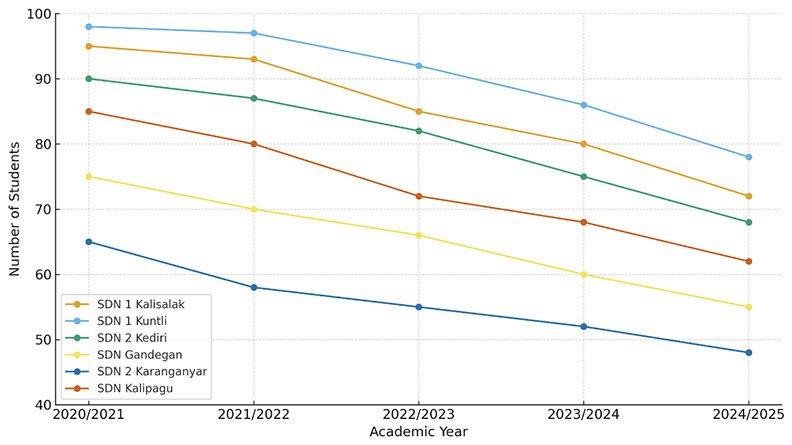
Enrollment data from six rural elementary schools in Banyumas Regency demonstrate a consistent decline from 2020/2021 to 2024/2025. To avoid repetition, the quantitative trend is presented once and supported by a visual summary (Figure 1).
Figure 1
Enrollment Trends in Selected Rural Elementary Schools in Banyumas Regency, Academic Years 2020/2021—2024/2025
Note. Data from the Basic Education Data System (Dapodik), Ministry of Primary and Secondary Education of Indonesia (Kemendikdasmen) (2025) (https://dapo.kemendikdasmen.go.id/). Figure created by the authors.
Principals, teachers, and community leaders identified demographic decline—particularly lower birth rates and outward migration—as the main contributors to shrinking school-age populations in rural villages. A community leader explained: “Every year, more of our young people leave for the city. The families that remain are older, and fewer children are born here.” School enrollment records confirmed the downward enrollment trend described earlier (see Figure 1). This finding aligns with global evidence indicating that demographic change is a primary driver of rural school decline (Adedeji & Olaniyan, 2011; OECD, 2022).
The rural schools studied were located in geographically remote areas, often requiring long travel on poor road infrastructure. Limited facilities—such as libraries, laboratories, and sports equipment—further reduced their attractiveness. Parents frequently compared these limitations with the stronger infrastructure available in urban and private schools. As one parent noted: “If we want our children to succeed, we prefer to send them to a school that has computers, libraries, and better teachers.” This pattern echoes Kimmons et al.’s (2019) findings that limited adoption of ODL systems reduces the competitiveness of rural schools.
Parents expressed increasing interest in enrolling their children in private or religious schools, which were perceived as offering stronger academic reputations and better integration of technology. A principal remarked, “We cannot compete with private schools that have computer labs and English programs. Parents see them as more modern.” This pattern is consistent with prior research indicating that limited adoption of open and distributed learning systems constrains the competitiveness and sustainability of rural schools (Kimmons et al., 2019).
Figure 2
Thematic Map of Determinants of Declining Enrollment in Rural Elementary Schools
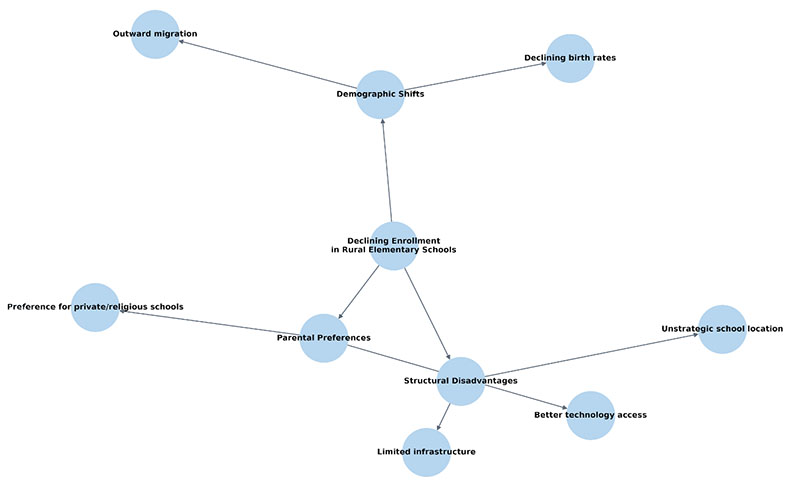
Note. Conceptual framework illustrating factors contributing to the decline in rural elementary schools. Figure created by the authors.
As illustrated in Figure 2, declining enrollment in rural elementary schools generates interconnected challenges related to instructional quality, teacher motivation, pedagogical diversity, digital access, and school sustainability. While small class sizes were acknowledged as providing certain benefits, such as more personalized attention and calmer classroom environments, participants consistently emphasized that these advantages were outweighed by negative implications for instructional quality, teacher motivation, and school sustainability.
Teachers experienced reduced motivation in small classes, where limited peer interaction restricted collaborative learning and led to more repetitive instructional activities. One teacher explained: “When only a few children are in the classroom, they become passive. They rarely ask questions, and as a teacher, I also feel less motivated to try new methods.” This finding supports earlier studies showing that declining rural enrollments reduce pedagogical diversity and teacher motivation (Adedeji & Olaniyan, 2011).
The absence of sufficient student numbers restricted group-based learning and extracurricular activities. Teachers relied heavily on traditional lecture-based methods, while digital tools were rarely used, partly due to infrastructure constraints. As one principal (school D) noted, “We want to use group work and projects, but with only five or six students, it is not possible. Activities become monotonous.” Similarly, a teacher from school F stated, “There are no computers in the classroom. We continue with blackboards and textbooks, while other schools already use online platforms.” These findings echo Sanwal’s (2024) conclusion that digital inequities exacerbate educational exclusion in rural contexts.
Principals expressed concerns that declining enrollment would eventually force school mergers or closures. District officials confirmed that schools with enrollments below 60 students were at risk of consolidation. One principal (school C) explained: “If enrollment continues to fall, this school may be merged. Parents are worried because their children would need to walk far, and the village would lose its identity.” The potential closure of rural schools not only reduces access to education but also undermines community cohesion and local identity.
Observations confirmed that classrooms had limited or no digital devices, and teachers lacked training in digital pedagogy. In contrast, competing schools offered blended learning and computer-based instruction. A parent of a student at school A commented: “In the city schools, children learn with computers and even tablets. Here, nothing. That is why many parents prefer to move their children.” Similarly, a teacher from school E stated, “We do not receive training on digital teaching, so we just continue with traditional methods.” This aligns with the work of Anderson and Barbour, emphasizing that distributed learning can sustain rural schools if adequate digital resources are in place, highlighting how digital inequity constrains the pedagogical viability of rural schools (Anderson & Dron, 2011; Barbour & LaBonte, 2024).
Figure 3
Implications of Declining Enrollment in Rural Elementary Schools
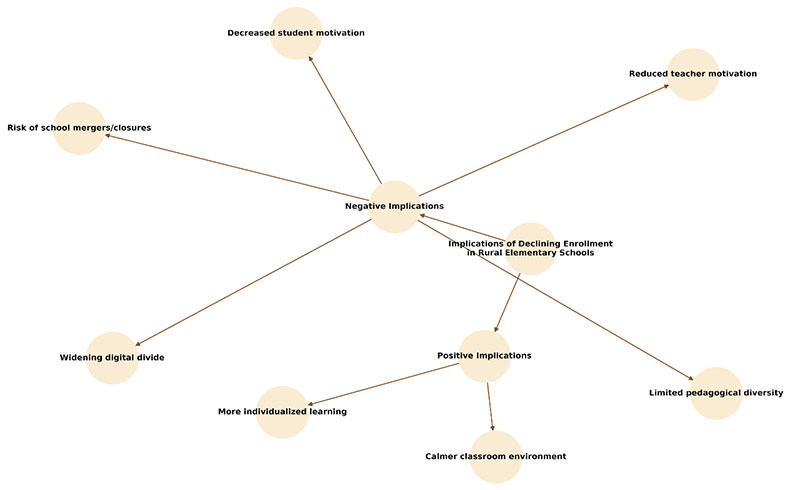
Note. Figure created by the authors based on the study’s qualitative findings.
The findings illustrate how demographic decline, structural barriers, and digital inequity intersect to shape rural school sustainability. Beyond confirming global patterns, the results indicate that digital readiness significantly influences parental decision-making in the Indonesian context.
Integrating these findings with Anderson’s (2008; Anderson & Dron, 2011) distributed learning framework clarifies how limited digital infrastructure restricts rural schools from leveraging ODL strategies that could mitigate the effects of demographic decline. This theoretical linkage strengthens the interpretation beyond descriptive patterns.
Consistent with OECD (2022) and Adedeji and Olaniyan (2011), declining birth rates and outward migration were identified as primary contributors to shrinking enrollments. Structural barriers such as poor infrastructure and geographic remoteness further discouraged enrollment. These factors, while significant, cannot fully explain why parents actively move their children away from rural schools toward alternative institutions.
The analysis also considers the tension between the potential benefits of small class environments—such as personalized attention—and the documented reductions in teacher motivation, peer interaction, and ICT adoption. These interrelated positive and negative implications are summarized in Figure 3, which illustrates how declining enrollment simultaneously creates pedagogical opportunities and systemic challenges in rural elementary schools. This tension provides a deeper understanding of how demographic decline interacts with pedagogical practices, suggesting that smaller class sizes do not automatically translate into improved learning experiences in digitally underserved rural schools.
Interpretation was further deepened by linking teacher demotivation, parental choice, and digital inequity with distributed learning principles, offering a more nuanced explanation of how demographic and digital factors shape rural schooling.
Within this broader context, the role of the digital divide emerged as a decisive factor. Parents increasingly view digital literacy and technological access as indicators of quality education. This perception aligns with findings by Sanwal (2024), who showed that marginalized rural populations are disproportionately disadvantaged by poor digital access. It also supports Kimmons et al.’s (2019) findings that rural schools are slower to adopt open and distributed systems, limiting their attractiveness to parents.
Anderson’s distributed learning framework (Anderson, 2008; Anderson & Dron, 2011) and Barbour and LaBonte’s (2024) rural e-learning perspectives were explicitly applied to interpret how demographic decline and limited digital capacity jointly constrain teaching practices and school competitiveness. Digital inequity emerged as a critical factor in enrollment decisions. Parents associated connectivity, device access, and digital learning opportunities with school quality, indicating that technology access functions as a central driver of school choice rather than as a supplemental factor.
This study extends ODL theory by conceptualizing rural enrollment decline as the result of demographic pressures interacting with digital inequity, thereby moving beyond technology adoption toward a demographic–digital sustainability perspective.
The practical applicability of the findings was strengthened by outlining concrete pathways for implementing ODL in rural Indonesian schools, including blended formats, community-based digital access points, and low-bandwidth distributed learning solutions.
These findings align with distributed learning theory, which emphasizes equitable access to learning resources (Anderson, 2008; Anderson & Dron, 2011). Studies in other rural contexts demonstrate how distributed models can sustain small schools by expanding curricular access (Barbour & LaBonte, 2024) and enhancing engagement through digital platforms (Trust & Pektas, 2018).
In Banyumas, such models remain largely absent due to infrastructure and teacher readiness gaps. This study thus highlights the need to adapt distributed learning models to rural Indonesia, ensuring that schools with small enrollment numbers can remain viable by leveraging digital tools.
By linking demographic decline to digital inequity, this study extends discussions on distributed learning to rural Indonesian settings. The results show that digital readiness mediates school competitiveness and should be integrated into theoretical models of rural education decline. By situating the Banyumas case within global debates, this study strengthens the comparative value of research published in IRRODL and advances understanding of rural education sustainability in the digital era.
Based on the findings, four key policy implications are identified.
As digital inequity emerged as a central driver of enrollment decline, rural schools require stable internet access, sufficient digital devices, and maintenance support. Public–private partnerships may accelerate infrastructure expansion. Lessons can be drawn from countries such as India that have established community-based digital learning hubs in rural areas (Mustafa et al., 2024).
Given the documented decline in teacher motivation and limited pedagogical innovation, teachers need ongoing professional development in digital pedagogy. Robinson (2008) demonstrated the potential of distance education for rural teacher training, but this requires adequate infrastructure. Blended professional development combining online modules with face-to-face mentoring may be effective in the Indonesian context.
In response to parental preferences shaping school choice, community–school collaboration is essential for sustaining enrollments. Parents and local leaders should be engaged as partners in resource mobilization and decision-making. Experiences from Latin America show that parent associations can successfully support digital initiatives in rural schools (Sanwal, 2024).
To address the combined pressures of small enrollment numbers and digital constraints, flexible ODL models should be piloted in rural Indonesia. Following Anderson (2008; Anderson & Dron, 2011) and Barbour and LaBonte (2024), blended and hybrid systems could allow rural schools to maintain viability despite small enrollments while expanding curricular options and improving digital integration.
This study examined the decline in student enrollment in rural elementary schools in Banyumas Regency, Indonesia, revealing that demographic shifts, structural disadvantages, and parental preferences interact with digital inequities to accelerate the decline of rural schools. Although smaller class sizes provided opportunities for individualized instruction, the negative effects—such as low teacher motivation, reduced pedagogical diversity, and an increased risk of school closures—were more pronounced.
The findings extend global ODL discussions by showing that enrollment decline in rural schools is not only due to demographic factors but is also shaped by systemic digital inequities that limit access to distributed learning opportunities. This reinforces insights from Robinson (2008), Kimmons et al. (2019), and Sanwal (2024), who collectively argue that rural education challenges are increasingly shaped by disparities in technology access and digital competence. By situating the Banyumas case within this broader discourse, this study contributes to international debates on ODL published in IRRODL.
From a policy perspective, the conclusion highlights that addressing demographic decline alone is insufficient. Strengthening rural education requires systemic strategies that expand digital infrastructure, build teacher capacity in digital pedagogy, and pilot distributed learning models tailored to small schools. Moreover, community engagement is critical to ensure parental trust and sustain enrollment.
Theoretically, this study underscores the need to conceptualize rural education decline through the intersection of demographics, structural inequities, and digital divides. From a practical perspective, it calls for innovation in how education systems support rural schools, ensuring that students in peripheral regions are not excluded from opportunities to develop 21st-century skills.
Future research should examine the longitudinal impacts of distributed learning pilots in rural Indonesian contexts, compare cross-regional cases, and assess the cost-effectiveness of digital interventions. Such studies would strengthen evidence for policies that safeguard the sustainability of rural education in the digital era.
Adedeji, S. O., & Olaniyan, O. (2011). Improving the conditions of teachers and teaching in rural schools across African countries. UNESCO. https://unesdoc.unesco.org/ark:/48223/pf0000216062
Anderson, T. (2008). The theory and practice of online learning (2nd ed.). Athabasca University Press. https://doi.org/10.15215/aupress/9781897425084.01
Anderson, T., & Dron, J. (2011). Three generations of distance education pedagogy. The International Review of Research in Open and Distributed Learning, 12(3), 80-97. https://doi.org/10.19173/irrodl.v12i3.890
Barbour, M. K., & LaBonte, R. (2024). State of the nation: K–12 e-learning in Canada. Canadian eLearning Network. https://k12sotn.ca/wp-content/uploads/2025/05/State_Nation_2024_English.pdf
Badan Pusat Statistik. (2022). Statistik Indonesia 2022 [Statistical yearbook of Indonesia 2022]. https://www.bps.go.id
Creswell, J. W., & Poth, C. N. (2018). Qualitative inquiry and research design: Choosing among five approaches (4th ed.). SAGE Publications, Inc.
Elías, A., Granada, I., Naslund-Hadley, E., Ortiz, P., Romero, J., & Davalos, A. (2022). Migration and education: Challenges and opportunities. Inter-American Development Bank. https://doi.org/10.18235/0004468
International Commission on the Futures of Education. (2021). Reimagining our futures together: A new social contract for education. UNESCO. https://doi.org/10.54675/ASRB4722
Kimmons, R., Hunsaker, E. W., Jones, J. E., & Stauffer, M. (2019). The nationwide landscape of K–12 school adoption of open systems: Comparing rural and urban contexts. The International Review of Research in Open and Distributed Learning, 20(3). https://doi.org/10.19173/irrodl.v20i4.3794
Li, M. (2024). Exploring the digital divide in primary education: A comparative study of urban and rural mathematics teachers’ TPACK and attitudes towards technology integration in post-pandemic China. Education and Information Technologies, 30(2), 1913-1945. https://doi.org/10.1007/s10639-024-12890-x
Li, W., Zhang, L., Lee, I., & Gkartzios, M. (2023). Overview of social policies for town and village development in response to rural shrinkage in East Asia: The cases of Japan, South Korea and China. Sustainability, 15(14), Article 10781. https://doi.org/10.3390/su151410781
Lincoln, Y. S., & Guba, E. G. (1985). Naturalistic inquiry. Sage Publications.
Mulyani, J. D., Festiawan, R., Aryani, A. A., & Agus, H. (2024). An analysis of factors contributing to the teacher shortage in rural public elementary schools in Banyumas Regency. TEGAR: Journal of Teaching Physical Education in Elementary School, 8(1), 7-14. https://ejournal.upi.edu/index.php/tegar/article/view/73419
Mustafa, F., Nguyen, H. T. M., & Gao, X. (2024). The challenges and solutions of technology integration in rural schools: A systematic literature review. International Journal of Educational Research, 126, Article 102380. https://doi.org/10.1016/j.ijer.2024.102380
Organisation for Economic Co-operation and Development. (2022). Education at a glance 2022: OECD indicators. OECD Publishing. https://www.oecd.org/en/publications/2022/10/education-at-a-glance-2022_4aad242c.html
Robinson, B. (2008). Using distance education and ICT to improve access, equity, and quality in professional development for rural teachers. The International Review of Research in Open and Distributed Learning, 9(1). https://doi.org/10.19173/irrodl.v9i1.486
Sanwal, A. (2024). Marginalization, technology access, and study approaches of undergraduate distance learners during the COVID-19 pandemic in India. The International Review of Research in Open and Distributed Learning, 25(2), 1-19. https://doi.org/10.19173/irrodl.v25i2.7718
Trust, T., & Pektas, E. (2018). Using the ADDIE model and Universal Design for Learning principles to develop an open online course for teacher professional development. Journal of Digital Learning in Teacher Education, 34(4), 219-233. https://doi.org/10.1080/21532974.2018.1494521
Trilling, B., & Fadel, C. (2009). 21st century skills: Learning for life in our times. Jossey-Bass/Wiley.

Enrollment Decline and the Digital Divide in Rural Elementary Schools: Implications for Equity in Basic Education by Jajang Dede Mulyani, Aisyah Apriliciciliana Aryani, and Kuat Leksono is licensed under a Creative Commons Attribution 4.0 International License.