Volume 27, Number 3
Natasha Ramroop Singh, Ayisha Najeeha C O K, Olivia Mendez Romero, and Kira Reierson
Thompson Rivers University, Kamloops, BC, Canada
Open educational resources (OER) have emerged as key tools in democratizing education, and the levels of student awareness of OER, as well as engagement and use in many Canadian institutions, are increasing. This study explores whether involving undergraduates in the creation of OER improves their understanding of open licensing, their perceptions of OER utility, and their ability to independently access such resources. A pre-/post-activity study was conducted with 57 undergraduate students enrolled in an advanced biochemistry course. As part of the course’s activities, students collaboratively contributed to the creation of a new open resource aiming to increase understanding of enzyme mechanisms, to be used by themselves as well as their peers. Data were collected using structured surveys and analyzed via the Wilcoxon signed-rank test across three domains: Creative Commons knowledge, OER perception, and OER access. Statistically significant improvements were observed in students’ understanding of open licensing, particularly their knowledge of Creative Commons licenses (e.g., understanding license types; p < .001), perceptions of OER credibility (e.g., perceived accuracy and source citation; p = .0049), and behaviors related to accessing diverse types of OER materials (p = .0397). Thematic analysis supported these findings, highlighting learning gains and increased engagement in areas previously unfamiliar to students. Participation in the creation of OER fostered a deeper conceptual understanding and more favorable attitudes toward open education. However, changes in access behavior were modest, indicating the need for institutional scaffolding to fully support learner autonomy in open environments.
Keywords: open educational resources, OER, student co-creation, Creative Commons, digital literacy
Open educational resources (OER) have emerged as a powerful force reshaping how knowledge is produced, shared, and accessed across educational institutions. As higher education grapples with rising textbook costs and persistent inequities in learning access (Mullens & Hoffman, 2023), OER offers a sustainable and inclusive solution. Defined by UNESCO (n.d., para. 1) as “learning, teaching and research materials in any format and medium that reside in the public domain or are under copyright that have been released under an open license, that permit no-cost access, re-use, re-purpose, adaptation and redistribution by others,” OER remove legal and financial barriers while supporting more collaborative and flexible forms of learning. At the heart of the OER movement lies a broader commitment to open education, which emphasizes access, equity, participation, and learner-centered pedagogy. Using open licenses, most commonly Creative Commons licenses, educators and learners can not only freely access materials but also adapt and redistribute them, making education more responsive to diverse learning needs (Adil et al., 2024; Mishra, 2025; Santos-Hermosa, 2024). Recent international guidance, such as the Dubai Declaration on OER, foregrounds the role of open-licensed content and emerging technologies in promoting equitable and inclusive access to knowledge, underscoring the global relevance of efforts to build and share collectively authored OER (UNESCO, 2024).
Student participation in the creation of OER appears to positively influence student engagement and perceptions of course content. When students actively create materials, such as essays, videos, or remixed texts, they transition from passive recipients to active contributors in their learning ecosystem (Trust et al., 2023). This process, aligning with the principles of OER-enabled pedagogy, transforms disposable assignments into renewable artifacts that provide ongoing value for the creator and for future learners (Tietjen & Asino, 2021; Werth & Williams, 2021a; Wiley & Hilton, 2018).
Initially, the adoption of OER in higher education was driven largely by a desire to lower costs for students (Wiley & Hilton, 2018). However, recent scholarship has revealed their broader pedagogical potential. Building on this, educators are moving beyond simply using open materials to embracing open pedagogy, a practice that actively involves students in the creation, adaptation, and dissemination of learning resources (Cronin, 2017; DeRosa & Robison, 2017). This participatory approach encourages students to shift from passive recipients of knowledge to active contributors in the educational process (Clinton-Lisell et al., 2023; Short et al., 2024).
Engaging students in the creation of OER has shown significant educational benefits. Research suggests that this involvement promotes the student’s understanding of the subject, improves learning outcomes, and fosters a stronger sense of ownership over their learning (Cho & Permzadian, 2024; Lubicz-Nawrocka & Bovill, 2023; Spencer et al., 2025). A study by Grimaldi et al. (2019) found that high school students who codeveloped interactive OER demonstrated gains in academic performance. Similarly, in higher education, students who adapted and integrated OER into their coursework reported a better grasp of open practices and digital literacy skills (Farias Gaytán et al., 2023; López Núñez et al., 2024; Nobre, 2021; Tinmaz et al., 2022).
These hands-on experiences promote deeper cognitive engagement, as students are required not only to comprehend the content but also to critically assess, reframe, and communicate it for peer and public use. This process also encourages reflection on issues such as licensing, audience diversity, and accessibility—key aspects of openness often overlooked in traditional educational contexts (Schmied et al., 2024; Werth & Williams, 2021c).
Both students and faculty generally express positive perceptions of OER, citing benefits such as cost savings, increased accessibility, and flexibility in learning (Hilton, 2020). When faculty engage in creating or adapting OER, their enhanced understanding of open educational practices often translates into more meaningful student learning experiences (Meger et al., 2021). Students involved in such practices report greater engagement and motivation and a sense of empowerment in their learning journeys (LeMire et al., 2024; Werth & Williams, 2021c).
Moreover, OER contributes directly to educational equity by making high-quality resources freely available to all learners, regardless of economic background. This is especially critical for students who may otherwise be unable to afford textbooks or other required materials (Hilton, 2020). When students participate in the creation of these resources, they not only benefit from free access but also gain an appreciation for inclusive educational design (Griffiths et al., 2022; Jhangiani et al., 2025; Meger et al., 2021).
Despite the promise of OER and open pedagogy, many students remain unaware of what OER are or how they function. Key concepts such as reuse rights, attribution, and open licensing remain unfamiliar to most learners. Additionally, students are rarely invited to participate in conversations about the creation, purpose, or future use of educational materials. This lack of exposure limits their ability to critically engage with the resources they use and undermines the transformative potential of open education (Adil et al., 2024; Cheung et al., 2022).
While research has extensively explored the cost-effectiveness of OER and faculty perspectives (Clinton, 2018; Clinton & Khan, 2019; Hilton, 2020), fewer studies have examined how students’ direct involvement in OER creation affects their understanding, perceptions, and ability to navigate open resources independently. As Nobre (2021) and Meger et al. (2021) have pointed out, meaningful student engagement in OER creation requires supportive institutional policies, faculty commitment, and training. However, these elements are still developing in many contexts (Arispe & Hoye, 2023; Maultsaid & Harrison, 2023; Mercer-Mapstone et al., 2017; Omland et al., 2025).
This study seeks to address this gap by exploring how undergraduate students’ participation in creating OER influences their understanding of open licensing, their perception of OER utility, and their ability to access and reuse such materials independently. The activity was implemented as part of a project in a third-year undergraduate biochemistry course, where students collaborated to develop openly licensed content. The full resource developed by students can be found at https://enzymemechanisms.pressbooks.tru.ca/. Pre- and post-activity surveys were used to measure changes in students’ knowledge, attitudes, and behaviors related to OER (Lan et al., 2025; Tlili et al., 2023; Tlili et al., 2025).
The central research question guiding this study is: Does participation in the creation of open educational resources improve students’ understanding, perception, and access to OER-related concepts?
By examining the effects of open pedagogical engagement using both statistical and thematic analyses, this study contributes new insights into the role of students as active agents in open education ecosystems. The findings aim to inform future efforts to integrate student-led OER initiatives into higher education curricula.
This study used a quantitative pre- and post-activity within-subjects design to evaluate changes in students’ understanding, perceptions, and access to OER due to participating in creating a course-based OER. The activity was embedded within an undergraduate biochemistry course and structured as a collaborative, hands-on module in which students developed openly licensed educational content. Students’ videos were evaluated using a rubric that emphasized scientific accuracy, clarity of communication, proper citation and attribution practices, and correct application of Creative Commons licensing, ensuring that only work meeting these quality standards was published. To capture changes in key constructs, data were collected at two time points: prior to the activity (pre-survey) and immediately after its completion (post-survey).
As part of the university’s commitment to advancing open education to reduce barriers to learning and enhance student success, the institution supports zero textbook cost approaches that replace commercial textbooks with OER and/or library-licensed materials, which lowers costs while keeping high-quality learning materials in students’ hands. Instructors are encouraged to support these efforts, and as such, research on the efficacy and success of these OER-enabled and open pedagogy activities are required for building a sustainable model for faculty and students alike.
The 57 participants in this study were undergraduate students enrolled in an advanced biochemistry course (BIOL 3130—Introduction to Biochemistry) at a Canadian postsecondary institution. The course incorporated an open pedagogy model, emphasizing learner participation in the co-creation of educational resources. All students were invited to voluntarily participate in the study, and informed consent was obtained in accordance with the institution’s ethical research guidelines. Survey participation was anonymous, and individual responses were matched across the two survey phases using non-identifiable coded keys to enable paired statistical analysis.
Data were collected using a structured survey instrument specifically designed to assess student knowledge, perceptions, and experiences with OER. The instrument consisted of 17 primary questions, many of which included multiple subitems, resulting in a total of over 30 analyzable variables. The survey elements were aligned with key thematic domains:
Most items were measured using 5-point Likert-type scales (e.g., 1 = Strongly Disagree to 5 = Strongly Agree or 1 = Never to 5 = Always), while a few items employed matrix-style formats or matching exercises to assess categorical knowledge. Both survey instruments (pre- and post-) were structurally identical to ensure a valid direct comparison.
The surveys were administered in class as paper-based questionnaires. Participating students responded to them at two points: before and after the OER creation activity. Participants were encouraged to complete both surveys to enable matched-pair analysis. For the final analysis, only cases in which participants completed both surveys were considered. Survey responses were exported to a statistical software environment for cleaning and preprocessing. The variables were anonymized and matched based on unique identifiers. “No Answer” and “Not Applicable” responses were retained for descriptive completeness but excluded from inferential testing. A detailed mapping of survey items to thematic codes is provided in Table 1.
The de-identified dataset, codebook, and analysis scripts that support the findings of this study are openly available in GitHub at https://github.com/nramroopsingh/IRRODL2025 and may be reused under license CC BY 4.0.
Table 1
Summary of Survey Questions and Themes
| Question no. | Survey question/item | Theme |
| 1a | Have you used OER in your academic studies? | Access to OER |
| 1b(i) | Frequency of OER use vs. traditional resources | Access to OER |
| 1b(ii) | Types of OER materials accessed (textbooks, videos, etc.) | OER types |
| 1b(iii) | Frequency of use of: OER Commons, OpenStax, LibreTexts, etc. | Platform usage |
| 2 | Overall perception of OER | Perception |
| 3 | Importance of factors: quality, access, variety, relevance, peer review, editability | Perception drivers |
| 4 | Engagement with course content when using OER | Engagement |
| 5 | Importance of features: interactivity, multimedia, collaboration, contribution | Engagement |
| 6 | Past experiences contributing to or modifying OER | Participation |
| 7 | Belief that contribution affects OER perception | Perception change |
| 8 | Belief that contribution increases engagement | Engagement change |
| 9 | Concern about licensing when contributing | Licensing awareness |
| 10 | Understanding of CC licenses | CC knowledge |
| 11 | Frequency of using CC-licensed content | CC usage |
| 12 | Matching CC licenses with correct descriptions | CC license differentiation |
| 13 | Appropriateness of CC licenses in various contexts (educational, personal, commercial) | CC application |
| 14 | Confidence in the accuracy of OER | Trust in OER |
| 15 | Importance of author credibility, peer review, citation, updates | Trust factors |
| 16 | Frequency of verifying OER accuracy with external sources | Verification behavior |
| 17a | Plan to take BIOL 3230 (Biochemistry) | Course planning |
| 17b | Reason for taking BIOL 3230 | Course motivation |
Note. OER = open educational resources; CC = Creative Commons.
Ethics approval for this research project was obtained from the university’s research ethics board. Participation was entirely voluntary, and students were informed that their decision to participate—or not—would have no impact on their course grades or academic standing. No personal identification was used in the analysis or reporting, and all data were stored securely.
Funding for this work was provided by the Centre for Excellence in Learning and Teaching’s (CELT) Scholarship of Teaching and Learning (SoTL) Scholars Development Grant.
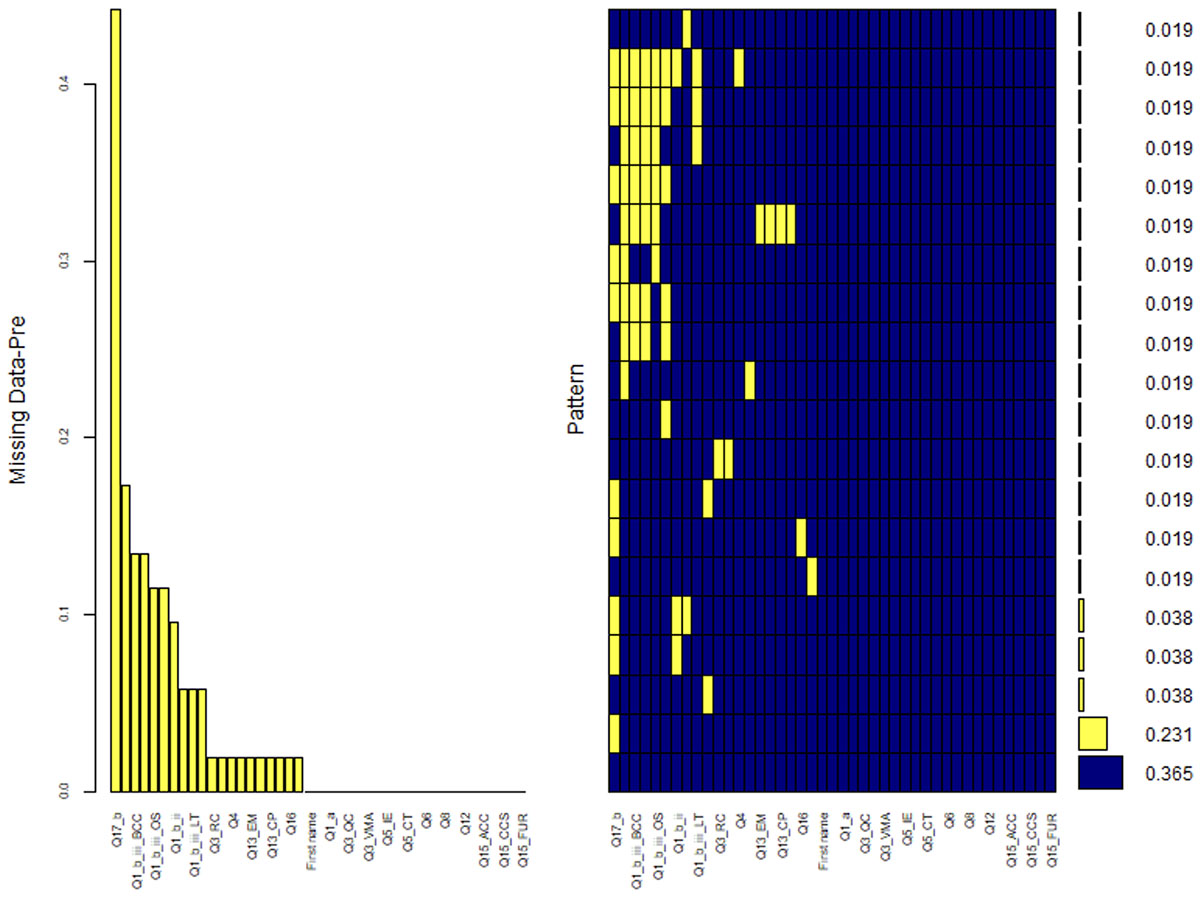
We excluded questions with missing responses over 20% to ensure data quality and reliability. The missingness threshold was applied independently to both the pre-survey and post-survey datasets. Questions exceeding this threshold in either dataset were removed from further analysis. A 20% threshold is widely accepted in survey-based research to minimize bias and reduce the risk of unreliable findings (Mirzaei et al., 2022). High levels of missing data can arise from unclear wording, lack of relevance, or survey fatigue, and retaining such questions may compromise the accuracy and validity of the results. Excluding these questions ensured the remaining data were sufficiently robust for meaningful statistical interpretation, as well as ensuring reliable conclusions.
Figures 1 and 2 show the distribution of missing data for pre-survey and post-survey items, respectively. Items with high missingness were mostly clustered in optional or multipart questions, suggesting possible survey fatigue or lack of relevance to certain respondents.
The final cleaned dataset allowed for direct, matched comparisons between the pre- and post-activity responses for each student. This paired structure was ideal for the application of the Wilcoxon signed-rank test, which does not require normality and is appropriate for ordinal Likert data.
Figure 1
Proportion and Patterns of Missing Data in the Pre-Survey
Note. Variables with the highest levels of missing responses are highlighted.
Figure 2
Proportion and Patterns of Missing Data in the Post-Survey
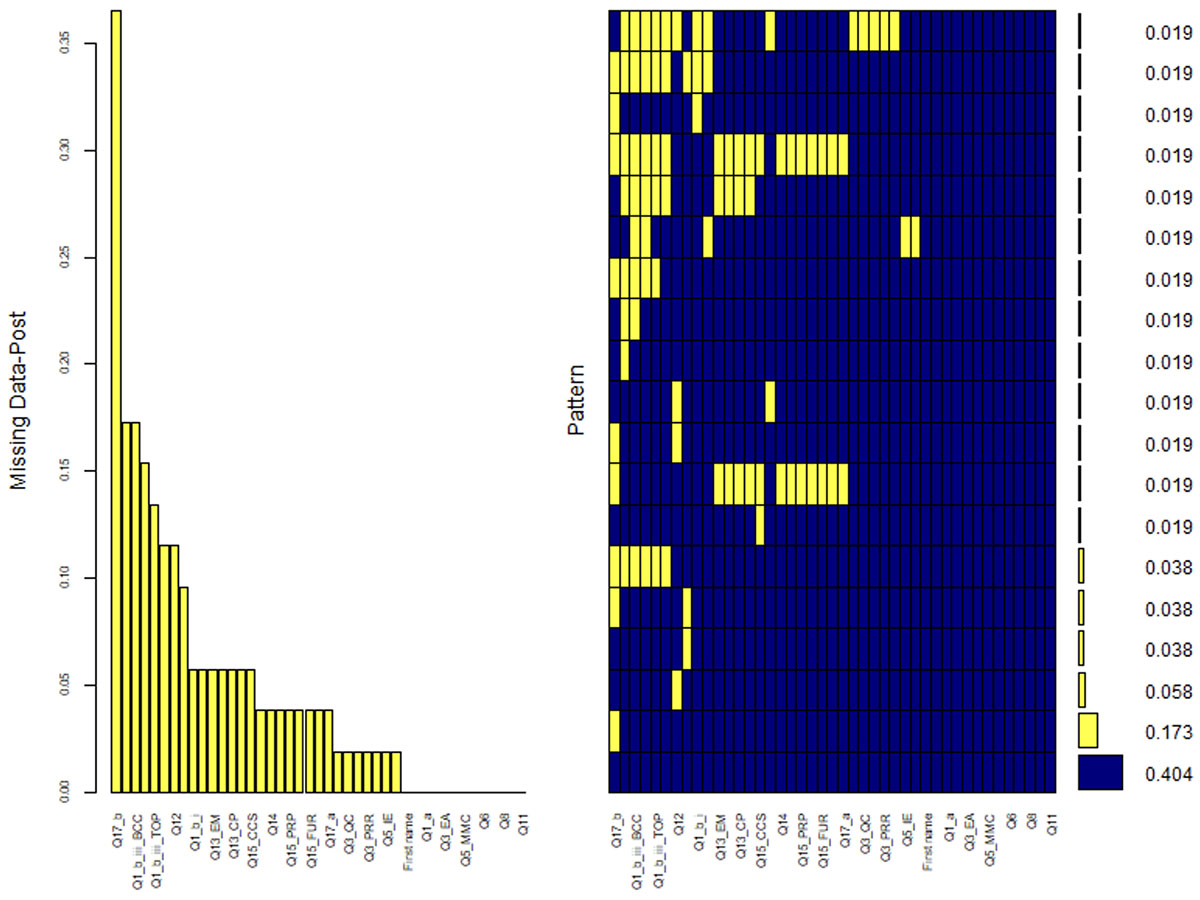
Note. Like in the pre-survey, select variables showed elevated levels of nonresponse. Variables with the highest levels of missing responses are highlighted.
Due to the ordinal nature of Likert scale data and potential violations of normality assumptions, a nonparametric approach was used. The Wilcoxon signed-rank test was applied to compare paired responses for each question before and after the activity.
To assess changes in students’ responses before and after the activity, the Wilcoxon signed-rank test was employed. This nonparametric statistical method is suitable for evaluating paired ordinal data, such as Likert scale responses, and does not assume a normal distribution of the underlying population.
The Wilcoxon signed-rank test is used to determine whether the median of differences between two related samples is significantly different from 0. In this study, it tested the null hypothesis that the educational activity would have no effect on students’ understanding, perceptions, or behaviors related to OER, as measured by matched pre-survey and post-survey responses.
The Wilcoxon signed-rank test is appropriate under the following conditions:
For each survey item, paired differences were calculated between post-survey and pre-survey responses:
\[D_i = y_i − x_i\]
where \(x_i\) and \(y_i\) represent the pre- and post-survey scores, respectively, for participant \(i\). Pairs for which \(D_i = 0\) were excluded. The absolute differences \(|D_i|\) were ranked in ascending order, with tied ranks assigned their average.
Each rank was then given the sign of the original difference \(D_i\). The test statistics \(W^+\) and \(W^−\) were calculated as the sum of the positive and negative signed ranks, respectively:
\[W^+ = \sum\limits_{\mathrm{positive} D_i} \mathrm{rank}(|D_i|), \quad W^- = \sum\limits_{\mathrm{negative} D_i} \mathrm{rank}(|D_i|)\]
The final test statistic is given by
\[V = \mathrm{min} (W^+, W^-)\]
For sample sizes greater than 20, a normal approximation was applied. The standardized test statistic \(Z\) is calculated as:
\[Z = {{W^+ - \mu} \over \sigma}\]
where the mean and standard deviation under the null hypothesis are
\[\mu = {{n(n + 1)} \over 4}, \quad \sigma = \sqrt{{n(n + 1)(2n + 1)} \over 24}\]
Here, \(n\) denotes the number of nonzero difference pairs.
The resulting Z score or rank-sum statistic was used to compute p values for each item. A result was considered statistically significant if p < .05, indicating that the activity produced a meaningful change in the students’ responses. Items with p ≥ .05 were interpreted as showing no statistically significant difference.
This test allowed for rigorous evaluation of learning and attitudinal shifts resulting from participation in the OER creation project while accommodating the ordinal nature of the data and the absence of normality assumptions.
To better understand the effects of the OER activity, the survey responses were grouped into three key thematic domains: (a) knowledge of Creative Commons licenses, (b) perception of OER, and (c) access to OER. These themes reflect the study’s core objective of evaluating shifts in students’ understanding, perceptions, and behaviors related to OER. Each theme was assessed using a set of targeted survey items and visualized using box plots comparing pre-survey and post-survey responses. Statistical comparisons were conducted using the Wilcoxon signed-rank test to detect significant changes in response distributions across time points.
To explore the initial patterns in the changes in responses between pre- and post-activity surveys, we visualized the distribution of responses on the Likert scale before and after the activity (Figure 3). Several key themes emerged.
The questions assessing students’ self-reported understanding of Creative Commons licenses showed a clear upward shift. This indicates that students gained familiarity with open licensing terminology and its applications after participating in the OER creation process.
The question about students’ past experiences with creating or improving OER also demonstrated a noticeable increase in post-survey responses. This suggests that the activity succeeded in providing students with practical exposure to open resource development.
In contrast, little to no change was revealed for items addressing the frequency of use of specific OER platforms (such as BCcampus and OER Commons). This may reflect students’ preexisting familiarity and comfort with these platforms, limiting the potential for growth in this domain.
A high concentration of neutral responses was shown for several items in the pre-survey, particularly the perceived importance of content quality in shaping OER perception. This suggests that many students initially lacked strong opinions or familiarity with these quality indicators. However, the post-survey distribution showed movement away from the neutral midpoint, implying increased confidence or more informed perspectives.
Figure 3
Comparison of Pre-Survey and Post-Survey Responses Across Likert Scale Items
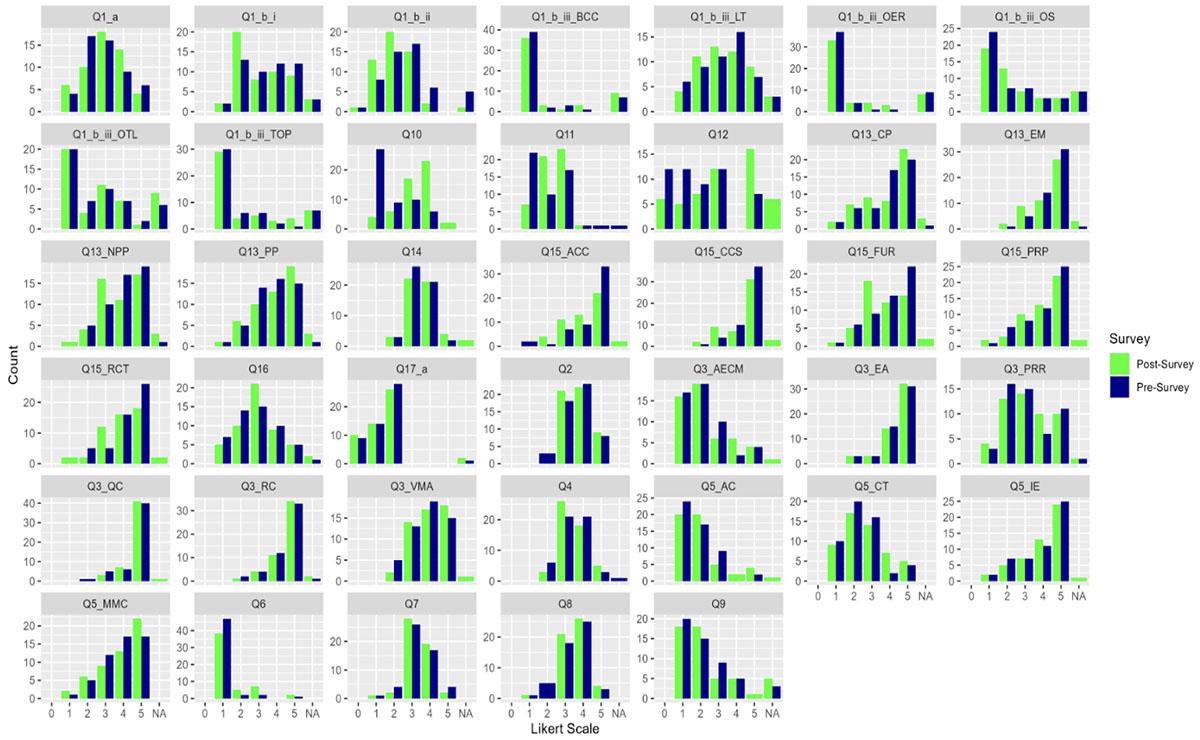
Note. Pre-survey responses are shown in blue, while post-survey green responses are shown in green.
The results of the Wilcoxon signed-rank test for the comparison of pre-survey and post-survey responses are presented in Table 2. The test was used to determine whether the students’ knowledge of, perceptions of, and engagement with OER changed significantly after participating in the OER creation activity. Several survey items showed statistically significant improvements. For instance, students reported accessing a wider variety of OER materials after the activity (Q1b[ii]), p = .0397), and more students indicated experience contributing to or improving OER (Q6, p = .0050). The most significant change was observed in the students’ understanding of Creative Commons licenses, which improved markedly after the activity (Q10, p = 4.54 × 10⁻⁷). Additional gains were seen in the use of Creative Commons-licensed content (Q11, p = .0238), correct identification of license types (Q12, p = .0227), and perceived importance of citing credible sources (Q15 CCS, p = .0284) and maintaining the OER content updated (Q15 FUR, p = .0487).
Although these items showed significant changes, most did not. Items such as previous OER usage (Q1a, p = .6857), ease of access (Q3 EA, p = .7819), and engagement with interactive features (Q5 IE, p = .7422) remained relatively stable. This suggests that some perceptions and habits were already well formed before the activity or were not strongly affected by it. For certain items, such as the belief that contributing to OER would change one’s perception (Q7, p = 1.000), all responses remained the same, indicating no shift in opinion.
Table 2
Wilcoxon Signed-Rank Test Results for Pre-Survey and Post-Survey Responses
| Question | p | Test statistic (V) |
| Q1a | .6857 | 274.5 |
| Q1b(i) | .1025 | 291.5 |
| Q1b(ii) | .0397 | 368 |
| Q1b(iii) OER | .1371 | 7 |
| Q1b(iii) OS | .5211 | 97 |
| Q1b(iii) LT | .7380 | 265 |
| Q1b(iii) OTL | .5538 | 118.5 |
| Q1b(iii) BCC | .4568 | 6.5 |
| Q1b(iii) TOP | .2478 | 52 |
| Q2 | .5298 | 118.5 |
| Q3 QC | .1658 | 22 |
| Q3 EA | .7819 | 79 |
| Q3 VMA | .2436 | 166 |
| Q3 RC | .4239 | 60 |
| Q3 PRR | .6717 | 198 |
| Q3 AECM | .4774 | 115.5 |
| Q4 | .4636 | 105.5 |
| Q5 IE | .7422 | 175.5 |
| Q5 MMC | .6028 | 222 |
| Q5 CT | .1144 | 135 |
| Q5 AC | .2507 | 92 |
| Q6 | .0050 | 0 |
| Q7 | 1.0000 | 95.5 |
| Q8 | .1902 | 72 |
| Q9 | .5692 | 130 |
| Q10 | 4.54e-07 | 54 |
| Q11 | .0238 | 117 |
| Q12 | .0227 | 189 |
| Q13 EM | .2496 | 203.5 |
| Q13 PP | .5513 | 263.5 |
| Q13 CP | .6213 | 167.5 |
| Q13 NPP | .3378 | 197 |
| Q14 | .2632 | 125 |
| Q15 ACC | .0746 | 195 |
| Q15 PRP | .9598 | 124.5 |
| Q15 CCS | .0284 | 133.5 |
| Q15 RCT | .0895 | 273 |
| Q15 FUR | .0487 | 344 |
| Q16 | .5661 | 264.5 |
| Q17 a | .5271 | 18 |
Note. OER = OER Commons; OS = OpenStax; LT = LibreTexts; OTL = Open Textbook Library; BCC = BCcampus; TOP = TRU Open Press; QC = Content Quality; EA = Ease of Access; VMA = Variety of Materials Available; RC = Relevance to Coursework; PRR = Peer Reviews or Recommendations; AECM = Ability to Edit or Change Material; IE = Interactive Elements; MMC = Multimedia Content; CT = Collaborative Tools; AC = Ability to Contribute or Modify Content; EM = Educational Materials; PP = Personal Projects; CP = Commercial Projects; NPP = Non-profit Projects; ACC = Author Credibility; PRP = Peer Reviews/Editing Process; CCS = Citing Credible Sources; RCT = Relevance to Coursework/Topic; FUR = Frequency of Updates/Refresh.; Statistically significant p values are bolded.
To help visually interpret the results, a volcano plot was created (Figure 4). This plot displays both the test statistic and the significance level for each item. Red markers highlight survey items where significant changes occurred, while blue markers indicate nonsignificant results. Overall, the findings suggest that the activity had the strongest impact on students’ knowledge of licensing and content contribution practices, while perceptions of access, usage, and platform familiarity showed little change.
Figure 4
Volcano Plot of Wilcoxon Signed-Rank Test Results for Pre-Survey and Post-Survey Responses
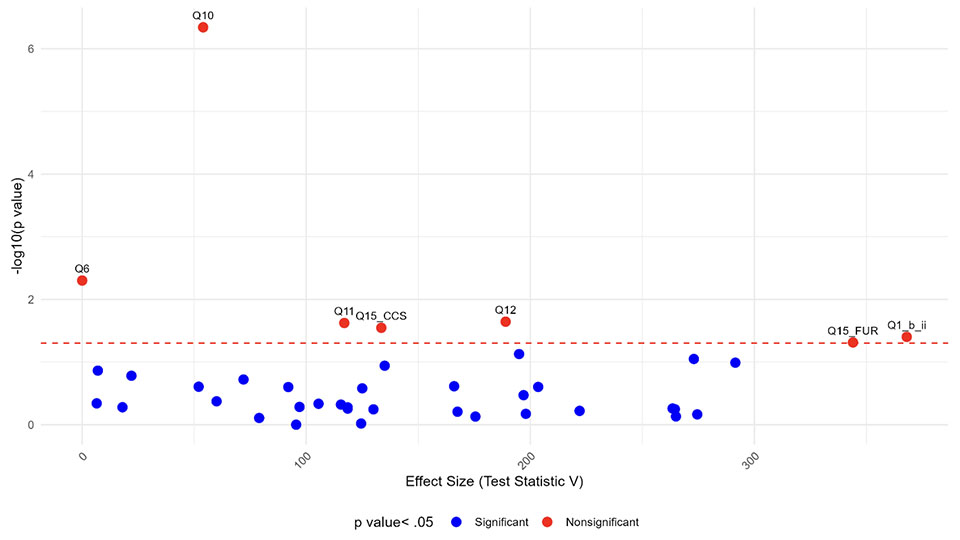
Note. The x-axis represents the effect size (Wilcoxon test statistic V), while the y-axis represents the significance level as −log10 (p value). Red points indicate statistically significant questions (p < .05); blue points represent nonsignificant questions. Labels are added for significant questions to facilitate interpretation.
The thematic summaries presented below reflect descriptive, domain-based interpretations aligned with the survey structure and are intended to contextualize statistically significant findings rather than represent an inductive or qualitative thematic analysis.
Participation in the OER creation activity produced the largest and most consistent gains in students’ understanding of Creative Commons (CC) licensing. This theme was assessed using responses to questions Q10, Q11, and Q12 (Figure 5). A clear improvement in the understanding of CC licensing by the students’ post-activity was observed. Q10 showed the most dramatic change, with a highly significant increase in self-reported understanding of CC licenses (p = 4.54 × 10⁻⁷). Q11 showed a more modest but still statistically significant improvement in the frequency of using CC-licensed content (p = .0238). Q12 responses indicated an improved ability to correctly match the license types with descriptions (p = .0227). Box plots revealed not only upward shifts in median values but also reduced variance, particularly for Q10. The substantial pre–post shift on self-reported CC knowledge (Q10), coupled with improved accuracy in matching license types with their descriptions (Q12), suggests movement beyond familiarity toward functional understanding. Notably, the reduction in response variance for Q10 indicates convergence around a higher shared baseline of licensing literacy. This matters in group writing, as one person’s misunderstanding can compromise the licensing compliance of the whole group.
Two mechanisms likely underpin these changes. The first is learning by doing: Making openly licensed artifacts requires students to select a license, justify that choice, and apply attribution standards to third-party assets. These activities are known to transform abstract policy into situated practice (e.g., OER-enabled pedagogy’s focus on authentic, public-facing tasks; Wiley & Hilton, 2018). Second, social accountability, in the form of public dissemination, raises the stakes of correct licensing and citation, prompting attention to reuse conditions and versioning. The modest but significant increase in the reported frequency of using CC-licensed materials (Q11) is consistent with a near-term shift in information-seeking habits; however, it likely represents early adoption rather than wholesale behavior change. This pattern aligns with prior research showing that co-creation primarily catalyzes conceptual and procedural knowledge first, with behavioral routinization emerging later with continued opportunities and support (Tlili et al., 2025; Trust et al., 2023).
Taken together, these results indicate that integrating explicit licensing decisions and attribution tasks into coursework is a high leverage feature of open pedagogy: It directly addresses a common barrier to reuse/remix and equips students with transferable digital civic competencies (Hilton, 2020; Werth & Williams, 2021a).
Figure 5
Comparison of Pre-Survey and Post-Survey Responses for the Theme “Knowledge of Creative Commons Licenses”
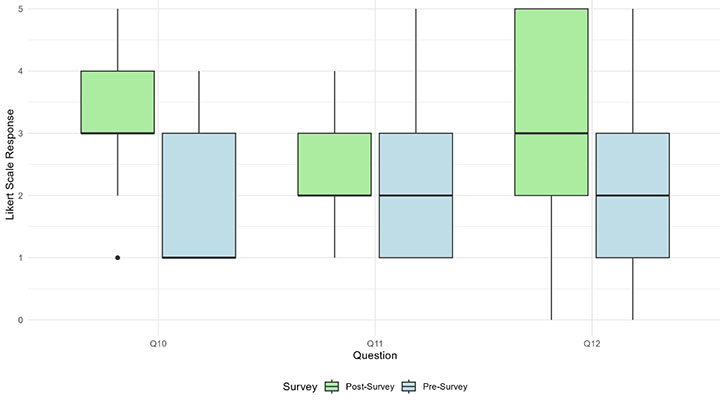
Note. Post-survey responses (green) show significant upward shifts, particularly in Q10 and Q12.
Students’ perceptions of OER also shifted positively, most clearly in their reported experience in contributing to or improving OER (Q6) and in the importance they placed on credible citation and currency (Q15 CCS; Q15 FUR; Figure 6). Students’ experience contributing to OER (Q6) showed a significant improvement (p = .0050), moving from a median response of 1 in the pre-survey to 2 in the post-survey. For Q15 CCS (citing credible sources) and Q15 FUR (importance of frequent updates), the responses were already high at baseline but showed small yet statistically significant gains (p = .0284 and p = .0487, respectively).
These findings suggest that the activity positively impacted on students’ trust of and perception of OER. The median increase for contribution experience was from “never” to “rarely.” Although this may appear small, it is substantively meaningful in a population that typically has had no prior authorship history. Moreover, the trust-related items were already high at baseline, suggesting ceiling effects; the observed gains, therefore, reflect reinforcement of an already favorable stance. When students have experience contributing and start paying closer attention to source credibility and how often materials are updated, they take on a producer mindset. Once their work is public, they prioritize where information comes from, how strong the evidence is, and keeping it up to date—core practices of OER stewardship (Cronin, 2017; DeRosa & Robison, 2017).
An additional qualitative signal is the movement away from neutral responses noted elsewhere in the results: As students encounter concrete editorial decisions (e.g., selecting sources to cite, deciding when an OER needs revision), uncertainty gives way to more informed judgments. This clearer, more critical way of judging sources is a key step for students toward participating on their own in open communities. It also aligns with research showing that cocreating students develop greater agency and a stronger sense of identity (Lubicz-Nawrocka & Bovill, 2023; Werth & Williams, 2021a).
Figure 6
Comparison of Pre-Survey and Post-Survey Responses for the Theme “Perception of OER”
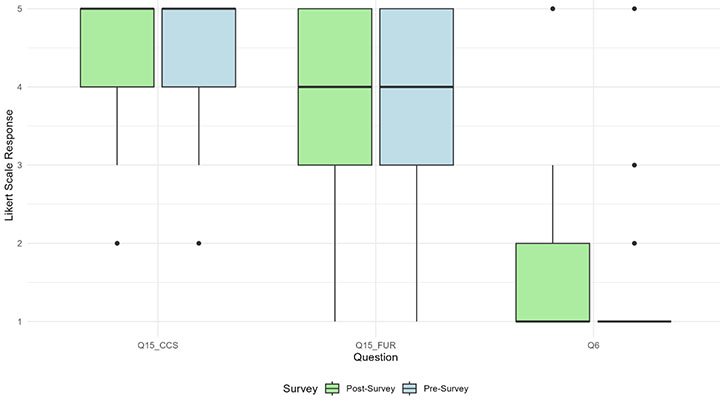
Note. Q6 showed the most notable shift; the other questions displayed consistently positive perceptions.
Access to OER and use behaviors were evaluated using Q1b(ii), which asked about the types of OER materials accessed (Figure 7). Changes in access were statistically significant but comparatively modest. Although the median response remained around 2, a statistically significant shift was observed after the activity (p = .0397). This indicates a larger, if modest, increase in exposure to different types of OER content, likely facilitated by the hands-on nature of the course module.
Figure 7
Comparison of Pre-Survey and Post-Survey Responses for the Theme “Access to OER” (Q1b[ii])
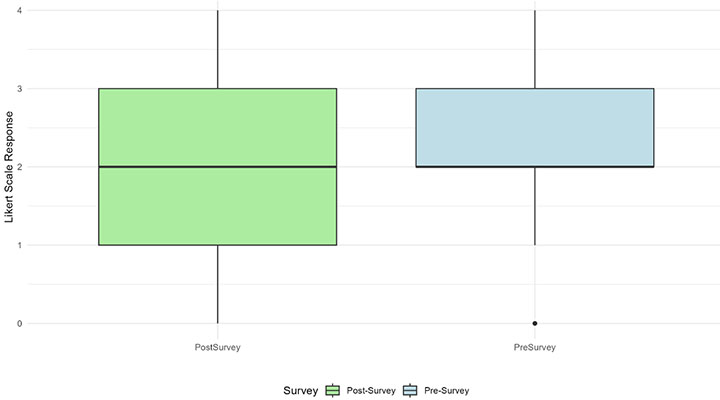
Note. Responses show a slight increase in access behaviors post-activity.
Students reported engaging with a broader variety of OER formats (e.g., videos, textbooks, interactives) after the activity, yet platform-specific usage patterns (e.g., BCcampus, OER Commons) were largely unchanged. This broadened but shallow adoption suggests that the course successfully exposed students to multiple open modalities without fully converting that exposure into habitual discovery and reuse.
Several factors can explain this pattern. First, the ability to find good OER is a learned skill: Because resources are scattered, students need to know how to search, use the right terms, and navigate each platform. Such competencies are typically underemphasized in disciplinary curricula (Farias-Gaytán et al., 2023; Tinmaz et al., 2022). Second, tight timelines can push students to finish an assignment rather than build repeatable search-and-review habits. Finally, in advanced courses, students often rely on instructor-curated links; without intentional transfer tasks (e.g., find and justify), those habits may slip after the activity or course ends.
In summary, thematic findings collectively highlight that the activity was effective in improving students’ understanding of Creative Commons licensing and their perceptions of OER quality and credibility. Although gains in access behaviors were present, they were more modest and suggest that further institutional support may be needed to reinforce regular OER use.
This study examined the impact of engaging undergraduate students in the creation of OER within a course-based activity. Using a pre–post-survey design and Wilcoxon signed-rank test analysis, we identified statistically significant improvements in students’ understanding of Creative Commons licenses, their perception of OER, and, albeit more modestly, their access to OER materials.
The most substantial gains were observed in the domain of Creative Commons knowledge, particularly in items assessing recognition of license types (Q10) and the ability to match licenses with their appropriate use (Q12). These findings suggest that active participation in OER creation can help demystify complex licensing frameworks and foster applied digital literacy competencies, a pattern similarly reported in studies of OER-enabled pedagogy and student authorship (Trust et al., 2023; Werth & Williams, 2021a; Wiley & Hilton, 2018). Because uncertainty about licensing frequently inhibits reuse and remixing, these gains represent both pedagogical and practical value within open education ecosystems.
The perception of OER theme also showed improvement, particularly in Q6. Prior to the activity, responses clustered at the lower end of the scale, suggesting unfamiliarity or initial skepticism. Post-activity results indicate that even a single structured engagement in OER creation can shift student attitudes, making learners more receptive to open practices, which is a finding that aligns with prior work on co-creation, student agency, and openness (LeMire et al., 2024; Lubicz-Nawrocka & Bovill, 2023; Maultsaid & Harrison, 2023). Trust-related items (Q15 CCS and Q15 FUR) remained high across both time points, reflecting preexisting confidence in OER credibility.
Improvements in the access to OER theme, although statistically significant, were comparatively modest. This suggests that while the learning activity increased awareness and strengthened perceptions, these did not fully translate into autonomous access behaviors. Prior research highlights that students often lack the search skills, repository familiarity, and procedural digital literacy needed to independently locate and evaluate open resources (Cheung et al., 2022; Farias-Gaytán et al., 2023; Tinmaz et al., 2022). This underscores a key challenge in open pedagogy: supporting learners not only in understanding openness but in developing the habits and competencies necessary to act on that understanding.
The absence of change across several items (e.g., prior OER use, ease of access, interactivity features) is also informative. Three considerations help contextualize these patterns. First, ceiling and floor effects likely constrained detectable movement where baseline ratings were already high or conceptions were already formed (Clinton & Khan, 2019). Second, research shows that changes in sourcing habits often require extended practice or repeated exposure across multiple courses rather than a single-semester intervention (Grimaldi et al., 2019; Tlili et al., 2023). Thirdly, the use of single-item Likert measures may have limited sensitivity to small but meaningful changes; multi-item scales could strengthen future assessments (Clinton & Khan, 2019).
These findings support the growing evidence that open pedagogy can be a powerful mechanism for enhancing students’ engagement with and understanding of OER. At the same time, the results suggest that familiarity with licensing and access infrastructures may require continued opportunities, structured guidance, and institutional support to produce deeper and more durable changes in student behavior.
This study had several strengths, including the use of a within-subjects pre–post design that provided a direct measure of change; the alignment of survey constructs with clearly defined domains of licensing knowledge, perception, and access; and the focus on Creative Commons literacy, which is an area that remains underexamined in OER scholarship. At the same time, several limitations should be acknowledged. The modest improvement observed in access behaviors suggests that short-term interventions may be insufficient to shift habitual sourcing practices, which often require repeated opportunities and broader institutional scaffolding. Additionally, because the activity was implemented within a single biochemistry course at one institution, the findings may not be generalizable across disciplines or contexts where students have different levels of digital literacy or prior exposure to OER. Future research could build on this work by incorporating qualitative approaches to capture students’ experiences more deeply, examining longitudinal changes in access behaviors and exploring how similar OER creation activities function in diverse disciplinary or institutional environments.
The integration of OER creation into an undergraduate biochemistry course significantly enhanced students’ knowledge of Creative Commons licensing, improved their perception of open resources, and modestly increased their reported access to OER. Students are not merely passive consumers of educational content but can be meaningfully positioned as co-creators in the learning process.
Engagement with open pedagogy led to more informed, confident, and positive attitudes toward open resources, particularly in areas where prior knowledge was limited. Students demonstrated measurable gains in both knowledge and perception, which are critical for the sustainability and success of open education initiatives. The distinctive contribution of this work lies in documenting measurable gains in licensing literacy, which is an essential yet often overlooked competency in ODL environments.
While access behavior showed some improvement, it remained an area requiring additional support. This underscores the importance of providing clear pathways for students to discover, evaluate, and use OER materials independently.
Although our focus was on quantitative changes, future studies could use qualitative methods to capture students’ voices and experiences as they move through the process of creating OER. These insights would complement the present results by highlighting how students make sense of licensing, authorship, and digital literacy in authentic, public-facing work.
When students create real, public work, they learn practical licensing skills (competency), feel more connected by coauthoring with peers and instructors (relatedness), and make editorial choices for real audiences (autonomy). These drivers help explain why knowledge and critical judgment improved most, while everyday access habits changed less (Werth & Williams, 2021c). Put simply, students started to think like open practitioners before they consistently acted like them.
Incorporating open pedagogy activities within courses should involve conceptual grounding, coached practice, and ideally, independent application across multiple courses. Institutional infrastructure should facilitate repositories, guidance, and sufficient recognition to sustain momentum.
In closing, we recommend that instructors build OER work into the heart of courses rather than adding it on the side. When students create and use open materials as a core activity, they practice digital authorship, learn about information ethics, and contribute to public knowledge. Students should be taught how to find, judge, adapt, and properly attribute OER. Clear instruction can close the gap between students’ positive views of OER and their ability to use it independently. Although our work was with biochemistry students, the methods can be adapted to students in other disciplines.
As higher education continues to evolve in response to affordability, equity, and access challenges, student-centered open pedagogy represents a promising avenue for transformative, inclusive education. This study adds to the growing body of evidence that involving students in OER creation not only supports content understanding but also fosters empowerment and engagement in the learning process.
No generative artificial intelligence tools were used in the design of the study, the collection or analysis of data, or the writing of this manuscript. All content, interpretations, and conclusions are the sole work and responsibility of the authors.
Adil, H. M., Ali, S., Sultan, M., Ashiq, M., & Rafiq, M. (2024). Open education resources’ benefits and challenges: A systematic review. Global Knowledge, Memory and Communication, 73(3), 274-291. https://doi.org/10.1108/GKMC-02-2022-0049
Arispe, K., & Hoye, A. (2023). Partnering higher education and K–12 institutions in OER: Foundations in supporting teacher OER-enabled pedagogy. The International Review of Research in Open and Distributed Learning, 24(2), 196-212. https://doi.org/10.19173/irrodl.v24i2.6856
Cheung, S. K. S., Wong, B. T M., & Li, K. C. (2022). Perceived usefulness of open educational resources: Impact of switching to online learning for face-to-face and distance learners. Frontiers in Psychology, 13, Article 1004459. https://doi.org/10.3389/fpsyg.2022.1004459
Cho, K. W., & Permzadian, V. (2024). The impact of open educational resources on student achievement: A meta-analysis. International Journal of Educational Research, 126, Article 102365. https://doi.org/10.1016/j.ijer.2024.102365
Clinton, V. (2018). Savings without sacrifice: A case report on open-source textbook adoption. Open Learning: The Journal of Open, Distance and e-Learning, 33(3), 177-189. https://doi.org/10.1080/02680513.2018.1486184
Clinton, V., & Khan, S. (2019). Efficacy of open textbook adoption on learning performance and course withdrawal rates: A meta-analysis. AERA Open, 5(3). https://doi.org/10.1177/2332858419872212
Clinton Lisell, V. E., Roberts Crews, J., & Gwozdz, L. (2023). SCOPE of open education: A new framework for research. The International Review of Research in Open and Distributed Learning, 24(4), 135-153. https://doi.org/10.19173/irrodl.v24i4.7356
Cronin, C. (2017). Openness and praxis: Exploring the use of open educational practices in higher education. The International Review of Research in Open and Distributed Learning, 18(5), 15-34. https://doi.org/10.19173/irrodl.v18i5.3096
DeRosa, R., & Robison, S. (2017). From OER to open pedagogy: Harnessing the power of open. In R. S. Jhangiani & R. Biswas-Diener (Eds.), Open: The philosophy and practices that are revolutionizing education and science (pp. 115-124). Ubiquity Press. https://doi.org/10.5334/bbc.i
Farias-Gaytán, S., Aguaded, I., & Ramírez-Montoya, M. S. (2023). Digital transformation and digital literacy in the context of complexity within higher education institutions: A systematic literature review. Humanities and Social Sciences Communications, 10, Article 386. https://doi.org/10.1057/s41599-023-01875-9
Griffiths, R., Mislevy, J., & Wang, S. (2022). Encouraging impacts of an open education resource degree initiative on college students’ progress to degree. Higher Education, 84(5), 1089-1106. https://doi.org/10.1007/s10734-022-00817-9
Grimaldi, P. J., Basu Mallick, D., Waters, A. E., & Baraniuk, R. G. (2019). Do open educational resources improve student learning? Implications of the access hypothesis. PLOS ONE, 14(3), Article e0212508. https://doi.org/10.1371/journal.pone.0212508
Hilton, J., III. (2020). Open educational resources, student efficacy, and user perceptions: A synthesis of research published between 2015 and 2018. Educational Technology Research and Development, 68(3), 853-876. https://doi.org/10.1007/s11423-019-09700-4
Jhangiani, R., Pakkal, O., & Xia, X. (2025). The multi-year impact of Canada’s first zero textbook cost initiative. Open Praxis, 17(2), 326-348. https://doi.org/10.55982/openpraxis.17.2.832
Lan, M., Liu, H., & Pan, Q. (2025). Unpacking the digital literacy—self-regulated learning nexus: A systematic review and a three-level meta-analysis. Educational Research Review, 48, Article 100713. https://doi.org/10.1016/j.edurev.2025.100713
LeMire, S., Anders, K., & Pantuso, T. (2024). Exploring first-generation student experiences with OER textbooks. College & Research Libraries, 85(7), Article 952. https://doi.org/10.5860/crl.85.7.952
López Núñez, J. A., Alonso García, S., Berral Ortiz, B., & Victoria Maldonado, J. J. (2024). A systematic review of digital competence evaluation in higher education. Education Sciences, 14(11), Article 1181. https://doi.org/10.3390/educsci14111181
Lubicz-Nawrocka, T., & Bovill, C. (2023). Do open students experience transformation through co-creating curriculum in higher education? Teaching in Higher Education, 28(7), 1744-1760. https://doi.org/10.1080/13562517.2021.1928060
Maultsaid, D., & Harrison, M. (2023). Can open pedagogy encourage care? Student perspectives. The International Review of Research in Open and Distributed Learning, 24(3), 77-98. https://doi.org/10.19173/irrodl.v24i3.6901
Meger, E., Schwartz, M., & Freeman, W. (2021). Participation in OER creation: A trajectory of values. The Open/Technology in Education, Society, and Scholarship Association Journal, 1(2), 1-10. https://doi.org/10.18357/otessaj.2021.1.2.13
Mercer Mapstone, L., Dvorakova, L. S., Matthews, K. E., Abbot, S., Cheng, B., Felten, P., Knorr, K., Marquis, E., Shammas, R., & Swaim, K. (2017). A systematic literature review of students as partners in higher education. International Journal for Students as Partners, 1(1), 15-37. https://doi.org/10.15173/ijsap.v1i1.3119
Mirzaei, A., Carter, S. R., Patanwala, A. E., & Schneider, C. R. (2022). Missing data in surveys: Key concepts, approaches, and applications. Research in Social and Administrative Pharmacy, 18(2), 2308-2316. https://doi.org/10.1016/j.sapharm.2021.03.009
Mishra, S. (2025). A review of reviews on open educational resources. Open Praxis, 17(2), 305-325. https://doi.org/10.55982/openpraxis.17.2.851
Mullens, A. M., & Hoffman, B. (2023). The affordability solution: A systematic review of open educational resources. Educational Psychology Review, 35, Article 72. https://doi.org/10.1007/s10648-023-09793-7
Nobre, A. (2021). Open educational practices and resources in the higher education learning environment. In D. Chatham (Ed.), Advancing online course design and pedagogy for the 21st century learning environment (pp. 93-111). IGI Global Scientific Publishing. https://doi.org/10.4018/978-1-7998-5598-9.ch006
Omland, M., Hontvedt, M., Siddiq, F., Amundrud, A., Hermansen, H., Mathisen, M. A. S., Rudningen, G., & Reiersen, F. (2025). Co-creation in higher education: A conceptual systematic review. Higher Education, 90, 1017-1047. https://doi.org/10.1007/s10734-024-01364-1
Santos-Hermosa, G. (2024). Impact and implementation of UNESCO’s recommendation on open educational resources in academic libraries: SPARC Europe case study. Research in Learning Technology, 32, Article 3183. https://doi.org/10.25304/rlt.v32.3183
Schmied, A., Ntonia, I., Ng, M. K. J., Zhu, Y., Gibbs, F., & Zou, H. G. (2024). Co-creating with students to promote science of learning in higher education: An international pioneer collaborative effort for asynchronous teaching. Trends in Neuroscience and Education, 35, Article 100229. https://doi.org/10.1016/j.tine.2024.100229
Short, C. R., Hilton, B., Hilton, J., III, Wiley, D., Chaffee, R., Guilmett, J., & Darrow, J. (2024). Higher education instructors’ perceptions of open pedagogy: An exploratory study of open pedagogy definitions in practice. Open Learning: The Journal of Open, Distance and e-Learning. Advance online publication. https://doi.org/10.1080/02680513.2024.2334237
Spencer, C., Angra, A., Dósa, K., & Jones, A. (2025). Undergraduate learning gains and learning efficiency in a focused open education resource. International Review of Research in Open and Distributed Learning, 26(2), 184-204. https://doi.org/10.19173/irrodl.v26i2.8117
Tietjen, P., & Asino, T. I. (2021). What is open pedagogy? Identifying commonalities. The International Review of Research in Open and Distributed Learning, 22(2), 185-204. https://doi.org/10.19173/irrodl.v22i2.5161
Tinmaz, H., Lee, Y.-T., & Baber, H. (2022). A systematic review on digital literacy. Smart Learning Environments, 9, Article 21. https://doi.org/10.1186/s40561-022-00204-y
Tlili, A., Garzón, J., Salha, S., Huang, R., Xu, L., Burgos, D., Denden, M., Farrell, O., Farrow, R., Bozkurt, A., Amiel, T., McGreal, R., López Serrano, A., & Wiley, D. (2023). Are open educational resources (OER) and practices (OEP) effective in improving learning achievement? A meta analysis and research synthesis. International Journal of Educational Technology in Higher Education, 20(1), Article 54. https://doi.org/10.1186/s41239-023-00424-3
Tlili, A., Zhang, X., Lampropoulos, G., Salha, S., Garzón, J., Bozkurt, A., Huang, R., & Burgos, D. (2025). Uncovering the black box effect of open educational resources (OER) and practices (OEP): A meta-analysis and meta-synthesis from the perspective of activity theory. Humanities and Social Sciences Communications, 12, Article 504. https://doi.org/10.1057/s41599-025-04644-y
Trust, T., Maloy, R. W., & Edwards, S. (2023). College student engagement in OER design projects: Impacts on attitudes, motivation, and learning. Active Learning in Higher Education, 24(3), 353-371. https://doi.org/10.1177/14697874221081454
UNESCO. (n.d.). Open educational resources (OER). https://en.unesco.org/themes/building-knowledge-societies/oer
UNESCO. (2024, November 20). Dubai Declaration on Open Educational Resources (OER): Digital public goods and emerging technologies for equitable and inclusive access to knowledge. https://unesdoc.unesco.org/ark:/48223/pf0000392271.locale=en
Werth, E., & Williams, K. (2021a). Exploring student perceptions as co authors of course material. Open Praxis, 13(1), 53-67. https://doi.org/10.5944/openpraxis.13.1.1187
Werth, E., & Williams, K. (2021b). Learning to be open: Instructor growth through open pedagogy. Open Learning: The Journal of Open, Distance and e-Learning, 38(4), 301-314. https://doi.org/10.1080/02680513.2021.1970520
Werth, E., & Williams, K. (2021c). What motivates students about open pedagogy? Motivational regulation through the lens of self-determination theory. The International Review of Research in Open and Distributed Learning, 22(3), 34-54. https://doi.org/10.19173/irrodl.v22i3.5373
Wiley, D., & Hilton, J. L., III. (2018). Defining OER-enabled pedagogy. The International Review of Research in Open and Distributed Learning, 19(4), 133-147. https://doi.org/10.19173/irrodl.v19i4.3601

From Consumers to Creators: How Student Participation in OER Development Transforms Understanding of Open Licensing and Improves Digital Literacy by Natasha Ramroop Singh, Ayisha Najeeha C O K, Olivia Mendez Romero, and Kira Reierson is licensed under a Creative Commons Attribution 4.0 International License.