Volume 27, Number 3
Mehmet Yavuz1*, Şener Balat1, Bünyami Kayalı2, and Emirhan Gülen1
1Bingöl University, Türkiye; 2Bayburt University, Türkiye; *Corresponding Author
Although research on distance education has increased substantially in recent years, comprehensive analyses capturing the overall thematic development of the field remain limited. Modeling studies are necessary to address this gap and to uncover long-term research trends. This study aimed to reveal the trends of research conducted in the field of distance education in the last two decades by using machine learning methodology and bibliometric analysis. The unique aspect of the study was its use of the Latent Dirichlet Allocation (LDA) algorithm, a machine learning method for analysing large-scale data. Within the scope of the study, 54,444 articles in the Web of Science database were analysed. Bibliometric analysis revealed that distance education had gained significant momentum, especially in the post-pandemic period, with a wide range of applications in different disciplines such as education, management, and health. As a result of LDA analysis, 19 thematic topics were identified. Among these, digitalization, artificial intelligence, Web-based learning, and social interaction and collaboration stood out. Time series analysis showed an increasing trend for topics such as artificial intelligence and emergency distance education over the years, with less interest shown in topics such as Web-based learning and program design. The study emphasized that distance education is in a technology-driven transformation process and pointed to areas that will offer new opportunities for researchers. Furthermore, recommendations for decision-makers, such as investments in digital infrastructure, integration of artificial intelligence-based systems, and the establishment of quality standards, also emerged.
Keywords: distance education, machine learning, topic modeling, LDA, bibliometric analysis
Distance education has driven an important paradigm shift in the field of education, thanks to rapidly developing technological infrastructures and increasing accessibility opportunities (Kaldoudi et al., 2010). With the widespread use of Internet technologies, distance education applications, which offer learning opportunities independent of time and space, have both diversified and enriched individuals’ learning processes (Park et al., 2012). Distance education has not only replaced traditional educational environments but also paved the way for the development of innovative pedagogical approaches (Watermeyer et al., 2021).
The last two decades have been a remarkable period for distance education research as technologies, methods, and pedagogical approaches used in distance education have rapidly diversified and developed significantly (Bates, 2014). In parallel with these developments, there has been a significant increase in research on the effects of distance education on learning outcomes (Bozkurt et al., 2015). Analysing these studies systematically and revealing general trends in the field is of great importance in terms of both understanding the existing body of knowledge and shaping future research directions (Özmen & Kan, 2021). However, with the increase in technology-oriented research and publishing opportunities, it has become almost impossible for researchers to determine the trends and development of the field by analysing the literature in a holistic manner in the face of the wide-ranging scientific content (Debortoli et al., 2016).
Technological developments in the field of machine learning have brought about a significant transformation in educational research (Peña-Ayala, 2014). Thanks to their superior ability to analyse large data sets and uncover complex relationships, machine learning algorithms have enabled faster, easier, and more detailed examination of trends in the field of distance education (Aggarwal & Zhai, 2012). Integrating these technologies into distance education research can enable a more comprehensive and objective evaluation of the studies conducted in the past (Blei, 2012). Thus, clearer and more reliable answers can be found for questions such as which topics are prominent in distance education research, which methodologies are preferred, and which gaps are found.
The concept of distance education emerged from flexible and decentralized learning needs and developed later than general education research (Zawacki-Richter & Naidu, 2016). Early studies in the 1960s were limited (Peters, 2014), descriptive, and criticized for weak design (Saba, 2000). In the 1980s, distance education began to professionalize with journals such as Distance Education (Delling, 1971). During the 1980s, research first emphasized defining the field and founding universities, then shifted to instructional technologies, design, and interaction strategies (Bozkurt & Zawacki-Richter, 2021).
In the 1990s, topics that addressed improving quality, developing student support services, and early online learning became central (Berge & Mrozowski, 2001). Technological advances reduced costs and expanded access (Howell et al., 2003). Instructional design remained important (Bozkurt & Zawacki-Richter, 2021), alongside calls for new methods and paradigms (Bozkurt et al., 2022). In the 2000s, research focused on collaborative learning (Oviatt et al., 2012), interaction (Aydın et al., 2020) and blended learning (Gunawardena & McIsaac, 2013). Studies also explored student and instructor experiences, as well as cultural, social, and ethical dimensions (Aydın et al., 2020).
From 2010 to 2020, debates on methodological rigor and comparisons with face-to-face education dominated (National Forum, 2021). MOOCs, technology-supported collaboration, and the shift from instructional to learning design stood out (Xiao, 2023). Open education and student support services gained emphasis (Bozkurt & Zawacki-Richter, 2021). After 2020, the COVID-19 pandemic accelerated online learning, leading to increased publications on personalized learning (Pai et al., 2021), learning analytics (Hamal et al., 2022), data mining, and machine learning (Yörük, 2024).
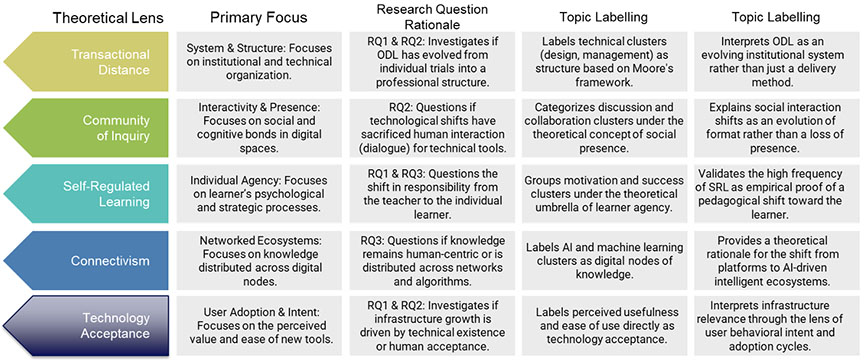
In this study, the interpretation of distance education research and the construction of the proposed taxonomy were supported by the synthesis of five established theoretical perspectives in the field. Moore’s transactional distance theory (Moore & Kearsley, 2012) provided a lens for explaining the relationship between instructional structure and dialogue, while the community of inquiry (CoI) framework (Garrison et al., 2000) contributed to the understanding of social presence, collaboration, and affective dimensions. Self regulated learning (SRL) theory (Zimmerman, 2002) grounded issues of learner autonomy and motivation. Connectivism (Siemens, 2005) conceptualized the rise of digitalization and network based learning, and the technology acceptance model (TAM; Davis, 1989) helped explain technological adoption and perceived usefulness. Taken together, these theoretical perspectives guided the formulation of research questions, the labelling of topic clusters, and the interpretation of the taxonomy. This enabled a theory-driven reading of the thematic evolution of distance education research rather than a purely descriptive account.
Topic modeling is a text mining technique that uses probabilistic models to uncover hidden semantic topics in large text collections (Blei, 2012). LDA, one of the most widely used algorithms, enables semantic analysis by identifying latent topics in document collections, especially in text mining and natural language processing (Griffiths & Steyvers, 2004).
LDA is a three-level hierarchical Bayesian model that represents each document as a combination of topics and each topic as a probabilistic distribution of words (Wallach, 2006). It treats words in documents as variables observed in an iterative probabilistic process based on a Dirichlet distribution (Karl et al., 2015). Rather than relying on a predefined taxonomy or fixed dictionary, LDA identifies topics based on the co-occurrence and contextual neighborhoods of words. This probabilistic framework allows the algorithm to group conceptually related terms into the same topic even if their lexical forms vary over time; for instance, if evolving terms share a similar set of surrounding words, they are mapped to the same underlying theme. By automating the extraction of these semantic structures, LDA has surpassed traditional bibliometric methods and manual reviews in both efficiency and depth (Aziz et al., 2022).
With its robust analytical capabilities, LDA has become an essential tool in academic and industrial research (Griffiths & Steyvers, 2004). It has been widely applied in the social sciences: (a) Gürcan et al. (2021) analysed 41,720 articles on human-computer interaction; (b) Aziz et al. (2022) examined 5,942 publications in finance; (c) Fu et al. (2024) assessed 27,316 student comments on MOOCs; and (d) Zankadi et al. (2023) analysed 120,000 tweets from 12,187 students. In the present study, the resulting topic structures were further interpreted and validated through independent expert labelling and consensus discussions, transforming the statistically derived topic clusters into a theory-informed and reliable thematic taxonomy.
This study examined trends in distance education research over the past two decades using a combined bibliometric and machine learning-based approach. Analysing a large corpus of 54,444 Web of Science (WoS)-indexed publications, it provided a data-driven taxonomy that mapped thematic evolution and identified priority areas for theory, policy, and practice. Unlike prior distance education and open and distance learning (ODL) syntheses, which largely relied on manual content analysis and shorter time windows, (e.g., 2000–2008 or 2014–2019), this study applied LDA to capture long-term thematic shifts and emerging trends at scale. This approach enabled a more precise identification of key developments—such as digitalisation, artificial intelligence, and social interaction—thereby offering a clearer and more systematic roadmap for future distance education research. The study also contributed to the redefinition of distance education theories in the context of digital transformation, with potential to offer a theoretical framework to broaden the impact of technology in education. From a practical perspective, the study yielded concrete recommendations for policy development regarding the integration of artificial intelligence (AI)-based systems and investments in digital infrastructure. Machine learning-based analysis has been touted as a useful methodology not only for distance education but also expected to bring a new perspective to educational research. In this study, published research on distance education was examined, and trends were analysed using machine learning algorithms. The following research questions guided this study.
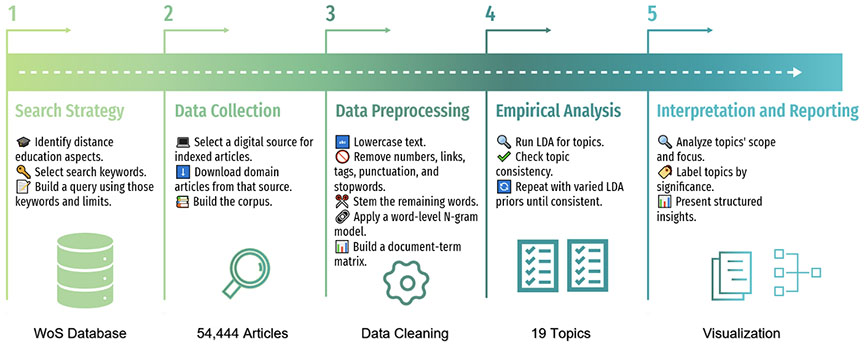
This study was conducted within the framework of machine learning methodology and using LDA, a text mining technique, to reveal the trends of distance education research over the last two decades. The methodological approach of the study consisted of five main stages: (a) search strategy, (b) data collection, (c) data preprocessing, (d) empirical analysis, and (e) interpretation and reporting. The scope was limited to English-language, WoS-indexed publications (2005–2024), which may have limited generalizability to non-English and non-WoS research. Works published in local journals or in different languages may offer different perspectives on thematic evolution and research trends. During model selection, topic coherence values for nearby topic numbers yielded comparable thematic patterns, supporting the robustness of the selected model. Records without abstracts were excluded due to insufficient textual information; however, as these constituted a small proportion of the corpus and were not concentrated in specific years or subject areas, their exclusion is unlikely to have systematically biased the identified topics. Figure 1 illustrates the stages and activities in the research process.
Figure 1
Research Methodology and Process Flow
The first stage involved developing a search strategy on distance education by analysing relevant concepts in the literature to obtain consistent data. Then, a dataset was created and academic articles fitting the criteria were compiled. This textual dataset was preprocessed with various techniques to make it suitable for topic modeling analysis.
Subsequently, the dataset was analysed using the LDA method. In the final stage, the topics obtained were evaluated, their contents analysed, and temporal trends revealed. Based on these analyses, a systematic taxonomy for distance education research was proposed.
In the first stage, a general search was conducted in the WoS database using the term distance education to determine frequently used keywords in the field. The distribution frequencies of these keywords were analysed and then included in the search query. Using them, a comprehensive search was carried out in the WoS database, which was preferred as it covers journals indexed in Science Citation Index Expanded, Social Sciences Citation Index, Emerging Sources Citation Index, and Arts & Humanities Citation Index (Charan, 2014). The exact search query and filtering criteria used in Web of Science are provided below.
TS=(“distance education” OR “e-learning” OR “online learning” OR “emergency remote teaching” OR “distance learning” OR “online education” OR “online teaching” OR “e-teaching” OR “distance teaching” OR “web-based learning” OR “web-based teaching”) AND DT=(Article) AND LA=(English) AND PY=(2005-2024)
On January 3, 2025, a total of 54,812 articles on distance education were accessed. In preprocessing, the title, abstract, and keywords of the articles were included, texts reformatted, and meaningless components removed. For 499 articles without abstracts, an additional search found 131, while 368 were excluded. Thus, 54,444 articles were included. Bibliometric data such as subject area, journal, author, and country were also obtained, forming a secondary dataset for descriptive analyses.
The data cleaning and preprocessing steps were carefully designed to ensure both data quality and conceptual integrity. Texts were tokenized, and noise was removed by eliminating HTML tags, punctuation, numbers, very short words, and common stop words (e.g., and, is, the) while preserving meaningful content. All words were lowercased and lemmatized to standardize word forms and make the texts suitable for modeling. Each article was then represented as word vectors using the bag-of-words approach and transformed into a document term matrix for topic modeling. All preprocessing and data cleaning procedures were implemented programmatically using Python-based natural language processing libraries, enabling a systematic, reproducible, and transparent workflow.
The LDA model was applied to the corpus to identify latent thematic structures. LDA is a probabilistic topic modeling approach that uncovers topics based not only on word frequency but also on patterns of word co-occurrence. Within this framework, each document is represented as a mixture of topics, and each topic as a probability distribution over words. Through an iterative estimation process, the model simultaneously learns which topics characterize which documents and which words represent each topic, thereby enabling the identification of conceptually coherent latent topics distributed across the corpus rather than simple clusters of frequently used keywords. Prior parameters α, β, and K were estimated for model optimization (Blei, 2012). The α parameter indicated topic distribution per document, β referred to word distribution per topic, and K represented the number of topics. Following recommendations for short texts, α = 0.1 and β = 0.01 were used (Li et al., 2016). The number of topics (K) was tested from 10 to 50, and the coherence metric CV was calculated to select the optimal K (Konrad, 2017), with the maximum score achieved at 19 topics. Model coherence was then used to evaluate topic meaningfulness. The final stage involved interpreting topics, analysing temporal trends, and presenting findings systematically. Independent labelling by multiple coders was followed by consensus discussions, ensuring agreement on topic interpretation. Topic momentum was calculated using LDA-derived yearly topic proportions. These proportions were normalized to control for annual publication volume differences and smoothed using a moving average. Momentum was then defined as the year-to-year change in the smoothed topic prevalence, indicating increases or decreases in research attention over time. Each topic included up to 20 descriptive keywords, and in addition to topic modeling, the bibliometric profile of the corpus was analysed in detail.
Based on these procedures, the identified topics reflected empirically derived latent topics interpreted at a conceptual level, rather than surface-level keyword clusters. Accordingly, the proposed taxonomy captured conceptually grounded shifts in research focus rather than surface-level changes in educational vocabulary. The mappings among latent topics, theoretical lenses, and taxonomic categories are summarized in Figure 2.
Figure 2
Functional Mapping of ODL Theories to Research Design and Taxonomy
The findings of this study have been organized by the three main research questions. First, bibliometric analysis results show the distribution of articles by years, subject areas, productive journals, and high-frequency terms. Second, the topics modeling discovered through the LDA method are presented and interpreted in context. Third, the temporal trends of these topics modeling are analysed and visualized with appropriate graphics.
To answer the first research question, this section presents the bibliometric characteristics of studies in the field of distance education. First, the distribution of these studies by year is shown in Figure 3 with frequency values.
Figure 3
Distribution of Articles by Year (between 2005 and 2024)
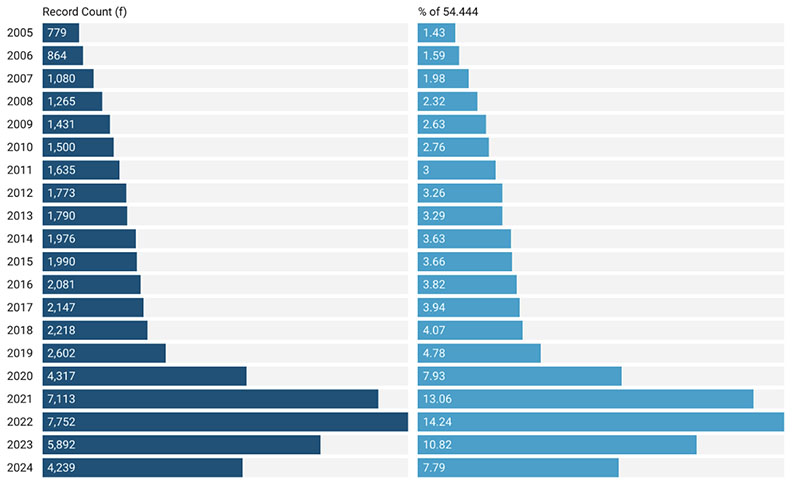
Figure 3 shows that academic interest in distance education has risen markedly since 2005. While 779 articles were published in 2005, the number grew steadily, reaching 1,500 in 2010 and peaking at 7,752 in 2022. In the last four years, 4,317 articles appeared in 2020, increasing to 7,113 in 2021 and 7,752 in 2022, but dropping to 5,892 in 2023 and 4,239 in 2024. These figures highlighted distance education as a growing research focus, with a post-2020 surge driven by the COVID-19 pandemic.
Another bibliometric result was concerned with subject areas. Figure 4 presents the percentage and frequency values of the top 20 fields represented in distance education studies, revealing which disciplines have dominated and which have been explored less.
Figure 4
Topics with the Highest Number of Articles
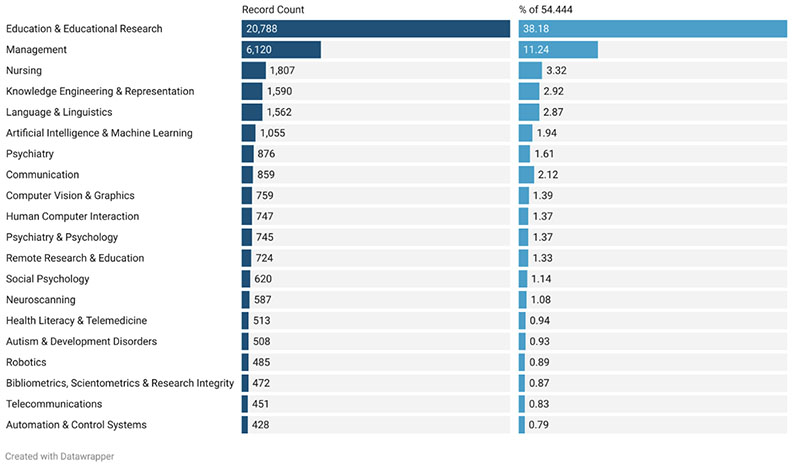
Figure 4 illustrates that most studies in distance education fell under education and educational research, with 20,788 studies (38.18%); this highlights the decisive role of pedagogical approaches as the basis of the field. The second-largest area was management with 6,120 studies (11.24%), which reflected interest in the managerial dimension. This was followed by health (1,807; 3.32%), then knowledge engineering and representation (1,590; 2.92%). Other notable areas included language and linguistics (2.87%), artificial intelligence and machine learning (1.94%), and psychiatry (1.61%). Although smaller in share, disciplines such as robotics (0.89%), bibliometrics and scientometrics (0.87%), telecommunications (0.83%), and automation and control systems (0.79%) have enriched the literature by addressing technological and methodological aspects of distance education.
The sub-topics variable was also analysed. The first 20 sub-subjects, showing how distance education research has focused on more specific topics, are presented in Figure 5 with their frequency and percentage values.
Figure 5
Sub-Topics with the Highest Number of Articles
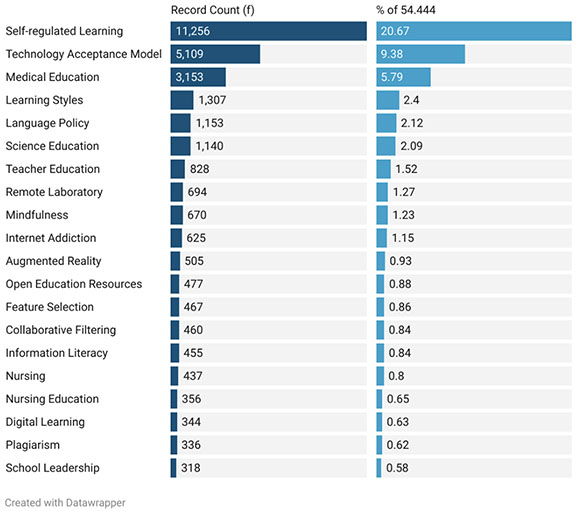
When Figure 5 is analysed, self-regulated learning emerged as the leading sub-subject with 11,256 articles (20.67%), indicating the centrality of individual learning skills in distance education. The technology acceptance model followed with 5,109 articles (9.38%), stressing technology adoption, while medical education ranked third with 3,153 articles (5.79%), reflecting the significance of distance education in health fields. Other sub-subjects included teacher education (1.52%), Internet addiction (1.15%), and open educational resources (0.88%), with smaller contributions from digital learning (0.63%), plagiarism (0.62%), and school leadership (0.58%).
Journals with the highest publication counts were also analysed as a variable. Results revealed that distance education studies were distributed across diverse journals, with leading outlets shown in Figure 6.
Figure 6
The Most Productive Journals
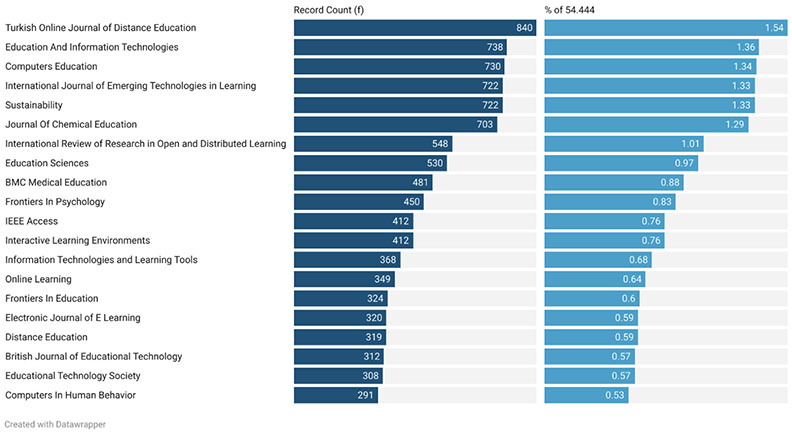
Figure 6 presents the distribution of the top 20 journals publishing the highest number of articles on distance education. Although Turkish Online Journal of Distance Education ranked first (1.54%), followed closely by Education and Information Technologies (1.36%) and Computers & Education (1.34%), the relatively low percentage values indicate that publications are not concentrated within a single dominant outlet. Instead, the findings suggest a dispersed publication pattern across multiple journals.
Notably, many of the leading journals focus on educational technology and digital learning environments, highlighting the strong connection between distance education research and technology-oriented scholarship. Furthermore, the presence of interdisciplinary journals such as Sustainability suggests that distance education has expanded beyond traditional educational research boundaries. Overall, the distribution reflects the field's multidisciplinary and widely disseminated nature.
An LDA-based topic modeling analysis of distance education research was conducted to determine the topics modeling and percentage distribution of studies. Figure 7 shows the extent to which different topics have been examined in the literature, along with the prominent keywords. The analysis included 19 topics ranging from digital education technologies to learner-centred designs, and from the effects of the pandemic to mobile computing security.
Figure 7
Ratings of Topics and Top Keywords Discovered by LDA
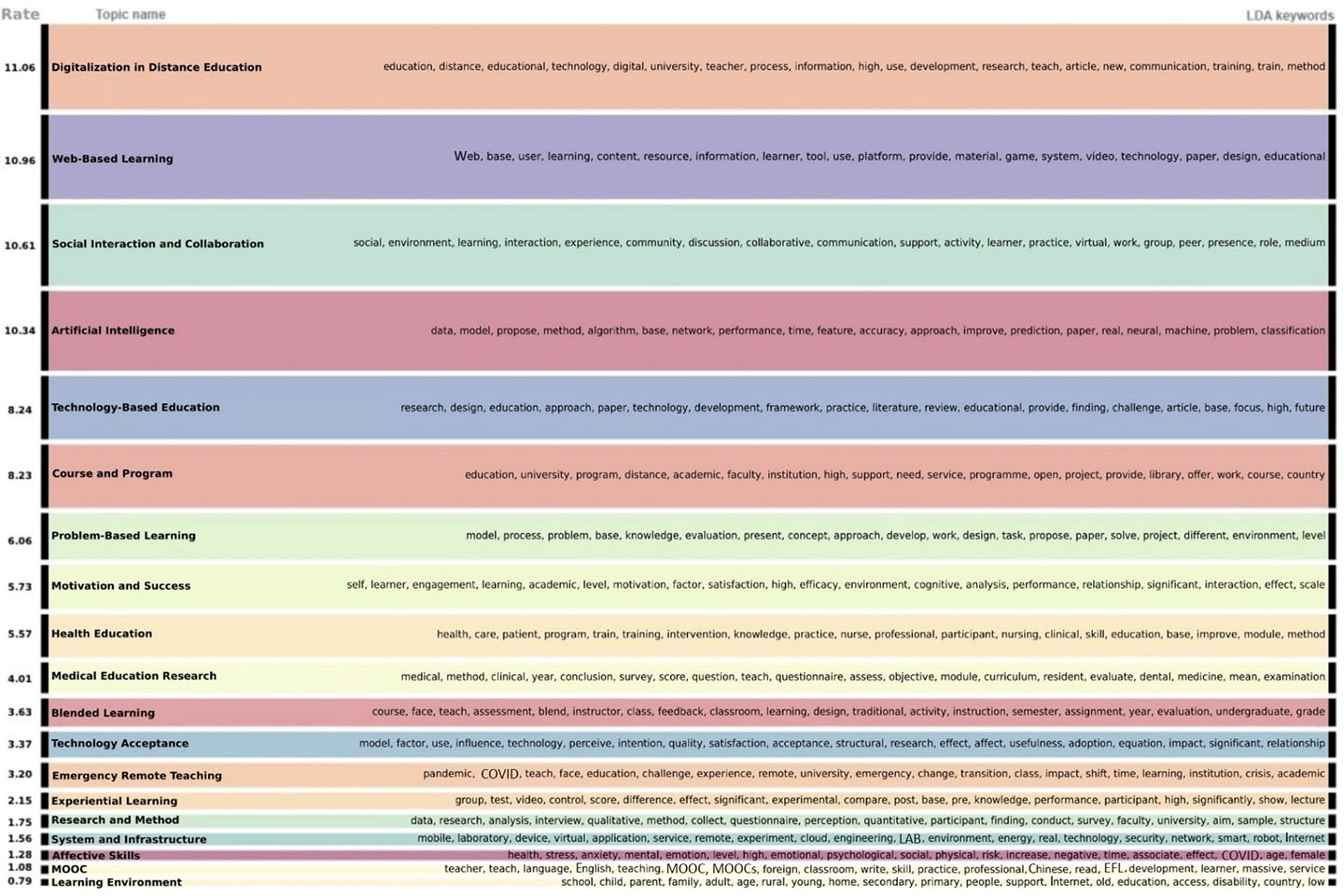
Prominent topics in Figure 7 included digitalisation in distance education (11.06%), Web-based learning (10.96%), social interaction and collaboration (10.61%), and artificial intelligence (10.34%). In contrast learning environment (0.79%) and system and infrastructure (1.56%) showed the lowest representation.
Other notable topics were technology-based education (8.24%), course and programme (8.23%), and problem-based learning (6.06%). Emergency remote teaching (3.20%) highlighted the effects of the COVID-19 pandemic, while less frequent topics such as affective skills (1.28%) pointed to growing attention on the emotional dimension of education. The distribution of distance education topic modeling is visualised in Figure 8.
Figure 8
Percentage Distribution of Distance Education Topic Modeling
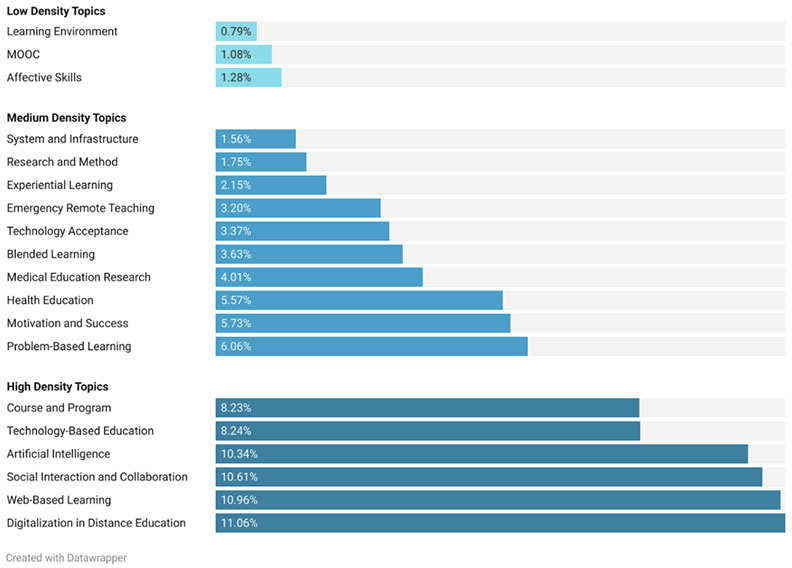
Figure 8 shows the percentage distribution of topics from the topic modeling analysis, grouped as high, medium, and low intensity. High-intensity topics (8.23%–11.06%) centred on technology-based learning. Digitalisation in distance education (11.06%) was studied most, followed by Web-based learning (10.96%), social interaction and collaboration (10.61%), and artificial intelligence (10.34%). Technology-based education (8.24%) and course and programme (8.23%) also drew strong interest.
Medium-intensity topics (1.56%–6.06%) focused on technological applications and pedagogy. While system and infrastructure (1.56%) and research and method (1.75%) were studied less, problem-based learning (6.06%), motivation and success (5.73%), and health education (5.57%) received moderate attention, showing the importance of methodological and assessment approaches.
Low-intensity topics (0.79%–1.28%) included learning environment (0.79%), MOOC (1.08%), and affective skills (1.28%). Although limited, topics like affective skills became more visible post-pandemic. Overall, findings revealed the dominance of technology integration, while areas such as psychological health, access, and traditional engineering remained less explored. After COVID-19, distance education and technology-based learning intensified significantly.
This section reports annual topic volume percentages and momentum patterns in distance education research. Figure 9 summarises temporal changes in topic prominence using a colour-coded heat map, where green indicates above-average and red below-average values.
Figure 9
Percentage of Volume and Acceleration Trends of Subjects by Year
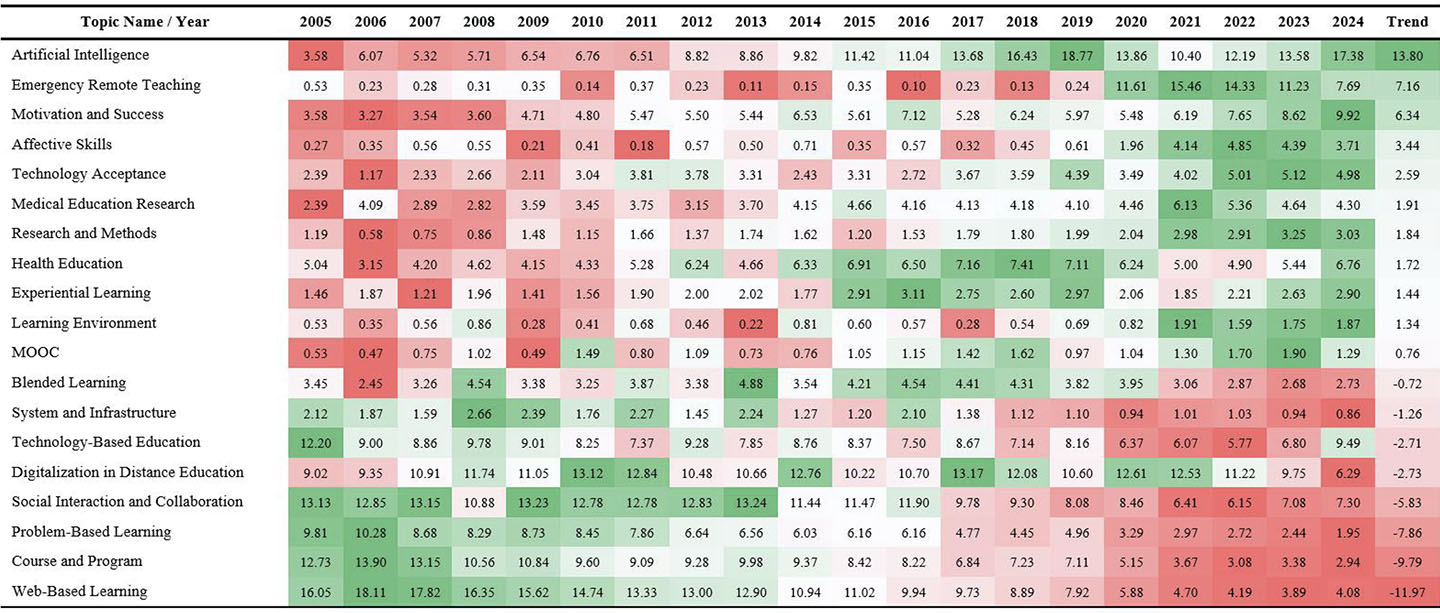
According to Figure 9, some topics have shown a strong upward trend in recent years. Artificial intelligence (13.80%) stood out with the highest growth, reaching 17.38% in 2024, highlighting its expanding role in distance education. Emergency remote teaching (7.16%) also rose rapidly during the COVID-19 pandemic and has remained influential. Interest in motivation and success (6.34%), affective skills (3.44%), and technology acceptance (2.59%) has increased, while health sector applications expanded significantly post-pandemic. More moderate growth has been seen in medical education research (1.91%), research and methods (1.84%), experiential learning (1.44%), and learning environment (1.34%).
Conversely, several topics have declined. Web-based learning (-11.97%) showed the sharpest drop, steadily falling until 2024. Once a leading area, it has become one of the lowest growth fields. Social interaction and collaboration (-5.83%), problem-based learning (-7.86%), and course and programme (-9.79%) have also decreased. Analyses indicated that while these topics dominated two decades ago, they have largely lost prominence since then. The topics with the highest and lowest momentum are shown in Figure 10.
Figure 10
Acceleration of Issues Between 2005 and 2024
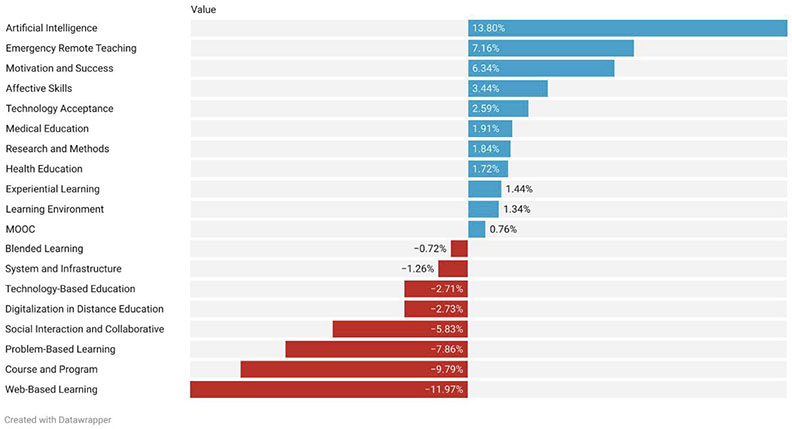
To summarise, Figure 10 illustrates how research trends in distance education have shifted over the years. Topics such as machine learning, data analytics, emergency remote teaching, and success and motivation have become increasingly prominent, while the decline of topics like Web-based learning, once highly important, revealed changing research priorities.
This study aimed to reveal research trends in distance education over the last two decades using a combined bibliometric and machine learning-based approach. In this context, 54,444 articles were identified in the Web of Science database through the specified keywords. The findings from both the bibliometric analysis and the LDA-based topic modeling of this dataset are discussed in detail in this section in line with the related literature and research questions.
In the research, it was determined that the number of academic studies on distance education has shown a continuous increase, reaching its peak in 2022. During the COVID-19 pandemic, this growth accelerated. The main reason has been the integration of high-potential technologies such as the Internet into educational environments (Whalley et al., 2021), which paralleled the increase in distance education activities. During the pandemic, the fact that most educational activities were carried out remotely under social distancing measures (Bozkurt & Sharma, 2020) further increased research interest (Mishra et al., 2021). Similar trends have been reported in Bozkurt et al. (2015) and Yılmaz Özden et al. (2023).
Another bibliometric finding concerned the subject areas where studies were concentrated. Distance education has been researched in education, management, nursing, engineering, and language. The adoption of digital technologies such as simulation, augmented reality, and virtual reality in health, engineering, and environmental sciences, and especially in education and computer sciences, has increased research in these disciplines (Blyznyuk et al., 2021). Moreover, opportunities such as flexibility, interaction, communication, and collaboration offered by distance education (Henderson et al., 2017) have increased the desirability of DE (Kanishcheva, 2022). Similar trends were reported by Amoozegar et al. (2018) and Gürcan et al. (2021).
Self-regulated learning, technology acceptance model, medical education, learning styles, and language policy were the sub-topics most often researched. In distance education, self-regulated learning is crucial as students must manage their learning processes independently (Bozkurt & Zawacki-Richter, 2021). The adoption of systems also depends on how students and teachers perceive technology; hence, the technology acceptance model has been studied frequently (Zawacki-Richter et al., 2009). Distance education also offers a different structure for medical students, which has led to increased research on its effectiveness (Djeki et al., 2022). Studies focused on self-regulated learning, technology acceptance, and medical education stood out (Teo, 2019).
Finally, bibliometric data showed that academic publications on distance education were concentrated in technology- and education-oriented journals. The Turkish Online Journal of Distance Education, Education and Information Technologies, Computers & Education, International Journal of Emerging Technologies in Learning, and Sustainability were prominent publication platforms. In particular, Computers & Education, Educational Technology & Society, and Distance Education were prominent as pioneering journals (Bozkurt, 2020). Similar emphasis was also noted in Amoozegar et al. (2018), Djeki et al. (2022), and Gürcan et al. (2021).
Within the scope of the second research question, LDA-based topic analysis was performed on studies in distance education. As a result, 19 topics were identified and classified into low, medium, and high intensity. Among them, digitalisation in distance education, social interaction and collaboration, Web-based learning, and artificial intelligence had the highest intensity. In recent years, distance education expanded rapidly with technological developments, and during the COVID-19 pandemic, both digitalisation processes and the transition to online learning accelerated globally (Bozkurt & Zawacki-Richter, 2021; Zawacki-Richter et al., 2020). Today, distance education has become mainstream, enabling students to access learning opportunities without time and space constraints (Hodges et al., 2020).
Digitalisation has reduced costs and allowed students to customise learning according to personal needs (Zawacki-Richter et al., 2020). Online platforms have integrated group work, peer assessments, and forum discussions to enhance interaction (Anderson, 2008). Innovative technologies such as AI, virtual reality, and augmented reality have served to simulate interactive experiences (Selwyn, 2019). AI in particular has supported equal opportunities in large-scale programmes through personalised learning, instant feedback, and data-driven decisions (Siemens & Long, 2011). These developments have created a paradigm shift in educational design (Zawacki-Richter et al., 2020). Accordingly, research has increasingly focused on digitalisation, AI, and interaction, as exemplified by the following studies:
The medium-intensity group included studies on pedagogical models and teaching strategies to make online learning more effective. Problem-based learning has been widely applied to develop critical thinking and active learning in online environments (Savery, 2009). Similarly, blended learning, combining face-to-face and online education, became prominent, especially after the pandemic, supported by digitalisation infrastructure. It provides flexibility and increases satisfaction (Means et al., 2013). Distance education in clinical and medical training also gained importance, with a major transformation in health education (Ellaway, 2018). The effectiveness of clinical distance education and its impact on patient care remain subjects of ongoing research (Huang, 2021).
The low-intensity group included learning environment, MOOCs, and affective skills. MOOCs, described as a revolution in education between 2012–2015 (Daniel, 2012), initially drew interest as they expanded access and promoted equality of opportunity (Veletsianos, 2020). However, commercialisation, platform-centred structures, limited interaction, and access issues reduced interest (Cornali, 2024). Moreover, the recent research shift toward pandemic and AI topics contributed to the decline (Kurulgan, 2024).
Clearly, trends in the distance education areas being researched have changed significantly over the years. Topics such as machine learning, data analytics, emergency remote teaching (ERT), as well as motivation and success, have become increasingly prominent in recent years. On the other hand, Web-based learning, interaction and collaboration, and course and programme, important in the past, have garnered less interest, indicating that research priorities have changed.
The contributions of AI-supported systems, such as providing individualised learning experiences, adapting content to students’ needs, offering real-time feedback, and encouraging active participation in distance learning (Al-Tkhayneh et al., 2023), have revealed that AI will be increasingly used in educational environments. This finding reflects global trends towards the integration of technological transformation into education.
During the COVID-19 pandemic, distance education ensured continuity in learning and minimised losses (Yavuz et al., 2020). At almost all levels, educational activities were carried out mainly through online learning (Can, 2020). This shifted the focus of studies during and after the pandemic to temporary applications such as ERT (Hodges et al., 2020). The increase in research on motivation and success was based on two factors. First, rapid technological developments enabled online platforms and personalised learning tools, making learning more effective (Lagos-Castillo et al., 2025). Second, physical restrictions during the COVID-19 pandemic made distance education inevitable; in this context, motivation and achievement problems became central (Martin, 2023). AI-supported learning processes have attracted strong interest, especially for their potential to personalise education and increase student success (Zawacki-Richter et al., 2020). According to Teo (2019), research on motivation and achievement has increased. Similarly, bibliometric studies by Kurulgan (2024) and Karagözoğlu et al. (2024) stated that research addressing ERT, learning analytics, AI applications, and motivation has increased.
While Web-based learning initially occupied an important place in the distance education literature, its decline has shown that both research priorities and technological integration have changed (Hrastinski, 2008; Siemens, 2005). This decline was associated with the prominence of personalisation, interactivity and advanced analytical approaches; traditional Web-based methods have been replaced by more dynamic and adaptive technologies. Similar results were reported in the bibliometric analyses by Kurulgan (2024) and Karagözoğlu et al. (2024).
This research analysed studies in distance education over the last 20 years using a machine learning-based method and comprehensively evaluated trends in the field. The findings reveal the diversity of topics, their temporal changes, and the intensity of their application across disciplines.
High-intensity topics such as digitalization in distance education, social interaction and collaboration, Web-based learning, and artificial intelligence were most prominent, highlighting the growing importance of digitalisation, interaction-oriented methods, and AI applications. The COVID-19 pandemic accelerated this transformation and increased academic interest. In addition, topics like self-regulated learning and technology acceptance underline the significance of students’ ability to manage learning and adopt technology in distance education.
Temporal analysis shows that while innovative areas such as artificial intelligence have gained popularity, traditional topics like Web-based learning have declined, reflecting the evolution of distance education in line with advancing technologies and changing needs.
Beyond a general focus on distance or online learning, these findings contribute directly to ODL by showing thematic shifts toward artificial intelligence, learning analytics, and affective dimensions, which relate to scalability, learner autonomy, openness, and sustainability. The taxonomy enables a theoretical reinterpretation of established ODL frameworks by highlighting how interaction, learner support, and openness are reshaped in digitally distributed environments.
Practically, the taxonomy offers guidance for program design and policy. For example, the prominence of artificial Intelligence and learning analytics suggests incorporating AI literacy, data-informed design, and ethical AI into curricula, while the decline of Web-based learning points to more adaptive, personalized models. Additionally, attention to affective skills and motivation and success can inform research priorities and funding decisions, emphasizing socio-emotional dimensions of distance education in post-pandemic contexts.
Based on the findings, recommendations are offered for researchers and policy makers. For researchers, priority should be given to studies on innovative technologies, especially AI and learning analytics, which can improve achievement, personalise learning, and enhance materials. Furthermore, qualified studies are needed on the social, psychological, and cultural effects of distance education in the post-pandemic period, particularly focusing on motivation, self-regulation, and student–teacher interactions.
For decision makers, distance education programmes should prioritise accessibility through infrastructure investments. The dissemination of personalised learning models is recommended to increase satisfaction and success, while AI-supported systems, with their potential for customised content and instant feedback, should be integrated into distance education processes.
The authors disclose that they employed DeepL, ChatGPT 5, and ChatGPT 5.2 (August, 2025/January, 2026) to translate and localize content. Human translators subsequently reviewed and adjusted the translations to ensure accuracy, cultural appropriateness, and contextual relevance.
Aggarwal, C. C., & Zhai, C. (2012). A survey of text classification algorithms. In C. C. Aggarwal & C. Zhai (Eds.), Mining text data (pp. 163-222). Springer. https://doi.org/10.1007/978-1-4614-3223-4_6
Al-Tkhayneh, K. M., Alghazo, E. M., & Tahat, D. (2023). The advantages and disadvantages of using artificial intelligence in education. Journal of Educational and Social Research, 13(4), 105-116. https://doi.org/10.36941/jesr-2023-0094
Amoozegar, A., Khodabandelou, R., & Ale Ebrahim, N. (2018). Major trends in distance education research: A combination of bibliometric and thematic analysis. International Journal of Information Research and Review, 5(2), 5352-5359. https://doi.org/10.6084/m9.figshare.6210536
Anderson, T. (Ed.). (2008). The theory and practice of online learning (2nd ed.). AU Press. https://doi.org/10.15215/aupress/9781897425084.01
Aydın, C. H., Zawacki-Richter, O., & Bozkurt, A. (2020, June). A review and content analysis of the Turkish Online Journal of Distance Education publications between 2000 and 2015. EDEN conference proceedings, 1, (pp. 217-225). https://doi.org/10.38069/edenconf-2020-ac0020
Aziz, S., Dowling, M., Hammami, H., & Piepenbrink, A. (2022). Machine learning in finance: A topic modeling approach. European Financial Management, 28(3), 744-770. https://doi.org/10.1111/eufm.12326
Bates, T. (2014). The role of technology in distance education. Taylor & Francis. https://doi.org/10.4324/9781315738598
Berge, Z. L., & Mrozowski, S. (2001). Review of research in distance education, 1990 to 1999. American Journal of Distance Education, 15(3), 5-19. https://doi.org/10.1080/08923640109527090
Blei, D. M. (2012). Probabilistic topic models. Communications of the Association for Computing Machinery, 55(4), 77-84. https://doi.org/10.1145/2133806.2133826
Blyznyuk, T., Budnyk, O., & Kachak, T. (2021). Boom in distance learning during the coronavirus pandemic: Challenges and possibilities. Journal of Vasyl Stefanyk Precarpathian National University, 8(1), 90-98. https://doi.org/10.15330/jpnu.8.1.90-98
Bozkurt, A. (2020). Coronavirus (COVID-19) pandemic process and education in the world after the pandemic evaluations: The new normal and the new educational paradigm. Journal of Open Education Applications and Research, 6(3), 112-142. https://izlik.org/JA99ML86GW
Bozkurt, A., Kır, Ş., Şenocak, D., Elibol, S., Özer, N., Orhan, G., Alpat, M. F., Çimen, E. E., Çankırlı, E., & İbileme, A. İ. (2022). Research tendencies in the discipline of distance education (2015–2022): Examination of doctoral theses in higher education in Turkey. Proceedings of the Fifth International Open & Distance Learning Conference (pp. 355-366). https://doi.org/10.5281/zenodo.7428522
Bozkurt, A., Kumtepe, E. G., Kumtepe, A. T., Aydın, İ. E., Bozkaya, M., & Aydın, C. H. (2015). Research trends in Turkish distance education: A content analysis of dissertations, 1986–2014. European Journal of Open, Distance and E-learning, 18(2), 1-21. https://doi.org/10.1515/eurodl-2015-0010
Bozkurt, A., & Sharma, R. C. (2020). Emergency remote teaching in a time of global crisis due to coronavirus pandemic. American Journal of Distance Education, 15(1), i-vi. https://doi.org/10.5281/zenodo.3778083
Bozkurt, A., & Zawacki-Richter, O. (2021). Trends and patterns in distance education (2014–2019): A synthesis of scholarly publications and a visualization of the intellectual landscape. International Review of Research in Open and Distributed Learning, 22(2), 19-45. https://doi.org/10.19173/irrodl.v22i2.5381
Bozkurt, A., Zawacki-Richter, O., & Aydın, C. H. (2019). Using social network analysis to review the research in open and distance learning. Proceedings of the Association for Educational Communications and Technology 2019 International Convention (pp. 38-44). Las Vegas, NV, United States.
Can, E. (2020). Coronavirus (COVID-19) pandemic and its pedagogical reflections: Open and distance education practices in Turkey. Journal of Open Education Applications and Research, 6(2), 11-53. https://izlik.org/JA32KL96LX
Charan, J. (2014). Impact factor: Is this a true measure of quality? International Journal of Medical Science and Public Health, 3(3), 246-247. https://doi.org/10.5455/ijmsph.2014.190420141
Cornali, F. (2024). In platform we trust(?): Concepts, problems and a case study about platform education. European Journal of Education, 59(4), e12702. https://doi.org/10.1111/ejed.12702
Daniel, J. (2012). Making sense of MOOCs: Musings in a maze of myth, paradox and possibility. Journal of Interactive Media in Education, 2012(3), 18. https://doi.org/10.5334/2012-18
Davis, F. D. (1989). Perceived usefulness, perceived ease of use, and user acceptance of information technology. MIS Quarterly, 13(3), 319-340. https://doi.org/10.2307/249008
Debortoli, S., Müller, O., Junglas, I., & Vom Brocke, J. (2016). Text mining for information systems researchers: An annotated topic modeling tutorial. Communications of the Association for Information Systems, 39(1), 7. https://doi.org/10.17705/1CAIS.03907
Delling, R. M. (1971). Grundzüge einer Wissenschaft vom Fernstudium [Fundamentals of the science of distance learning]. Epistolodidaktika, 1, 14-28.
Djeki, E., Dégila, J., Bondiombouy, C., & Alhassan, M. H. (2022). E-learning bibliometric analysis from 2015 to 2020. Journal of Computers in Education, 9(4), 727-754. https://doi.org/10.1007/s40692-021-00218-4
Ellaway, R. H. (2018). Technology-enhanced learning. In T. Swanwick (Ed.), Understanding medical education: Evidence, theory, and practice (2nd ed., pp. 139-149). Wiley-Blackwell. https://doi.org/10.1002/9781119373780.ch10
Fu, H., Xiao, Y., Mensah, I. K., & Wang, R. (2024). Exploring the configurations of learner satisfaction with MOOCs designed for computer science courses based on integrated LDA-QCA method. Education and Information Technologies, 29(8), 9883-9905. https://doi.org/10.1007/s10639-023-12185-7
Garrison, D. R., Anderson, T., & Archer, W. (2000). Critical inquiry in a text‐based environment: Computer conferencing in higher education. The Internet and Higher Education, 2(2-3), 87-105. https://doi.org/10.1016/S1096-7516(00)00016-6
Griffiths, T. L., & Steyvers, M. (2004). Finding scientific topics. Proceedings of the National Academy of Sciences, 101(1), 5228-5235. https://doi.org/10.1073/pnas.0307752101
Gunawardena, C. N., & McIsaac, M. S. (2013). Distance education. In Jonassen, D., & Driscoll, M. (Eds.), Handbook of research on educational communications and technology (pp. 361-401). Routledge. https://doi.org/10.4324/9781410609519
Gurcan, F., Özyurt, Ö., & Çağıltay, N. E. (2021). Investigation of emerging trends in the e-learning field using latent Dirichlet allocation. International Review of Research in Open and Distributed Learning, 22(2), 1-18. https://doi.org/10.19173/irrodl.v22i2.5358
Hakan, C., Zawacki-Richter, O., & Bozkurt, A. (2020, June). A review and content analysis of the Turkish online journal of distance education publications between 2000 and 2015. In EDEN Conference Proceedings, 1 (pp. 217-225). https://doi.org/10.38069/edenconf-2020-ac0020
Hamal, O., El Faddouli, N. E., Harouni, M. H. A., & Lu, J. (2022). Artificial intelligence in education. Sustainability, 14(5), 2862. https://doi.org/10.3390/su14052862
Henderson, M., Selwyn, N., & Aston, R. (2017). What works and why? Student perceptions of “useful” digital technology in university teaching and learning. Studies in Higher Education, 42(8), 1567-1579. https://doi.org/10.1080/03075079.2015.1007946
Hodges, C., Moore, S., Lockee, B., Trust, T., & Bond, A. (2020). The difference between emergency remote teaching and online learning. EDUCAUSE Review, 27(1), 1-9. https://er.educause.edu/articles/2020/3/the-difference-between-emergency-remote-teaching-and-online-learning
Howell, S. L., Williams, P. B., & Lindsay, N. K. (2003). Thirty-two trends affecting distance education: An informed foundation for strategic planning. Online Journal of Distance Learning Administration, 6(3). https://www.westga.edu/∼distance/ojdla/fall63/howell63.html
Hrastinski, S. (2008). What is online learner participation? A literature review. Computers & Education, 51(4), 1755-1765. https://doi.org/10.1016/j.compedu.2008.05.005
Huang, Y. (2021). Strategies for enhancing student interaction in an online health promotion course. College Student Journal, 55(1), 1-6. https://eric.ed.gov/?id=EJ1313964
Kaldoudi, E., Konstantinidis, S., & Bamidis, P. D. (2010). Web advances in education: Interactive, collaborative learning via Web 2.0. In M. D. Lytras, P. Ordóñez de Pablos, A. Ziderman, E. Damiani, D. Avison, & J. B. E. M. L. Horner (Eds.), Affective, interactive and cognitive methods for e-learning design: Creating an optimal education experience (pp. 32-50). IGI Global. https://doi.org/10.4018/978-1-60566-940-3.ch003
Kanishcheva, N. A. (2022, February). The role of distance learning in the development of the digital economy. International Scientific and Practical Conference Strategy of Development of Regional Ecosystems (pp. 198-203). Atlantis Press. https://doi.org/10.2991/assehr.k.220208.029
Karagözoğlu, A. A., Abdurrezzak, S., & Doğan, Ü. (2024). A bibliometric analysis of studies on distance education. Anadolu Journal of Educational Sciences International, 14(1), 449-474. https://doi.org/10.18039/ajesi.1281711
Karl, A., Wisnowski, J., & Rushing, W. H. (2015). A practical guide to text mining with topic extraction. Wiley Interdisciplinary Reviews: Computational Statistics, 7(5), 326-340. https://doi.org/10.1002/wics.1361
Konrad, M. (2017). Text mining and topic modeling toolkit. PyPI. https://pypi.org/project/tmtoolkit/
Kurulgan, M. (2024). A bibliometric analysis of research on dropout in open and distance learning. Turkish Online Journal of Distance Education, 25(4), 200-229. https://doi.org/10.17718/tojde.1355394
Lagos-Castillo, A., Chiappe, A., Ramirez-Montoya, M. S., & Becerra Rodríguez, D. F. (2025). Mapping the intelligent classroom: Examining the emergence of personalized learning solutions in the digital age. Contemporary Educational Technology, 17(1), ep543. https://doi.org/10.30935/cedtech/15617
Li, C., Wang, H., Zhang, Z., Sun, A., & Ma, Z. (2016, July). Topic modeling for short texts with auxiliary word embeddings. Proceedings of the 39th International Conference on Research and Development in Information Retrieval (pp. 165-174). Association for Computing Machinery. https://doi.org/10.1145/2911451.2911499
Martin, A. J. (2023). University students’ motivation and engagement during the COVID-19 pandemic: The roles of lockdown, isolation, and remote and hybrid learning. Australian Journal of Education, 67(2), 163-180. https://doi.org/10.1177/00049441231179791
Means, B., Toyama, Y., Murphy, R., & Baki, M. (2013). The effectiveness of online and blended learning: A meta-analysis of the empirical literature. Teachers College Record, 115(3), 1-47. https://doi.org/10.1177/016146811311500307
Mishra, S., Sahoo, S., & Pandey, S. (2021). Research trends in online distance learning during the COVID-19 pandemic. Distance Education, 42(4), 494-519. https://doi.org/10.1080/01587919.2021.1986373
Moore, M. G., & Kearsley, G. (2012). Distance education: A systems view of online learning. Cengage.
National Forum. (2021). Next steps for teaching and learning: Moving forward together. Key themes in online and blended learning, 2010–2020. https://www.teachingandlearning.ie/wp-content/uploads/Key-themes-in-online-and-blended-learning-2010-2020.pdf
Oviatt, D., Burdis, J., & West, R. E. (2012). Distance education, 2000–2010. Educational Technology, 52(1), 44-48. http://www.jstor.org/stable/44429990
Özmen, E., & Kan, A. Ü. (2021). Bibliometric analysis of theses on distance education in Turkey between 2015–2020. Turkish Studie Educational Sciences, 16(4), 2005-2027. https://doi.org/10.47423/TurkishStudies.51788
Pai, K.-C., Kuo, B.-C., Liao, C.-H., & Liu, Y.-M. (2021). An application of Chinese dialogue-based intelligent tutoring system in remedial instruction for mathematics learning. Educational Psychology, 41(2), 137-152. https://doi.org/10.1080/01443410.2020.1731427
Park, S. Y., Nam, M.-W., & Cha, S.-B. (2012). University students’ behavioral intention to use mobile learning: Evaluating the technology acceptance model. British Journal of Educational Technology, 43(4), 592-605. https://doi.org/10.1111/j.1467-8535.2011.01229.x
Peña-Ayala, A. (Ed.). (2014). Educational data mining: Applications and trends. Springer. https://doi.org/10.1007/978-3-319-02738-8
Peters, O. (2014). Foreword. In O. Zawacki-Richter & T. Anderson (Eds.), Online distance education: Towards a research agenda (pp. ix-xii). Athabasca University Press. http://dx.doi.org/10.15215/aupress/9781927356623.01
Saba, F. (2000). Research in distance education: A status report. International Review of Research in Open and Distributed Learning, 1(1), 1-9. https://doi.org/10.19173/irrodl.v1i1.4
Savery, J. R. (2009). Problem-based approach to instruction. In C. M. Reigeluth & A. A. Carr-Chellman (Eds.), Instructional-design theories and models: Building a common knowledge base (Vol. III, pp. 155-178). Routledge.
Selwyn, N. (2019). Should robots replace teachers? AI and the future of education. John Wiley & Sons. https://doi.org/10.1002/9781119340829
Siemens, G. (2005). Connectivism: A learning theory for the digital age. Elearnspace. http://www.elearnspace.org/Articles/connectivism.htm
Siemens, G., & Long, P. (2011). Penetrating the fog: Analytics in learning and education. EDUCAUSE Review, 46(5), 30-40. https://er.educause.edu/articles/2011/9/penetrating-the-fog-analytics-in-learning-and-education
Teo, T. (2019). Students and teachers’ intention to use technology: Assessing their measurement equivalence and structural invariance. Journal of Educational Computing Research, 57(1), 201-225. https://doi.org/10.1177/0735633117749430
Veletsianos, G. (2020). Learning online: The student experience. Johns Hopkins University Press.
Wallach, H. M. (2006, June). Topic modeling: Beyond bag-of-words. Proceedings of the 23rd International Conference on Machine Learning (pp. 977-984). Association for Computing Machinery. https://doi.org/10.1145/1143844.1143967
Watermeyer, R., Crick, T., Knight, C., & Goodall, J. (2021). COVID-19 and digital disruption in UK universities: Afflictions and affordances of emergency online migration. Higher Education, 81(3), 623-641. https://doi.org/10.1007/s10734-020-00561-y
Whalley, B., France, D., Park, J., Mauchline, A., & Welsh, K. (2021). Towards flexible personalized learning and the future educational system in the fourth industrial revolution in the wake of COVID-19. Higher Education Pedagogies, 6(1), 79-99. https://doi.org/10.1080/23752696.2021.1883458
Xiao, J. (2023). Critical issues in open and distance education research. International Review of Research in Open and Distributed Learning, 24(2), 213-228. https://doi.org/10.19173/irrodl.v24i2.6881
Yavuz, M., Kayalı, B., Balat, Ş., & Karaman, S. (2020). Review of distance learning applications in the universities in the COVID-19 period. Journal of National Education, 49(1), 129-154. https://doi.org/10.37669/milliegitim.784822
Yılmaz Özden, Ş., Hamutoğlu, N. B., Kıyıcı, M., & Bozkurt, A. (2023). Investigation of research trends in educational technologies based on scientometric method (1965–2020): A cross-comparative study between publications from the world and the UK. Educational Technology Research and Development, 71(4), 1421-1447. https://doi.org/10.1007/s11423-023-10224-1
Yörük, T. (2024). Artificial intelligence and personalised learning in education. In S. Karataş (Ed.), International research in the field of educational sciences XXIII (pp. 21-34). Eğitim Publisher.
Zankadi, H., Idrissi, A., Daoudi, N., & Hilal, I. (2023). Identifying learners’ topical interests from social media content to enrich their course preferences in MOOCs using topic modeling and NLP techniques. Education and Information Technologies, 28(5), 5567-5584. https://doi.org/10.1007/s10639-022-11373-1
Zawacki-Richter, O., Bäcker, E. M., & Vogt, S. (2009). Review of distance education research (2000 to 2008): Analysis of research areas, methods, and authorship patterns. International Review of Research in Open and Distributed Learning, 10(6), 21-50. https://doi.org/10.19173/irrodl.v10i6.741
Zawacki-Richter, O., Marin, V. I., Bond, M., & Gouverneur, F. (2020). Systematic review of research on artificial intelligence applications in higher education. International Journal of Educational Technology in Higher Education, 17(1), 1-27. https://doi.org/10.1186/s41239-019-0171-0
Zawacki-Richter, O., & Naidu, S. (2016). Mapping research trends from 35 years of publications in Distance Education. Distance Education, 37(3), 245-269. https://doi.org/10.1080/01587919.2016.1185079
Zimmerman, B. J. (2002). Becoming a self-regulated learner: An overview. Theory Into Practice, 41(2), 64-70. https://doi.org/10.1207/s15430421tip4102_2

The 20-Year Evolution of Distance Education: A Bibliometric and LDA-Based Topic Model Analysis by Mehmet Yavuz, Şener Balat, Bünyami Kayalı, and Emirhan Gülen is licensed under a Creative Commons Attribution 4.0 International License.