Volume 27, Number 3
Barış Avcı and Meral Güven
Anadolu University, Eskişehir, Türkiye
This mixed-methods study developed and evaluated a comprehensive 5-week asynchronous in-service training program to enhance K–12 teachers’ online education competencies across pedagogical, social, managerial, and technical domains. Following needs assessment, 21 teachers in Türkiye participated using the Canvas learning management system (LMS). The competency-based program emphasized authentic learning experiences, requiring participants to design online lesson plans, use Web 2.0 tools, and implement the LMS in classroom contexts. Data collection employed triangulated methods including learning analytics and products, pre-/post-test assessments, and semi-structured interviews. Results demonstrated significant improvement in post-test scores (p < .05) and high engagement through practical activities. Learning analytics revealed varied engagement patterns, with participants completing authentic assignments. Qualitative findings highlighted gains in content development, instructional design skills, and digital competence. The study demonstrates that teachers require experiential learning as online students before becoming effective online instructors, emphasizing the necessity of systematic, needs-oriented training programs integrating theory with hands-on practice for comprehensive pedagogical transformation.
Keywords: online education, teacher training, curriculum development, K-12
Online education, defined as learning and teaching activities occurring synchronously or asynchronously in shared digital environments regardless of physical location (Mackay, 2013), has evolved from a supplementary educational tool to a central component of contemporary schooling (Zuo et al., 2024). This technological transformation has revealed a critical disconnect wherein teachers trained exclusively in conventional classroom settings frequently lack both personal experience with online education environments and the specialized competencies required for effective digital instruction (Avcı & Güven, 2025). This disconnect represents more than a simple skills gap; it constitutes a fundamental pedagogical crisis that undermines educational quality across global educational systems.
This disconnect is exacerbated by the fact that professional development approaches remain mainly reactive rather than proactive, with teachers receiving training only after beginning online instruction rather than during initial preparation (Kamal & Illiyan, 2021). Compounding this problem, a significant research-practice divide persists, as academic researchers have traditionally not prioritized solving K–12 classroom problems (Larson & Archambault, 2019). These parallel failures create a particularly destructive feedback loop: Without research addressing practical K–12 needs, teachers must independently restructure their approaches to accommodate field-specific constraints, including program standards, course durations, and cultural terminology unique to K–12 settings (Lokey-Vega et al., 2018; Orakcıoğlu, 2019). This fragmentation both perpetuates inadequate preparation and prevents the development of evidence-based practices, ensuring that each new cohort of online teachers faces the same foundational challenges as their predecessors.
The COVID-19 pandemic served as a devastating proof of concept for these systemic vulnerabilities, transforming theoretical concerns about teacher readiness into observable educational failures at scale. The crisis revealed not merely that teachers lacked specific technical skills but that the entire infrastructure for preparing and supporting online teachers was fundamentally inadequate.
Effective online education demands mastery of interconnected competencies spanning technology-enhanced course design, digital content delivery, and multimodal communication with students and parents through both real-time and asynchronous platforms. However, a framing of this challenge as simply a matter of acquiring new skills fundamentally misunderstands the depth of transformation required. As Koenig (2020, para. 6) bluntly observed, “most teachers simply don’t know how to teach online. No one ever taught them how or asked them to learn.”
The problem extends beyond what teachers know to encompass what they have experienced. Research consistently demonstrates that teachers’ own experiences as online learners constitute a foundational prerequisite for developing effective online pedagogical practices (Leary et al., 2020). This experiential knowledge enables teachers to internalize the constraints, challenges, and opportunities inherent in online contexts—insights that cannot be adequately conveyed through theoretical instruction alone. The absence of this experiential foundation helps explain why pedagogical strategies effective in traditional classrooms often fail when transferred to digital environments (König et al., 2020), a phenomenon the pandemic brought into sharp relief.
Most teachers, however, enter online teaching without this critical experiential base, beginning their digital instruction careers through institutional mandate rather than deliberate professional development pathways (Tschida et al., 2017). This gap represents a systemic institutional inadequacy; teachers are being asked to guide students through learning experiences they themselves have never navigated.
These global challenges are exemplified in Türkiye’s educational system, which offers a revealing case study of how systemic failures translate into tangible educational outcomes. Turkish teachers are not required to undergo specialized training for digital instruction (Bakioğlu & Çevik, 2020), revealing a critical gap in professional readiness. The consequences of this deficiency became evident during emergency remote instruction, when traditional pedagogical methods were precipitously transposed into online environments without adaptation, resulting in substantial learning deficits (Kaptanoğlu, 2021). A comprehensive analysis conducted by TEDMEM (İpek et al., 2020) further confirmed that Turkish teachers demonstrate general unpreparedness for online education delivery.
The inadequacy of teacher preparation extends beyond preservice education to in-service training initiatives. Additionally, an evaluation of in-service teacher training programs administered by the Turkish Ministry of National Education (MoNE), encompassing 1,080 courses and 174 seminars, revealed that only a minimal proportion specifically addressed online teaching competencies (Avcı & Güven, 2021). This finding aligns with broader evidence from literature reviews, university course catalogue analyses, and national education assessments, which consistently highlight pervasive inadequacy in teacher preparation for online educational contexts.
Contemporary teacher education programs demonstrably lack capacity to develop essential competencies for online instruction (Sengil-Akar & Kurtoglu-Erden, 2021), making the development of appropriate competencies an imperative rather than an option as online education continues redefining teacher roles (Basilotta-Gómez-Pablos et al., 2022).
Effective training programs grounded in systematic, evidence-based identification of essential competencies represent the cornerstone of transformation (Brenner, 2022). Yet, despite increased availability of professional development opportunities, research has inadequately addressed the foundational questions that determine program effectiveness. Critical gaps persist regarding comprehensive needs assessments (Stavermann, 2025), precise competency definitions, appropriate proficiency benchmarks for online teachers (Tian & Tian, 2025), and practical implementation strategies. Perhaps most significantly, few studies employ triangulated methodologies that integrate quantitative behavioral indicators with qualitative feedback mechanisms (Fayda-Kınık, 2021) to comprehensively evaluate program impact.
These research gaps are not merely academic concerns; they directly impede the development of preparation programs capable of breaking the cycle of inadequacy that currently characterizes online teacher education. Without rigorous evidence about what works, why it works, and how to implement effective practices at scale, educational systems will continue producing teachers unprepared for the digital environments in which increasing numbers of students learn.
This study employed a multiphase mixed-methods design to implement and evaluate a comprehensive in-service training program aimed at enhancing K–12 teachers’ online education competencies. A multiphase mixed-methods design focuses on addressing a series of interrelated research questions aimed at achieving a research objective and provides comprehensive answers to the problem by using multiple data collection methods (Creswell, 2012). It is considered the most appropriate method for use in curriculum development and evaluation studies (Nastasi et al., 2007).
The in-service training program (ITP) theoretical foundation was established through a competency-based framework developed via extensive preliminary research conducted over 1 year prior to implementation. Recognizing the inadequate preparation many teachers face and the often-overlooked needs of K–12 online teaching in scholarly inquiry, the competency identification process employed a rigorous three-round Delphi study with six experts (four in open and distance education, two in curriculum and instruction). Beginning with an open-ended inquiry that generated 200 distinct items, the pool was meticulously refined to 157 items for subsequent rounds. Through systematic consensus-building using interquartile ranges, 41 competencies achieved unanimous expert agreement and were organized across Berge’s (1995) framework: pedagogical (13), social (5), managerial (14), and technical (9). This foundational work ensured alignment between training objectives and the multifaceted demands and specific challenges encountered by K–12 teachers transitioning to online educational environments.
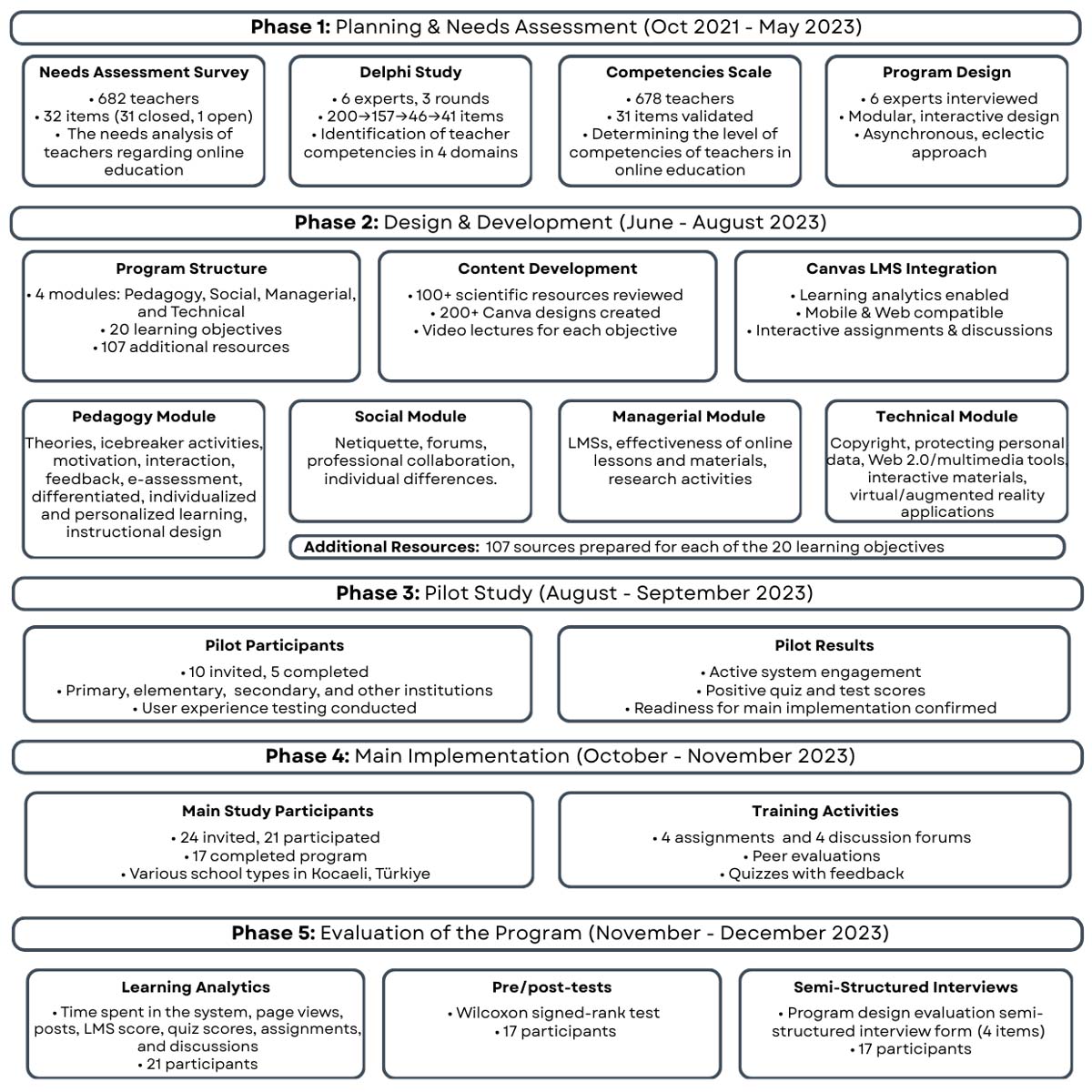
Following the establishment of this theoretical framework, the program design and implementation progressed through five distinct phases. The planning phase spanned from October 2021 to May 2023. Multiple needs assessment instruments were administered, including a survey, a Delphi study to identify key competencies, and preliminary interviews to inform program architecture. Subsequently, the content development phase ran from June through July 2023, during which program content was developed collaboratively by practicing teachers and academic experts. This process involved the review of more than 100 scholarly sources and the design of over 200 custom visuals and interactive components. The resulting content was integrated into the Canvas learning management system (LMS) between August 1 and August 6, 2023.
The instructional delivery phase employed an asynchronous format, enabling flexible access for participants. The program incorporated diverse activities (e.g., pedagogical activities, discussions, quizzes, assignments) and supplementary resources. Participants designed and implemented authentic online lessons, facilitated discussions, and received peer and expert feedback.
Finally, a comprehensive assessment framework evaluated learning outcomes through multiple methods. These included peer review for assignments and varied module-end assessments (e.g., multiple-choice, true/false, open-ended). The LMS provided automated feedback, while the instructor and expert conducted observational evaluations. Follow-up interviews were conducted to collect their insights on learning objectives, content quality, instructional strategies, and assessment. Figure 1 presents an overview of the ITP’s methodological implementation stages.
Figure 1
Overview of the In-Service Training Program’s Methodological Stages
Note. LMS = learning management system.
Having established these methodological stages, the research team proceeded to pilot the ITP in a real-world educational context.
Before launching the full program, a pilot study was conducted from August 23 to September 25, 2023, with five volunteer teachers from primary, elementary, and high schools. The pilot aimed to test usability across platforms, including desktops, Android/iOS mobile browsers, and the Canvas Student app, and to evaluate participant engagement.
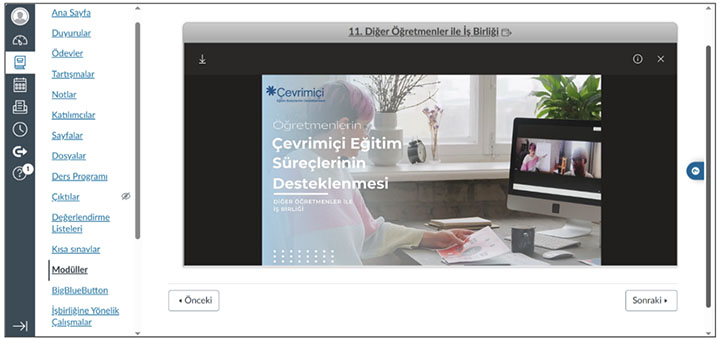
Analytics showed high levels of participation, and both pre- and post-tests revealed significant learning gains. Interviews conducted at the end of the pilot confirmed the program’s effectiveness and usability. Encouraged by these findings, the full implementation phase ran from October 9 to November 17, 2023, delivering the asynchronous training through the same Canvas platform used during the pilot. Figure 2 shows an example of a video lesson screen.
Figure 2
Video Lesson Interface
Following successful pilot study validation, the main implementation phase was executed from October 9 to November 17, 2023, maintaining identical platform specifications and instructional design components to those employed during the pilot validation period.
The study was conducted in Kocaeli, Türkiye; a purposive sampling methodology was employed to ensure comprehensive representation across educational levels and academic disciplines. Initially, 21 teachers were invited to participate through established professional networks and institutional partnerships. Following completion of informed consent procedures and ethical clearance protocols, 17 teachers successfully completed the entire program implementation cycle. The sample size was intentionally determined through consultation with experts in open and distance learning (ODL) as well as curriculum and instruction. While experts recommended maintaining a group size of 10–15 participants to enable systematic tracking of all assignments and activities, timely support for emerging issues, and individualized feedback delivery, the final implementation began with 21 participants to account for the characteristically high attrition rates in online courses. This approach is consistent with the group size parameters recommended by Palloff and Pratt (2007) for asynchronous instruction.
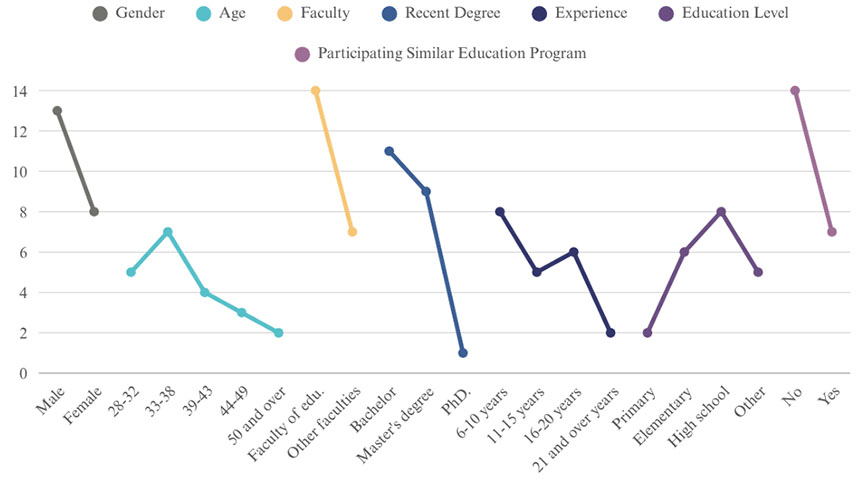
Figure 3
Demographics of the Main Implementation Participants
As illustrated in Figure 3, the final participant cohort comprised teachers representing primary, elementary, and secondary education levels, spanning diverse academic disciplines including mathematics, natural sciences, language arts, social studies, and special education. This heterogeneous sampling approach provided comprehensive perspectives on online education challenges across varied pedagogical contexts and diverse student populations, thereby enhancing the generalizability and ecological validity of research findings.
Data collection was done using a triangulated approach with three researcher-developed instruments: the teacher competencies in online education scale (pre-/post-test), the program design evaluation semi-structured interview protocol, and Canvas LMS learning analytics. Learning analytics tracked engagement metrics, system activity, content access, forum participation, and assessment performance to reflect competency development. Quantitative and qualitative data were integrated to understand program effectiveness and teacher development, with convergent findings strengthening validity and divergent findings prompting deeper exploration. Interviews captured participant perceptions, complementing behavioral data from the LMS.
Data collection occurred from February 2022 through December 2023 using multiple modalities (face-to-face and online) for surveys and interviews to ensure accessibility, while LMS analytics were recorded continuously. This triangulated methodology yielded a robust dataset for evaluating competency development and program impact.
Data analysis followed the mixed-methods strategies of Creswell and Plano Clark (2011). Quantitative data (pre-/post-tests, LMS metrics) were analyzed using descriptive and inferential statistics in SPSS 27. Qualitative data from interviews were thematically analyzed using MAXQDA 2020 (https://www.maxqda.com/), following Braun and Clarke’s (2006) six-phase framework. The coding process and thematic development were guided by the semi-structured interview protocol structure and established theoretical perspectives on reflective professional practice.
Methodological rigor was maintained through reliability assessment. A self-coding reliability rate of 90% was maintained. Inter-coder reliability assessments with an independent expert achieved agreement rates of 95% (pilot) and 91% (main). These coefficients exceed Miles and Huberman’s (1994) recommended 70% threshold, confirming the analytical credibility of the coding procedures. The multiphase mixed-methods design enabled validation of findings through data source triangulation, enhancing internal validity and the robustness of conclusions regarding program effectiveness and teacher competency development.
The 5-week in-service training program was successfully implemented with 17 teachers completing the full sequence of instruction. This section presents findings from the comprehensive mixed-methods evaluation, integrating learning analytics, quantitative assessment data, and qualitative interview responses into a unified analytical narrative that demonstrates program effectiveness and illuminates participant experiences.
Beginning with engagement patterns, learning analytics from the Canvas LMS revealed substantial variation in participant engagement patterns across multiple dimensions (Table 1).
Table 1
Learning Analytics Summary
| Participant | Time spent in LMS (hours) | Page views | Posts | LMS score (%) | Quiz score (%) |
| K1 | 02.13 | 166 | 12 | 65.53 | 62.25 |
| K2 | 02.59 | 111 | 4 | 51.32 | 48.75 |
| K3 | 03.10 | 244 | 9 | 84.21 | 80 |
| K4 | 06.36 | 146 | 10 | 52.5 | 42 |
| K5 | 01.24 | 137 | 5 | 71.58 | 68 |
| K6 | 05.57 | 245 | 12 | 81.32 | 77.25 |
| K7 | 01.47 | 81 | 8 | 56.32 | 53.5 |
| K8 | 03.22 | 184 | 11 | 64.21 | 61 |
| K9 | 02.39 | 164 | 9 | 55.53 | 52.5 |
| K10 | 02.51 | 77 | 5 | 53.42 | 50.75 |
| K11 | 04.48 | 179 | 8 | 79.47 | 75.5 |
| K12 | 03.41 | 238 | 11 | 80.53 | 76.5 |
| K13 | 04.14 | 203 | 11 | 92.63 | 88 |
| K14 | 03.17 | 155 | 8 | 46.05 | 44 |
| K15 | 01.38 | 122 | 7 | 86.67 | 13 |
| K16 | 13.52 | 654 | 12 | 92.37 | 87.75 |
| K17 | 04.15 | 214 | 9 | 86.32 | 82 |
| K18 | 00.07 | 2 | 0 | ||
| K19 | 00.10 | 2 | 0 | ||
| K20 | 04.23 | 54 | 4 | 48.64 | 26.75 |
| K21 | 00.15 | 44 | 0 | ||
| Mean | 03.50 | 162 | 7,3 | 69.37 | 60.52 |
Note. LMS = learning management system. Empty cells indicate insufficient participant activity to generate scores.
Time spent in the system ranged from 7 minutes to 13.52 hours, with an average of 3.5 hours per participant. These figures should be interpreted cautiously due to technical limitations in Canvas’s tracking capabilities (see Conclusion). Moreover, quantitative time measurements proved less informative than qualitative engagement patterns in understanding the learning experience. For instance, while participant K16 demonstrated the highest activity levels (13.52 hours and 654 page views), participant feedback consistently emphasized that program flexibility, rather than time investment, was the critical factor in facilitating meaningful learning outcomes.
K3 articulated this flexibility as a core strength: “Online environments provide individuals with freedom in terms of place and time. In this respect, I think it is more useful and economical for adults who are aware of their learning responsibilities.” However, this same flexibility demanded self-directed learning capacity, which helps explain the natural attrition from 21 enrollees to 17 completers.
While temporal and navigational patterns illuminated how participants engaged with the program, an equally critical dimension of analysis concerned which content elements elicited the strongest engagement. Table 2 presents assignment and discussion completion rates across the four training modules.
Table 2
Number of Assignments and Discussions Submitted
| Domain | No. of assignments | No. of discussions |
| Pedagogical | 13 (Instructional design) | 11 (Student interaction) |
| Social | 9 (Initiating/sustaining discussions) | 11 (Collaboration with teachers) |
| Managerial | 11 (Using LMS) | 10 (Research activities) |
| Technical | 13 (Using Web 2.0/multimedia tools) | 12 (Protection of personal data) |
Note. LMS = learning management system.
The high engagement levels are notable given that the program required time-intensive tasks, such as detailed instructional design plans and the creation of Web 2.0/multimedia tool projects. This consistent effort, despite the substantial time investment, suggests that participation was driven by a strong alignment with participants’ immediate professional needs and a motivation to apply their learning, rather than by simple topic preference.
Interview responses strongly supported this connection. Participant K1 illuminated this need: “I find the content quite sufficient. ... It was an area where I felt lacking. That’s why I participated the training program, and I’m satisfied with the result.” The high completion rate for the instructional design assignment (13 participants) directly corresponded with this expressed need for practical skills. K15 captured this transformation: “I thought I was conducting online classes just by using videoconferencing. Online classes are not just about that; I improved my instructional design skills.”
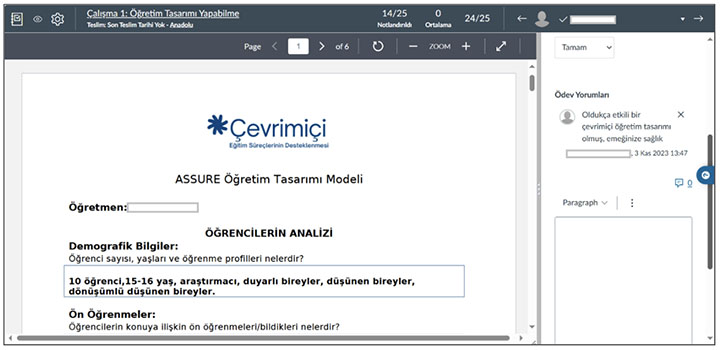
The instructional design assignment exemplified how the program bridged theory and practice. For instance, participant K16 prepared a 4-hour lesson plan covering all critical design stages, analyzing students, stating objectives, selecting media, ensuring participation, and evaluation, and successfully conducted the lesson in a real synchronous classroom (Figure 4).
Figure 4
Study 1—Instructional Design
Such authentic applications fostered a community of practice where participants both validated and inspired one another. K17’s peer evaluation validated the quality of learning products: “It was a very effective online instructional design, thank you for your efforts.” K16’s own reflection revealed the motivational impact: “The applicability and transformation of the knowledge I acquired into a product motivated me personally.”
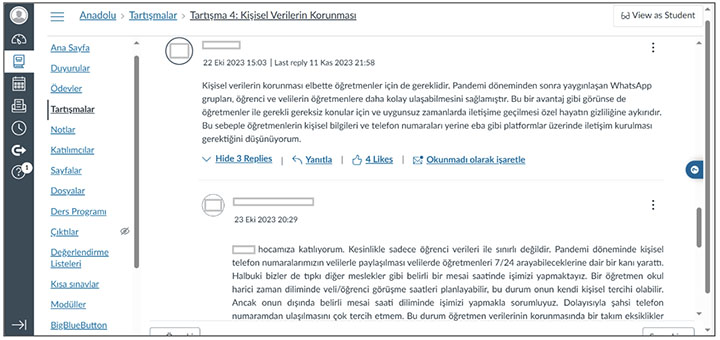
Parallel to these authentic application experiences, asynchronous discussions provided additional opportunities for professional exchange. For the discussion initiation/sustaining assignment, participants were asked to initiate a discussion or participate in existing discussions on the basis of the 20 topics within the four course modules. While only 9 participants submitted the discussion initiation/sustaining assignment, resulting in lower completion metrics (see Conclusion), the 44 posts shared revealed substantive engagement with critical topics. The most discussed subjects—personal data protection, student interaction, and collaboration with other teachers—aligned with participants’ emerging professional concerns rather than prescribed curriculum priorities. For the discussion initiation/sustaining assignment, participants were asked to initiate a discussion or participate in existing discussions on the basis of the 20 topics within the four modules of the program, following netiquette rules. The views of K7 and K11 on continuing the discussion are presented in Figure 5.
Figure 5
Assignment 2—Initiating/Sustaining Discussion
Note. English translation of top post: “The protection of personal data is, of course, necessary for teachers as well. WhatsApp groups, which became widespread after the pandemic, have made it easier for students and parents to reach teachers. Although this seems like an advantage, it also violates the privacy of teachers in terms of communication on irrelevant matters and at inappropriate times. For this reason, I think that communication with teachers should be established on platforms such as EBA, where teachers’ personal information and phone numbers are not disclosed.” English translation of bottom post: “I agree with my colleague [name]. It is definitely not limited to just student data. The sharing of our personal phone numbers with parents during the pandemic created an impression among parents that they could call teachers 24/7. However, just like other professions, we perform our work during specific working hours. A teacher may plan parent/student meeting hours outside of school time; this would be their own personal choice. But other than that, we are responsible for doing our job during specific working hours. Therefore, I do not much prefer being reached via my personal phone number. This indicates certain deficiencies regarding the protection of teacher data.”
K13 provided crucial context for understanding these engagement patterns: “Classroom practices were organized in a way to support the theoretical foundations. ... In this training, participants are provided with expert support, practice, and the opportunity to communicate and interact through sharing.”
This intentional design prioritized the quality of professional dialogue over discussion frequency, as exemplified by K7’s and K11’s exchanges, which demonstrated genuine knowledge construction through peer interaction. This quality-over-quantity pattern extended to other collaborative elements. K2 recognized the program’s community-building potential: “It also offers the opportunity for collaboration, in my opinion. After all, we work in the same province, so why not carry out or collaborate on the projects we are conducting or could do together?”
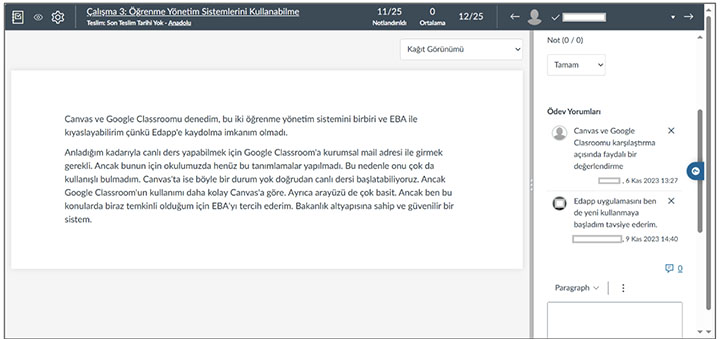
This orientation toward practical collaboration was further reflected in participants’ engagement with technology-focused assignments, where they explored tools that could facilitate such professional partnerships. The assignments focused on LMS use and Web 2.0/multimedia tools generated both quantitative evidence of engagement and qualitative insights into skill development trajectories. In the assignment related to LMS use, participants were asked to sign up for Google Classroom, EdApp, and Canvas LMS and explain, with five reasons, which of the three best served their teaching phases. K15’s post, along with the opinions of 11 participants, is presented in Figure 6.
Figure 6
Assignment 3—Using Learning Management Systems
Note. English translation of main text (left): “I have tried Canvas and Google Classroom; I can compare these two learning management systems with each other and with EBA. But I did not have the opportunity to sign up for EdApp. To be able to hold live lessons, it is necessary to log in to Google Classroom with an institutional email address. However, these configurations have not yet been made at our school. For this reason, I did not find it very useful. In Canvas, there is no such situation; we can start live lessons directly. However, I find Google Classroom easier to use than Canvas. Its interface is also very simple. But since I am a bit cautious about these issues, I prefer EBA. It has the Ministry's infrastructure and is a reliable system.” English translation of comments on right sidebar—top: “A useful evaluation regarding the comparison of Canvas and Google Classroom”; bottom: “I’m also new to EdApp. I’d recommend it.”
K15’s comparative analysis demonstrated participants’ developing capacity to critically evaluate educational technologies. This evaluative competence represented a significant shift from passive technology users to informed decision-makers. K12’s reflection on Web 2.0 tools captured this journey: “I developed my Web 2.0 tool. Acquiring skills ... to the extent that I could perform tasks in my lesson, made me happy.”
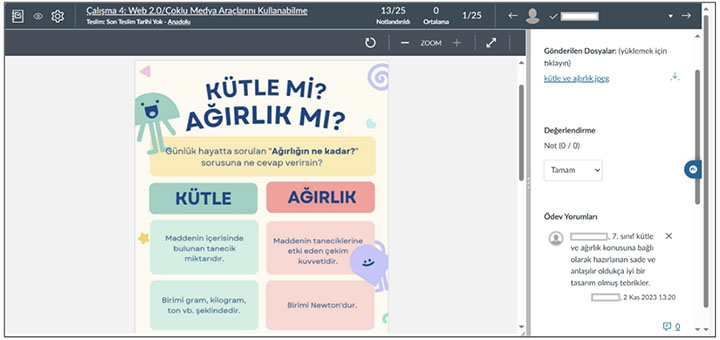
The depth of skill acquisition K12 described was exemplified in participants’ Web 2.0 assignments. The participants were asked to select one of the Web 2.0/multimedia tools or interactive material creation software and share the activities they designed using this tool. K11’s work on using Web 2.0/multimedia tools demonstrated both technical proficiency and pedagogical thoughtfulness (Figure 7).
Figure 7
Assignment 4—Using Web 2.0/Multimedia Tools
While individual assignments showcased participant growth, the underlying program design played a role in enabling such development. K8 particularly valued the program’s resource integration: “The necessary resources to make the training quality and effective were also provided. ... [We were] given various examples and additional study opportunities, QR codes/links embedded in the videos, which I find very important.” K6’s system evaluation—“I was using Google Classroom. ... However, I liked Canvas better”—illustrates how hands-on experience enabled informed preferences. K16’s emphasis on resource utility reinforced this pattern: “I frequently used the suggested digital resources during the content development process. I plan to use other suggested digital resources in my future classroom activities.”
While participants’ reflections illuminated the qualitative dimensions of their learning experiences, pre- and post-test measures provided quantitative evidence of knowledge gains. To assess learning gains, pre-test and post-test scores were analyzed using the Wilcoxon signed-rank test due to the non-normal distribution of difference scores. The results are presented in Table 3.
Table 3
Wilcoxon Signed-Rank Test Results
| Post-test–pre-test | N | M rank | Sum of ranks | Z | p |
| Negative ranks | 2 | 4.00 | 8.00 | −3.245 | .001 |
| Positive ranks | 15 | 9.67 | 145.00 | ||
| Ties | 0 | ||||
| Total | 17 |
The Wilcoxon signed-rank test demonstrated a statistically significant improvement in scores from pre-test (M = 3.54, SD = 0.59) to post-test (M = 4.17, SD = 0.37): Z = -3.245, p = .001. To evaluate the magnitude of this change, the effect size r was calculated using the formula r = Z / √N (Rosenthal, 1991), yielding r = -3.245 / √17 = -0.787. Following Cohen’s (1988) benchmarks, this represents a large effect size (|r| = 0.787 ≥ 0.50), indicating substantial practical significance and suggesting that the intervention produced meaningful improvements in participant performance.
While these statistical measures confirm the intervention’s effectiveness, participant responses shed light on the mechanisms underlying these improvements. K1 appreciated the formative assessment design: “When an answer is incorrect, feedback pops up indicating which topic to review. I noticed my mistake, went back, and watched it again. It is a big advantage, well thought out.” This feedback mechanism transformed assessment from evaluation into learning opportunity, though the analytics showed differential use.
However, the relationship between engagement patterns and learning outcomes proved more complex than surface-level metrics suggested. K15’s case illustrated the limitations of quantitative metrics: Despite an LMS score of 86.67, the quiz score was only 13, suggesting either technical issues or assessment misalignment. Conversely, participants K13 (quiz score: 88) and K16 (quiz score: 87.75) demonstrated consistency across both engagement metrics and assessment outcomes. K13’s transformation was particularly notable: “It helped me overcome my prejudices against online education. ... Through this training, I not only acquired many skills related to online education but also developed a deep desire to learn about the discussed topics.”
Beyond individual differences in performance metrics, participants converged on identifying the human support structure that enabled their varied paths to success. Despite the program’s asynchronous structure, instructor presence emerged as a critical success factor. K16 emphasized: “I believe that tracking participation in the program, grading submitted exams, providing comments on submitted work, [and] instant feedback are very important.” K17 reinforced this point: “Despite the asynchronous structure of the program, one of the aspects that pleased me the most was that instructor monitored the entire process and provided guidance.”
This instructor support operated within a time frame that participants judged to be well-suited to the learning goals. The 5-week program, described by K17 as “neither long enough to diminish interest nor short enough to be ineffective, but structured within an ideal time frame,” was also viewed by K9 as “extremely sufficient for an asynchronous education.”
However, the broader issue of workload and time commitment elicited more varied responses. The one dissenting voice on duration (finding it too long) was balanced by K11’s acknowledgment of the value-effort trade-off: “The task-oriented assignments took a lot of my time, but I think they were beneficial in terms of application.” This tension between time investment and perceived value appeared throughout the data, with most participants ultimately validating the program structure.
Participants’ acceptance of the demanding workload reflected appreciation for the program’s fundamental design principle: the integration of theoretical knowledge with practical application. K16 articulated this comprehensively: “I think that by supporting what is given in the lectures with additional examples and providing the opportunity to practice in the application part, it contributed to the teachers’ competencies in both theoretical and practical areas of online education.”
This integration manifested differently across participants based on their starting points and needs. K2’s expectation for “a program that would be easily carried out with a practical system and understandable” was met, while K15’s more nuanced appreciation of the modular resource structure—“more of these resources were presented in a modular form and in different topics”—indicated sophisticated engagement with the program architecture.
Participants’ appreciation extended beyond the program itself to how it compared with alternative learning platforms. K13’s comparison with other online learning platforms provided external validation:
I have also taken courses on Coursera and edX, where the instructor encourages practice and gives feedback. However, these are paid, at least for Coursera. The free ones are like YouTube videos or like a slide presentation. In this training, on the other hand, participants are provided with expert support, practice, and the opportunity to communicate and interact through sharing.
These qualitative gains, combined with the significant pre-/post-test improvements, painted a picture of comprehensive professional development that addressed multiple competency dimensions.
While these outcomes demonstrated the program’s current effectiveness, participants’ forward-looking recommendations revealed their deeper investment in its continued evolution. Participants’ suggestions for program enhancement reflected both satisfaction with the current design and vision for future iterations. Content recommendations focused on emerging needs. K15 advocated for artificial intelligence integration: “If we know how these tools are used and their possibilities, we can easily distinguish the unethical behaviors of students”; K16 proposed subject-specific customization: “The program’s content could be tailored specifically for each subject”; and K7 suggested adaptive pathways: “It might have been better if the training had been adapted to focus more or less on our specific needs.”
Complementing these curricular proposals, participants offered recommendations for enhancing the program’s infrastructure and collaborative elements. K15 envisioned organic program growth: “It would be a program that grows gradually, and as it grows, its content would be enriched and kept up to date.” K2 recommended formalized learning groups: “In this way, the sense of community increases, and the feeling of loneliness decreases.” The fact that most participants stated they would recommend the program to colleagues provided perhaps the strongest qualitative endorsement.
However, a complete program evaluation requires acknowledgment of the technical obstacles some participants encountered. Technical issues, file downloads, peer evaluation functionality, and video rewinding affected some participants but did not significantly detract from overall program effectiveness. K6’s positive evaluation of the Canvas LMS, combined with the high completion rates for platform-based activities, suggest that technical barriers were minimal for most participants.
When viewed holistically, the patterns emerging across statistical measures, usage analytics, and participant narratives point to the underlying factors driving program effectiveness. The convergence of quantitative and qualitative evidence reveals a professional development program that succeeded by honoring adult learning principles: flexibility in structure, relevance to professional context, integration of theory and practice, opportunities for peer interaction, and responsive instructor support. The high completion rate, significant learning gains, varied but substantive engagement patterns, and consistently positive participant evaluations collectively demonstrate program effectiveness.
Beneath these statistical patterns lie personal narratives of professional transformation that illuminate what the numbers represent in human terms. Most significantly, the qualitative evidence revealed transformations that quantitative metrics alone could not capture: K13’s shift from prejudice to enthusiasm for online education, K15’s evolution from viewing online teaching as “just video conferencing” to sophisticated instructional design, and K12’s pride in newly developed Web 2.0 competencies. These narrative accounts of professional growth, supported by learning products demonstrating practical application and validated by significant statistical improvements in knowledge measures, establish that the program achieved its fundamental purpose: supporting teachers’ online education processes in ways both measurable and meaningful.
This study demonstrates that addressing K–12 online teacher preparation requires both practical program design and a theoretical understanding of professional learning in ODL contexts. The growing demand for in-service training (Koçak & Çakır, 2023) reflects teachers’ evolving needs across pedagogical, social, managerial, and technical domains (Martín-Bylund & Stenliden, 2024). Responding to these needs, the developed program integrated theory and practice, emphasized real-world classroom application, and adapted to diverse contexts, distinguishing it from existing models such as AKADEMA (Anadolu University, n.d.), edX (Tsinghua University, n.d.), and Udemy (Subramonian, 2021), as well as MoNE’s ÖBA platform (Turkish MoNE, n.d.) and scholar-designed programs (Kocatürk-Kapucu & Adnan, 2018). Unlike typical short, theory-driven modules, this program engaged teachers in authentic, practice-oriented tasks, including designing online lessons, integrating Web 2.0 tools, and evaluating implementations, demonstrating that experiential, contextually grounded learning is key to effective online professional development for teachers (Turley, 2022).
This reconceptualization of structure and flexibility advances understanding of how learning occurs in ODL environments. This study provides empirical support for the proposition that experiential learning in online settings is essential for developing online teaching competence. Participants’ progression from viewing online teaching as “just videoconferencing” to sophisticated instructional design highlights that tacit knowledge about digital pedagogy cannot be transmitted through explicit instruction alone. Teachers who experienced online learning as students developed deeper insights into digital instructional challenges, echoing Theelen et al. (2020) on the importance of authentic learning experiences. These findings challenge deficit models that treat teacher preparation gaps as missing knowledge, suggesting instead that effective online pedagogy emerges through guided experiential transformation rather than through knowledge transmission alone.
This study operationalized this principle through a community of inquiry (CoI)-based model (Garrison et al., 1999), enabling teachers to first experience a functional CoI as learners. The ITP exemplified all three presences: Teaching presence was modelled through timely feedback and instructor monitoring while being developed through instructional design tasks; social presence was fostered via structured discussions and peer evaluations; and cognitive presence emerged through iterative engagement supported by formative feedback. This dual function of CoI as both learning environment and outcome provides a robust framework for teacher professional development in online contexts.
Building upon this CoI foundation, the findings extend Moore’s (1993) transactional distance theory by revealing a paradox: The ITP’s highly structured competency framework facilitated rather than constrained dialogue and learner autonomy. While traditional theory posits that increased structure reduces dialogue and autonomy, structural clarity enabled personalized learning pathways. Wide variation in engagement patterns demonstrates that in professional development contexts, explicit frameworks may reduce psychological distance by clarifying expectations while supporting autonomous learning trajectories. This challenges conventional interpretations that treat structure and autonomy as inversely related, suggesting instead that effective ODL design requires simultaneous attention to clarity of outcomes and multiplicity of pathways. Participants achieved comparable outcomes through markedly different engagement patterns, indicating that flexibility should be conceptualized as enabling personalized trajectories within structured frameworks rather than as absence of structure. This approach aligns with research emphasizing that effective teacher professional development must be grounded in clearly defined competency frameworks rather than ad hoc training initiatives and should provide sustained support along with multiple opportunities for practice and reflection (Sims et al., 2023).
Within this model, interaction quality consistently outweighed quantity. Nine participants completed formal discussions yet generated 44 meaningful exchanges, demonstrating that in professional development contexts, the depth and relevance of dialogue matter more than frequency. Even limited but substantive interactions fostered genuine knowledge construction, suggesting that professional learners engage in selective, purposeful peer exchanges rather than frequent but superficial ones. This finding requires ODL theories to account more carefully for how professional contexts shape interaction patterns and learning outcomes, moving beyond simple metrics of participation frequency.
Finally, the study illustrates how Kolb’s (2014) experiential learning cycle can operate effectively in fully asynchronous ODL contexts. Participants developed and implemented lesson plans, received peer validation, and reflected on motivational impacts, demonstrating that meaningful experiential learning does not require synchronous interaction. This finding carries important implications for cognitive load theory (Sweller, 1988), as the study revealed that authentic, complex tasks can enhance rather than hinder learning when appropriately contextualized. Specifically, when tasks align with learners’ immediate professional needs, the germane cognitive load generated by relevant, complex activities supports deeper engagement and professional growth (Zeitlhofer et al., 2024).
The practical success of completion rates, large effect sizes, and positive participant evaluations provides evidence that systematic, competency-based professional development can effectively develop online teaching competencies. This effectiveness depends on several key design insights: authentic learning experiences anchored in participants’ actual teaching contexts; structured architectures balancing predetermined pathways with individualized exploration; strategic instructor engagement combining timely interventions with learner autonomy; purposeful collaborative activities promoting both cognitive and social dimensions; and integration of genuine workplace tasks bridging theory with practice.
These insights extend beyond practical utility to advance ODL scholarship by refining transactional distance theory, extending the CoI framework, and elaborating experiential learning principles for digital contexts. Importantly, these advances move beyond describing what works to explaining why it works and under what conditions, providing foundations for future scholarship and practice. In doing so, the findings challenge traditional approaches by demonstrating that online education requires fundamental reconceptualization of pedagogical practice rather than mere technological adoption.
These design principles thus serve dual purposes: They explain the program’s practical success while offering theoretical insight into the mechanisms through which effective online professional learning occurs. The theoretical contributions emerge from deep qualitative analysis of the purposive sample of 17 completing participants. It must be noted that while this approach limits statistical generalizability, the findings are also contextualized by the specific demographic composition of the cohort; although recruitment extended to all schools in the province, the study predominantly attracted educators from high-performing institutions, resulting in a lack of representation from less advantaged educational contexts.
Nevertheless, this deep analysis enables refinements to transactional distance theory, extensions of the CoI framework, and elaborations of experiential and cognitive load theories in ODL contexts, all providing empirically grounded hypotheses for larger-scale validation. Beyond such validation, future theoretical development must address the epistemological challenges of ODL assessment, a necessity underscored by specific technical limitations encountered in this study. For instance, platform incompatibilities with iOS tablets prevented the recording of time spent on external videos, and the lack of device reporting made it impossible to verify the scope of this issue, ultimately resulting in the underreporting of overall engagement time. Furthermore, rigid algorithmic tracking incorrectly marked assignments as “incomplete” when participants omitted a final confirmation step despite having completed the discussion, artificially lowering completion metrics for a subset of users. These technical discrepancies exemplify the disconnect between LMS metrics and actual learning outcomes, raising fundamental questions: What constitutes evidence of learning in asynchronous digital environments? How can we distinguish meaningful engagement from superficial interaction? How might we develop learning analytics capable of capturing qualitative transformations in understanding? These epistemological dimensions represent critical frontiers for advancing ODL scholarship toward more robust theoretical frameworks that adequately capture the complexity of learning in ODL environments.
Artificial intelligence assistance (Claude by Anthropic) was used in the preparation of this manuscript for the limited purposes of proofreading and checking English grammar. The authors reviewed and edited the output as needed and take full responsibility for the content.
This study is derived from Barış Avcı’s doctoral dissertation (Avcı, 2024), completed at Anadolu University, under the supervision of Meral Güven and submitted on July 6, 2024.
Anadolu University. (n.d.). Dijital eğitim ortamlarına giriş [Introduction to digital learning environments]. AKADEMA. https://acik.anadolu.edu.tr/materialdetail?materialcode=10982&sourceid=1
Avcı, B. (2024). Öğretmenlerin çevrimiçi eğitim süreçlerinin desteklenmesine yönelik eğitim programı tasarısının hazırlanması, uygulanması ve değerlendirilmesi [Preparation, implementation and evaluation of a training program design for supporting teachers' online education processes] [Doctoral dissertation, Anadolu University]. Council of Higher Education Thesis Center. https://tez.yok.gov.tr/UlusalTezMerkezi/TezGoster?key=usXiZIM9Lp0wk-YzRoaT-ypU_NRvJLyKFUxfykrTfEe7XbmwxlUas9V_54rZnnTq
Avcı, B., & Güven, M. (2021). Öğretmenlerin çevrim içi eğitime ilişkin hizmet içi eğitim gereksinimlerinin belirlenmesi. [Identifying training needs of in-service teachers for online education]. Dokuz Eylül Üniversitesi Buca Eğitim Fakültesi Dergisi, (51), 345-367. https://doi.org/10.53444/deubefd.882866
Avcı, B., & Güven, M. (2025). K-12 teachers’ online education competencies in Türkiye. American Journal of Distance Education, 1-15. https://doi.org/10.1080/08923647.2025.2513099
Bakioğlu, B., & Çevik, M. (2020). COVID-19 pandemisi sürecinde fen bilimleri öğretmenlerinin uzaktan eğitime ilişkin görüşleri [Science teachers’ views on distance education in the COVID-19 pandemic process]. Turkish Studies, 15(4), 109-129. https://doi.org/10.7827/TurkishStudies.43502
Basilotta-Gómez-Pablos, V., Matarranz, M., Casado-Aranda, L. A., & Otto, A. (2022). Teachers’ digital competencies in higher education: A systematic literature review. International Journal of Educational Technology in Higher Education, 19(1), Article 8. https://doi.org/10.1186/s41239-021-00312-8
Berge, Z. L. (1995). The role of online instructor/facilitator. Educational Technology, 35(1), 20−30. https://www.researchgate.net/publication/238348806_the_role_of_the_online_instructorfacilitator
Braun, V., & Clarke, V. (2006). Using thematic analysis in psychology. Qualitative Research in Psychology, 3(2), 77-101. https://doi.org/10.1191/1478088706qp063oa
Brenner, C. A. (2022). Self-regulated learning, self-determination theory and teacher candidates’ development of competency-based teaching practices. Smart Learning Environments, 9(1), Article 3. https://doi.org/10.1186/s40561-021-00184-5
Cohen, J. (1988). Statistical power analysis for the behavioral sciences (2nd ed.). Lawrence Erlbaum Associates. https://doi.org/10.4324/9780203771587
Creswell, J. W. (2012). Educational research: Planning, conducting, and evaluating quantitative and qualitative research (4th ed.). Pearson.
Creswell, J. W., & Plano Clark, V. L. (2011). Designing and conducting mixed methods research (2nd ed.). Sage Publications.
Fayda-Kınık, F. Ş. (2021, July). Türkiye’de “çevrimiçi eğitim” araştırmaları: güncel eğilimler üzerine bir inceleme [“Online education” research in Turkey: A study on current trends] [Paper presentation]. Ninth International Eurasian Educational Research Congress (EJERCongress 2021), Aksaray University, Aksaray, Türkiye. https://www.researchgate.net/publication/358346882_turkiye'de_cevrimici_egitim_arastirmalari_guncel_egilimler_uzerine_bir_inceleme
Garrison, D. R., Anderson, T., & Archer, W. (1999). Critical inquiry in a text-based environment: Computer conferencing in higher education. The Internet and Higher Education, 2(2-3), 87-105. https://doi.org/10.1016/S1096-7516(00)00016-6
İpek, D. S., Aydın, G. Ç., Çelikdemir, K., Celep, N. D., Sunar, S., & Karip, E. (2020). COVID-19 sürecinde eğitim: uzaktan öğrenme, sorunlar ve çözüm önerileri [Education during the COVID-19 pandemic: Distance learning, problems and proposed solutions report]. TEDMEM. https://tedmem.org/storage/publications/February2023/FvZgqcTeABuqBueLWx50.pdf
Kamal, T., & Illiyan, A. (2021). School teachers’ perception and challenges towards online teaching during COVID-19 pandemic in India: An econometric analysis. Asian Association of Open Universities Journal, 16(3), 331-325. https://doi.org/10.1108/AAOUJ-10-2021-0122
Kaptanoğlu, B. (2021). Facilitating online education during the COVID-19 pandemic: Challenges & opportunities [Master’s thesis, İstanbul Bilgi University]. Council of Higher Education Thesis Center. https://tez.yok.gov.tr/ulusaltezmerkezi/tezgoster?key=8tbpippmwv_b-ırrn9yeal_stlikrvowbkflkg-ffvzbkn1bsl0cry8rr9zqtgex
Koçak, S., & Çakır, R. (2023). A qualitative study on successfully sustaining online teaching: Teachers needs in online education. Education Mind, 2(1), 45-55. https://doi.org/10.58583/pedapub.em2304
Kocatürk-Kapucu, N., & Adnan, M. (2018). Uzaktan öğretimde çevrimiçi eğitmen başarısının değerlendirilmesi [Assessment of e-tutor success in online professional development]. HAYEF: Journal of Education, 15(1), 7-20. https://www.proquest.com/openview/f98c4e0d3fd98bada3b450deca55c9c8/1?pq-origsite=gscholar&cbl=1796367
Koenig, R. (2020, May 28). Pandemic may (finally) push online education into teacher prep programs. Ed Surge. https://www.edsurge.com/news/2020-05-28-pandemic-mayfinally-push-online-educationinto-teacher-prep-program
Kolb, D. A. (2014). Experiential learning: Experience as the source of learning and development. FT Press.
König, J., Jäger-Biela, D. J., & Glutsch, N. (2020). Adapting to online teaching during COVID-19 school closure: Teacher education and teacher competence effects among early career teachers in Germany. European Journal of Teacher Education, 43(4), 608-622. https://doi.org/10.1080/02619768.2020.1809650
Larson, J. S., & Archambault, L. (2019). The extent of K–12 online teacher development: A disconnect between preparation and practice. In T. Heafner, R. Hartshorne, & R. Thripp (Eds.), Handbook of research on emerging practices and methods for K–12 online and blended learning (pp. 57-77). IGI Global. https://doi.org/10.4018/978-1-5225-8009-6.ch003
Leary, H., Dopp, C., Turley, C., Cheney, M., Simmons, Z., Graham, C. R., & Hatch, R. (2020). Professional development for online teaching: A literature review. Online Learning, 24(4), 254-275. https://doi.org/10.24059/olj.v24i4.2198
Lokey-Vega, A., Jorrín-Abellán, I., & Pourreau, L. (2018). Theoretical perspectives in K–12 online learning. In K. Kennedy & R. E. Ferdig (Eds.), Handbook of research on K–12 online and blended learning (pp. 65-89). ETC Press. http://doi.org/10.1184/R1/6686810
Mackay, J. (2013). Online schools. Gale Cengage Learning.
Martín-Bylund, A., & Stenliden, L. (2024). Closer to the senses in post-pandemic teacher training—Reclaiming the body in online educational encounters. Education and Information Technologies, 29, 3133-3154. https://doi.org/10.1007/s10639-023-11952-w
Miles, M. B., & Huberman, A. M. (1994). Qualitative data analysis: An expanded sourcebook (2nd ed.). Sage Publications, Inc.
Moore, M. G. (1993). Theory of transactional distance. In D. Keegan (Ed.), Theoretical principles of distance education (pp. 22-29). Routledge. https://doi.org/10.4324/9780203983065
Nastasi, B. K., Hitchcock, J., Sarkar, S., Burkholder, G., Varjas, K., & Jayasena, A. (2007). Mixed methods in intervention research: Theory to adaptation. Journal of Mixed Methods Research, 1(2), 164-182. https://doi.org/10.1177/1558689806298181
Orakcıoğlu, E. (2019). Türkiye’de uzaktan eğitim temalı 2013–2018 yılları arasında yapılan lisansüstü tezlerin incelenmesi [An examination of postgraduate theses on distance education conducted in Türkiye between 2013 and 2018] [Master’s thesis, Eskişehir Osmangazi University]. Council of Higher Education Thesis Center https://tez.yok.gov.tr/ulusaltezmerkezi/tezgoster?key=mir2lxqk1dkmq9ige3pzbkvml2_wu02v9gdxmi07ei_wnulydmxwyevabgeoqwn7
Palloff, R. M., & Pratt, K. (2007). Building online learning communities: Effective strategies for the virtual classroom (2nd ed.). John Wiley & Sons.
Rosenthal, R. (1991). Meta-analytic procedures for social research (Rev. ed.). Sage Publications, Inc. https://doi.org/10.4135/9781412984997
Sengil-Akar, S., & Kurtoglu-Erden, M. (2021). Distance education experiences of secondary school math teachers during the pandemic: A narrative study. Turkish Online Journal of Distance Education, 22(3), 19-39. https://doi.org/10.17718/tojde.961809
Sims, S., Fletcher-Wood, H., O’Mara-Eves, A., Cottingham, S., Stansfield, C., Goodrich, J., Van Herwegen, J., & Anders, J. (2023). Effective teacher professional development: New theory and a meta-analytic test. Review of Educational Research, 95(2), 213-254. https://doi.org/10.3102/00346543231217480
Stavermann, K. (2025). Online teacher professional development: A research synthesis on effectiveness and evaluation. Technology, Knowledge and Learning, 30(1), 203-240. https://doi.org/10.1007/s10758-024-09792-9
Subramonian, S. (2021, September). Professional diploma in online teaching. Udemy. https://www.udemy.com/course/fully-accredited-doctor-of-online-education-ded/
Sweller, J. (1988). Cognitive load during problem solving: Effects on learning. Cognitive Science, 12(2), 257-285. https://doi.org/10.1016/0364-0213(88)90023-7
Theelen, H., van den Beemt, A., & Brok, P. den. (2020). Enhancing authentic learning experiences in teacher education through 360-degree videos and theoretical lectures: reducing preservice teachers’ anxiety. European Journal of Teacher Education, 45(2), 230-249. https://doi.org/10.1080/02619768.2020.1827392
Tian, J., & Tian, W. (2025). Modeling K12 teachers’ online teaching competency and its predictive relationship with performance-a mixed-methods study based on behavioral event interviews. Behavioral Sciences, 15(5), Article 628. https://doi.org/10.3390/bs15050628
Tschida, C. M., Hodge, E. M., & Schmidt, S. W. (2017). Learning to teach online: Negotiating issues of platform, pedagogy, and professional development. In Information Resources Management Association (Ed.), Medical education and ethics: Concepts, methodologies, tools, and applications (pp. 236-257). IGI Global. https://doi.org/10.4018/978-1-5225-0978-3.ch013
Tsinghua University. (n.d.). TsinghuaX: Shifting your teaching online. edX. https://www.edx.org/learn/education/tsinghua-university-shifting-your-teaching-online/
Turkish Ministry of National Education. (n.d.). Eğitimler [Trainings]. ÖBA. https://www.oba.gov.tr/egitim/listeleme
Turley, C. A. (2022). A missing piece in the K–12 online learning puzzle: Professional development for online teachers [Doctoral dissertation, Brigham Young University]. BYU ScholarsArchive. https://scholarsarchive.byu.edu/etd/9401/
Zeitlhofer, I., Zumbach, J., & Schweppe, J. (2024). Complexity affects performance, cognitive load, and awareness. Learning and Instruction, 94, Article 102001. https://doi.org/10.1016/j.learninstruc.2024.102001
Zuo, M., Yan, Y., Ma, Y., & Luo, H. (2024). Modeling the factors that influence schoolteachers’ work engagement and continuance intention when teaching online. Education and Information Technologies, 29, 9091-9119. https://doi.org/10.1007/s10639-023-12186-6

Systemic Vulnerabilities in Online Education: Diagnosing and Meeting K-12 Teacher Preparation Needs by Barış Avcı and Meral Güven is licensed under a Creative Commons Attribution 4.0 International License.