Volume 27, Number 1
Xieling Chen1, Huimei Chen1, Di Zou2*, Haoran Xie3, and Fu Lee Wang4
1School of Education, Guangzhou University, Guangzhou, China; 2Department of English and Communication, The Hong Kong Polytechnic University, Hong Kong SAR; 3School of Data Science, Lingnan University, Hong Kong SAR; 4School of Science and Technology, Hong Kong Metropolitan University, Hong Kong SAR; *Corresponding Author
Collaborative knowledge-building is an important mode of learning in which students’ cognitive presence has a significant impact on learning outcomes. To better understand how cognitive presence influences collaborative learning, this study applied three complementary analytic approaches: epistemic network analysis, which maps how ideas are connected in discussions; sequential pattern mining, which identifies temporal sequences; and social network analysis, which examines the interaction patterns and roles among group members. Using data from 37 students divided into 8 groups in a university course on academic reading and writing, we compared high-performing groups (HPGs) and low-performing groups (LPGs). The results showed that HPGs demonstrated stronger exploratory, integrative, and problem-solving abilities in their cognitive networks, with members actively exchanging ideas, questioning, and summarizing. In contrast, LPGs relied more on encouragement and reminders to sustain discussions. Furthermore, HPGs displayed more complex and varied behavioral sequences and clearer leadership and facilitation roles within their social networks, whereas LPGs showed simpler and less developed interaction patterns and lacked core members in their networks. These findings provide insights for instructors on how to better design and guide group knowledge-building to enhance online collaborative learning outcomes.
Keywords: online collaborative knowledge-building, cognitive presence, structural pattern, temporal sequence, social connection
Collaborative knowledge-building, as a learning mode that emphasizes knowledge co-construction through sustained dialogue, mutual support, and shared responsibility among learners, aligns well with the pedagogical shift from teacher-centered instruction to learner-centered and interaction-driven approaches. This process fosters not only the development of domain-specific knowledge but also higher-order skills and competencies such as critical thinking, communication, and teamwork, which are essential in the 21st-century learning paradigm (Jiang et al., 2023). For example, in engaging students in working together in teams to participate in tasks, reach consensus through discussion, share resources and ideas, and correct misconceptions, collaborative knowledge-building contributes to students’ development of a deeper understanding of new knowledge.
Central to the effectiveness of collaborative knowledge-building is cognitive presence, defined as the extent to which learners can construct and confirm meaning through sustained reflection and discourse (Baanqud et al., 2020). Effective cognitive engagement is critical for supporting higher-order thinking in collaborative processes (Chen et al., 2025). However, variations in the structure, dynamics, and social patterns of cognitive presence can affect learning outcomes (Moon et al., 2024). Students who struggle to engage cognitively or interact effectively within groups may experience lower academic performance; thus, it is important to understand these patterns (Liu et al., 2022).
While previous studies have underscored the importance of cognitive presence as a critical indicator of deep learning in collaborative settings (Morueta et al., 2016), several issues remain. Many prior studies have relied on static or linear analyses (Bhutoria & Aljabri, 2022), failing to capture the complex, dynamic, and socially situated nature of learners’ cognitive presence. There is also limited research on comparing cognitive presence structures, temporal patterns, and social interaction dynamics across learners with different academic performance levels. These gaps suggest an incomplete understanding of how cognitive presence unfolds and difficulty in identifying strategies to support at-risk learners due to less effective cognitive and social engagement.
To address these challenges, this study proposed a multidimensional analytical framework that integrated epistemic network analysis (ENA), sequential pattern mining (SPM), and social network analysis (SNA) to investigate cognitive presence in online collaborative knowledge-building. Specifically, this study identified and quantified the connections among coded cognitive presence elements by visualizing structural patterns across high-performing groups (HPGs) and low-performing groups (LPGs). Second, temporal sequences of cognitive activities were visualized through sequential analysis to understand how learners’ engagement evolved during collaboration. In addition, interaction patterns and members’ positions were examined through social network visualization to reveal relational dynamics that influence cognitive development. Accordingly, this study aimed to address three research questions:
RQ1: What are the structural differences in cognitive presence between HPGs and LPGs, and how can these be identified through ENA and validated statistically?
RQ2: How do sequential patterns of cognitive presence differ between HPGs and LPGs?
RQ3: What are the differences in social network characteristics between HPGs and LPGs, and how can these be identified through SNA and validated statistically?
This study aimed to provide a fine-grained, multi-layered analysis of cognitive presence, capturing structural, temporal, and social dimensions. Findings are expected to inform instructional design to optimize cognitive engagement and academic performance for diverse learners.
Collaborative knowledge-building, as a process in which individuals work together to form wisdom products such as opinions, ideas, and methods, represents a shift from traditional didactic instruction toward learner-centered, inquiry-based pedagogies that emphasize knowledge co-construction through social interaction, discourse, and reflective thinking (Shea et al., 2022). Within this context, cognitive presence, rooted in the community of inquiry (CoI) framework (Wilson & Berge, 2023), refers to learners’ capacity to construct and confirm meaning through sustained reflection and dialogue (Maranna et al., 2022). In the CoI framework, there are four progressive phases of cognitive presence: triggering event, exploration, integration, and resolution, which capture how learners move from encountering a problem to proposing actionable solutions, highlighting a pathway for deep, meaningful learning.
In collaborative learning contexts, where learners co-construct meaning through processes such as idea-sharing, negotiation, conflict resolution, and joint problem-solving, cognitive presence is closely intertwined with social interaction and metacognitive regulation (Moon et al., 2024). As conceptualized by Sharma et al. (2024), collaborative knowledge-building, which involves iterative cycles of sharing, arguing, negotiating, creating, and reflecting, underscores the complexity of cognitive engagement within social systems. In analyzing the cognitive presence, existing research has often relied on linear or static models; thus, the challenge remains in fully capturing the dynamics of collaborative knowledge-building in real-world learning environments from temporal and networked perspectives.
ENA, as a methodological innovation in learning analytics, has attained attention for its ability to model and visualize complex cognitive structures over time by analyzing coded discourse or behavioral data to construct network models that quantify the strength and structure of connections among epistemic elements. Its visual representation ability allows the visualization of the development process of thinking and cognitive change rules, thus offering insights into how learners’ ideas evolve, cohere, and relate to one another during collaborative learning (Elmoazen et al., 2024).
ENA has been applied in varied contexts such as collaborative problem-solving, multi-task learning, and peer assessment. For instance, by analyzing students’ problem-solving process, Gao et al. (2022) found that the communication between excellent group members was more active, showing stronger social cognition and a sense of responsibility. Fougt et al. (2018) analyzed students’ essays to understand the differences in cognitive structure between high-quality and low-quality essays. However, ENA has been underused in studies that explicitly compare cognitive presence structures between students of varying academic performance levels, particularly within naturally occurring student discussions. This study addresses this gap by applying ENA to contrast the cognitive structures of HPGs and LPGs in online collaborative discussions.
SPM, including methods such as lag sequential analysis, which are particularly effective for uncovering hidden behavioral and cognitive patterns that unfold over time, allows researchers to examine temporal and logical dependencies between events or behaviors in learning processes in the field of education. For instance, Cheng et al. (2022) tracked online learners’ activity flows for predicting learning achievement based on behavioral sequences. He et al. (2021) used sequence-mining of process data from a large-scale assessment to identify test-takers’ problem-solving strategies, finding that optimal strategies were linked to higher performance, with older adults and women more likely to use sub-optimal approaches. Despite its effectiveness, SPM has seldom been applied to examine differences in cognitive presence between HPGs and LPGs in the context of collaborative group discussions. Thus, this study explored how learners’ cognitive trajectories diverged during online collaboration to allow a more nuanced understanding of the temporal aspects of cognitive engagement.
SNA, by mapping and analyzing the relationships among individuals in a learning community, is able to capture interaction patterns, information flow, and positional dynamics through metrics such as degree centrality, betweenness centrality, and network density to provide a structural perspective on learning. For instance, Zou et al. (2021) used machine learning and network analytics to show that positive social presence indicators in MOOC forum posts—such as asking questions or expressing gratitude—are linked to higher learner prestige, while negative expressions reduce it, highlighting the effect of social behavior on online learning dynamics. Norz et al. (2023) analyzed social presence in online learning and found significant relationships that can help track social presence in real time. However, there remains a lack of research that compares social interaction patterns in relation to cognitive presence and performance levels. Also, while studies have explored general interaction frequency or network centrality, few have linked these structural features to specific phases of cognitive presence or learning outcomes. This study sought to bridge these gaps by examining how social network characteristics varied between HPG and LPG to understand how social positioning relates to cognitive engagement.
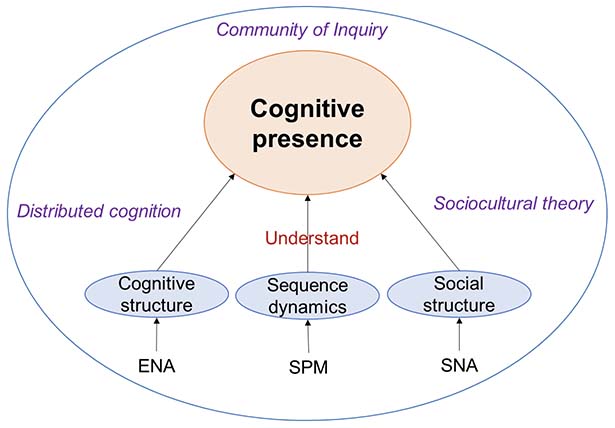
Cognitive presence encompasses inquiry-related discourse (e.g., triggering events, exploration, integration, resolution), is increasingly shaped by the temporal sequencing of inquiry processes (sequence dynamics), and is influenced by social affordances such as interaction patterns, frequency, and participant roles (Chen et al., 2025). Our study adopted a framework that linked theoretical perspectives to analytic lenses (see Figure 1) by integrating CoI, sociocultural theory, and distributed cognition. In our framework, cognitive presence was understood as sustained inquiry, learning was viewed as social and culturally situated, and knowledge was seen as embedded in interactions and social relations. Specifically, ENA captures the structure of cognitive elements and idea integration, SPM represents the temporal sequencing of inquiry moves, and SNA depicts the social structure and pathways of scaffolding and information flow. These lenses enable multilevel mapping from interactions, as shown in micro-level transcripts, through processes in meso-level sequences and networks, to outcomes reflected in group performance and sustained cognitive presence.
Figure 1
Integrative Theoretical and Analytic Framework Used in This Study
Note. ENA = epistemic network analysis; SPM = sequential pattern mining; SNA = social network analysis
This study employed a case study of a higher-education course to examine how 37 third-year Educational Technology majors, grouped by academic performance, engaged cognitively and socially in online collaborative knowledge-building using a multi-method approach combining ENA, SPM, and SNA. To examine whether observed patterns differed statistically between HPGs and LPGs, we conducted multivariate analyses of variance (MANOVAs), complementing our study’s qualitative, exploratory design with quantitative analyses that provided statistical support for observed differences.
The participants were enrolled in the course Academic Reading and Writing. Students were assigned to eight groups (four to six members each), with each group working in its own dedicated WeChat group chat. The instructor posted one open-ended discussion prompt every 2 weeks to all groups simultaneously to stimulate inquiry, argumentation, and collaborative meaning-making. Students responded asynchronously within their group chat, contributing ideas, asking questions, and engaging in collaborative reasoning throughout the week. The five prompts were: (a) How can information literacy be improved? (b) Why is a literature review important in academic research? (c) What techniques are effective for reading English-language scholarly articles? (d) Does critical thinking necessarily imply rejecting or dismissing others’ ideas? (e) Is it necessary to include every article in a literature review? Chat transcripts that captured all learner contributions, reflecting both cognitive and social dimensions of participation in a naturally occurring, text-based collaborative environment, were collected.
At the end of the semester, groups submitted a joint assignment that required them to analyze and critique a scholarly article and present their insights to the class. Course grades, based on the quality of this assignment, were used to categorize the top four performing groups as HPGs and the bottom four as LPGs for comparative analysis.
To systematically examine cognitive presence in online group discussions, a qualitative content analysis was conducted using a structured coding scheme adapted from the CoI framework and prior research (e.g., Ba et al., 2023; Zhang et al., 2022). The scheme encompassed five primary cognitive themes: triggering event, exploration, integration, resolution, and encouragement, and comprised 17 specific behavior codes (see Table 1).
A total of 521 comments were coded by two trained coders with backgrounds in educational technology and experience in discourse analysis, following a three-step approach. First, the two coders participated in a joint training session where they thoroughly reviewed the coding scheme and conducted a pilot coding round on a randomly selected 10% of the dataset; subsequently, the coders independently applied the codes and discussed discrepancies to align their interpretations and refine category boundaries as needed. After achieving initial consensus, the coders independently coded the full dataset, considering both linguistic content and contextual cues. To assess the consistency of coding between the two coders, Cohen’s kappa coefficient was computed, which was 0.94, indicating a high level of agreement and suggesting that the coding scheme was reliably applied. Discrepancies were resolved through discussion and consensus, and the coded data were used for data analysis.
According to the frequency distribution presented in Table 1, the analysis shows a clear emphasis on exploration (33%) and integration (39%), with resolution also well-represented (26%), whereas triggering (3.64%) behaviors were comparatively rare. This reflects that the students actively shared and built ideas in online collaborative learning, although more support may be needed to foster deeper inquiry and thinking.
Table 1
Coding Scheme for Discourse Analysis to Understand Cognitive Presence in Online Group Discussions
| Cognitive theme | Behavior codes | Code | Description | Example | Frequency, n (%) |
| Triggering | Clarification | CL | Clarify | “Clarifying, we are discussing literature searches.” | 14 (2.69) |
| Restating | RE | Restate | “Let me repeat that point.” | 5 (0.95) | |
| Exploration | Agreement | AWS | Agreement without substantiation | “I think so.” | 46 (8.83) |
| Information sharing | IS | Stating a fact, policy, or rule; citing a source | “Here is some news from the Internet for reference.” | 60 (11.52) | |
| Divergence | DIS | Disagreement | “I don’t agree.” | 1 (0.19) | |
| Personal narration | PN | Story, relating an incident, describing practices at their job | “I usually translate passages whole.” | 6 (1.15) | |
| Opinion | OP | Belief, judgment, personal view, or attitude based on grounds insufficient to conclude factual | “I think we should pay closer attention to information and its associations.” | 56 (10.75) | |
| Integration | Building on | BO | Augmenting a point made by self or by another earlier | “To build on these foundations, strengthen practice, explore new skills, and stay current with emerging technologies.” | 84 (16.12) |
| Creating solutions | CS | Novel conclusion | “So, reading the literature turns ignorance into insight, revealing solutions otherwise overlooked.” | 29 (5.57) | |
| Justified hypothesis | JH | A tentative assumption made to draw out and test its logical consequence to prove or show to be reasonable; coming to a conclusion predicted by ongoing discussion but supported with relevant reasons | “If we neglect the paper, conclusions risk vagueness; careful attention should yield clarity and coherence.” | 32 (6.14) | |
| Supported divergence | SD | Disagreement with the reason stated | “I disagree, since some papers contain information unrelated to our project.” | 7 (1.34) | |
| Supported agreement | SA | Agreement with reason stated | “Yes, a process is needed, involving keyword searches and filtering results.” | 9 (1.73) | |
| Wrap-up | WU | Concluding; summarizing | “So there are three things: get the information, understand the information, and apply it.” | 39 (7.49) | |
| Resolution | Thought experiment | TE | Questioning “What if?” or “What do you think about?” | “What if we search papers in different databases?” | 45 (8.64) |
| Apply, test, and defend | ATD | Any of the three, but not retrospective narrative; must be an application of new thought initiated by the discussion present | “To keep pace with society, we should track social trends and emerging computer technologies to strengthen our information literacy.” | 51 (9.79) | |
| Encouragement | Encouraging answer | EA | Encouraging answer | “What do you think?” | 37 (7.10) |
Data analysis proceeded in three stages, each aligned with a specific research question, employing a multi-method approach that integrated qualitative coding with quantitative modeling and statistical testing to provide detailed process insights alongside comparative group-level validation.
To examine structural patterns of cognitive presence (RQ1), ENA was employed to model the co-occurrence of coded cognitive presence elements within student discussions. ENA constructs networks in which nodes represent specific cognitive elements (e.g., triggering event, exploration, integration, resolution) and edges represent their co-occurrence within the same discourse segment, such that frequently co-occurring elements form stronger connections, visually depicting group thinking structures. To assess whether these structural patterns differed between HPGs and LPGs, a MANOVA was adopted to test differences in the frequency of the five main cognitive presence themes.
Second, SPM was employed to identify recurring sequences of cognitive presence moves (RQ2), capturing the evolution of inquiry processes in online discussions. Learners’ activities were analyzed as ordered behavior sequences (e.g., posting a question → providing explanation → making a connection) to highlight patterns occurring more frequently than expected by chance. In the resulting behavioral transition diagram, nodes represent specific behaviors, with size proportional to frequency, while directed arrows indicate significant transitions and line thickness reflects the magnitude of adjusted residuals (Z-scores), allowing typical discourse trajectories and critical inquiry transitions to be observed for each group.
In addition, SNA was used to examine interactional structures and individual centrality within groups (RQ3). In the resulting network diagrams, nodes represent members, lines indicate interactions with thickness proportional to communication frequency, and arrows show the direction of information flow. Centrality indices quantified each member’s role and influence, and group-level differences were tested via MANOVA to determine whether HPGs and LPGs differed in social structure.
This multi-method study captures the structural, temporal, and social dimensions of cognitive presence in online collaborative learning, using MANOVA to confirm whether observed structural and social differences are statistically significant, and provides a comprehensive view of its manifestation and evolution.
According to Table 2, which summarizes the frequency of cognitive presence themes, the average frequency of all cognitive presence themes is consistently higher in the HPGs compared to the LPGs. For example, regarding exploration, HPGs averaged 60.5 instances, more than double the LPG average of 24.5. Considering integration, HPGs (79.5) demonstrated significantly more behaviors related to synthesizing and building upon ideas than LPGs (41.25), highlighting a more advanced level of meaning-making. In terms of resolution, HPGs showed stronger evidence of applying and testing knowledge, averaging 99 instances versus 33 in LPGs. In addition, regarding triggering, it was absent in LPGs (0), whereas HPGs engaged in some level of initiating inquiry (4.5), reflecting a stronger ability or tendency to pose problems or raise questions during discussion.
Table 2
Mean Frequency of the Five Cognitive Themes
| Theme | Group | |
| High performing | Low performing | |
| Triggering | 4.5 | 0 |
| Exploration | 60.5 | 24.5 |
| Integration | 79.5 | 41.25 |
| Resolution | 99 | 33 |
| Encouragement | 27.5 | 22.5 |
A MANOVA analysis was further applied to see if the frequency of the five main themes differed for HPGs and LPGs, with results detailed in Table 3. The Box’s M test [χ2 (15, n = 36) = Inf, p < 2.2e-16] and Pillai’s Trace test revealed a significant MANOVA effect [Pillai’s Trace = 0.59473, F(1, 36) = 8.8049, p = 3.145e-05] and suggest statistically significant differences between HPGs and LPGs. The univariate tests showed significant differences between groups, as shown in Table 3.
Table 3
Results of the Multivariate Analysis of Variance (MANOVA) on the Frequency of Cognitive Themes Between HPGs and LPGs
| Cognitive themes | Group | Univariate test | |||||
| High-performing | Low-performing | ||||||
| M | SD | M | SD | F | η2 | Sig. | |
| Triggering | 1 | 0.268 | 0 | 0 | 6.70* | .165 | 0.014 |
| Exploration | 6.72 | 0.939 | 2.72 | 0.463 | 13.9*** | .29 | 0.000 |
| Integration | 5.89 | 1.02 | 3.06 | 0.392 | 14.6*** | .3 | 0.000 |
| Resolution | 5.5 | 0.772 | 1.83 | 0.232 | 20.7*** | .378 | 0.000 |
| Encouragement | 1.22 | 0.348 | 1 | 0.302 | 0.232 | .007 | 0.633 |
Note. ***: p < 0.001; **: p < 0.01; *: p < 0.05.
Table 4 provides a more granular analysis of cognitive behaviors within each group and compares the average percentage of these behaviors between HPGs and LPGs. The percentages were calculated by dividing the mean frequency of each category by the total mean frequency for the respective group (HPGs or LPGs), then multiplying by 100. For example, in the HPGs, the frequency of clarification was 3.5, and the total frequency was 91.5. The percentage is therefore calculated as: 3.5/91.5 x 100 = 3.83%. Results in Table 4 show that agreement without substantiation occurred more in HPGs than in LPGs, indicating a greater tendency among HPGs to reach consensus, even if not fully reasoned. Also, thought experiment behaviors were significantly more frequent in HPGs than in LPGs, suggesting a more active engagement in speculative reasoning and hypothetical thinking in HPGs. Regarding resource sharing and elaboration, LPGs exhibited higher proportions of behaviors of information sharing, opinion, and building on than HPGs, suggesting that while LPGs were highly engaged in idea sharing and elaboration, they might have lacked deeper synthesis and critical evaluation compared to HPGs.
Table 4
Mean Frequency of Behavioral Codes Between HPGs and LPGs
| Behavioral Codes | Abbreviations | Group | |||
| High performing | Low performing | ||||
| n | % | n | % | ||
| Clarification | CL | 3.5 | 3.83 | 0 | 0 |
| Restating | RE | 1 | 1.09 | 0.25 | 0.65 |
| Agreement | AWS | 9.25 | 10.11 | 2.25 | 5.81 |
| Information sharing | IS | 10 | 10.93 | 5 | 12.90 |
| Divergence | DIS | 0 | 0.00 | 0.25 | 0.65 |
| Leap to conclusion | LTC | 0 | 0.00 | 0 | 0.00 |
| Personal narration | PN | 1.5 | 1.64 | 0 | 0.00 |
| Opinion | OP | 9.5 | 10.38 | 4.5 | 11.61 |
| Building on | BO | 13.5 | 14.75 | 7.5 | 19.35 |
| Creating solution | CS | 5 | 5.46 | 2.25 | 5.81 |
| Justified hypothesis | JH | 4.75 | 5.19 | 3.25 | 8.39 |
| Supported divergence | SD | 1.5 | 1.64 | 0.25 | 0.65 |
| Supported agreement | SA | 1.75 | 1.91 | 0.5 | 1.29 |
| Wrap-up | WU | 5.5 | 6.01 | 4.25 | 10.97 |
| Thought experiment | TE | 10.5 | 11.48 | 0.75 | 1.94 |
| Apply, test, and defend | ATD | 8.75 | 9.56 | 4 | 10.32 |
| Encouraging answer | EA | 5.5 | 6.01 | 3.75 | 9.68 |
| Total | 91.5 | 100 | 38.75 | 100 | |
The contrasting cognitive network structures presented in Figure 2 reveal that HPGs were characterized by cognitively rich, conceptually integrated discussions, while LPGs tended to rely more heavily on surface-level behaviors and motivational prompts to maintain dialogue. For example, for the HPGs, the centrality of building on (BO) among their cognitive behaviors suggests that members frequently engaged in elaborating and expanding upon others’ ideas, indicating deeper cognitive processing and collaborative meaning-making. The strongest co-occurrence connections reflected by the darkest lines in the network were observed between BO and opinion (OP), BO and wrap-up (WU), thought experiment (TE) and BO, and apply, test, and defend (ATD) and BO, demonstrating that group members not only extended discussions but also effectively integrated personal opinions, summarized conclusions, engaged in hypothetical reasoning, and applied conceptual knowledge. Additionally, justified hypothesis (JH), TE, and ATD exhibited high connectivity with others, suggesting that introducing conceptual challenges or application-based scenarios facilitated the emergence of higher-order thinking and sustained the cognitive engagement of the group (see Morueta et al., 2016).
In contrast, the cognitive network of the LPGs shows a markedly less complex structure, with a lower density of connections between behavioral codes. For example, the strongest behavioral associations between OP and BO, BO and WU, and BO and encouraging answer (EA) indicate a tendency among LPG members to move from expressing opinions to building on them and summarizing, often with peer encouragement as a mediating factor. Furthermore, the relatively darker lines connecting EA to BO, OP, and WU imply that encouragement behaviors were instrumental in sustaining interaction and prompting further contributions, albeit possibly at the expense of more advanced integrative or exploratory behaviors (see Zou et al., 2021).
Figure 2
Cognitive Network Structures of HPGs and LPGs
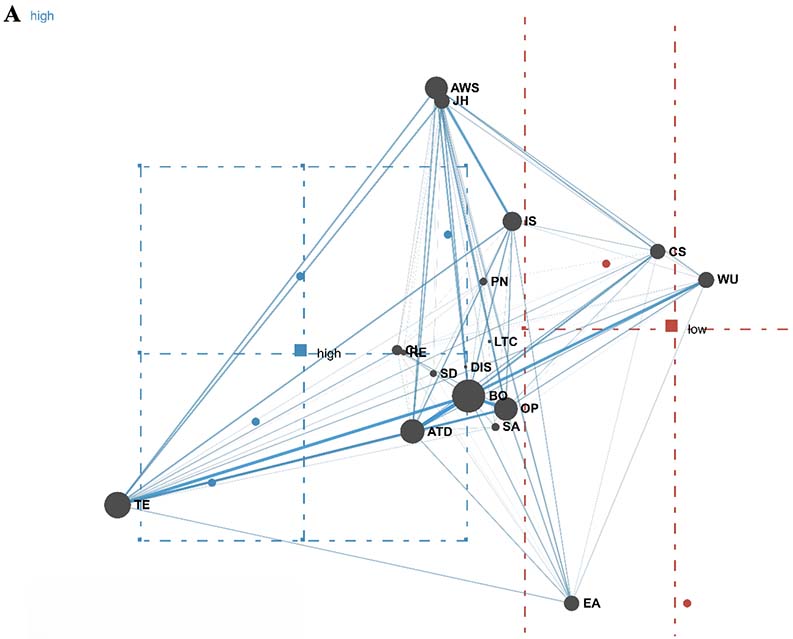
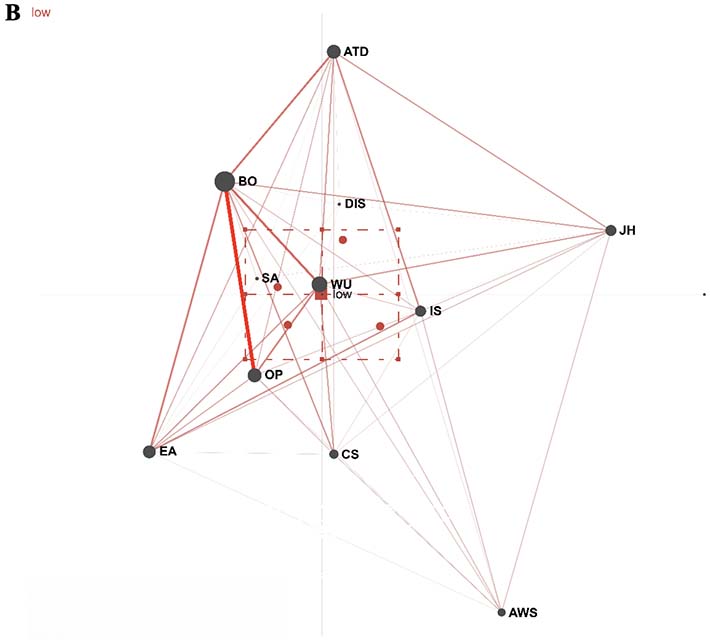
Note. HPG = high-performing group; LPG = low-performing group. Panel A: Interactions between behavior codes in HPGs. Panel B: Interactions between behavior codes in LPGs. ATD = apply, test, and defend; AWS = agreement; BO = building on; CL = clarification; CS = creating solutions; DIS = divergence; EA = encouraging answer; IS = information sharing; JH = justified hypothesis; LTC = leap to conclusion; OP = opinion; PN = personal narration; RE = restating; SA = supported agreement; SD = supported divergence; TE = thought experiment; WU = wrap-up. Blue dots and lines represent the interactions within the HPG, while red dots and lines represent the interactions within the LPGs. The thicker lines indicate stronger interactions between behavior codes.
According to Figure 3, which presents the superimposed subtraction plots of the cognitive networks for HPGs and LPGs, HPGs demonstrated a more integrated and exploratory cognitive discourse structure compared to the more interactionally supportive yet cognitively superficial patterns observed in LPGs. For example, for HPGs, TE, which emerges as a central anchor, exhibited strong connections with ATD, OP, BO, agreement (AWS), and JH. Conversely, for the LPGs, the most prominent behavioral pairings of OP-BO, JH-WU, and BO-EA suggest that members tended to focus more on basic opinion expression and summarization, with encouragement behaviors playing a notable role in sustaining participation rather than fostering conceptual elaboration or cognitive engagement (Chen et al., 2022).
Figure 3
Superimposed Subtraction Plots of the Cognitive Networks for HPGs and LPGs
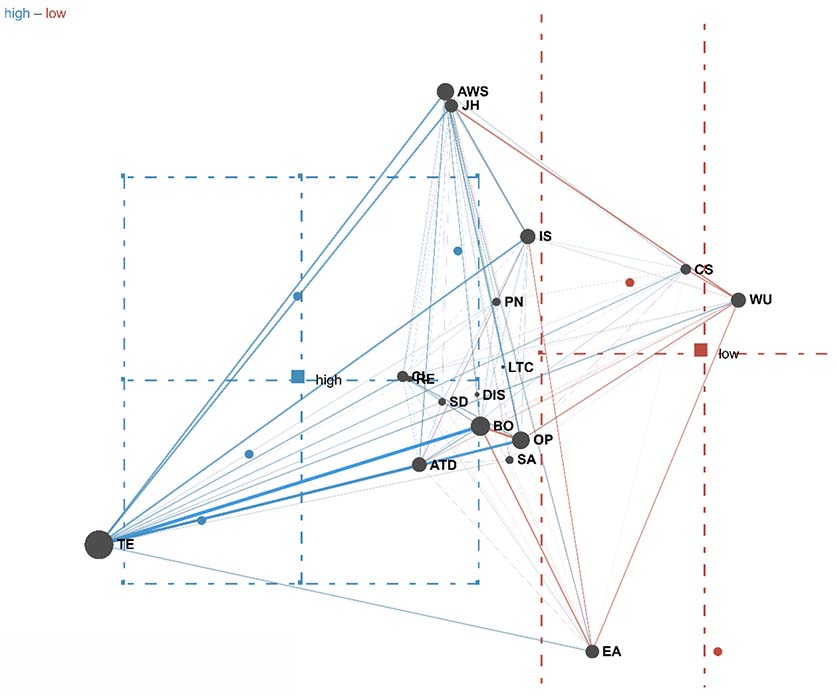
Note. HPG = high-performing group; LPG = low-performing group. ATD = apply, test, and defend; AWS = agreement; BO = building on; CL = clarification; CS = creating solutions; DIS = divergence; EA = encouraging answer; IS = information sharing; JH = justified hypothesis; LTC = leap to conclusion; OP = opinion; PN = personal narration; RE = restating; SA = supported agreement; SD = supported divergence; TE = thought experiment; WU = wrap-up. The figure represents the interactions between different behavior codes across HPGs and LPGs. The blue dots and blue dashed squares represent the HPGs, while the red dots and red dashed squares represent the LPGs. The grid lines in the figure correspond to the boundaries of the groups, separating high and low levels of interaction within the behavior codes. The thicker lines indicate stronger interactions between the behavior codes. The top red line is cut off due to the limits of the figure's display, but this is not an intentional aspect of the data representation.
According to Figure 4, which captures the interactions among the five core cognitive themes (i.e., triggering, exploration, integration, resolution, and encouragement), the HPG network demonstrated more balanced and diverse connections compared to the relatively limited and linear structure observed in the LPG. The LPG network lacks triggering, suggesting that LPGs may have entered directly into exploration without adequate cognitive preparation or question posing, potentially limiting the depth of subsequent discourse (Ba et al., 2023). In both networks, the strongest inter-theme connections are observed between exploration and integration, indicating that participants frequently transitioned from exploring ideas to building on and synthesizing them; the strong connections between integration and resolution and between exploration and resolution also suggest that ideas were carried forward into deeper reasoning and attempts at conclusion or application.
Figure 4
Comparison of Cognitive Theme Interaction Networks Between HPGs and LPGs
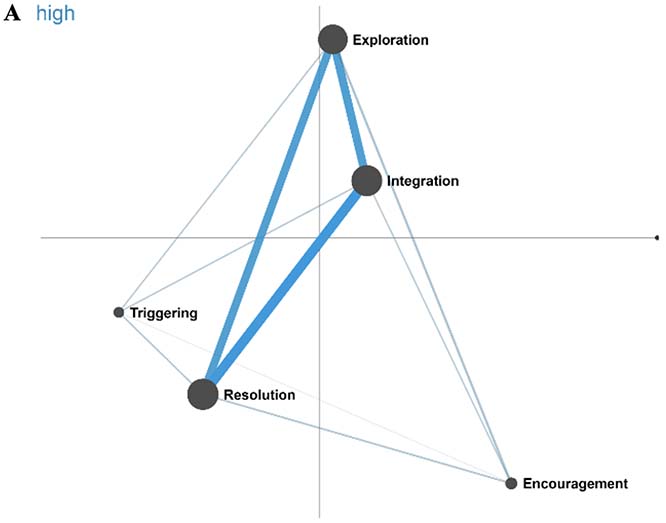
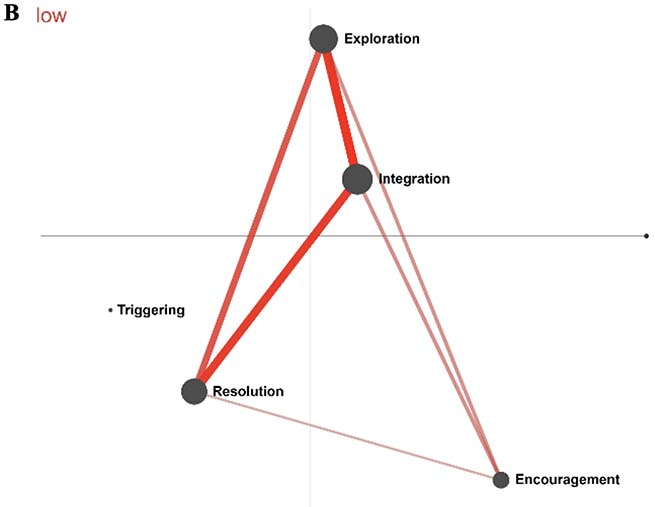
Note. HPG = high-performing group; LPG = low-performing group. Panel A: Interactions between cognitive themes in HPGs. Panel B: Interactions between cognitive themes in LPGs. Blue dots and lines represent the interactions within the HPG, while red dots and lines represent the interactions within the LPGs. The thicker lines indicate stronger interactions between cognitive themes. The grey axes in the background represent the structural framework of the ENA model, used for visualizing the relative positioning and interaction intensity between cognitive themes. These axes do not display actual data points but provide a reference for interpreting the connections and relationships in the network.
Figure 5 shows differential interaction patterns between HPGs and LPGs across the five principal cognitive themes. The stronger connection between integration and encouragement suggests that LPGs may rely more heavily on encouraging discourse when integrating ideas, possibly as a compensatory mechanism to sustain collaborative engagement. In contrast, several connections involving resolution and triggering appear more intense in the HPGs, reflecting a stronger engagement in initiating problem-based thinking and driving discussions toward meaningful conclusions. HPGs thus appear to engage more robustly in the initiation and resolution phases of discourse, whereas LPGs emphasize emotional or motivational support during integration, potentially at the expense of deeper knowledge construction processes.
Figure 5
Combined Cognitive Network for HPGs and LPGs Regarding Main Themes
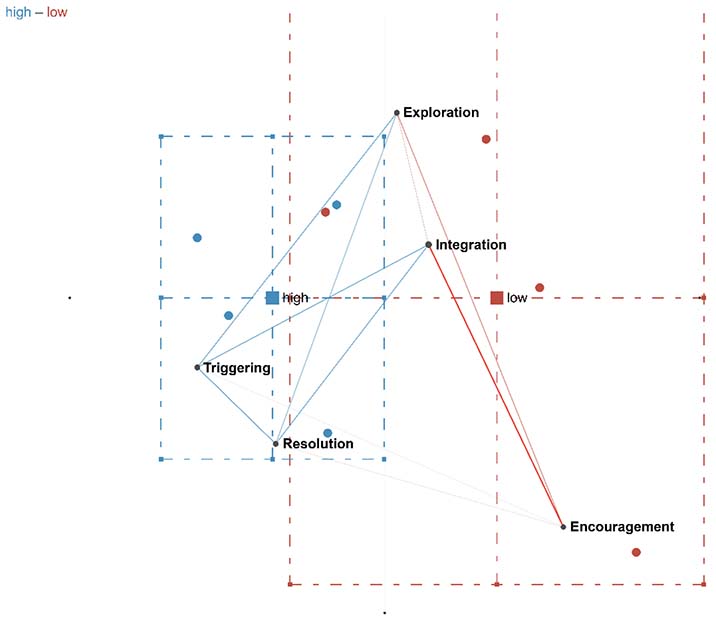
Note. HPG = high-performing group; LPG = low-performing group. The figure represents the interactions between different cognitive themes across HPGs and LPGs. The blue dots and blue dashed squares represent the HPGs, while the red dots and red dashed squares represent the LPGs. The grid lines in the figure correspond to the boundaries of the groups, separating high and low levels of interaction within the cognitive themes. The thicker lines indicate stronger interactions between the cognitive themes. The top red line is cut off due to the limits of the figure's display, but this is not an intentional aspect of the data representation.
Figure 6 presents the overall behavioral transition diagram. The self-cyclic transition of information sharing (IS; IS → IS, Z = 6.66) indicates sustained knowledge exchange among members, which likely involves understanding, integrating, and evaluating peers’ contributions—processes that reflect higher-order thinking as emphasized in prior research on online discussion forums (Wu & Wu, 2021). Second, the significant transition from TE to supported divergence (SD; TE → SD, Z = 6.75) suggests that hypothetical questioning often prompted participants to express disagreements with reasoned justification, supporting deeper conceptual elaboration and group understanding (Cherbow & McNeill, 2022). Third, the behavioral shift from personal narration (PN) to supported agreement (SA; PN → SA, Z = 5.93) indicates personal anecdotes’ contributions to collective understanding and group cohesion through reasoned affirmation. Additionally, the movement from OP to BO (OP → BO, Z = 5.50) highlights that personal viewpoint expressions facilitated elaboration by peers to enhance both interactive richness and cognitive depth.
Figure 6
Overall Transition Diagram Showing Changes in Behavior Codes Across All Groups
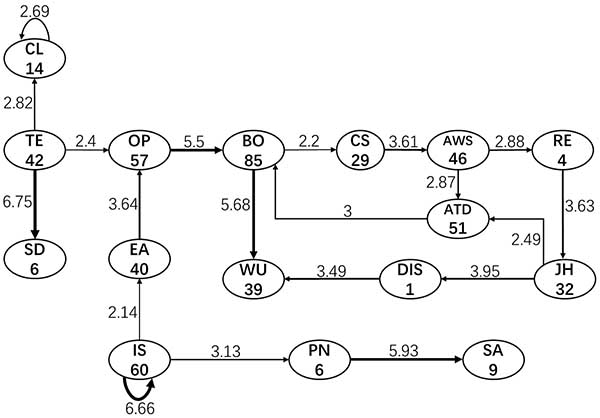
Note. Each node represents a behavior and directed arrows denote significant behavioral transitions, with line thickness reflecting the magnitude of the adjusted residual value (Z-score). ATD = apply, test, and defend; AWS = agreement; BO = building on; CL = clarification; CS = creating solutions; DIS = divergence; EA = encouraging answer; IS = information sharing; JH = justified hypothesis; LTC = leap to conclusion; OP = opinion; PN = personal narration; RE = restating; SA = supported agreement; SD = supported divergence; TE = thought experiment; WU = wrap-up.
Figures 7 and 8, which respectively visualize group-specific behavioral sequences for HPGs (18 significant transitions) and LPGs (9 significant transitions), highlight that HPGs engage in more dialogically rich and cognitively integrated discourse patterns, while LPGs show limited behavioral diversity and elaboration, often relying on more superficial conversational strategies. For example, for HPGs, BO emerges as a central node with high connectivity with restating (RE; Z = 1.98) and WU (Z = 4.77), indicating its pivotal role in facilitating extended discourse, with reflective and elaborative behaviors frequently culminating in summarization. In contrast, LPGs, with an absence of a dominant behavior and unidirectional transitions, suggest fewer reciprocal interactions and more linear and less dynamic discourse patterns.
Furthermore, a cognitively rich path (i.e., IS → PN → SA) in HPGs illustrates the progression from factual exchange to personal contextualization, ultimately reaching consensus; the TE-centered transitions (e.g., TE → OP → BO → WU and TE → SD) also indicate a robust engagement in challenge-response sequences that foster deeper reasoning. In LPGs, while sequences such as creating solutions (CS) → AWS → JH → divergence (DIS) → WU are structurally coherent, they often terminate without extensive elaboration or justification, suggesting a tendency to conclude discussions quickly at the expense of conceptual depth and collaborative refinement. Comparatively, HPGs, with a sequence of CS → AWS → restating (RE)/ATD → BO → WU, indicate continued cognitive development and discussion iteration post-conclusion.
Figure 7
Transition Diagram Showing Changes in Behavior Codes Across HPGs
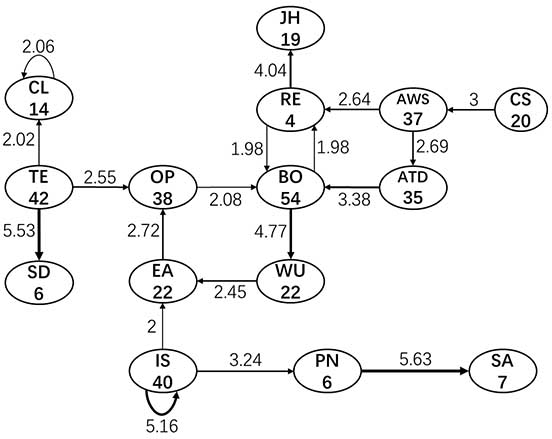
Note. HPG = high-performing group. Each node represents a behavior and directed arrows denote significant behavioral transitions, with line thickness reflecting the magnitude of the adjusted residual value (Z-score). ATD = apply, test, and defend; AWS = agreement; BO = building on; CL = clarification; CS = creating solutions; DIS = divergence; EA = encouraging answer; IS = information sharing; JH = justified hypothesis; LTC = leap to conclusion; OP = opinion; PN = personal narration; RE = restating; SA = supported agreement; SD = supported divergence; TE = thought experiment; WU = wrap-up.
Figure 8
Transition Diagram for LPGs Showing Changes in Behavior Codes Across LPGs
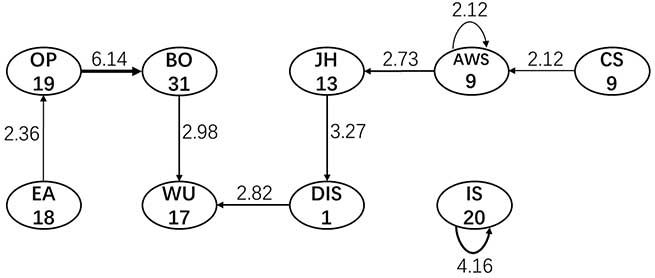
Note. LPG = low-performing group. Each node represents a behavior and directed arrows denote significant behavioral transitions, with line thickness reflecting the magnitude of the adjusted residual value (Z-score). ATD = apply, test, and defend; AWS = agreement; BO = building on; CL = clarification; CS = creating solutions; DIS = divergence; EA = encouraging answer; IS = information sharing; JH = justified hypothesis; LTC = leap to conclusion; OP = opinion; PN = personal narration; RE = restating; SA = supported agreement; SD = supported divergence; TE = thought experiment; WU = wrap-up.
In figures 9 and 10, which present the interactional structures of the eight groups. While all four HPGs (G2, G4, G7, and G8) demonstrated a fully connected network with each member engaging with all others at least once (network density of 1.0), interaction patterns varied across groups. For example, G2 and G7, where one member (e.g., HYW in group 2) occupies a central position in the network, exhibit pronounced single-centrality structures, indicating a centralized communication flow where coordination was largely driven by one individual. G8, where two or three members were actively engaged in frequent communication, while others remained on the periphery, displays a polycentric structure, suggesting that leadership and participation were more distributed but still unequal. In contrast, G4 shows a more evenly distributed interaction pattern, with relatively uniform communication frequencies among members, suggesting a more collaborative group dynamic. Despite these differences, HPGs are marked by frequent and multidirectional exchanges, reflecting a high degree of interaction intensity and shared cognitive engagement.
For the LPGs, groups 1 and 3 lacked a clear central figure and showed weak connections among members, indicating poor coordination and limited leadership, which may have hindered group effectiveness, confirming the findings of Chen et al. (2022). In contrast, groups 5 and 6 had a central leader, but most other members contributed minimally, reflecting highly uneven participation that likely constrained opportunities for shared knowledge-building (see Liu et al., 2023).
Figure 9
Interactional Structures for HPGs
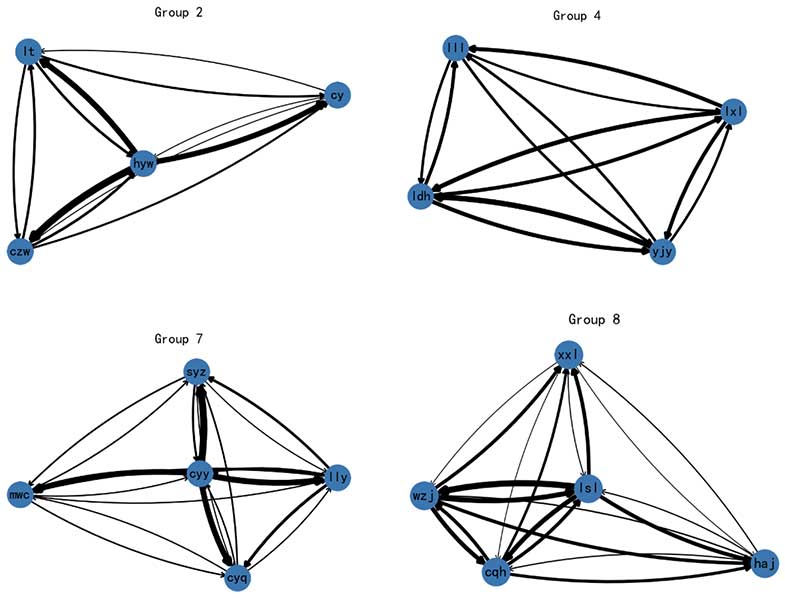
Note. HPG = high-performing group. The initials on the nodes represent the first letters of each student’s name. The thickness of the lines indicates the frequency of interactions between two students, and the arrows show the direction of communication (who is speaking to whom).
Figure 10
Interactional Structures for LPGs
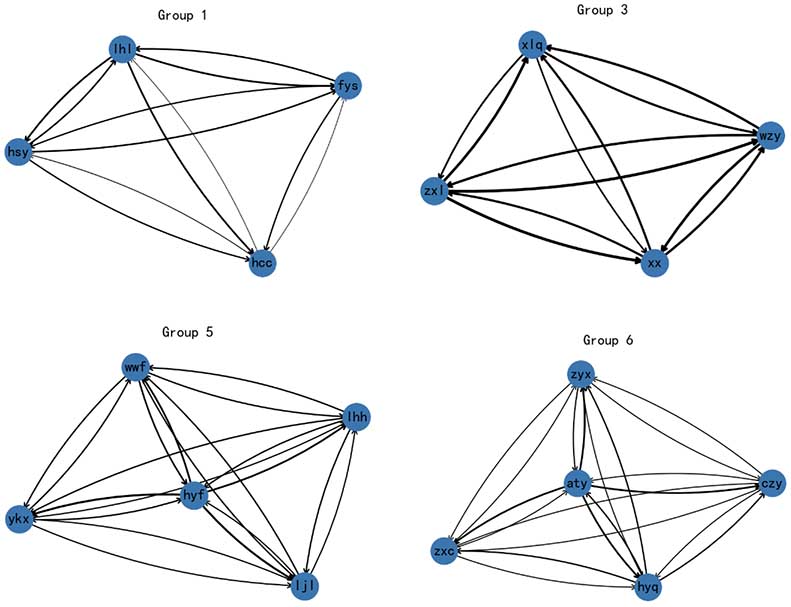
Note. LPG = low-performing group. The initials on the nodes represent the first letters of each student’s name. The thickness of the lines indicates the frequency of interactions between two students, and the arrows show the direction of communication (who is speaking to whom).
A MANOVA was conducted to examine differences in centrality indices between HPGs and LPGs (see Table 5). The Box’s M test [χ2(10, n = 36) = Inf, p < 2.2e-16] and Pillai’s Trace indicated a significant overall effect [Pillai’s Trace = 0.582, F(1, 36) = 8.80, p < .001]. Univariate analyses showed that HPGs scored higher than LPGs on degree centrality [F(1, 36) = 21.4, p < .001] and betweenness centrality [F(1, 36) = 5.12, p < .05], indicating that HPG members were more actively connected and that some played key bridging roles in linking different parts of the network. These results suggest that successful groups not only had more evenly distributed participation but also stronger coordination roles, facilitating the flow of information across the group (see Liu et al., 2022).
Table 5
Results of Multivariate Analysis of Variance (MANOVA) Examining Differences in Centrality Indices Between HPGs and LPGs
| Category of centrality | High-performing | Low-performing | Univariate Test | ||||
| M | SD | M | SD | F | η2 | Sig. | |
| Degree | 20.3 | 3.54 | 11.6 | 1.49 | 21.4*** | .387 | 0.0000517 |
| Betweenness | 0.03 | 0.026 | 0 | 0 | 5.12* | .131 | 0.03 |
| Closeness | 0.055 | 0.004 | 0.105 | 0.01 | 1.36 | .039 | 0.251 |
| Eigenvector | 0.466 | 0.017 | 0.457 | 0.013 | 0.205 | .006 | 0.654 |
Note. ***: p < 0.001; **: p < 0.01; *: p < 0.05.
By employing a multi-analytical approach, this study provides a comprehensive, multi-dimensional understanding of cognitive presence in online collaborative knowledge-building, showing not only what learning processes occurred (e.g., discourse structures and cognitive behaviors) but also how sequential, behavioral, and social dynamics shaped effective collaboration.
A key finding of this study is that HPGs and LPGs differ fundamentally in demonstrating cognitive presence, or the extent to which learners construct and confirm meaning through dialogue. HPGs frequently initiated inquiry through questions (triggering), integrated and built upon peers’ contributions (exploration and integration), and synthesized discussions into coherent solutions (resolution). In contrast, LPGs rarely initiated questions, remained at surface-level exploration, and seldom reached resolution. These patterns suggest that educators should design prompts, roles, or scaffolds to encourage all groups to generate questions, connect ideas, and apply discussions to problem-solving tasks (Liu et al., 2022; Wise & Hsiao, 2019).
From both behavioral and thematic perspectives, HPGs engaged in more conceptually rich and integrative dialogue, with dense and connected behaviors such as building on, thought experiment, and opinion reflecting movement through all phases of cognitive presence. LPGs, by contrast, relied on motivational prompts to sustain dialogue, with limited engagement in inquiry. Teachers can support LPGs by providing structured starter questions, rotating discussion leaders, or scaffolding to encourage elaboration and justification (Yang et al., 2018).
SPM analyses revealed that HPGs followed recursive discussion loops (e.g., TE → OP → BO → WU), reflecting iterative refinement of ideas (Hong & Choi, 2019), whereas LPGs displayed linear and fragmented patterns. This underscores the importance of requiring reflection checkpoints, peer feedback, or summary–revision cycles to encourage revisiting and refining ideas (Chen et al., 2022).
SNA results showed that HPGs exhibited multidirectional communication and, in some cases, distributed leadership, supporting sustained idea elaboration and synthesis. LPGs displayed fragmented communication and lacked facilitators, making them prone to topic drift, limited focus, and premature closure. The MANOVA confirmed that central actors in HPGs maintained cognitive presence by guiding and integrating discourse (Onrubia et al., 2022). Educators can address this by assigning peer facilitators or strategically stepping in as “more knowledgeable others” (Vygotsky, 1978) to keep discussions focused and collaborative.
In sum, HPGs succeeded by initiating questions, building on each other’s ideas, synthesizing discussions, and actively sharing responsibility, while LPGs often stopped at opinion-sharing, lacked clear leadership, and failed to connect ideas meaningfully. Instructional strategies that encourage inquiry, support integration of ideas, and assign balanced roles can help all groups achieve deeper cognitive engagement.
Based on the findings, this study has five implications for teachers and instructional designers.
First, foster cognitive presence by using open-ended prompts that require students to identify problems or pose questions.
Second, encourage integration and resolution by providing guiding questions that move students from information sharing to connecting and applying ideas.
Third, normalize idea revision by structuring activities that prompt students to revisit, critique, and refine contributions.
Fourth, support participation by assigning rotating group roles (e.g., leader, challenger, summarizer) to prevent marginalization and promote shared responsibility.
Fifth, leverage learning analytics (ENA, SPM, SNA) to detect groups engaged in surface-level discourse and provide timely interventions.
There are four implications for students.
First, engage beyond opinion-sharing by actively building on others’ ideas, asking clarifying questions, and co-constructing meaning.
Second, rotate roles to take responsibility for different group functions and develop collaborative and metacognitive skills.
Third, reflect regularly through logs or peer feedback to monitor cognitive progress and refine strategies.
Fourth, value iterative learning by recognizing that disagreement, revision, and rethinking are essential for deep knowledge-building.
Overall, applying these guidelines will enable teachers to design collaborative learning environments that foster higher-order cognitive processes, ensure balanced participation, and support inclusion, while students actively take responsibility for co-constructing knowledge. In addition, integrating ENA, SPM, and SNA would provide practical tools for instructors to identify at-risk learners and implement timely scaffolds to enhance both individual and group outcomes.
This study examined cognitive presence in collaborative knowledge-building using a multi-analytical approach to capture structural, sequential, and social dynamics. HPGs exhibited richer, more interconnected discourse, recursive behavioral patterns, and denser, well-coordinated social networks, whereas LPGs showed surface-level engagement, linear or fragmented sequences, and weaker interaction structures. These findings indicate that strong cognitive presence emerges when learners not only share information but also ask questions, build on ideas, and sustain dialogue through coordinated participation. Practically, teachers should design prompts that trigger inquiry, scaffold the integration and resolution of ideas, and assign rotating roles to ensure equitable participation, while learning analytics can help identify groups at risk of remaining at surface-level discourse and enable timely interventions.
Limitations of this study include a small sample and reliance on coded discussion data, which may not capture affective or motivational aspects of learning. Future research should explore larger and more diverse contexts and integrate multimodal or machine learning methods to capture the full complexity of collaborative learning. In sum, fostering cognitive presence requires both cognitive scaffolds and social supports to help all students, not just high performers, engage in deeper, more meaningful knowledge-building.
This work was supported by the National Natural Science Foundation of China (No. 62307010) and the Philosophy and Social Science Planning Project of Guangdong Province of China (No. GD24XJY17).
Ba, S., Hu, X., Stein, D., & Liu, Q. (2023). Assessing cognitive presence in online inquiry‐based discussion through text classification and epistemic network analysis. British Journal of Educational Technology, 54(1), 247-266. https://doi.org/10.1111/bjet.13285
Baanqud, N. S., Al-Samarraie, H., Alzahrani, A. I., & Alfarraj, O. (2020). Engagement in cloud-supported collaborative learning and student knowledge construction: A modeling study. International Journal of Educational Technology in Higher Education, 17, Article 56. https://doi.org/10.1186/s41239-020-00232-z
Bhutoria, A., & Aljabri, N. (2022). Patterns of cognitive returns to information and communication technology (ICT) use of 15-year-olds: Global evidence from a hierarchical linear modeling approach using PISA 2018. Computers & Education, 181, Article 104447. https://doi.org/10.1016/j.compedu.2022.104447
Chen, X., Xie, H., Qin, S. J., Wang, F. L., & Hou, Y. (2025). Artificial intelligence‐supported student engagement research: Text mining and systematic analysis. European Journal of Education, 60(1), Article e70008. https://doi.org/10.1111/ejed.70008
Chen, X., Zou, D., Cheng, G., & Xie, H. (2022). Understanding classroom interaction using epistemic and social network analysis. In R. C. Li, S. K. S. Cheung, P. H. F. Ng, L. P. Wong, & F. L. Wang (Eds.), Blended learning: Engaging students in the new normal era. ICBL 2022. Springer. https://doi.org/10.1007/978-3-031-08939-8_14
Cherbow, K., & McNeill, K. L. (2022). Planning for student-driven discussions: A revelatory case of curricular sensemaking for epistemic agency. Journal of the Learning Sciences, 31(3), 408-457. https://doi.org/10.1080/10508406.2021.2024433
Elmoazen, R., Saqr, M., Hirsto, L., & Tedre, M. (2024). Capturing temporal pathways of collaborative roles: A multilayered analytical approach using community of inquiry. International Journal of Computer-Supported Collaborative Learning, 20, 41-77. https://doi.org/10.1007/s11412-024-09431-6
Fougt, S. S., Siebert-Evenstone, A., Eagan, B., Tabatabai, S., & Misfeldt, M. (2018, March). Epistemic network analysis of students’ longer written assignments as formative/summative evaluation. In A. Pardo, K. Bartimote-Aufflick, & G. Lynch (Eds.), Proceedings of the 8th international conference on learning analytics and knowledge (pp. 126-130). ACM. https://doi.org/10.1145/3170358.3170414
Gao, Q., Zhang, S., Cai, Z., Liu, K., Hui, N., & Tong, M. (2022). Understanding student teachers’ collaborative problem solving competency: Insights from process data and multidimensional item response theory. Thinking Skills and Creativity, 45, Article 101097. https://doi.org/10.1016/j.tsc.2022.101097
He, Q., Borgonovi, F., & Paccagnella, M. (2021). Leveraging process data to assess adults’ problem-solving skills: Using sequence mining to identify behavioral patterns across digital tasks. Computers & Education, 166, Article 104170. https://doi.org/10.1016/j.compedu.2021.104170
Hong, Y.-C., & Choi, I. (2019). Relationship between student designers’ reflective thinking and their design performance in bioengineering project: Exploring reflection patterns between high and low performers. Educational Technology Research and Development, 67, 337-360. https://doi.org/10.1007/s11423-018-9618-6
Jiang, J.-P., Hu, J.-Y., Zhang, Y.-B., & Yin, X.-C. (2023). Fostering college students’ critical thinking skills through peer assessment in the knowledge building community. Interactive Learning Environments, 31(10), 6480-6496. https://doi.org/10.1080/10494820.2022.2039949
Liu, S., Kang, L., Liu, Z., Zhao, L., Yang, Z., & Su, Z. (2023). Exploring the relationships between students’ network characteristics, discussion topics and learning outcomes in a course discussion forum. Journal of Computing in Higher Education, 35(3), 487-520. https://doi.org/10.1007/s12528-022-09335-0
Liu, Z., Zhang, N., Peng, X., Liu, S., Yang, Z., Peng, J., Su, Z., & Chen, J. (2022). Exploring the relationship between social interaction, cognitive processing and learning achievements in a MOOC discussion forum. Journal of Educational Computing Research, 60(1), 132-169. https://doi.org/10.1177/07356331211027300
Maranna, S., Willison, J., Joksimovic, S., Parange, N., & Costabile, M. (2022). Factors that influence cognitive presence: A scoping review. Australasian Journal of Educational Technology, 38(4), 95-111. https://doi.org/10.14742/ajet.7878
Moon, J., McNeill, L., Edmonds, C. T., Banihashem, S. K., & Noroozi, O. (2024). Using learning analytics to explore peer learning patterns in asynchronous gamified environments. International Journal of Educational Technology in Higher Education, 21, 45. https://doi.org/10.1186/s41239-024-00476-z
Morueta, R. T., López, P. M., Gómez, Á. H., & Harris, V. W. (2016). Exploring social and cognitive presences in communities of inquiry to perform higher cognitive tasks. The Internet and Higher Education, 31, 122-131. https://doi.org/10.1016/j.iheduc.2016.07.004
Norz, L.-M., Dornauer, V., Hackl, W. O., & Ammenwerth, E. (2023). Measuring social presence in online-based learning: An exploratory path analysis using log data and social network analysis. The Internet and Higher Education, 56, Article 100894. https://doi.org/10.1016/j.iheduc.2022.100894
Onrubia, J., Roca, B., & Minguela, M. (2022). Assisting teacher collaborative discourse in professional development: An analysis of a facilitator's discourse strategies. Teaching and Teacher Education, 113, Article 103667. https://doi.org/10.1016/j.tate.2022.103667
Sharma, P., Akgun, M., & Li, Q. (2024). Understanding student interaction and cognitive engagement in online discussions using social network and discourse analyses. Educational Technology Research and Development, 72(5), 2631-2654. https://doi.org/10.1007/s11423-023-10261-w
Shea, P., Richardson, J., & Swan, K. (2022). Building bridges to advance the community of inquiry framework for online learning. Educational Psychologist, 57(3), 148-161. https://doi.org/10.1080/00461520.2022.2089989
Song, Y., Cheng, B., Zhu, J., & Hu, X. (2022). Exploring the collective process of classroom dialogue using sequential pattern mining technique. International Journal of Educational Research, 115, Article 102050. https://doi.org/10.1016/j.ijer.2022.102050
Vygotsky, L. S. (1978). Mind in society: The development of higher psychological process. Harvard University Press.
Wilson, E. C., & Berge, Z. L. (2023). Educational experience and instructional design effectiveness within the Community of Inquiry framework. The International Review of Research in Open and Distributed Learning, 24(1), 159-174. https://doi.org/10.19173/irrodl.v24i1.6751
Wise, A. F., & Hsiao, Y.-T. (2019). Self-regulation in online discussions: Aligning data streams to investigate relationships between speaking, listening, and task conditions. Computers in Human Behavior, 96, 273-284. https://doi.org/10.1016/j.chb.2018.01.034
Wu, B., & Wu, C. (2021). Research on the mechanism of knowledge diffusion in the MOOC learning forum using ERGMs. Computers & Education, 173, Article 104295. https://doi.org/10.1016/j.compedu.2021.104295
Yang, X., Li, J., & Xing, B. (2018). Behavioral patterns of knowledge construction in online cooperative translation activities. The Internet and Higher Education, 36, 13-21. https://doi.org/10.1016/j.iheduc.2017.08.003
Zhang, S., Gao, Q., Sun, M., Cai, Z., Li, H., Tang, Y., & Liu, Q. (2022). Understanding student teachers’ collaborative problem solving: Insights from an epistemic network analysis (ENA). Computers & Education, 183, Article 104485. https://doi.org/10.1016/j.compedu.2022.104485
Zou, W., Hu, X., Pan, Z., Li, C., Cai, Y., & Liu, M. (2021). Exploring the relationship between social presence and learners’ prestige in MOOC discussion forums using automated content analysis and social network analysis. Computers in Human Behavior, 115, Article 106582. https://doi.org/10.1016/j.chb.2020.106582

Exploring Cognitive Presence in Online Collaborative Knowledge-Building: Structural, Temporal, and Social Perspectives by Xieling Chen, Huimei Chen, Di Zou, Haoran Xie, and Fu Lee Wang is licensed under a Creative Commons Attribution 4.0 International License.