Volume 27, Number 1
Flavio Manganello1 and Giuseppe Aleo2
1Institute for Educational Technologies, National Research Council, Genoa, Italy; 2Faculty of Nursing and Midwifery, Royal College of Surgeons in Ireland, Dublin, Ireland
This study investigated how the community of inquiry (CoI) framework can inform digital platform design for interprofessional continuing professional development (ICPD) in healthcare. Using a three-stage comparative methodology, we analyzed technological tools from foundational CoI literature (stage 1), conducted a rapid review of current digital ICPD practices (stage 2), and synthesized findings through matrix-based comparison (stage 3). The analysis of 10 foundational CoI studies and 11 digital interprofessional education studies revealed four distinct adaptation patterns: (a) technological convergence in core communication tools (asynchronous forums, Learning Management System (LMS) platforms); (b) evolutionary divergence in collaborative technologies (video conferencing, real-time document sharing); (c) implementation gaps in reflective and scaffolding tools; and (d) professional context adaptations addressing healthcare-specific needs. While current ICPD practices have demonstrated strong alignment with CoI principles in communication and collaboration tools, significant gaps exist in structured reflection mechanisms, automated feedback systems, and adaptive facilitation features. Critically, systematic CoI framework application in authentic ICPD contexts with practicing professionals has remained largely unexplored, with studies predominantly focused on pre-licensure interprofessional education. Current implementations have used CoI retrospectively as an analytical framework rather than proactively for design guidance. These findings suggest selective rather than comprehensive CoI integration in professional continuing education contexts. The study provided preliminary theoretical guidance for enhancing digital ICPD through CoI-informed design while highlighting the urgent need for empirical validation with practicing healthcare professionals.
Keywords: interprofessional continuing professional development, community of inquiry, distance education, collaborative learning, healthcare professionals
The evolving healthcare landscape demands continuous professional development to uphold care quality and respond to emerging clinical challenges. Interprofessional continuing professional development (ICPD) has emerged as a critical strategy for fostering collaboration among healthcare professionals, supporting essential competencies for effective teamwork in complex care environments (Barr, 2009; Meleis, 2016). Through structured learning experiences, ICPD has enabled practicing professionals to develop communication, teamwork, ethical practice, and role understanding skills necessary for high-quality patient care (Dyess et al., 2019; Thigpen et al., 2023).
However, traditional face-to-face ICPD has encountered significant systemic barriers. Research consistently identifies geographical constraints, scheduling conflicts, and resource limitations as primary obstacles to effective interprofessional learning (Rawlinson et al., 2021). These barriers have intensified since the COVID-19 pandemic, with accelerated demands for scalable, effective ICPD solutions that maintain educational quality while accommodating diverse professional schedules. Digital platforms have offered promising solutions through flexible, scalable approaches that can overcome temporal and spatial constraints (MacNeill et al., 2014).
Yet the transition to digital ICPD has presented fundamental design challenges that extended beyond technological implementation. Research has revealed a critical gap between technological capability and pedagogical effectiveness, with platforms often prioritizing technical features over meaningful educational design (Shohel & Kirkwood, 2012). Studies examining digital interprofessional education have consistently highlighted the need for frameworks that systematically support interaction and collaboration (Evans et al., 2018), while current implementations frequently lack structured approaches to foster the collaborative inquiry essential for interprofessional learning. This disconnect between technological potential and educational outcomes suggested that successful digital ICPD requires more than platform functionality; it demands theoretically grounded frameworks that can guide design decisions and ensure pedagogical coherence.
The selection of appropriate educational frameworks for digital ICPD has represented a critical yet underexplored challenge. While multiple theoretical approaches could inform platform design, including the emphasis of connectivism on network-based learning (Siemens, 2013), the focus of activity theory on collaborative work systems (Engeström, 2009), and constructivist approaches emphasizing individual knowledge building (Fosnot, 2013), each framework offered distinct advantages and limitations for interprofessional contexts.
The community of inquiry (CoI) framework (Garrison et al., 2000) has emerged as particularly promising for digital ICPD design for several reasons. Unlike connectivism, which prioritized network connections over structured collaboration, CoI explicitly theorized the interplay among cognitive engagement, social interaction, and instructional facilitation—core requirements for interprofessional learning. Compared to activity theory’s complex system focus, CoI has provided an accessible yet theoretically grounded approach with demonstrated effectiveness across diverse educational contexts (Robb & Spadaro, 2022; Zheng et al., 2023). While constructivist approaches have emphasized individual learning, the CoI community-centred model has aligned with the collaborative requirements of interprofessional education.
However, the application of the CoI to professional continuing education has revealed significant theoretical and practical limitations that remain underexplored. Originally developed for higher education contexts with sustained student engagement, the framework assumed participation patterns that may not align with practicing professionals’ time constraints and established expertise. The emphasis of the framework on asynchronous discussion, while valuable for reflective inquiry, may inadequately address the real-time collaborative decision-making central to interprofessional practice. Furthermore, the development of the CoI for student populations requires adaptation for professionals who bring established expertise and seek immediate practice applications rather than foundational knowledge building.
These theoretical limitations have manifested empirically in a concerning disconnect between the potential of the CoI and practical ICPD implementation. While studies have demonstrated CoI applicability in synchronous online interprofessional education contexts (Tunningley et al., 2024), systematic analysis of how CoI-recommended tools have enhanced interprofessional collaboration remains limited. Current evidence suggests that digital ICPD platforms have addressed cognitive presence through content delivery and basic social presence through communication tools, yet structured support for collaborative inquiry and adaptive facilitation (core CoI principles) has remained underused (Evans et al., 2018). This implementation gap extends beyond technological considerations to fundamental questions about how collaborative inquiry has unfolded among experienced professionals versus traditional students.
The urgency of addressing this theory-practice gap has intensified with the accelerated adoption of digital health education and growing demands for evidence-based ICPD solutions. Current platforms have demonstrated selective implementation of CoI principles rather than systematic framework integration, suggesting missed opportunities to enhance interprofessional collaboration through theoretically informed design. Understanding how CoI-recommended tools compare with current ICPD practices, and identifying adaptation strategies for professional contexts, represents a critical step toward more effective digital interprofessional learning environments.
This study investigated how the CoI framework can inform digital ICPD platform design through a systematic three-stage analysis to identify implementation gaps and develop recommendations for enhancing interprofessional collaboration. Our analytical framework encompassed technological affordances, CoI presence alignment, implementation contexts, and adaptation requirements for practicing professionals.
The research employed a systematic three-stage approach. Stage 1 mapped technological tools from foundational CoI literature to establish theoretical benchmarks for framework-based design. In stage 2 we conducted a rapid review of current digital ICPD practices following the population-concept-context framework (Aromataris et al., 2024), examining healthcare professionals (population), technological tools and collaborative mechanisms (concept), within digital interprofessional education platforms (context). Stage 3 synthesized findings through comparative analysis to generate CoI-informed recommendations that bridge theoretical principles with practical implementation needs.
The study explored three key research questions that built systematically toward actionable recommendations.
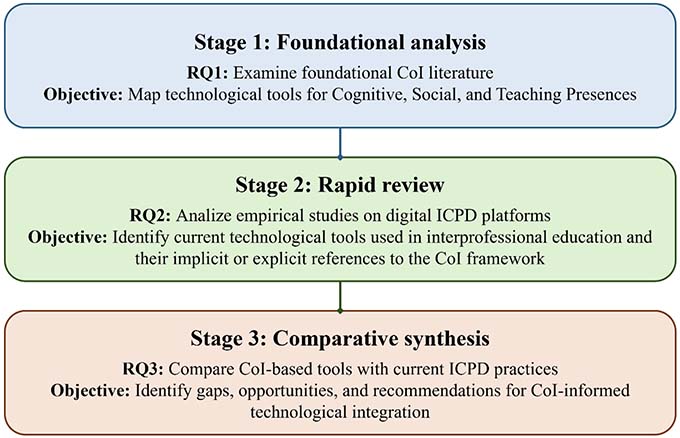
This study’s three-stage methodology examined how the CoI framework can inform the design of digital ICPD platforms, integrating theoretical analysis with empirical evidence to develop evidence-based recommendations. The overall research process is illustrated in Figure 1, which outlines the three stages and their corresponding research questions and objectives.
Figure 1
Three-Stage Research Process: Methodological Approach, Research Questions, and Objectives
Stage 1 addressed our first research question through systematic content analysis of foundational CoI research papers by the framework’s developers, mapping technological tools explicitly recommended to support cognitive, social, and teaching presence to establish theoretical benchmarks for CoI-based design.
Stage 2 addressed the second research question through a rapid review following PRISMA for rapid reviews (PRISMA-RR) guidelines (Tricco et al., 2015). This review analyzed empirical studies on digital ICPD platforms, identified technological tools and features supporting interprofessional education, regardless of explicit CoI references, and highlighted common practices and design strategies.
In stage 3, we addressed our third research question through a matrix-based comparative analysis of findings from the first two stages, identifying alignments, gaps, and opportunities between CoI-recommended tools and current ICPD practices.
In stage 1, we analyzed peer-reviewed journal articles from foundational CoI research papers by the framework’s developers. Inclusion criteria required (a) empirical studies with explicit discussion of technological tools for implementing the CoI framework, (b) clear description of tool functions and CoI presence relationships, and (c) implementation in educational contexts. Exclusion criteria eliminated (a) book chapters, conference proceedings, dissertations; and (b) purely theoretical papers without technological focus; (c) studies lacking specific tool descriptions; and (d) secondary analyses or reviews.
Stage 2 included empirical studies (2010–2024) meeting the following criteria: (a) digital platforms involving healthcare professionals from multiple disciplines, (b) continuing professional development or interprofessional education focus, (c) specific technological tool descriptions, (d) reference to collaborative learning mechanisms regardless of explicit CoI mention, and (e) peer-reviewed articles and conference papers in English. Exclusion criteria removed (a) studies focusing solely on pre-licensure Interprofessional Education (IPE) without professional development components; (b) face-to-face learning without digital components; (c) conceptual papers without empirical data; (d) studies lacking detailed technological tool descriptions; and (e) secondary analyses, reviews, or book chapters.
Stage 1 used foundational CoI research papers from the official compilation of the developers, gathered in September 2024. Stage 2 (conducted October 2024) employed a systematic search in Scopus and Web of Science (WoS) using three combined term sets:
Searches were limited to peer-reviewed articles and conference papers in English (2010–2024).
Structured content analysis identified technological tools in foundational CoI literature using a custom extraction form capturing: (a) article metadata (author, year, context); (b) technological tool specifications (name, function, implementation mode); (c) CoI presence associations (cognitive/social/teaching); (d) implementation context (course type, duration, participant numbers); and (e) reported outcomes.
Coding categories included: (a) learning management systems (Blackboard, WebCT); (b) communication tools (forums, chat, e-mail); (c) conferencing systems (synchronous, asynchronous); (d) content tools (wikis, blogs, multimedia); and (e) assessment tools (quizzes, peer review systems). Both authors conducted calibration using three pilot articles before independent coding. Cohen’s kappa achieved K = 0.82 for tool identification and K = 0.78 for presence categorization, indicating substantial agreement (Belur et al., 2021). Discrepancies were resolved through discussion, producing structured mapping of distinct technological tools categorized by CoI presence support.
Both authors independently screened titles and abstracts using Rayyan QCRI, achieving 85% initial agreement on study inclusion. Data extraction used standardized forms capturing: (a) study characteristics (design, participants, setting); (b) platform specifications (technology type, features, integration); (c) technological tools (synchronous/asynchronous communication, content delivery, collaboration features); (d) professional disciplines involved; and (e) implementation challenges and outcomes.
Coding categories for ICPD platforms included: (a) core communication (video conferencing, discussion boards); (b) collaboration tools (shared documents, virtual whiteboards); (c) content delivery (LMS, multimedia resources); (d) assessment methods (case studies, peer feedback); and (e) support features (facilitation tools, analytics). Inter-rater reliability achieved 91% agreement for technological tool identification and 87% for CoI construct mapping on calibration subset (n = 5), with disagreements resolved through discussion and consensus.
Quality assessment employed MMAT version 2018 criteria (Hong et al., 2018), evaluating study design appropriateness, sampling adequacy, data collection rigor, and reporting transparency. Individual criteria responses informed evidence synthesis with particular attention to studies that demonstrated stronger methodological rigor.
Matrix-based thematic comparison followed Braun and Clarke’s (2022) reflexive thematic analysis. The analytical process involved four systematic steps.
The comparative matrix systematically mapped CoI-recommended tools against ICPD platform tools, identifying convergent practices, framework-specific recommendations, platform-specific innovations, and implementation gaps where CoI principles remain underused in current ICPD practice.
In stage 1, we analyzed 35 foundational CoI articles (1999–2015) from the official CoI website, with 10 articles explicitly addressing technological tools included for analysis. Stage 2 identified 527 records from Scopus and WoS, with 11 studies ultimately included after screening and full-text assessment. Table 1 summarizes the selection process for the first two stages.
Table 1
Number of Studies Identified and Selected for Analysis in Each Stage
| Selection process | CoI literature | 2) ICPD platforms |
| Source and number of records identified | Foundational studies (n = 35) | Scopus (n = 358) WoS (n = 169) |
| Duplicates removed | — | 143 |
| Records screened (title & abstract) | — | 384 |
| Full-text articles assessed for eligibility | 35 | 130 |
| Full-text articles excluded | 25 | 119 |
| Final studies included | 10 | 11 |
The foundational CoI dataset included 10 articles (1999–2011), revealing a focused but evolving technological landscape. Table 2 provides an overview of the identified technologies and their relation to the three CoI presences.
Table 2
How Different Technologies Support Online Learning in Foundational CoI Studies
| Study | Technological tool | Cognitive presence | Social presence | Teaching presence |
| Rourke et al. (1999) | Computer conferencing (FirstClass, WebCT) | Not analyzed, focus on social presence methodology | Framework for measuring affective/interactive/cohesive responses through content analysis | Implications discussed; instructor monitoring and facilitation roles |
| Garrison et al. (2000) | Computer conferencing | Practical inquiry model phases | Supported cognitive presence through interaction; ability to project personal characteristics as real people | Instructional design, facilitation, direct instruction; design of educational experience and content delivery |
| Garrison et al. (2001) | Computer conferencing | Four-phase practical inquiry operationalization | Collaborative critical thinking support | Guided discourse, facilitated inquiry progression |
| Anderson et al. (2001) | Computer conferencing | Analysis not focused on cognitive presence | Facilitated student-instructor interaction | Categorized design, facilitation, instruction |
| Akyol & Garrison (2008) | LMS (Blackboard) Synchronous conferencing (Elluminate) | Tracked inquiry phase engagement across time periods | Showed increased group cohesion over time, decreased affective expression | Evaluated instructor guidance effectiveness, student facilitation roles |
| Garrison & Akyol (2009) | Web 2.0 tools LMS (Blackboard) | Enabled collaborative information discovery and knowledge construction | Fostered interaction through personal blogs, social media, networking sites | Expanded design capabilities, enhances facilitation, supports direct instruction through diverse content forms |
| Akyol et al. (2009a) | LMS (Blackboard) Synchronous conferencing (Elluminate) | Tracked engagement across inquiry phases; compares online vs. blended integration patterns | Compared affective expression online vs. blended; higher group cohesion in blended format | Facilitation and organization patterns; direct instruction distribution between online/blended |
| Akyol et al. (2009b) | LMS (Blackboard) Synchronous conferencing (Elluminate) | Integration phase dominant in both contexts; significantly higher in blended course | Higher group cohesion in blended; more affective expression in online | Students assumed facilitation roles; blended course showed higher teaching presence perceptions |
| Akyol & Garrison (2011) | LMS (Blackboard), Synchronous conferencing (Elluminate) | Integration phase most active in both contexts; strong correlation with perceived learning (r = 0.67 - 0.81) | Distributed student facilitation; higher perceptions in blended course | Student-led facilitation model; teaching presence distributed among participants |
| Akyol et al. (2011) | LMS (Blackboard) Synchronous conferencing (Elluminate) | Integration phase higher in long-term (47.4%) vs short-term (35.6%); resolution also higher in long-term courses | Group cohesion higher in short-term; affective expression higher in long-term courses | Direct instruction higher in long-term; facilitating discourse higher in short-term courses; higher teaching presence perceptions in short-term |
Computer conferencing systems dominated early CoI applications, serving as the primary vehicle for implementing all three presences. Learning management systems emerged as the core platform, with Blackboard predominant for content delivery, discussion, and assessment. Technological evolution was evident across the timeframe. Early studies (1999–2001) relied exclusively on computer conferencing for asynchronous communication. Synchronous conferencing tools (e.g., Elluminate) appeared in later studies (2008–2011), enabling real-time interaction and expanding social presence opportunities. Web 2.0 tools received limited exploration, representing underused potential.
Presence-specific technological patterns emerged clearly. Cognitive presence was consistently supported through structured discussion forums and implementation of the practical inquiry model, with tools facilitating progression through triggering events, exploration, integration, and resolution phases. Social presence relied primarily on communication features that enabled affective expression, open communication, and group cohesion development, with later studies showing distributed student facilitation roles. Teaching presence was operationalized through LMS instructional design capabilities, facilitation tools, and direct instruction features.
Critical findings revealed technological convergence around LMS-synchronous conferencing combinations in later studies, suggesting optimal tool pairing for CoI implementation. The integration phase of cognitive presence emerged as most frequently coded across multiple studies, indicating successful progression beyond initial exploration. Notably, distributed teaching presence through student facilitation became a recurring design pattern, representing a significant evolution from instructor-centered approaches. The timeframe (1999–2011) captured the transition from basic computer conferencing to more sophisticated blended technological environments, establishing foundational patterns for future CoI implementations.
The digital ICPD dataset included 11 studies (2011–2023) that represented the next evolutionary phase beyond foundational CoI implementations (Table 3). During this period, there was dramatic technological diversification, with video conferencing platforms emerging as the dominant synchronous communication tool, replacing basic computer conferencing systems. Learning management systems maintained their central role while expanding beyond Blackboard to include OpenEdX and Moodle.
Collaborative platforms emerged as transformative innovations unavailable during the foundational CoI period. Google Docs, Padlet, and Miro enabled real-time collaborative content creation, supporting cognitive and social presence through shared knowledge construction previously impossible with earlier technologies. Multimedia tools gained prominence, with FlipGrid and comic-style animations enhancing engagement beyond text-based interactions.
Professional context adaptations were evident in tool selection and implementation. Case-based discussion platforms (e.g., asynchronous discussion boards focused on patient scenarios) became prevalent, reflecting healthcare education’s emphasis on practical application. Synchronous patient case conferences via video conferencing addressed real-time collaborative decision-making needs specific to interprofessional healthcare practice.
Despite technological advancement, structured reflective tools (e.g., e-portfolios, learning journals, reflection prompts) were notably absent across all ICPD studies, representing a significant departure from the emphasis of CoI on individual reflection within collaborative inquiry. Automated feedback mechanisms and peer moderation tools were similarly underused, limiting teaching presence optimization.
Geographic and temporal patterns revealed Australian and Canadian leadership in CoI-informed IPE research, with implementation spanning undergraduate health professions programs exclusively. No studies examined CoI application with practicing healthcare professionals, highlighting the fundamental gap between theoretical framework development and real-world ICPD implementation.
Table 3
Overview of IPE Studies using Digital Platforms
| Study | Country | Population | Description of CoI-based implementation | Description of technological implementation | Outcome measures |
| Billings et al. (2022) | USA | 350 health professional educators, learners, and administrative staff | CoI framework for shared experiences, interaction, critical inquiry | Zoom, FlipGrid, Google Docs, Qualtrics | 4,000+ ideas generated, 92% satisfaction |
| Bluteau (2020) | UK | Pre-registration health/social care students | CoI with therapeutic presence emphasis | Moodle, case scenarios, comic animations | Successful therapeutic presence, positive evaluations |
| Evans et al. (2017) | Australia | 14 health profession facilitators | Teaching presence focus (discourse, instruction, design) | Asynchronous discussion boards | 64 messages on average: 50.2% discourse, 32.8% instruction, 17.2% design |
| Evans et al. (2020) | Australia | 7 health profession facilitators | Teaching and social presence indicators | Asynchronous discussion boards | 17 of 19 CoI indicators used; new feedback on assessment tasks indicator |
| Evans & Perry (2023) | Australia | 118 students, 21 facilitators | CoI comparison: synchronous vs. asynchronous | Discussion boards, Zoom conferences | Higher facilitation strategy ratings in synchronous vs. asynchronous sessions |
| Hanna et al. (2013) | Canada | 7 trained IPE facilitators | CoI for teaching/social presence | Audio-video conferencing, chat | Four themes: technology as dynamic force, reduced non-verbal cues, group process evolution, co-facilitation importance |
| Hayward et al. (2021) | Canada | Health professional students | CoI for social, cognitive, teaching presence | Discussion boards, video introductions, Zoom, collaborative tools | Four principles: facilitator development, modelling IPC, meaningful content, psychological safety |
| Lazinski et al. (2021) | USA | 54 PT/PA students | CoI-based HIPE model integration | Asynchronous (Padlet, video) and synchronous (Web-conferencing) phases | Improved understanding of interprofessional practice, teamwork, communication; asynchronous format preferred over synchronous |
| MacNeill et al. (2014) | Canada | 15 multidisciplinary practicing healthcare professionals | CoI framework for cognitive, social, teaching presence in interprofessional collaboration | Asynchronous e-modules and synchronous build-a-case exercise; group vs. individual learning | Group learners: deeper understanding, peer feedback; individual learners: flexibility but lower motivation |
| Waterston (2011) | Canada | 323 students from six healthcare disciplines | CoI for cognitive, social, teaching presence | Mixed-mode: Blackboard discussions, Web-based communication | High participation groups more successful; positive teams showed greater interaction, effective facilitator use, meaningful discourse |
| Zheng et al. (2023) | Hong Kong | 110 undergraduate students from five disciplines | Extended CoI framework incorporating self-regulation and co-regulation as learning presence | OpenEdX platform and Miro for collaborative concept mapping | Co-regulation significantly predicted cognitive presence and self-regulation; both self-regulation and co-regulation had significant positive effects on perceived progress |
To address our third research question, we used comparative analysis to examine the alignment between technological tools from foundational CoI literature (RQ1) and those used in digital ICPD platforms (RQ2). Table 4 presents a matrix mapping the tools from both datasets, highlighting shared practices, missing elements, and areas for future development to support CoI-informed ICPD platforms.
Table 4
Comparing Technologies Used in CoI Research Versus Current IPE Platforms
| Technological tool/feature | Foundational CoI literature | Digital ICPD practices | Multiple affordances | Comparative notes |
| Asynchronous discussion forums | Extensive use | Widely used | Strong continuity; supported multiple presences | Asynchronous discussion forums |
| LMS platforms | Core platform | Core platform | Full alignment across contexts | LMS platforms |
| Synchronous conferencing | Emerging use | Dominant tool | Expanded for real-time collaboration | Synchronous conferencing |
| Video conferencing | Minimal use | Dominant tool | Professional adaptation; ubiquitous in ICPD | Video conferencing |
| Collaborative document tools | Minimal use | Common usage | Growth in co-construction activities | Collaborative document tools |
| Case-based platforms | Not present | Widely used | Professional context innovation | Case-based platforms |
| Reflective tools | Recommended | Largely absent | Significant implementation gap | Reflective tools |
| Web 2.0 tools | Limited exploration | Rarely used | Underused potential | Web 2.0 tools |
| Assessment tools | Recommended | Limited use | Implementation gap in professional contexts | Assessment tools |
| Multimedia tools | Not present | Emerging use | Innovation in engagement strategies | Multimedia tools |
The comparative analysis revealed four distinct patterns of technology-framework alignment across foundational CoI literature and current digital ICPD practices.
The first was technological convergence, which emerged in core tools where both datasets demonstrated strong alignment. Asynchronous discussion forums and LMS platforms represented the stable foundation of CoI-informed learning, maintaining central roles across contexts. These technologies demonstrated functional multiplicity, supporting multiple CoI presences simultaneously. Discussion forums primarily supported cognitive presence through structured inquiry while fostering social presence through community building and teaching presence through guided facilitation.
The second pattern, evolutionary divergence, appeared where current ICPD practices extended beyond foundational CoI recommendations. Synchronous conferencing evolved from an emerging social presence tool in foundational literature to the dominant communication platform in current ICPD practice. Collaborative document tools (e.g., Google Docs, Padlet, Miro) emerged as significant innovations absent from foundational CoI literature, supporting real-time co-construction activities that bridged cognitive and social presence. Video conferencing platforms became ubiquitous in ICPD contexts despite minimal presence in foundational CoI work, reflecting the emphasis of professional education on real-time collaboration and decision-making.
A pattern of implementation gaps revealed critical disconnects between CoI theoretical recommendations and ICPD practice. Reflective tools, strongly recommended in foundational CoI literature for supporting cognitive presence and individual meaning-making, were largely absent from current ICPD implementations. This constituted a significant departure from emphasis of the CoI on personal reflection within collaborative inquiry. Similarly, Web 2.0 tools remained underused across both contexts, suggesting missed opportunities for enhancing social presence through user-generated content and community interaction.
Finally, professional context adaptations highlighted how ICPD practices evolved to meet healthcare professionals’ specific needs. Case-based discussion platforms emerged as a professional education innovation, adapting asynchronous forums to focus on patient scenarios and clinical decision-making. Synchronous patient case conferences addressed real-time collaborative needs central to interprofessional healthcare practice, extending beyond traditional educational applications.
Our analysis revealed that current ICPD practices have demonstrated selective implementation of CoI principles rather than comprehensive framework adoption. While communication and collaboration tools aligned well with CoI recommendations, the absence of structured reflection mechanisms suggests incomplete realization of the framework’s cognitive presence potential in professional continuing education contexts.
This study investigated the technological foundations of the CoI framework and its application in digital interprofessional continuing development, revealing both continuity and divergence between theoretical underpinnings and current practical implementation. The comparative analysis identified four distinct patterns: technological convergence, evolutionary divergence, implementation gaps, and professional context adaptations. These findings contributed to understanding CoI framework adaptation in distributed learning environments, with implications extending beyond health education to broader professional continuing education contexts.
The analysis of foundational CoI literature confirmed a technological ecosystem anchored in computer conferencing systems, learning management systems, and emerging synchronous tools, reflecting the framework’s origins in higher education contexts. The technological evolution from 1999 to 2011 demonstrated how distance education frameworks developed technological recommendations that responded to available capabilities while maintaining theoretical coherence. The CoI framework’s strength lies in its technological flexibility, providing presence-based criteria that can accommodate technological evolution rather than prescribing specific tools.
Current digital ICPD practices have demonstrated significant adaptation beyond foundational CoI recommendations, reflecting the specific needs of practicing healthcare professionals. The emergence of case-based platforms, synchronous patient conferences, and real-time collaborative tools represents professional education innovations extending traditional applications. These adaptations addressed fundamental differences between student-focused and professional-focused environments, including time constraints, established expertise, and immediate practice applications.
Critically, CoI constructs have been frequently used retrospectively as analytical lenses rather than proactively guiding instructional design. This suggests that while theoretical constructs provided valuable evaluation criteria, their translation into design principles for professional continuing education required substantial adaptation.
Our comparative analysis revealed that technological tools in professional continuing education have demonstrated functional multiplicity, supporting multiple CoI presences simultaneously rather than serving single-purpose functions. Asynchronous discussion forums exemplified this multiplicity, primarily supporting cognitive presence through structured inquiry while fostering social presence through community building and teaching presence through guided facilitation.
Technological convergence emerged in core communication and platform tools, suggesting robust foundational alignment in basic infrastructure requirements for distributed collaborative learning. However, evolutionary divergence appeared in collaborative document tools, video conferencing platforms, and multimedia innovations that became dominant in professional contexts despite minimal presence in foundational CoI work.
Our analysis identified critical implementation gaps between CoI theoretical recommendations and ICPD practice, particularly regarding structured reflective tools and automated feedback mechanisms. The absence of reflective tools represented a significant departure from CoI’s emphasis on individual meaning-making within collaborative inquiry, potentially limiting cognitive presence development in professional contexts.
These findings revealed clear opportunities for innovation in ICPD platform design. Integrating structured reflective tools directly into collaborative learning environments could reinforce cognitive presence while accommodating professional learners’ preferences for practice-integrated reflection. Intelligent facilitation systems capable of providing adaptive feedback and targeted scaffolding could enhance teaching presence while addressing scalability challenges in professional continuing education.
The selective implementation pattern observed in ICPD contexts—where communication and collaboration tools align with framework recommendations while reflective and scaffolding tools remain underused—may represent a common adaptation strategy when frameworks transition from formal educational to professional development contexts. This study demonstrated how comparative analysis can illuminate both successful adaptations and missed opportunities, providing guidance for framework evolution that serves diverse learning populations in distributed learning environments.
This study has made distinctive contributions to the ODDE field beyond the specific healthcare education context, through advancing understanding of how established pedagogical frameworks adapt when transitioning from formal educational to professional continuing education contexts. While the CoI framework is one of the most extensively cited theories in distance education, our research represented the first systematic analysis of framework evolution across educational contexts, revealing adaptation patterns with broader theoretical and practical implications.
The comparative methodology demonstrated here offers a replicable approach for examining pedagogical framework translation across diverse learning populations. The four adaptation patterns identified (i.e., technological convergence, evolutionary divergence, implementation gaps, professional context adaptations) have provided a conceptual framework for understanding how educational technologies and pedagogical approaches evolve when serving different learner populations. These insights extend beyond healthcare to inform framework application in other professional continuing education domains, including engineering, business, education, and legal professions, where practitioners require ongoing professional development through distributed learning environments.
Critically, this research revealed that framework adaptation involves more than technological substitution. The finding that current implementations use CoI retrospectively as an analytical framework rather than proactively for design guidance illuminates a broader challenge in distance education, namely the gap between theoretical frameworks developed for student populations and their application in professional contexts. This disconnect suggests that successful framework translation requires systematic adaptation rather than direct application, with implications for how the distance education field approaches framework implementation across diverse learning contexts.
The identification of selective implementation patterns, where communication and collaboration tools aligned with framework recommendations while reflective and scaffolding mechanisms remained underused, may represent a common adaptation strategy when frameworks transition between educational contexts. This insight contributes to distance education theory by suggesting that framework evolution follows predictable patterns that can inform proactive adaptation strategies rather than reactive implementation challenges.
Furthermore, this study demonstrated how technological affordances interact with pedagogical frameworks across different learning populations. The emergence of real-time collaborative tools and case-based platforms in professional contexts, despite their absence from foundational framework literature, illustrates how learner characteristics and contextual demands drive technological innovation beyond original framework specifications. This technological-pedagogical evolution pattern likely applies across professional education domains, informing distance education practice in diverse continuing education contexts.
The methodological contribution of systematic comparative analysis between foundational framework literature and current implementation practices has provided a model for evidence-based framework adaptation that addresses both theoretical coherence and practical implementation needs. This approach offers distance education researchers and practitioners a systematic method for understanding framework evolution and optimizing implementation across diverse learning contexts, advancing both distance education theory and practice beyond specific disciplinary boundaries.
This study was associated with several critical limitations affecting scope and generalizability that require careful consideration when interpreting findings and recommendations.
Most critically, we found no direct evidence of systematic CoI framework application in authentic ICPD contexts involving practicing healthcare professionals. While the stage 2 review identified one study (MacNeill et al., 2014) involving practicing professionals, this study used CoI only as background theoretical foundation rather than systematic design framework, without analyzing CoI presence constructs or implementing CoI-recommended tools. The remaining studies focused exclusively on pre-licensure interprofessional education with student populations, creating a fundamental gap between theoretical analysis and real-world ICPD implementation. This absence represented a significant limitation because practicing professionals differ substantially from students in terms of time constraints, established expertise, immediate practice applications, and learning motivations. Without empirical evidence from systematic CoI implementation in actual continuing education contexts, our recommendations remain theoretical propositions requiring validation rather than evidence-based directives for immediate implementation.
The predominant focus on pre-licensure education in current research, with only one study (MacNeill et al., 2014) involving practicing professionals without systematic CoI implementation, limits transferability of findings to practicing professionals. Students and professionals represent fundamentally different learning populations with distinct characteristics: students engage in sustained, structured learning programs while professionals require flexible, practice-integrated development opportunities. Students build foundational knowledge while professionals adapt existing expertise to evolving challenges. This population difference suggests that CoI presence patterns, technological tool effectiveness, and collaborative learning dynamics may function differently in professional contexts, requiring empirical validation before confident generalization.
Additional constraints included temporal mismatch between datasets, with foundational CoI literature (1999–2011) reflecting earlier technological capabilities while current ICPD practices (2011–2023) use more advanced tools. The rapid review methodology limited analytical depth compared to full systematic reviews, while geographic concentration in Australia and Canada limited generalizability to other healthcare systems and cultural contexts. These methodological constraints affected the comprehensiveness of evidence synthesis and cross-cultural applicability of recommendations.
Given these limitations, our recommendations should be viewed as preliminary theoretical guidance requiring empirical validation rather than evidence-based directives for immediate implementation. The lack of authentic ICPD data means that proposed CoI adaptations remain largely hypothetical until tested with practicing professionals in real-world continuing education contexts. Implementation recommendations necessarily rely on theoretical extrapolation from student-focused research rather than direct professional education evidence.
These limitations collectively suggest that our study represents an initial step toward understanding framework adaptation across educational contexts rather than definitive guidance for professional education design. The findings illuminated both adaptation patterns and critical research gaps, highlighting the need for empirical investigation of how established pedagogical frameworks function in professional continuing education environments.
Despite these constraints, this study has made distinctive contributions to the ODDE field by providing the first systematic analysis of how established pedagogical frameworks transition from higher education to professional continuing education contexts. The comparative methodology demonstrated here can inform future research examining framework adaptation across educational contexts, while the four adaptation patterns identified also provide a conceptual framework for understanding educational technology evolution beyond specific disciplinary boundaries.
Empirical testing of CoI-informed designs with practicing healthcare professionals in authentic ICPD settings represents the most critical research need. Longitudinal studies examining CoI presence patterns between student and professional populations could validate theoretical assumptions underlying framework adaptation and inform design principles specific to professional continuing education contexts. Cross-cultural validation studies and investigation of framework adaptation principles applicable beyond healthcare contexts represent important directions for advancing distance education theory and practice.
The need for design-based research approaches that systematically develop and test CoI-informed technologies while documenting adaptation strategies could contribute both to practical design guidelines and theoretical insights about framework evolution, advancing both professional education practice and distance education theory in distributed learning environments.
This study revealed a partial integration of CoI principles within digital ICPD practices through four distinct adaptation patterns: (a) technological convergence in core communication tools, (b) evolutionary divergence in collaborative technologies, (c) implementation gaps in reflective mechanisms, and (d) professional context adaptations addressing healthcare-specific needs. Current implementations have demonstrated selective rather than comprehensive framework adoption, with significant opportunities for innovation through structured reflective tools, intelligent facilitation systems, and co-regulation mechanisms.
For the broader distance education field, this research has demonstrated how comparative analysis can illuminate framework evolution across learning contexts, revealing that successful adaptation requires systematic modification rather than direct application when transitioning from student to professional populations. The methodological approach and adaptation patterns identified provide a replicable framework for understanding pedagogical theory translation across diverse continuing education domains.
Future developments must prioritize empirical validation with practicing professionals in authentic ICPD settings to transform these theoretical insights into evidence-based guidance for professional continuing education in distributed learning environments.
Akyol, Z., & Garrison, D. R. (2008). The development of a community of inquiry over time in an online course: Understanding the progression and integration of social, cognitive and teaching presence. Journal of Asynchronous Learning Networks, 12, 3-22. https://doi.org/10.24059/olj.v12i3-4.1680
Akyol, Z., & Garrison, D. R. (2011). Understanding cognitive presence in an online and blended community of inquiry: Assessing outcomes and processes for deep approaches to learning. British Journal of Educational Technology, 42(2), 233-250. https://doi.org/10.1111/j.1467-8535.2009.01029.x
Akyol, Z., Garrison, D. R., & Ozden, M. Y. (2009a). Development of a community of inquiry in online and blended learning contexts. Procedia-Social and Behavioral Sciences, 1(1), 1834-1838. https://doi.org/10.1016/j.sbspro.2009.01.324
Akyol, Z., Garrison, D. R., & Ozden, M. Y. (2009b). Online and blended communities of inquiry: Exploring the developmental and perceptional differences. The International Review of Research in Open and Distributed Learning, 10(6), 65-83. https://doi.org/10.19173/irrodl.v10i6.765
Akyol, Z., Vaughan, N., & Garrison, D. R. (2011). The impact of course duration on the development of a community of inquiry. Interactive Learning Environments, 19(3), 231-246. https://doi.org/10.1080/10494820902809147
Anderson, T., Rouke, L., Garrison, D. R., & Archer, W. (2001). Assessing teaching presence in a conferencing context. Journal of Asynchronous Learning Networks, 5(2), 1-17. https://doi.org/10.24059/olj.v5i2.1875
Aromataris, E., Lockwood, C., Porritt, K., Pilla, B., & Jordan, Z. (Eds.). (2024). JBI manual for evidence synthesis. JBI. https://synthesismanual.jbi.global
Barr, H. (2009). An anatomy of continuing interprofessional education. Journal of Continuing Education in the Health Professions, 29(3), 147-150. https://doi.org/10.1002/chp.20027
Belur, J., Tompson, L., Thornton, A., & Simon, M. (2021). Interrater reliability in systematic review methodology: Exploring variation in coder decision-making. Sociological Methods & Research, 50(2), 837-865. https://doi.org/10.1177/0049124118799372
Billings, H., Malin, T., Allen, J., Bergene, A., Cornelius, K., Craft, S., Hartzheim, L., Johnson, S. A., Kallay, J., Kreuter, J., Raths, M., Renner, A. S., & Hall, E. (2022). Reimagining learning spaces of the future: An interprofessional, virtual workshop utilizing rapid idea generation and lean startup methodologies. MedEdPORTAL, 18, 11217. https://doi.org/10.15766/mep_2374-8265.11217
Bluteau, P. (2020). The good enough facilitator: Exploring online interprofessional therapeutic facilitation in times of COVID-19. Journal of Interprofessional Care, 34(5), 647-654. https://doi.org/10.1080/13561820.2020.1807919
Braun, V., & Clarke, V. (2022). Thematic analysis: A practical guide. Sage.
Dyess, A. L., Brown, J. S., Brown, N. D., Flautt, K. M., & Barnes, L. J. (2019). Impact of interprofessional education on students of the health professions: A systematic review. Journal of Educational Evaluation for Health Professions, 16. https://doi.org/10.3352%2Fjeehp.2019.16.33
Engeström, Y. (2009). The future of activity theory: A rough draft. In A. Sannino, H. Daniels, & K. Gutierrez (Eds.), Learning and expanding with activity theory (pp. 303-328). Cambridge University Press.
Evans, S., Knight, T., Walker, A., & Sutherland-Smith, W. (2020). Facilitators’ teaching and social presence in online asynchronous interprofessional education discussion. Journal of Interprofessional Care, 34(4), 435-443. https://doi.org/10.1080/13561820.2019.1622517
Evans, S., & Perry, E. (2023). An exploration of perceptions of online asynchronous and synchronous interprofessional education facilitation strategies. Journal of Interprofessional Care, 37(6), 1010-1017. https://doi.org/10.1080/13561820.2023.2213718
Evans, S. M., Ward, C., & Reeves, S. (2017). An exploration of teaching presence in online interprofessional education facilitation. Medical Teacher, 39(7), 773-779. https://doi.org/10.1080/0142159X.2017.1297531
Evans, S., Ward, C., & Reeves, S. (2018). Online interprofessional education facilitation: A scoping review. Medical Teacher, 40(7), 762-771. https://doi.org/10.1080/0142159X.2018.1460656
Fosnot, C. T. (2013). Constructivism: Theory, perspectives, and practice (2nd ed.). Teachers College Press.
Garrison, D. R., & Akyol, Z. (2009). Role of instructional technology in the transformation of higher education. Journal of Computing in Higher Education, 21, 19-30. https://doi.org/10.1007/s12528-009-9014-7
Garrison, D. R., Anderson, T., & Archer, W. (2000). Critical inquiry in a text-based environment: Computer conferencing in higher education. The Internet and Higher Education, 2(2-3), 87-105. https://doi.org/10.1016/S1096-7516(00)00016-6
Garrison, D. R., Anderson, T., & Archer, W. (2001). Critical thinking, cognitive presence, and computer conferencing in distance education. American Journal of Distance Education, 15(1), 7-23. https://doi.org/10.1080/08923640109527071
Hanna, E., Soren, B., Telner, D., MacNeill, H., Lowe, M., & Reeves, S. (2013). Flying blind: The experience of online interprofessional facilitation. Journal of Interprofessional Care, 27(4), 298-304. https://doi.org/10.3109/13561820.2012.723071
Hayward, K., Brown, M., Pendergast, N., Nicholson, M., Newell, J., Fancy, T., & Cameron, H. (2021). IPE via online education: Pedagogical pathways spanning the distance. Journal of Interprofessional Education & Practice, 24, 100447. https://doi.org/10.1016/j.xjep.2021.100447
Hong, Q. N., Fàbregues, S., Bartlett, G., Boardman, F., Cargo, M., Dagenais, P., Gagnon, M.-P., Griffiths, F., Nicolau, B., O’Cathain, A., Rousseau, M.-C., Vedel, I., & Pluye, P. (2018). The mixed methods appraisal tool (MMAT) version 2018 for information professionals and researchers. Education for Information, 34(4), 285-291. https://doi.org/10.3233/EFI-180221
Lazinski, M. J., Ross, L., Wolf, S., Finck, M., & Cherry, L. (2021). Interprofessional education at a distance: The hybrid interprofessional education model. Internet Journal of Allied Health Sciences and Practice, 19(3), 15. https://doi.org/10.46743/1540-580X/2021.2011
MacNeill, H., Telner, D., Sparaggis-Agaliotis, A., & Hanna, E. (2014). All for one and one for all: Understanding health professionals’ experience in individual versus collaborative online learning. Journal of Continuing Education in the Health Professions, 34(2), 102-111. https://doi.org/10.1002/chp.21226
Meleis, A. I. (2016). Interprofessional education: A summary of reports and barriers to recommendations. Journal of Nursing Scholarship, 48(1), 106-112. https://doi.org/10.1111/jnu.12184
Rawlinson, C., Carron, T., Cohidon, C., Arditi, C., Hong, Q. N., Pluye, P., Peytremann-Bridevaux, I., & Gilles, I. (2021). An overview of reviews on interprofessional collaboration in primary care: Barriers and facilitators. International Journal of Integrated Care, 21(2), 32. https://doi.org/10.5334/ijic.5589
Robb, M., & Spadaro, K. C. (2022). Exploration of online Doctor of Nursing practice students’ perceptions of effective teaching methods using the critical incident technique. Nurse Educator, 47(6), 328-331. https://doi.org/10.1097/NNE.0000000000001217
Rourke, L., Anderson, T., Garrison, D. R., & Archer, W. (1999). Assessing social presence in asynchronous text-based computer conferencing. The Journal of Distance Education/Revue de l’ducation Distance, 14(2), 50-71. Retrieved September 3, 2024 from https://www.learntechlib.org/p/92000/
Shohel, M. M. C., & Kirkwood, A. (2012). Using technology for enhancing teaching and learning in Bangladesh: Challenges and consequences. Learning, Media and Technology, 37(4), 414-428. https://doi.org/10.1080/17439884.2012.671177
Siemens, G. (2013). Learning analytics: The emergence of a discipline. American Behavioral Scientist, 57(10), 1380-1400. https://doi.org/10.1177/0002764213498851
Thigpen, J., Naccarini, D., Moore, S. L., & Culhane, N. S. (2023). Incorporating interprofessional education into a required introductory pharmacy and nursing didactic course. American Journal of Pharmaceutical Education, 87(9), 100123. https://doi.org/10.1016/j.ajpe.2023.100123
Tricco, A. C., Antony, J., Zarin, W., Strifler, L., Ghassemi, M., Ivory, J., Perrier, L., Hutton, B., Moher, D., & Straus, S. E. (2015). A scoping review of rapid review methods. BMC Medicine, 13, 1-15. https://doi.org/10.1186/s12916-015-0465-6
Tunningley, J. M., Zucchero, R. A., & Hooker, E. A. (2024). Comparing quantitative outcomes of synchronous online versus in-person interprofessional symposium. Journal of Interprofessional Care, 38(1), 113-120. https://doi.org/10.1080/13561820.2023.2241506
Waterston, R. (2011). Interaction in online interprofessional education case discussions. Journal of Interprofessional Care, 25(4), 272-279. https://doi.org/10.3109/13561820.2011.566647
Zheng, B., Ganotice, F. A., Lin, C. H., & Tipoe, G. L. (2023). From self-regulation to co-regulation: Refining learning presence in a community of inquiry in interprofessional education. Medical Education Online, 28(1), 2217549. https://doi.org/10.1080/10872981.2023.2217549

Innovating Interprofessional Continuing Professional Development: Applying the Community of Inquiry Framework to Digital Learning Platforms by Flavio Manganello and Giuseppe Aleo is licensed under a Creative Commons Attribution 4.0 International License.