International Review of Research in Open and Distributed Learning
Volume 27, Number 2
May - 2026
The Answerthis.io AI App Looks at My Interaction Equivalency Theory
Terry Anderson
Professor Emeritus, Athabasca University
Abstract
This field note provides an example of the use of an education/researcher artificial intelligence program to provide an overview of the Interaction Equivalency Theory. This theory was first presented as an example in Anderson, T. (2003), "Getting the mix right again: An updated and theoretical rationale for interaction", in The International Review of Research in Open and Distributed Learning, 4(2). The AI tool provides a useful synopsis and overview of the value of this theory for distance education students and researchers.
Keywords: EQuiv, interaction equivalency, student-student interaction, student-teacher interaction, student-content interaction
The Answerthis.io AI App Looks at My Interaction Equivalency Theory
This “note from the field” is not a scholarly work. However, I hope it serves as a useful, illustrative example of new ways that researchers, teachers, and students can dig into the research literature. Open access journals, such as IRRODL, make freely available years of scholarly work directly related to challenges and opportunities in distance education practice and research. However, scouring, summarizing, and making that knowledge accessible is time-consuming and challenging. Using AI tools makes this knowledge much more accessible. However, AI brings its own bias and selection lens, is prone to error, and thus its results require critical review.
I’m not immune from the relentless hype (and warnings from multiple perspectives) about general AI, AI-enhanced browsers, and AI customized for specific applications. Thus, I couldn’t resist spending a few minutes checking out an AI app—Answerthis.io, specifically aimed at researchers and students (https://answerthis.io/).
Not being overly modest (to say the least), I decided to ask a question about an article I published over 20 years ago: “Getting the Mix Right Again: An Updated and Theoretical Rationale for Interaction, published in 2003 in The International Review of Research in Open and Distributed Learning, 4(2). Figure 1 is an illustration from the article showing the types of interactions supported in formal educational contexts. The basic idea of the article was that interaction of one type can be substituted for one of the other types of interaction, without major impairment of the learning experience.
Figure 1
Modes of Interaction in Distance Education From Anderson and Garrison (1998)
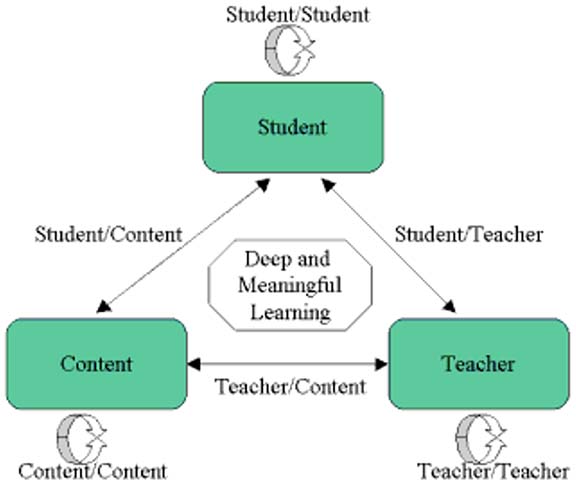
Note. From “Getting the Mix Right Again: An Updated and Theoretical Rationale for Interaction,” by T. Anderson, 2003, The International Review of Research in Open and Distributed Learning, 4(2), p. 3 (https://doi.org/10.19173/irrodl.v4i2.149). CC BY 4.0.
The paper achieved modest success with 1,850 citations (Google Scholar, March 2026). This was a bit surprising as I wasn’t sure there really was a learning equivalency between student/content interaction, student/teacher interaction, and student/student interaction. Moreover, I wasn’t sure how this “theory” could be empirically validated or disproved. However, over the years, a number of researchers (aided in no small part by my Japanese colleague Terumi Miyazoke (https://miyazoe.info/) have used it, and it seems to have been useful—perhaps most noticeably for financially pressed distance education administrators trying to create affordable (and thus accessible) learning opportunities.
I asked the Answerthis.io app: “What is useful about Anderson’s interaction equivalency theory?”
The AI tool examined 93 papers in a minute or two and came back with more indicators of usefulness than I could have come up with. The resulting (completely unedited) AI answer is as follows:
“Anderson’s Interaction Equivalency Theory” (also known as the Interaction Equivalency Theorem, or EQuiv) is a significant conceptual framework in online and distance education. At its core, it states that “deep and meaningful learning is supported as long as one of three forms of interaction (student-teacher, student-student, student-content) is at a high level; the other two may be offered at minimal levels or even eliminated without degrading the educational experience.” The theory recognizes that sustaining all forms of interaction at maximum levels may not always be feasible due to constraints such as time, resources, and institutional scale, especially in online or blended environments.
Key Benefits and Usefulness of Anderson’s Theory
- Flexible Course Design and Resource Allocation:
EQuiv allows educational designers and institutions to focus resources and instructional efforts where they are most impactful. If strong interaction can be established in one domain (e.g., through rich content or peer collaboration), then the other types may be comparatively minimized without a loss in learning quality. For instance, in very large courses where teacher-student interactions are limited, enhanced student-content or student-student interactions can compensate, enabling scalability without compromising outcomes. - Personalization and Adaptation:
The theory provides a rationale to adapt interaction according to the specific needs and circumstances of different learner groups, such as non-traditional or part-time students who may not engage frequently with instructors but can benefit from alternative interaction forms. - Practical Framework for Blended and Online Learning:
It offers educators a guide to make informed decisions on which instructional tools or approaches to use, justifying, for instance, the use of Learning Management Systems (LMS) to enhance interaction and accessibility, allowing for key educational goals (like participation and learning engagement) to be met even if instructor interaction is limited. - Supports Student Satisfaction and Achievement:
Empirical and conceptual studies support the application of EQuiv in raising learner satisfaction, reducing attrition risk in distance education settings, and increasing course completion rates, particularly when strong “interaction presence” is maintained in at least one channel. - Guides Risk Identification and Intervention:
The theory isn’t just for course designers—it can be used by institutions to develop risk profiles of students potentially at risk of dropping out, enabling targeted interventions where interaction is lacking. - Extends Beyond Structured Courses:
Although EQuiv originated in distance and online learning, it has potential applications in other higher education contexts, such as the master-apprentice model in doctoral education. By compensating for limited supervisor (S2T) interaction with enhanced content or peer interactions, EQuiv addresses issues of isolation and supports deeper learning. - Efficient Use of Learning Technologies:
By focusing on maximizing one type of interaction, it provides a rationale for the use of asynchronous content, peer forums, or automated feedback systems—tools essential for scaling and accessibility in digital education. - Framework for Ongoing Research and Development:
The theory has stimulated further research into interaction dynamics, informing both empirical investigations and theoretical development around how different forms of interaction contribute to learning, motivation, and retention in virtual environments. - Facilitates Deep and Meaningful Learning:
The focus on ensuring at least one robust interaction provides conceptual and empirical support for deep cognitive engagement, even when all three modes are not maximally present. This is crucial for the design of effective massive open online courses (MOOCs) and large-scale distance education, where teacher-student contact is inherently limited. - Guides Implementation of New Educational Models:
EQuiv justifies the structural design decisions in “flipped classrooms,” blended courses, and synchronous/asynchronous online programs, providing a theoretical foundation for deliberate reduction or enhancement of interaction modes based on course goals, audience, and technological affordances.
In summary, Anderson’s Interaction Equivalency Theory is useful because it offers a flexible, evidence-based, and scalable framework for online, blended, and distance education. By clarifying how and where to invest instructional resources, it enables educators and institutions to optimize learning outcomes, enhance satisfaction, reduce attrition, and adapt to diverse learner needs across multiple educational contexts.
My Takeaways
- The tool does a credible job of summarizing ways that other scholars have used the theory. It looks to be both accurate and thorough.
- In a couple of minutes, AI was able to scour the literature and find applications of the theory, made by others, that I had not heard of nor could have imagined today, much less than when I originally wrote the paper.
- It shows that assigning tasks such as this as an assessment activity in a senior undergraduate or graduate course hardly seems worthwhile, given the time and effort taken by a teacher for assessment. I have had graduate students create blog and wiki entries on major ideas and short literature reviews in distance education in the past, but given these new tools, such an exercise may still be useful for student learning but has little practical value for assessment. I can, however, imagine assessments in which the student is challenged to provide examples from their own context in which these ten “uses” are instantiated.
- For a busy scholar (or student) trying to get up to speed on ideas from the literature that they may have missed or be unfamiliar with, or if they are in need of a refresher, the tool can be remarkably efficient and effective.
- The tool may inspire new and novel educational innovations as these uses are put into practice, or inspire new research questions.
- The tool doesn’t yet have much of a revenue model�—it was free for this example—but no doubt that will come.


The Answerthis.io AI App Looks at My Interaction Equivalency Theory by Terry Anderson is licensed under a Creative Commons Attribution 4.0 International License.