Volume 26, Number 3
Ibrahim Kizil1, Fatima Seyma Kizil1, and Bong Gee Jang1
1School of Education, Syracuse University, Syracuse, NY
The global shift to distance education during the COVID-19 pandemic challenged the resilience and efficiency of educational systems worldwide. This study investigated the factors influencing the effectiveness and resilience of distance education in elementary schools in Türkiye. Using a quantitative method, 100 elementary school teachers from various regions of Türkiye were surveyed. Guided by the technology acceptance model (TAM) and employing exploratory factor analysis (EFA), the study identified four critical factors: (a) teachers’ prior knowledge and experience with distance education; (b) perspectives on the Educational Informatics Network (EIN); (c) stakeholder support; and (d) technology integration knowledge and experience. The findings emphasized the role of comprehensive teacher training programs in equipping educators to adapt to digital teaching environments. They also underlined the importance of national educational platforms like EIN, which served as a critical resource during the pandemic. Collaborative support systems involving school administration, parents, and technical teams were found to significantly enhance the success of distance education. Furthermore, teachers’ ability to integrate technology into their teaching practices emerged as a crucial factor. These results have significant implications for educational policy, and highlight the need for a multidimensional strategy to strengthen distance education systems and ensure their resilience during global crises.
Keywords: distance education, technology integration, global crisis, elementary schools
Effects of the COVID-19 pandemic have caused a startling shift in the educational landscape. Educational institutions have had to quickly modify their traditional teaching strategies to fit the needs of distance education. This has tested the adaptability and durability of global education systems (Hodges et al., 2020). Like many other nations, Türkiye’s swift adoption of distance education has demonstrated the immense possibilities and noteworthy constraints of distance education during emergencies (Bozkurt & Sharma, 2020; Mishra et al., 2020).
The education community was unprepared for the abrupt shift to remote learning. Many teachers were unaware of the importance of certain topics in distance education. For remote learning settings to be effective, teacher training, technology infrastructure, and support are essential (König et al., 2020). In times of crisis, distance education can be a useful substitute for traditional in-person instruction; however, its efficacy is contingent upon many factors, including the technological proficiency of the teacher, administrative support, family support, and teacher preparation (Bao, 2020; Ozudogru, 2021).
Elementary schools have found it particularly difficult to make the switch to distance education because younger pupils require more direction and engagement (Wysocka-Narewska, 2022). Since many teachers had limited experience with online teaching practices, they were challenged to swiftly adjust their pedagogical approaches. Significant inadequacies in teacher preparation programs were exposed by this abrupt change, underscoring the need for more comprehensive professional development programs with emphasis on technology integration and online teaching techniques (Carrillo & Flores, 2020; Dhawan, 2020).
Access to and use of technology have been major factors in the efficacy of distance learning. The gap between students with easy access to computers and the Internet and those without, known as the digital divide (Van Dijk, 2020), has become even more pronounced. Like many other nations, Türkiye has seen disparities in educational possibilities due to disparities in technology and high-speed Internet access. These disparities have particularly affected students from low socioeconomic backgrounds and those who live in rural regions (Bozkurt et al., 2020; Logan & Burdick-Will, 2017).
There has also been an examination of the function of policy execution and administrative assistance. Making quick judgments on curriculum adaption, assessment techniques, and resource allocation forced school administrators and education policymakers to traverse unfamiliar ground (Fernandez & Shaw, 2020). The ability of educational leaders to give instructors, students, and parents clear direction, technical help, and emotional support is often critical to the success of distance learning projects (Huber & Helm, 2020; Rasmitadila et al., 2020).
The COVID-19 pandemic also made clear the importance of family support to the process of remote learning. As education began to take place in homes, parents and guardians assumed the role of de facto educators for their kids. This highlighted strong school-family partnerships and the significance of providing families with the knowledge and resources necessary to support their children’s remote learning (Bhamani et al., 2020; Garbe et al., 2020).
Using the experiences of elementary school teachers in Türkiye during the pandemic as a guide, we investigated the elements influencing the efficacy of distance education during the crisis. We examined the challenges they faced, the strategies they used, and the resources they thought were very beneficial to them during their distance learning. The technology acceptance model (TAM) served as the basis for our study. It provided a thorough framework for understanding the factors affecting the adoption and efficacy of technology in the classroom (Davis, 1989). TAM effectively explained how perceptions of technology’s usefulness and ease of use can influence adoption. This aligned with the study’s focus on understanding the role of technology integration in distance education.
This study aimed to provide educators, administrators, and policymakers with a diagnostic tool to assess key elements influencing distance education resilience. By using this tool, institutions can strengthen remote learning environments and enhance preparedness for future challenges. The findings offered a preliminary framework to guide policy and future research on distance education resilience. By identifying critical factors such as teacher training, stakeholder support, and technology integration skills, this study offered practical recommendations for improving the effectiveness and resilience of distance education systems during crises.
While existing studies have explored various aspects of distance education during the COVID-19 pandemic (Bozkurt & Sharma, 2020; Hodges et al., 2020; Mishra et al., 2020), limited attention has been given to the specific challenges faced by elementary school teachers in Türkiye, who had to adapt to the unique needs of younger students requiring greater engagement and direction (Wysocka-Narewska, 2022). While research has explored distance education resilience, few efforts quantified its key influences. This study proposed a preliminary scale as a framework for assessment, though further validation is needed for broader application.
In summary, our research aimed to investigate and improve the resilience of distance education, particularly in the context of elementary school teachers in Türkiye during global crises, such as the COVID-19 pandemic. In this study, we developed a scale to enable distance education to be carried out successfully when it is necessary to switch to distance education in times of a national or global crisis. Additionally, this study provided a framework for future-proofing education systems, ensuring they are better prepared to deliver effective distance education in the face of global emergencies. Hopefully, addressing the challenges of the present have made a contribution to building resilient and adaptable education systems for the future.
The following research questions guided our study.
Although we conducted this study in Türkiye, the factors influencing distance education resilience are common in other global contexts (e.g., United States, Finland, South Korea). Previous studies (e.g., Bozkurt et al., 2020; König et al., 2020) have shown that teacher preparation, access to technology, and administrative support are critical for effective distance learning worldwide. The findings of this study contributed to this growing literature by providing an evidence-based framework that can be adapted to multiple educational settings.
The COVID-19 pandemic underscored the need for resilience in education. Central to this transition were the roles and experiences of teachers, whose knowledge, skills, and access to resources significantly influenced the effectiveness of online teaching. Our literature review explored four critical components shaping the success of distance education: (a) teachers’ prior knowledge and experience; (b) their perspectives on educational platforms like the Educational Informatics Network (EIN); (c) support from various stakeholders; and (d) teachers’ technology integration skills. These interconnected elements provided a foundation for understanding how to enhance the resilience and efficiency of distance education systems, particularly during global crises.
Many studies have highlighted the importance of teachers’ pre-existing knowledge and experience in distance education. Educators with previous online teaching experience were better equipped to handle the sudden transition to remote learning brought on by the COVID-19 pandemic (Mishra et al., 2020). König et al. (2020) found that a teacher’s ability to maintain high-quality instruction in online settings was closely linked to their digital proficiency, often gained from previous experience. Distance education’s success is reliant on educators’ knowledge of online teaching tools and methods, obtained through either prior experience or training (Bao, 2020). Trust and Whalen (2020) found that educators who had previously taught online were more inclined to use a wider variety of digital tools and better involve students in remote learning.
Within Türkiye, the EIN has played a crucial role in facilitating distance education. In their study on educators’ perspectives of EIN during the epidemic, Duzgun (2021) found that most educators viewed it as essential for online teaching. However, some teachers encountered difficulties maximizing the platform’s capabilities due to technical issues or a lack of familiarity. In their investigation into the efficacy of EIN from the viewpoint of teachers, Karalar and Dogan (2017) discovered that although many valued its extensive content, a few thought that additional interactive elements could improve student involvement. This is consistent with research by Ozer (2020), who hypothesized that EIN’s capacity to assist remote learning might be greatly increased by ongoing modification and enhancement based on instructor input. While EIN has been instrumental in Türkiye, its role aligns with global efforts to develop national digital learning platforms.
For distance education to be effective, several stakeholders must support the program. According to Rasmitadila et al. (2020), school management played critical role in helping instructors adjust to online learning by giving them tools, direction, and emotional support. They discovered that schools with robust administrative assistance were better able to sustain academic standards during the pandemic. The importance of parental support came to light, particularly for younger students. Research by Garbe et al. (2020) showed that parental involvement significantly impacted students’ achievement and engagement in online learning. Technical support has been identified as another crucial element. Dhawan (2020) emphasized that robust technical support was essential for addressing the inevitable technological challenges that arose in distance education, helping to minimize disruptions to teaching and learning.
The key to success in distance education has been teachers’ ability to successfully incorporate technology into their lessons. According to Tondeur et al. (2019), educators with greater expertise and familiarity with technology integration demonstrated greater flexibility and inventiveness in their virtual teaching methodologies. Ozudogru (2021) looked at how instructors’ attitudes toward distance learning and their ability to integrate technology were related. According to the study, educators who were more confident of their capacity to incorporate technology into their lessons also expressed more positivity toward online learning and experienced fewer implementation difficulties. Author (2024) stated that teachers’ lack of knowledge and skills was an important internal challenge that prevented them from using technology effectively in literacy classes. The research emphasized that teachers’ technology integration skills are not limited to technical knowledge but should also include pedagogical practices. For example, a teacher’s lack of knowledge of how to use technology in writing and reading activities posed an obstacle to using these tools effectively in education. In this context, it has been stated that in-service training programs and professional development opportunities played a critical role in overcoming such challenges by increasing teachers’ technology integration skills.
TAM, the theoretical foundation for our study, offered a thorough treatment of the variables influencing the uptake and effectiveness of technology in education (Davis, 1989). TAM was especially appropriate for our research because it concentrated on accepting and adopting technology. One of the most crucial elements in successfully putting distance learning into practice is technology, particularly in times of an international emergency like the COVID-19 pandemic. With its robust empirical backing, this model offered a sound basis for exploring the variables that affected instructors’ preparedness and desire to use technology in their lesson plans. TAM was the basis for our thorough assessment of the perspectives and attitudes of elementary school teachers in Türkiye regarding technology use in online teaching, given the significance of teacher preparation and technology integration in distance education. Furthermore, TAM aligned with the overarching objectives of our study by helping us create a scale to quantify these crucial elements. Several studies have made use of TAM for research into remote learning. For example, Scherer et al. (2019) examined teachers’ adoption of technology in 11 countries using an extended version of TAM and discovered that instructors’ intentions to use technology were highly impacted by perceived utility and simplicity of use. Likewise, Teo et al. (2019) used TAM to investigate pre-service teachers' intentions to use technology, emphasizing the role that perceived utility played in influencing these intentions. While TAM explains technology adoption, it overlooks socio-economic disparities and policy barriers in distance education. Al-Adwan et al. (2023) have suggested extending TAM to address these limitations.
In this study, we adopted a quantitative research design and used the survey method to collect data from elementary school teachers across all regions of Türkiye. The study aimed to examine the factors influencing distance education’s resilience, durability, and effectiveness during a global crisis, specifically the COVID-19 pandemic. We distributed the survey link to approximately 200 elementary school teachers, of which 105 completed the form. This approach enabled us to identify key factors contributing to the success of distance education under challenging circumstances, providing insights into the unique experiences of educators during the pandemic.
We designed an online survey comprising three sections. To facilitate descriptive analysis, the first section, demographic information, collected data on participants’ age, gender, and teaching experience. The second section, key analytical questions, included targeted items such as the participation rate of students in online classes to gather data for inferential analysis and address the study’s primary research objectives. The third section consisted of 12 statements rated on a 5-point Likert scale, ranging from 1 (strongly disagree) to 5 (strongly agree). It included items that asked respondents to assess whether they received adequate support for the technical problems they experienced during distance education. Since our study was carried out in Türkiye, the survey was conducted in Turkish, the participants’ native language, to ensure clarity and accuracy.
The sample for this study initially comprised 105 elementary school teachers representing all socioeconomic and geographic regions of Türkiye, including the Marmara, Aegean, Central Anatolia, Mediterranean, Black Sea, Eastern Anatolia, and Southeastern Anatolia regions. Exploratory factor analysis (EFA) requires 5 to 10 participants per variable (Hair et al., 2010; Kline, 2013), making 100 participants sufficient for our 12-item scale. While larger samples improve generalizability, prior research (Scherer et al., 2019) has confirmed that moderate samples can yield valid structures for well-defined constructs such as teacher training, stakeholder support, and technology integration. Participants were selected based on their experience providing distance education during the COVID-19 pandemic. However, five responses were excluded due to insufficient information, resulting in a final sample of 100 teachers. A convenience sampling technique (Creswell & Creswell, 2017) was practical and accessible given the restrictions and challenges posed by the pandemic.
Due to the restrictions imposed by the COVID-19 pandemic, the survey was conducted virtually to ensure the safety of participants and researchers while maintaining accessibility. The survey link was distributed electronically to elementary school teachers via e-mail and professional networks. Before completing the survey, participants were required to read and sign an informed consent form, which detailed the purpose of the study, the voluntary nature of their participation, and the measures in place to ensure confidentiality. Data collection was carried out over a period of six weeks in 2021, allowing ample time for participants to respond at their convenience. This virtual approach adhered to pandemic-related restrictions and facilitated participation from teachers across diverse geographic regions of Türkiye.
For data analysis, we used the Statistical Package for the Social Sciences (SPSS) version 29. The analysis process involved several steps. First, we conducted a descriptive analysis by calculating the means and standard deviations of the scale items and demographic factors. Second, reliability analysis involved calculating Cronbach’s alpha to assess the internal consistency of the scale. Third, in EFA, principal component analysis with Oblimin rotation was used to allow for correlated factors aligned with the interdependent nature of our constructs. Prior studies (Teo et al., 2019) have reinforced the use of Oblimin rotation in similar educational models.
The elementary school instructors who took part in our study came from seven distinct locations in Türkiye. The participants’ age ranges and teaching experiences varied significantly, while they were evenly distributed by gender. The participants’ diverse backgrounds allowed for a thorough evaluation of distinctions and similarities across different demographic groups as we analyzed the resilience, durability, and effectiveness of distance education.
Initially, 105 individuals responded to our survey. Five responses were excluded due to insufficient data, resulting in a final sample of 100 participants. Our sample had a balanced gender distribution, with 50 male and 50 female participants. See Table 1 for complete descriptive statistics.
Table 1
Descriptive Statistics
| Category | Subcategory | Count |
| Gender | Male | 50 |
| Female | 50 | |
| Age | 21–30 | 33 |
| 31–40 | 46 | |
| 41–50 | 15 | |
| 51–61 | 6 | |
| Teaching experience | 0–3 years | 14 |
| 4–7 years | 23 | |
| 8–11 years | 23 | |
| 12–15 years | 15 | |
| 16–20 years | 14 | |
| 20+ years | 11 | |
| Geographic region | Eastern Anatolia | 23 |
| Marmara | 21 | |
| Southeastern Anatolia | 20 | |
| Central Anatolia | 16 | |
| Mediterranean | 8 | |
| Aegean | 7 | |
| Black Sea | 5 |
Reliability of the questionnaire was confirmed with a Cronbach alpha value of 0.749. This indicated a satisfactory level of internal consistency for the 12 items in the survey. The items reliably measured the intended constructs and the survey was considered reliable for further analysis.
We conducted EFA to explain inferential statistics succinctly and divide relevant questions into component groups. As a result of EFA, we found that the questions of our study focused on four components.
EFA determined the structures underlying the survey items. We used principal component analysis with Oblimin rotation. It revealed a more accurate structure, taking into account possible correlations between factors. By selecting a rotation method that aligned closely with real-world applications, the analysis minimized potential errors and ensured a more reliable representation of the data.
As a result of EFA, the survey items were sorted under four components. Table 2 shows the loading of each item according to relevant factors and the strength of these loadings. This table helps us understand which items loaded more on which factors and the content of these factors. According to these loadings, the components were named as follows:
Component 1: Prior knowledge and experience
Component 2: Educational Informatics Network (EIN)
Component 3: Support from stakeholders
Component 4: Technology integration
Table 2
Pattern Matrix for Principal Component Analysis with Oblimin Rotation
| Factor | Component | |||
| 1 | 2 | 3 | 4 | |
| 1. I think I had enough experience in distance education before the COVID-19 pandemic. | .835 | |||
| 2. I took a sufficient number of distance education courses during my undergraduate/graduate education. | .469 | |||
| 3. I find the in-service training given to us before distance education sufficient. | .777 | |||
| 4. The courses I took during my undergraduate studies guided me on how technology could affect the teaching strategies I use in my classes. | .441 | |||
| 5. I can use the strategies I learned about teaching with technology throughout my undergraduate life in my classes. | .751 | |||
| 6. It is easy for me to integrate technology into teaching content (i.e., math, reading/writing, science, life studies). | .720 | |||
| 7. I received adequate support for the technical problems I experienced during distance education. | .567 | |||
| 8. My students’ parents made positive contributions during my online classes. | .591 | |||
| 9. The school administration has made positive contributions to my online courses. | .835 | |||
| 10. EIN plays an important role during my online courses. | -.920 | |||
| 11. I think the efficiency of my online lessons has increased with EIN. | -.952 | |||
| 12. The content provided by the EIN is sufficient for the presentation of online classes. | -.734 | |||
Note. Extraction Method: Principal Component Analysis. Rotation Method: Oblimin with Kaiser Normalization.a
a Rotation converged in 12 iterations.
Factors obtained from EFA explained 65.025% of the total variance. Table 3 shows the amount of variance explained by each component and the cumulative percentage of variance explained. As seen in Table 3, the first component explained 29.532% of the variance, the second explained 14.114%, the third explained 12.135%, and the fourth component explained 9.243%. Together, these components explained 65.025% of the total variance. This shows that most of the scale items were explained by these four components and reveals the validity of the structure of the scale. Furthermore, when the fifth and sixth components are included, the total variance explained increases to 80%. This indicates that incorporating these additional components strengthened the scale and enhanced its explanatory power, suggesting a more robust measurement tool.
Table 3
Total Variance Explained by Principal Component Analysis
| Component | Initial eigenvalues | Rotation sums of squared loadinga | ||
| Total | % of variance | Cumulative % | Total | |
| 1 | 3.544 | 29.532 | 29.532 | 2.324 |
| 2 | 1.694 | 14.114 | 43.647 | 2.821 |
| 3 | 1.456 | 12.135 | 55.782 | 1.770 |
| 4 | 1.109 | 9.243 | 65.025 | 1.902 |
| 5 | .947 | 7.892 | 72.917 | |
| 6 | .845 | 7.042 | 79.959 | |
| 7 | .587 | 4.892 | 84.851 | |
| 8 | .571 | 4.760 | 89.611 | |
| 9 | .464 | 3.867 | 93.478 | |
| 10 | .350 | 2.918 | 96.396 | |
| 11 | .326 | 2.715 | 99.111 | |
| 12 | .107 | .889 | 100.000 | |
Note. Extraction Method: Principal Component Analysis.
a When components are correlated, sums of squared loadings cannot be added to obtain a total variance.
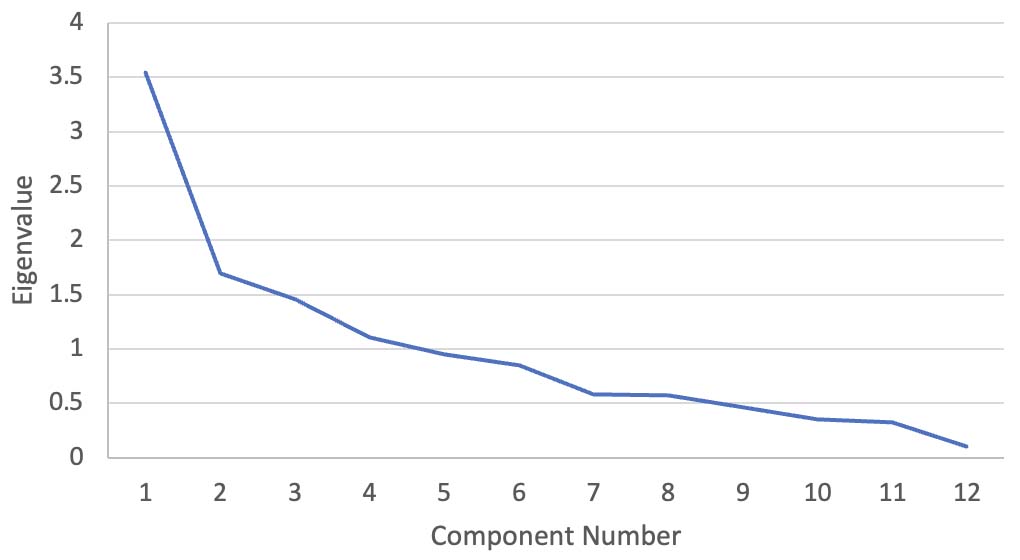
In the Figure 1 we can see the loading of each component and the amount of variance explained by them. The table clearly shows that the first and second factors are the most important and that they explain the largest part of the variance. Conversely, the last factor is the least significant and explains the smallest part of the variance. Figure 1 illustrates the relative importance of each component in the analysis.
Figure 1
Scree Plot of Principal Component Analysis
Our study aimed to investigate the factors influencing the resilience and effectiveness of distance education in elementary schools during global crises, with a specific focus on the COVID-19 pandemic in Türkiye. The results of the factor analysis revealed four key components that played crucial roles in this context: (a) teachers’ prior knowledge of and experience in distance education, (b) teachers’ perspectives on the EIN, (c) support received from stakeholders, and (d) teachers’ technology integration knowledge and experience.
The findings highlighted the critical importance of teachers’ prior knowledge of and experience in distance education. This aligned with previous research by König et al. (2020), who found that educators with prior online teaching experience were better equipped to handle the sudden transition to remote learning. The strong loading of items related to pre-pandemic experience and undergraduate training in distance education suggested that teacher preparation programs should incorporate more extensive training in online teaching methodologies. This finding was further supported by Trust and Whalen (2020), who observed that teachers with previous online teaching experience were more likely to use a wider variety of digital tools and effectively engage students in remote learning environments. Similarly, Bao (2020) emphasized that effective distance education relied heavily on instructors’ familiarity with online teaching tools and pedagogies, which is often acquired through prior experience or training. The importance of prior knowledge extended beyond just familiarity with technology. Carrillo and Flores (2020) found that teachers with previous experience in online education were better able to adapt their pedagogical approaches to the digital environment, maintaining student engagement and learning outcomes. This adaptability is crucial, as Hodges et al. (2020) pointed out that emergency remote teaching differed significantly from well-planned online learning experiences. Furthermore, our results were consistent with Toquero (2020), who suggested that teacher training programs should be revamped to focus more on educational technology and online teaching methods. This is especially crucial considering the possibility of future interruptions to conventional in-person teaching, whether caused by pandemics or unexpected events. The significant link between previous knowledge and successful execution of remote learning further reinforced Ferdig et al. (2020), who highlighted that educators who had previous experience in online teaching were more self-assured, creative in their pedagogical methods, and better equipped to cater to their students’ educational requirements amidst the pandemic.
The emergence of EIN as a distinct influence underscored its significance in the Turkish context. This finding supported the work of Duzgun (2021) and Karalar and Dogan (2017), who identified EIN as a valuable tool for online instruction in Türkiye. The positive correlation between this factor and teachers’ prior knowledge suggested that familiarity with distance education may have led to more effective use of platforms like EIN. The importance of EIN in the Turkish educational landscape during the pandemic was further emphasized by Ozer (2020), who highlighted the platform’s role in ensuring educational continuity. Ozer noted that EIN’s rapid expansion and adaptation were crucial in meeting the sudden surge in demand for online educational resources. This aligned with our findings, which showed that teachers’ perspectives on EIN significantly influence the effectiveness of distance education. Karatas and Tuncer (2020) carried out an in-depth examination of the characteristics of EIN and determined that the platform’s ease of use and varied content were key factors in its popularity among Turkish teachers. Our findings supported this idea, indicating that teachers’ favorable views of EIN were associated with its usefulness and user-friendliness, important components in the TAM (Davis, 1989). The connection between teachers’ previous knowledge and their viewpoints on EIN was especially remarkable. Teo et al. (2019) found that teachers’ attitudes toward new digital platforms were positively affected by their previous experience with educational technology, supporting this relationship. This means that teachers with greater experience in online learning were more likely to make the most of EIN’s features. Nevertheless, it is crucial to acknowledge that despite its overall success, EIN still faces obstacles. Karalar and Dogan (2017) highlighted that some teachers faced challenges in making full use of EIN’s capabilities because of technical problems or inadequate training. This emphasized the importance of continuous professional growth and technical assistance, as mentioned in our third factor. Lastly, the positive perception of EIN among teachers, as revealed in our study, supported the findings of Akbulut et al. (2020), who reported high levels of satisfaction with EIN among both teachers and students. This positive reception suggested that EIN, and similar platforms, may continue to play a significant role in Turkish education even beyond the pandemic, potentially reshaping the landscape of educational technology in the country.
The importance of support from school administration, parents, and technical staff emerged as a separate influence, confirming the findings of Rasmitadila et al. (2020) and Garbe et al. (2020). Similar patterns were observed globally, such as in Indonesia, where Rasmitadila et al. (2020) found that administrative support and stakeholder collaboration significantly influenced online education success. Likewise, in the US, Garbe et al. (2020) emphasized the role of parental involvement, paralleling our findings on stakeholder engagement. However, in our study it is seen that stakeholder support varied by socio-economic context. Parents in low-income households may have limited time or digital literacy, affecting their ability to assist with remote learning. Policies should account for these disparities. This highlighted the need for a holistic approach to distance education, where success depends on teachers and a supportive ecosystem involving multiple stakeholders. The critical role of school administration in facilitating effective distance education was further emphasized by Fernandez and Shaw (2020), who argued that educational leaders need to provide clear guidance, technical assistance, and emotional support to teachers during crisis-driven transitions to online learning. This aligned with our findings, which showed that administrative support significantly influences teachers’ ability to deliver effective distance education. Parental support, another key element in our findings, has been corroborated by the work of Bhamani et al. (2020), who found that parental involvement was crucial in maintaining student engagement and motivation during remote learning. Additionally, Dong et al. (2020) noted that the efficacy of online education, particularly for younger students, was greatly influenced by parents’ capacity to create a supportive learning environment at home. Our study emphasized the significance of technical support, which aligned with Dhawan’s (2020) findings stressing the importance of strong technical infrastructure and support in overcoming technological obstacles in distance education. This idea has also been backed up by Trust and Whalen (2020), who discovered that teachers with consistent technical support were more inclined to try out various online teaching methods and tools. Furthermore, our study’s results were in line with Garrison et al.’s (2010) suggestion of the community of inquiry model, which underscored the significance of social presence in virtual educational settings. Different stakeholders’ support helps build a feeling of community that improves the overall learning experience. Support’s rise as an individual factor aligns with Huber and Helm’s (2020) research, which revealed that collaborative school environments and supportive leadership played crucial roles in schools effectively managing distance education during the COVID-19 pandemic globally.
The fourth component of our study highlighted the importance of teachers incorporating technology into their teaching practices. This supported the findings of Tondeur et al. (2019 and Ozudogru (2021), indicating that teachers with advanced technology integration abilities demonstrated increased adaptability and enthusiasm for online education. The strong connection between this component and teachers’ previous experience with distance education indicated that these abilities are connected and support each other. Koehler and Mishra (2009) backed up this discovery with their proposed technological pedagogical content knowledge (TPACK) framework. TPACK highlighted the significance of teachers’ capacity to efficiently merge technology, pedagogy, and content knowledge in their instructional methods. The findings of our study resonated with this model, emphasizing the vital importance of technology integration skills in effective distance learning. Ertmer and Ottenbreit-Leftwich (2010) suggested that teachers’ views and feelings about technology played a major role in their capacity to incorporate it into their teaching practices. This aligned with our results and indicated a strong link between teachers’ understanding of technology integration and their performance in online teaching. Scherer et al. (2019) further emphasized the significance of proficiency in integrating technology through a meta-analysis of studies on the TAM in the educational sector. They discovered that teachers’ perceptions of technology as easy to use and useful were important in predicting their intention to use technology in teaching. This was consistent with our results and indicated that educators who have more advanced technology integration abilities may view online teaching resources as more beneficial and user-friendly. Our results supported the idea of a connection between technology integration skills and previous experience with distance education, which was also evident in König et al. (2020). They discovered that teachers’ proficiency in using digital tools, often acquired from prior experience with technology-aided teaching, strongly influenced their capability to uphold high standards of instruction in virtual settings. Additionally, Sánchez-Cruzado et al. (2021) stressed the significance of continuous professional growth in technology integration, and highlighted that educators who consistently participate in such programs had more skill in successfully integrating technology into their instructional methods. This indicated the importance of continually developing technology integration skills, rather than just making a single attempt.
Our study had several limitations. First, the sample was limited to 100 elementary school teachers in Türkiye, which may affect the generalizability of the findings. While participants were selected from different regions, a larger and more diverse sample could offer deeper insights. Second, the cross-sectional design of the study limited our ability to assess changes in teachers’ perceptions and practices over time; longitudinal studies could address this. Third, the reliance on self-reported data carries risks of biases such as social desirability or recall errors. Future research could incorporate methods like classroom observations, interviews, and student outcomes for a more holistic analysis. Finally, this study focused solely on teachers’ perspectives, excluding those of students, parents, and administrators, whose views could enhance our understanding of distance education’s effectiveness and durability.
The purpose of our research was to analyze the factors that impacted the strength and success of remote learning in elementary schools in Türkiye during the COVID-19 pandemic. Our study has pinpointed four essential components that are vital in this situation: (a) teachers’ prior knowledge of and experience in distance education, (b) teachers’ perspectives on the EIN, (c) support received from stakeholders, and (d) teachers’ technology integration knowledge and experience. Our study introduced a validated scale that enabled quantifiable assessment of these key components. Unlike prior conceptual models, this tool provided measurable means for evaluating institutional preparedness and instructional resilience. Although developed in Türkiye, the scale was designed to address global challenges in online education (Bozkurt et al., 2020; König et al., 2020) and can be adapted to different educational contexts. Future research can validate its cross-cultural applicability. While this study introduced a framework for assessing resilience in distance education, additional validation is necessary to establish its broader applicability and effectiveness in diverse educational settings. Future adaptations of this scale could consider context-specific factors in different education systems, such as infrastructure disparities in developing regions and variations in policy-driven distance learning models worldwide.
These results have highlighted the intricate and multi-dimensional aspects of successful distance learning, especially during emergency situations. The rise of four separate but interconnected factors underscored the importance of taking a comprehensive approach to improving the resilience and effectiveness of distance education.
The information we gathered has shown that teachers’ prior knowledge of and experience in distance education are essential for effective online teaching. This highlighted the need to include thorough distance education training in teacher preparation programs and in continuing professional development efforts. The importance of the EIN in Türkiye illustrated how national educational platforms can help facilitate widespread shifts to online learning. Nevertheless, it also emphasized the necessity of ongoing enhancements and adjustments to these platforms to address changing educational requirements.
Support from school administrators, parents, and technical staff is essential for effective remote learning, requiring strong collaboration among stakeholders. Policies should foster partnerships among teachers, school leaders, parents, and IT support teams to enhance distance education resilience.
Our findings have key implications for educational policy and practice, calling for
Beyond Türkiye, these findings inform global efforts to strengthen distance education. Governments and institutions can use this scale to assess gaps in teacher training, stakeholder support, and technology integration, guiding investments in professional development and digital infrastructure. Adapting this framework across diverse education systems can help shape targeted policies for equitable and sustainable remote learning.
In summary, our study highlighted that the strength and success of distance education during the global crisis relied on various factors such as teacher readiness, technological support, stakeholder involvement, and teachers’ skill in using technology in teaching. Educational systems can improve their ability to deliver high-quality education despite challenging situations such as the COVID-19 pandemic by tackling these factors in a thorough and organized fashion.
It would be beneficial to investigate how the factors revealed in our study are expressed in various cultural and educational settings, and how they change as online learning becomes more highly integrated in worldwide education systems. Furthermore, long-term studies may offer important perspectives on the lasting effects of these factors on student academic outcomes and overall quality of education.
This paper was reviewed, edited, and refined with assistance from ChatGPT (Model 4.0 as of December 2024) serving as a complement to the human editorial process. The human authors critically evaluated and validated all content to ensure academic rigor and addressed any potential biases in the AI-generated contributions. The final responsibility for the content and conclusions of this paper lies solely with the human authors (Bozkurt, 2024).
Akbulut, M., Şahin, U., & Esen, A. C. (2020). More than a virus: How COVID 19 infected education in Turkey? Journal of Social Science Education, 19(1), 30-42. https://doi.org/10.4119/jsse-3490
Al-Adwan, A. S., Li, N., Al-Adwan, A., Abbasi, G. A., Albelbisi, N. A., & Habibi, A. (2023). Extending the technology acceptance model (TAM) to predict university students’ intentions to use metaverse-based learning platforms. Education and Information Technologies, 28(11), 15381-15413. https://doi.org/10.1007/s10639-023-11816-3
Bao, W. (2020). COVID-19 and online teaching in higher education: A case study of Peking University. Human Behavior and Emerging Technologies, 2(2), 113-115. https://doi.org/10.1002/hbe2.191
Bhamani, S., Makhdoom, A. Z., Bharuchi, V., Ali, N., Kaleem, S., & Ahmed, D. (2020). Home learning in times of COVID: Experiences of parents. Journal of Education and Educational Development, 7(1), 9-26. http://dx.doi.org/10.22555/joeed.v7i1.3260
Bozkurt, A. (2024). GenAI et al.: Cocreation, authorship, ownership, academic ethics and integrity in a time of generative AI. Open Praxis, 16(1), 1-10. https://doi.org/10.55982/openpraxis.16.1.654
Bozkurt, A., Jung, I., Xiao, J., Vladimirschi, V., Schuwer, R., Egorov, G., Lambert, S., Al-Freih, M., Pete, J., Olcott, D., Jr., Rodes, V., Aranciaga, I., Bali, M., Alvarez, A., Jr., Roberts, J., Pazurek, A., Raffaghelli, J. E., Panagiotou, N., de Coetlogon, P.,... Paskevicius, M. (2020). A global outlook to the interruption of education due to COVID-19 pandemic: Navigating in a time of uncertainty and crisis. Asian Journal of Distance Education, 15(1), 1-126. https://www.asianjde.com/ojs/index.php/AsianJDE/article/view/462
Bozkurt, A., & Sharma, R. C. (2020). Education in normal, new normal, and next normal: Observations from the past, insights from the present and projections for the future. Asian Journal of Distance Education, 15(2), i-x. https://www.asianjde.com/ojs/index.php/AsianJDE/article/view/512
Carrillo, C., & Flores, M. A. (2020). COVID-19 and teacher education: A literature review of online teaching and learning practices. European Journal of Teacher Education, 43(4), 466-487. https://doi.org/10.1080/02619768.2020.1821184
Creswell, J. W., & Creswell, J. D. (2017). Research design: Qualitative, quantitative, and mixed methods approaches. Sage. https://shorturl.at/U0GGV
Davis, F. D. (1989). Perceived usefulness, perceived ease of use, and user acceptance of information technology. MIS Quarterly, 13(3), 319-340. https://doi.org/10.2307/249008
Dhawan, S. (2020). Online learning: A panacea in the time of COVID-19 crisis. Journal of Educational Technology Systems, 49(1), 5-22. https://doi.org/10.1177/0047239520934018
Dong, C., Cao, S., & Li, H. (2020). Young children’s online learning during COVID-19 pandemic: Chinese parents’ beliefs and attitudes. Children and Youth Services Review, 118, 105440. https://doi.org/10.1016/j.childyouth.2020.105440
Duzgun, S. (2021). Teachers’ attitudes toward Turkey education informatics network during the distance education period in the COVID-19 pandemic. International Journal of Progressive Education, 17(5). https://doi.org/10.29329/ijpe.2021.375.8
Ertmer, P. A., & Ottenbreit-Leftwich, A. T. (2010). Teacher technology change: How knowledge, confidence, beliefs, and culture intersect. Journal of Research on Technology in Education, 42(3), 255-284. https://doi.org/10.1080/15391523.2010.10782551
Ferdig, R. E., Baumgartner, E., Hartshorne, R., Kaplan-Rakowski, R., & Mouza, C. (Eds.). (2020). Teaching, technology, and teacher education during the COVID-19 pandemic: Stories from the field. Association for the Advancement of Computing in Education. https://www.learntechlib.org/p/216903/
Fernandez, A. A., & Shaw, G. P. (2020). Academic leadership in a time of crisis: The coronavirus and COVID‐19. Journal of Leadership Studies, 14(1), 39-45. https://doi.org/10.1002/jls.21684
Garbe, A., Ogurlu, U., Logan, N., & Cook, P. (2020). COVID-19 and remote learning: Experiences of parents with children during the pandemic. American Journal of Qualitative Research, 4(3), 45-65. https://doi.org/10.29333/ajqr/8471
Garrison, D. R., Anderson, T., & Archer, W. (2010). The first decade of the community of inquiry framework: A retrospective. The Internet and Higher Education, 13(1-2), 5-9. https://doi.org/10.1016/j.iheduc.2009.10.003
Hair, J. F., Black, W. C., Babin, B. J., & Anderson, R. E. (2010). Multivariate data analysis (7th ed.). Pearson.
Hodges, C., Moore, S., Lockee, B., Trust, T., & Bond, A. (2020). The difference between emergency remote teaching and online learning. Educause Review, 27, 1-12. https://er.educause.edu/articles/2020/3/the-difference-between-emergency-remote-teaching-and-online-learning
Huber, S. G., & Helm, C. (2020). COVID-19 and schooling: Evaluation, assessment and accountability in times of crises—Reacting quickly to explore key issues for policy, practice and research with the school barometer. Educational Assessment, Evaluation and Accountability, 32, 237-270. https://doi.org/10.1007/s11092-020-09322-y
Karalar, H., & Dogan, U. (2017). Teacher perception on educational informatics network: A qualitative study of a Turkish Anatolian high school. International Education Studies, 10(4), 101-112. https://doi.org/10.5539/ies.v10n4p101
Karatas, S., & Tuncer, H. (2020). Sustaining language skills development of pre-service EFL teachers despite the COVID-19 interruption: A case of emergency distance education. Sustainability, 12(19), 8188. https://doi.org/10.3390/su12198188
Kizil, I., & Kizil, F. S. (2024). Internal barriers to integrating technology in literacy instruction: Challenges faced by teachers. Journal of Social Perspective Studies, 1(1), 20-30.
Kline, R. (2013). Exploratory and confirmatory factor analysis. In Y. Petscher, C. Schatschneider, & D. L. Compton (Eds.), Applied quantitative analysis in education and the social sciences (pp. 171-207). Routledge.
Koehler, M. J., & Mishra, P. (2009). What is technological pedagogical content knowledge? Contemporary Issues in Technology and Teacher Education, 9(1). https://citejournal.org/volume-9/issue-1-09/general/what-is-technological-pedagogicalcontent-knowledge
König, J., Jäger-Biela, D. J., & Glutsch, N. (2020). Adapting to online teaching during COVID-19 school closure: Teacher education and teacher competence effects among early career teachers in Germany. European Journal of Teacher Education, 43(4), 608-622. https://doi.org/10.1080/02619768.2020.1809650
Logan, J. R., & Burdick-Will, J. (2017). School segregation and disparities in urban, suburban, and rural areas. The ANNALS of the American Academy of Political and Social Science, 674(1), 199-216. https://doi.org/10.1177/0002716217733936
Mishra, L., Gupta, T., & Shree, A. (2020). Online teaching-learning in higher education during lockdown period of COVID-19 pandemic. International Journal of Educational Research Open, 1, 100012. https://doi.org/10.1016/j.ijedro.2020.100012
Ozer, M. (2020). Educational policy actions by the Ministry of National Education in the times of COVID-19 pandemic in Turkey. Kastamonu Education Journal, 28(3), 1124-1129. https://doi.org/10.24106/kefdergi.722280
Ozudogru, G. (2021). Problems faced in distance education during COVID-19 pandemic. Participatory Educational Research, 8(4), 321-333. https://doi.org/10.17275/per.21.92.8.4
Rasmitadila, R., Aliyyah, R. R., Rachmadtullah, R., Samsudin, A., Syaodih, E., Nurtanto, M., & Tambunan, A. R. S. (2020). The perceptions of primary school teachers of online learning during the COVID-19 pandemic period: A case study in Indonesia. Journal of Ethnic and Cultural Studies, 7(2), 90-109. https://doi.org/10.29333/ejecs/388
Sánchez-Cruzado, C., Santiago Campión, R., & Sánchez-Compaña, M. T. (2021). Teacher digital literacy: The indisputable challenge after COVID-19. Sustainability, 13(4). https://doi.org/10.3390/su13041858
Scherer, R., Siddiq, F., & Tondeur, J. (2019). The technology acceptance model (TAM): A meta-analytic structural equation modeling approach to explaining teachers’ adoption of digital technology in education. Computers & Education, 128, 13-35. https://doi.org/10.1016/j.compedu.2018.09.009
Teo, T., Huang, F., & Hoi, C. K. W. (2019). Explicating the influences that explain intention to use technology among English teachers in China. Interactive Learning Environments, 27(8), 1032-1048. https://doi.org/10.1080/10494820.2017.1341940
Tondeur, J., Scherer, R., Baran, E., Siddiq, F., Valtonen, T., & Sointu, E. (2019). Teacher educators as gatekeepers: Preparing the next generation of teachers for technology integration in education. British Journal of Educational Technology, 50(3), 1189-1209. https://doi.org/10.1111/bjet.12748
Toquero, C. M. (2020). Challenges and opportunities for higher education amid the COVID-19 pandemic: The Philippine context. Pedagogical Research, 5(4). https://doi.org/10.29333/pr/7947
Trust, T., & Whalen, J. (2020). Should teachers be trained in emergency remote teaching? Lessons learned from the COVID-19 pandemic. Journal of Technology and Teacher Education, 28(2), 189-199. https://www.learntechlib.org/primary/p/215995/
Van Dijk, J. (2020). The digital divide. Polity Press. https://www.researchgate.net/publication/336775088_Jan_van_Dijk_20192020_The_Digital_Divide_Polity_Press
Wysocka-Narewska, M. (2022). Distance learning at the level of primary education: Parents’ opinions and reflections. International Journal of Research in E-learning, 8(2), 1-20. https://doi.org/10.31261/IJREL.2022.8.2.06

Enhancing Distance Education Resilience: Developing a Scale for Effective Implementation During Global Crises by Ibrahim Kizil, Fatima Seyma Kizil, and Bong Gee Jang is licensed under a Creative Commons Attribution 4.0 International License.