Volume 26, Number 3
Virgiawan Listanto, Janu Arlinwibowo, Anggraeni Dian Permatasari, Khofifa Najma Iftitah, and Ence Oos Mukhamad Anwas
National Research and Innovation Agency, Jakarta Pusat, Indonesia
This study evaluated the effect of electronic books (e-books) on improving language learning outcomes, particularly in core proficiencies such as speaking, writing, and listening, which are identified as key areas of improvement. Using a meta-analysis approach, this research employed a randomized model with experimental and control groups. Data selection followed the preferred reporting items for systematic reviews and meta-analyses (PRISMA) scheme, based on inclusion and exclusion criteria, using the Scopus database. Statistical analyses included tests for heterogeneity, publication bias, total effect size, and moderator variables using analysis of variance. The findings indicate that e-books positively influence the learning process as compared to printed books, with a medium standardized effect size of 0.5. Among languages, Arabic and Turkish benefitted the most from e-book use, while native language learning showed greater improvements than second-language acquisition. Interactive e-books demonstrated significantly higher effectiveness compared to non-interactive ones, though their impact on reading skills was relatively smaller. These results underscore the value of e-books as tools for enhancing language learning. Future efforts should focus on developing interactive e-books tailored to specific languages and proficiency needs to maximize educational potential.
Keywords: e-book, printed book, language learning, student achievement, meta-analysis
Electronic books (e-books) have evolved from being merely an alternative format to printed books to being a mainstream medium in various aspects of life, including education, entertainment, and research. In education, e-books have enabled the distribution of learning materials at a lower cost and faster time than printed books (Alsalhi et al., 2020; Amirtharaj et al., 2023). In addition, increased accessibility through mobile devices such as tablets and smartphones has expanded the reach of e-book users.
In education, e-books offer easy access and distribution that is not limited by geographical location, allowing students and teachers to access educational resources more efficiently (Bradley et al., 2023; Tlili et al., 2022). Previous research shows that using e-books can increase students’ motivation, enable more interactive and dynamic learning, and improve learning outcomes (Franco & Bidarra, 2022; Liana Mumrikoh et al., 2023). Interactive features such as hyperlinks, multimedia, and digital annotations allow students to learn more deeply and engage with course material.
E-books equipped with interactive features such as audio, video, and animation can help language learners better understand context and pronunciation. The use of e-books in English as a foreign language (EFL) learning has been shown to improve students’ reading and comprehension skills (Hsieh & Huang, 2020). These multimedia features allow learners to hear correct pronunciation, see visualizations of concepts, and interact with the content more deeply.
Other studies have also shown that e-books can enrich vocabulary, improve comprehension, build reading habits, and analyze texts, making them practical for learning foreign languages at various educational levels (Pavlovic & Petrović, 2020). E-books are essential in improving vocabulary in language learning because they have various interactive features and recommendations tailored to students’ needs. E-books provide a complete platform for efficient vocabulary learning by assessing students’ knowledge based on their activities and giving personalized recommendations (Takii et al., 2021). In addition, e-books can incorporate digital storytelling tools, such as text, audio, and visuals, effectively improving vocabulary, English language skills, and motivation to learn a foreign language (Albishi & Alqiawi, 2022).
Furthermore, integrating visual images into e-books for writing tasks has been shown to significantly increase participants’ vocabulary, demonstrating the effectiveness of innovative learning designs in improving vocabulary acquisition through learning using e-books (Sariani et al., 2021). E-books can enhance the quality of learning, student achievement, and classroom atmosphere by providing many learning tools and possibilities (Duvnjak et al., 2022). These studies have shown that since e-books positively impact language learning outcomes, they have become a valuable resource.
Although there are some drawbacks to the use of e-books in language learning, such as the lack of direct interaction between teachers and students, the difficulty of reading on screens, and limitations on some learning content, the effectiveness of e-books depends on how they are structured, their quality, and the learning environment created by teachers (Puric & Sekač, 2022). This study provides a comprehensive understanding of the impact of e-book use, both positive and negative, in various contexts. It also explores how factors such as grade, class size, and reading format preferences can influence the e-book user experience. Thus, the study’s results provide more holistic and applicable insights for various stakeholders, including educators, policymakers, and technology developers.
So far, research related to the use of e-books in language learning has focused only on children’s reading or literacy skills at an early age (Egert et al., 2022; Furenes et al., 2021; Lee & McKee, 2023; Savva et al., 2022) and reading skills in grades K–12 (Swanson et al., 2020). Meanwhile, meta-analysis research involving studies of all levels and all language skills has yet to be conducted. Therefore, research related to the effect of e-books on language learning that examines a range of variables, including level of education and participants’ language abilities (not only reading), is fundamental. In addressing this research gap, this study aimed to examine the effect of e-books on language learning by considering various moderator variables including language, language status, language proficiency, grade, e-book type, domain competencies, the information-base, era, and class size. These variables would be expected to provide new insights into how e-books affected different user groups. Thus, exploring these variables had the potential to significantly contribute to our understanding of e-book usage, especially in language learning.
This research is a meta-analysis that aimed to summarize various data on the effect of specialized electronic books in English language learning. Meta-analysis research is a technique used to summarize various studies with similar methods and identical themes (Chang et al., 2022). It is a suitable method for synthesizing results from multiple experimental studies. In this study, we used the group contrast model to analyze data from diverse research findings (Fajaruddin et al., 2024). In meta-analysis research, the final result of inference is the total effect size, which represents the general picture, in this case, the difference in the effect of electronic books versus printed books (Mamekova et al., 2021).
This study retrieved data from selected articles found in globally reputable publications, which were Scopus-indexed journals. Data collection was carried out through the Scopus database portal (https://www.scopus.com), and several research results owned by researchers. The selection of the Scopus database was intended to allow control of data quality. Researchers assume that every research paper published in Scopus-indexed journals has gone through a rigorous review process so that the quality of the research is guaranteed, at least compared to articles in non-reputable journals.
The data collection process used the keywords “interactive book” OR “e-book” OR “electronic book” OR “audiobook” OR “audio book” OR “digital book” OR “virtual book” AND “language” OR “english” OR “indonesian” OR “arabic” OR “EFL” AND “achievement” OR “outcome” OR “skill” OR “knowledge” OR “attitude” OR “reading” OR “grammar” OR “ vocabulary” OR “structure” OR “listening”. The use of various Boolean logics was used to obtain a larger but targeted set of articles. From the search results based on keywords, we made a selection with strict inclusion and exclusion criteria. These are shown in Table 1.
Table 1
Inclusion and Exclusion Criteria Used to Identify Studies on E-Books and Language Learning
| Aspect | Inclusion criteria | Exclusion criteria |
| Year | 2019–2024 | Else |
| Language | English | Else |
| Article type | Research article | Else |
| Data type | Quantitative | Qualitative |
| Research design | Group contrast | Else |
| Research model | Control and experiment | Does not load either or both |
| Data component | Sample size, mean, and standard deviation | Does not load one, two, or all three |
| Analysis data | Quantitative | Qualitative |
| Theme | The influence of e-books on language learning | Else |
| Data base | Scopus | Else |
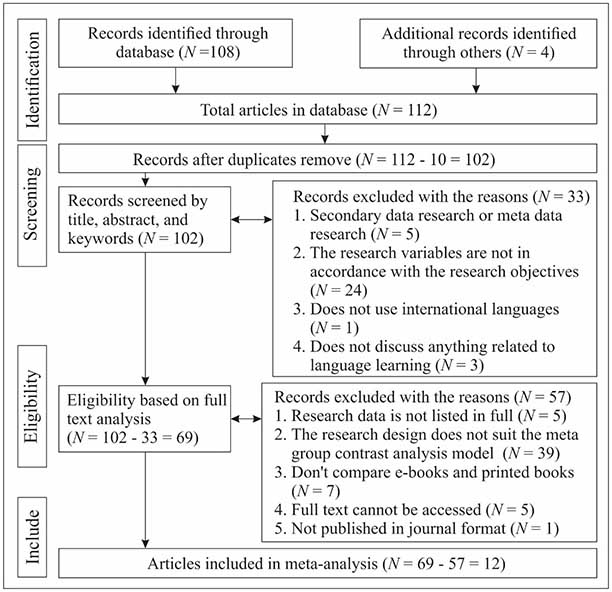
The selected data were from articles that met all the inclusion criteria. If a criterion was not met, the data were excluded from the analysis. To control the data search process, this research used the preferred reporting items for systematic reviews and meta-analyses (PRISMA) model. The PRISMA model is used as a data recapitulation procedure so that the data search sequence can be well documented, with all data traced and accounted for (Page et al., 2021). The PRISMA diagram for this study is shown in Figure 1.
Figure 1
Data Selection Flow With PRISMA Model
Note. PRISMA = preferred reporting items for systematic reviews and meta-analyses (https://www.prisma-statement.org/).
In the data selection process, 12 articles were obtained that met all inclusion criteria. These 12 articles each had mostly more than one relevant data point. For example, the article written by Tsuei et al. (2020) had five relevant data to analyze (Research Data section, paragraph 4, page 5), and the research by Phadung and Dueramae (2018) had three relevant data to analyze. The 12 articles contained 43 relevant data points to be analyzed.
The data collected for analysis showed a heterogeneous character indicated by research conducted in various countries, levels, languages, media, and other undefined conditions. Thus, based on the characteristics of the data, the appropriate analysis model would be the random-effect model. However, the identified characteristics needed to be statistically confirmed through heterogeneity tests (Borenstein, 2009). This study used three test models to confirm heterogeneity: the Q statistic, tau-squared (τ2), and I-squared (I2) parameter methods. Data is said to be heterogeneous if the probability value of Q < .05 (5% error), τ2 > 0 (Retnawati et al., 2018), and I2 < 75% (Higgins, 2003). Use of three methods can be expected to be accurate because there would be mutual correction between methods.
In the next step, we needed to prove that the data collected were free from publication bias. Although the data collection process had strictly adhered to the robust PRISMA procedures, the quality of the data still needed to be confirmed. To prove that the data were free from publication bias, we used three methods of proof: the funnel plot, Egger’s test method, and the fail-safe N formula. A dataset is said to be free from publication bias if the distribution of points in the funnel plot tends to be symmetrical, when the Egger’s test probability value exceeds the tolerance of error (Retnawati et al., 2018), and when N > 5K + 10 (where N is the fail-safe N value and K is the number of studies; Mullen et al., 2001).
In this study, we used a group contrast model with a different group design, namely between the experimental and control groups. In the process of examining the data, we found variations in data intervals that required a standardization process. Therefore, we applied a standardized group difference model (Arlinwibowo et al., 2023). After the data were proportionally standardized, the next step was the calculation to find the total effect size. To minimize the bias of the effect size, the calculation process was transformed with the Hedges formula (Hedges, 1981). The analysis process was assisted by R software (Version R 4.4.1), with meta and metaphor packages. The total effect-sizes were classified according to the recommendations from Sullivan and Feinn (2012) as shown in Table 2.
Table 2
Categories of Effect Sizes Applied in This Meta-Analysis
| Effect size | Category |
| 0–0.19 | No effect |
| 0.20–0.49 | Small |
| 0.50–0.79 | Medium |
| 0.80–1.29 | Large |
| More than 1.30 | Very large |
To understand in greater depth the total effect size, we carried out a moderator variable analysis to explore the variables alleged to influence the main variable. The moderator variables analyzed were expected to enrich the meaning of the findings. In this meta-analysis, there were 9 moderator variables: language, status, proficiency, grade, e-book type, domain, information base, era, and class size. The analysis of moderator variables was based on variant analysis techniques (Arlinwibowo et al., 2023), with inference criteria based on identifying the significance of differences between variables. The identification of significance was based on probability values. If the probability value was below 5%, there would be a significant difference between groups of moderator variables (95% confidence level). Table 3 shows the moderator variables analyzed in this study as well as their categories and frequency.
Table 3
Categories and Frequency of Moderator Variables Analyzed in the Study
| Variable | Category | n | % |
| Language | Chinese | 15 | 34.88 |
| English | 21 | 48.84 | |
| Spanish | 1 | 2.33 | |
| Turkish | 2 | 4.65 | |
| Thai | 3 | 6.98 | |
| Arab | 1 | 2.33 | |
| Status | Native language | 24 | 55.81 |
| Foreign language | 19 | 44.19 | |
| Proficiency | Lexical | 13 | 30.23 |
| Writing | 2 | 4.65 | |
| Reading | 20 | 46.51 | |
| Listening | 6 | 13.95 | |
| Speaking | 2 | 4.65 | |
| Grade | Elementary | 26 | 60.47 |
| Junior High School (JHS) | 9 | 20.93 | |
| Senior High School (SHS) | 6 | 13.95 | |
| University | 2 | 4.65 | |
| E-book type | Interactive | 13 | 30.23 |
| Non-interactive | 30 | 69.77 | |
| Domain | Attitude | 8 | 18.60 |
| Knowledge | 22 | 51.16 | |
| Skill | 13 | 30.23 | |
| Information base | Visual | 36 | 83.72 |
| Audio | 7 | 16.28 | |
| Era | Pre COVID (2018–2019) | 8 | 18.60 |
| COVID (2020–2021) | 20 | 46.52 | |
| Post COVID (2022–2024) | 15 | 34.88 | |
| Class Size | Small (n <= 30) | 30 | 69.77 |
| Large (n < 30) | 13 | 30.23 |
Our analysis began with proving the data used in our study were heterogeneous. Heterogeneity must be proven when a study uses a random-effects model, although in the data collection process, it was already apparent to us that the data were heterogeneous, as indicated by the highly variable data sources (school level, country of study, time of implementation, e-book type, and various other aspects).
To assess heterogeneity, three statistical tests were employed: the I2 statistic, the Q statistic, and the tau-squared (τ2) estimate. This multi-method approach was adopted to enhance the robustness of the findings. The results indicated significant heterogeneity across studies. The I2 statistic was 79.3%, with a 95% confidence interval [72.7%, 84.4%], classifying the heterogeneity as substantial. The Q statistic yielded a probability value of less than .0001, further supporting the presence of heterogeneity. Additionally, the τ2 estimate was .2769, with a 95% confidence interval [.1621, .5188], confirming the existence of variability beyond chance. Given these results, a random-effects model was deemed appropriate for the subsequent meta-analysis.
The assumption of freedom from publication bias was assessed using three methods. A visual inspection of the funnel plot (Figure 2) revealed a relatively symmetrical distribution of effect sizes, suggesting no apparent bias. To further quantify this assessment, Egger’s test was conducted, yielding a p-value of .0771, which exceeded the .05 significance level. Additionally, a fail-safe N analysis was performed, resulting in a value of 2,061, significantly larger than the required threshold of 225. Based on these combined findings, it was confidently concluded that the data used in this meta-analysis were free from publication bias, thereby enhancing the reliability of the overall results.
Figure 2
Funnel Plot Showing the Association of Effect Sizes in the Analyzed Publications
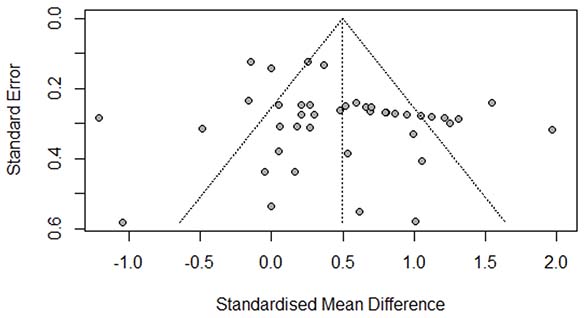
Note. Each dot represents an individual study included in the meta-analysis comparing language learning outcomes using e-books versus printed books. The x-axis displays the standardized mean difference (SMD) for each study, while the y-axis indicates the standard error. The two diagonal lines form a funnel shape, representing the 95% confidence limits within which study results are expected to fall around the overall mean effect. The vertical dashed line in the center shows the summary effect size from the meta-analysis. This plot is used to assess the symmetry of the data and to identify potential publication bias.
Having established data heterogeneity and no publication bias, we proceeded to calculate a total effect size to compare e-book and printed book learning. This analysis combined the effect sizes from individual studies to determine the overall effect of e-book use. Table 4 presents this data, summarizing the effect size of each study and showing the total effect size.
Table 4
Effect Sizes of E-Book Versus Printed Book on Langauge Learning in Individual Studies Included in the Meta-Analysis
| Article | Study | n.e | Mean.e | SD.e | n.c | Mean.c | SD.c | SMD | Lower | Upper |
| Alsalhi et al. (2020) | 1 | 46 | 16.46 | 2.14 | 45 | 13.93 | .82 | 1.55 | 1.07 | 2.02 |
| Aydın & Tunagür (2021) | 1 | 30 | 83.73 | 6.91 | 30 | 75.27 | 8.89 | 1.05 | .51 | 1.59 |
| Aydın & Tunagür (2021) | 2 | 30 | 75.90 | 4.54 | 30 | 68.70 | 6.17 | 1.31 | .75 | 1.87 |
| Chen et al. (2023) | 1 | 30 | 18.97 | 2.33 | 30 | 16.83 | 1.30 | 1.12 | .57 | 1.67 |
| Chen et al. (2023) | 2 | 30 | 18.97 | 2.33 | 30 | 17.63 | 1.38 | .69 | .17 | 1.21 |
| Chen et al. (2023) | 3 | 30 | 19.93 | 1.44 | 30 | 18.20 | 1.38 | 1.21 | .66 | 1.76 |
| Chen et al. (2023) | 4 | 30 | 19.93 | 1.44 | 30 | 17.43 | 1.04 | 1.96 | 1.34 | 2.59 |
| Chen et al. (2023) | 5 | 30 | 7.53 | 1.54 | 30 | 6.27 | 1.55 | .80 | .28 | 1.33 |
| Chen et al. (2023) | 6 | 30 | 7.53 | 1.54 | 30 | 6.13 | 1.38 | .95 | .41 | 1.48 |
| Chen et al. (2023) | 7 | 30 | 6.70 | .76 | 30 | 6.07 | .36 | 1.05 | .50 | 1.59 |
| Chen et al. (2023) | 8 | 30 | 6.70 | .76 | 30 | 6.18 | .36 | .86 | .33 | 1.39 |
| Chen et al. (2023) | 9 | 30 | 7.27 | 1.23 | 30 | 6.20 | 1.42 | .80 | .27 | 1.32 |
| Chen et al. (2023) | 10 | 30 | 7.27 | 1.23 | 30 | 6.63 | 1.38 | .48 | -.03 | 1.00 |
| Hsieh & Huang (2020) | 1 | 7 | 23.71 | 3.90 | 7 | 18.57 | 5.50 | 1.01 | -.13 | 2.14 |
| Hsieh & Huang (2020) | 2 | 7 | 29.29 | 4.42 | 7 | 24.71 | 8.75 | .62 | -.46 | 1.70 |
| Hsieh & Huang (2020) | 3 | 10 | 28.00 | 1.89 | 11 | 27.64 | 2.34 | .16 | -.70 | 1.02 |
| Hsieh & Huang (2020) | 4 | 10 | 41.40 | 3.41 | 11 | 41.55 | 2.51 | -.05 | -.90 | .81 |
| Hsieh & Huang (2020) | 5 | 7 | 29.43 | .98 | 7 | 29.43 | .98 | .00 | -1.05 | 1.05 |
| Hsieh & Huang (2020) | 6 | 7 | 47.43 | 1.51 | 7 | 49.14 | 1.57 | -1.04 | -2.18 | .10 |
| Kartal & Simsek (2017) | 1 | 32 | 6.53 | 2.37 | 34 | 4.94 | 2.13 | .70 | .20 | 1.20 |
| Moutsinas et al. (2023) | 1 | 21 | .94 | .47 | 21 | .79 | .59 | .27 | -.34 | .88 |
| Moutsinas et al. (2023) | 2 | 21 | .67 | .62 | 21 | .94 | .47 | -.48 | -1.10 | .13 |
| Moutsinas et al. (2023) | 3 | 21 | .88 | .53 | 21 | .79 | .45 | .18 | -.43 | .79 |
| Moutsinas et al. (2023) | 4 | 21 | 3.79 | .58 | 21 | 3.76 | .45 | .06 | -.55 | .66 |
| Moutsinas et al. (2023) | 5 | 21 | 4.00 | .58 | 21 | 3.55 | .24 | 1.00 | .35 | 1.64 |
| Park & Lee (2021) | 1 | 42 | 73.12 | 12.96 | 32 | 63.81 | 18.24 | .60 | .13 | 1.07 |
| Park & Lee (2021) | 2 | 42 | 50.45 | 18.41 | 32 | 53.41 | 17.84 | -.16 | -.62 | .30 |
| Phadung & Dueramae (2018) | 1 | 28 | 7.29 | 2.12 | 26 | 6.54 | 2.77 | .30 | -.24 | .84 |
| Phadung & Dueramae (2018) | 2 | 28 | 6.50 | 2.02 | 26 | 6.00 | 2.59 | .21 | -.32 | .75 |
| Phadung & Dueramae (2018) | 3 | 28 | 7.50 | 1.03 | 26 | 5.08 | 2.54 | 1.25 | .66 | 1.83 |
| Rahman & Hajar (2020) | 1 | 30 | 48.80 | 16.52 | 30 | 68.00 | 14.86 | -1.21 | -1.76 | -.65 |
| Tsuei et al. (2020) | 1 | 48 | 65.49 | 16.43 | 25 | 64.60 | 19.41 | .05 | -.43 | .53 |
| Tsuei et al. (2020) | 2 | 48 | 77.32 | 16.39 | 25 | 73.64 | 18.95 | .21 | -.27 | .70 |
| Tsuei et al. (2020) | 3 | 48 | 72.08 | 17.59 | 25 | 66.64 | 23.51 | .27 | -.21 | .76 |
| Tsuei et al. (2020) | 4 | 48 | 92.77 | 15.63 | 25 | 81.45 | 30.03 | .52 | .03 | 1.01 |
| Tsuei et al. (2020) | 5 | 48 | 107.63 | 18.03 | 25 | 91.41 | 32.93 | .67 | .17 | 1.16 |
| Tusmagambet (2020) | 1 | 14 | 162.92 | 25.57 | 14 | 135.29 | 25.39 | 1.05 | .25 | 1.85 |
| Tusmagambet (2020) | 2 | 14 | 8.64 | .93 | 14 | 8.00 | 1.36 | .53 | -.22 | 1.29 |
| Tusmagambet (2020) | 3 | 14 | 2.94 | .43 | 14 | 2.92 | .35 | .05 | -.69 | .79 |
| Wood et al. (2018) | 1 | 108 | 20.64 | 7.32 | 95 | 20.67 | 6.79 | .00 | -.28 | .27 |
| Wood et al. (2018) | 2 | 141 | 18.57 | 9.96 | 124 | 16.23 | 8.42 | .25 | .01 | .49 |
| Wood et al. (2018) | 3 | 121 | 86.85 | 11.46 | 137 | 88.71 | 13.50 | -.15 | -.39 | .10 |
| Wood et al. (2018) | 4 | 112 | 87.24 | 18.19 | 114 | 80.66 | 17.26 | .37 | .11 | .63 |
Note. n = 12 articles included in the meta-analysis summarize individual studies comparing language learning outcomes between e-book and printed book users. Studies are listed alphabetically by first author. Each row pair presents data for the experimental and control groups, including sample size (n), mean score (Mean), and standard deviation (SD). n.e = total sample size for experimental group; n.c = total sample size for control group; Mean.e = mean score of experimental group; Mean.c = mean score of control group; SD.e = standard deviation of experimental group; SD.c = standard deviation of control group; SMD = standardized mean difference. The overall effect size (not shown in the table) based on a random-effects model was SMD = 0.50, 95% CI [0.32, 0.68], p < .0001.
This analysis showed a p-value of less than .0001, meaning that there was a significant difference between language learning outcomes when using e-books versus printed books. The total effect size had a value of 0.5, with a lower limit of 0.32 and an upper limit of 0.68 at a 95% confidence interval. Thus, there was a positive effect, indicating that the e-book generally provided a better impact than the printed book on language learning. The value of 0.5 indicates that the effect falls into the medium effect size category.
E-books, especially interactive ones, have been shown to increase student engagement, which reinforces language learning (Chen et al., 2023; Wu & Chen, 2018). In line with this, Nasir et al. (2022) mentioned that e-books could support language learning reinforcement because they facilitate students to connect with online dictionaries and Internet resources. However, the effectiveness of e-books for learning will depend on their quality (Liaw & Huang, 2016).
A significant positive effect of e-books on learning was found. To delve deeper, we examined the impact of several moderator variables: language, language status, skill aspects, education level, e-book type, competency domain, audiobook use, implementation period, and class size. The forest plot in Figure 3 illustrates the results of this moderator analysis.
Figure 3
Forest Plot of the Effect of Moderator Variables on Language Learning Using E-Books
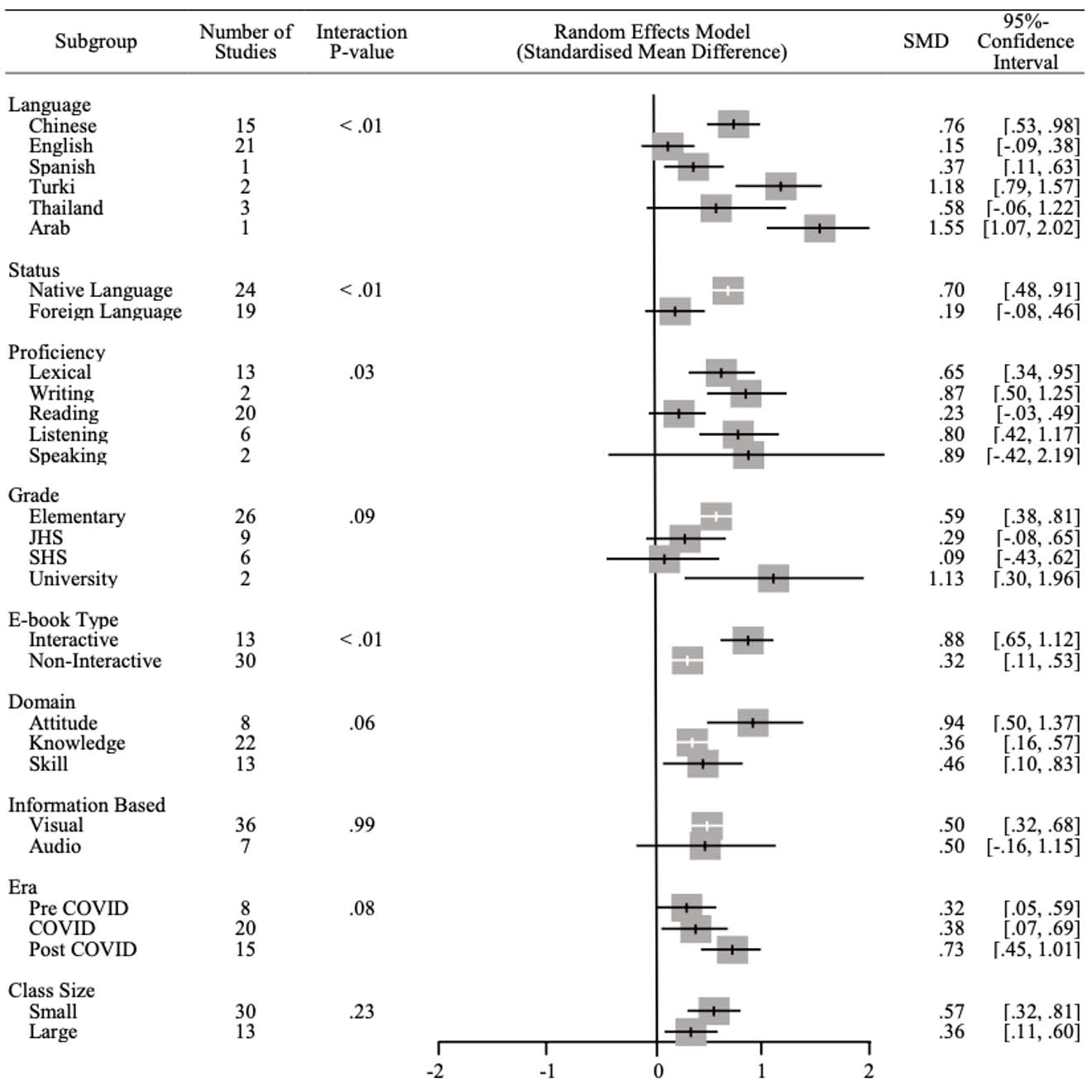
Note. Subgroup analysis of the effect of e-books on language learning outcomes. Effect sizes are presented as standardized mean differences (SMDs) with 95% confidence intervals (CI) shown in brackets [lower, upper]. Interaction p values reflect the significance of moderation effects across subgroups. Some squares in the plot lack visible confidence interval lines due to extremely narrow ranges. The shading of the squares reflects study weight: darker (black) lines indicate greater weight, while lighter (white) lines indicate less contribution to the meta-analysis. Categories are spaced to visually separate subgroups for clarity. JHS = Junior High School. SHS = Senior High School. SMD = Standardized Mean Difference.
Based on the analysis of the effect of the moderator variables in the category of language, there was a significant difference in the e-book effect on the language being taught. As presented in Figure 3, Arabic and Turkish showed higher positive effects, albeit based on only one study, when compared to Chinese, Thai, Spanish, and English. In terms of effect size, the highest impact was on Arabic language learning, indicating a very positive effect. The confidence interval did not include zero, indicating a statistically significant effect. English, with the highest number of studies, had a much smaller effect size. These differences suggest that the target language being learned significantly influence outcomes, possibly due to cultural (Akbar et al., 2015), educational, or methodological differences (Park & Lee, 2021).
The status category compares the impact of interventions on participants using their native language versus a foreign language. The analysis showed significant, solid, and moderate positive effects for e-book interventions in the mother tongue. In contrast, intervention in a foreign language produced a minor and statistically less significant effect. With an interaction p-value of less than .01, the difference between the effects in the mother tongue and foreign language contexts was statistically significant. This implies that interventions are substantially more effective when delivered in a student’s native language compared to a foreign language. From a language learning point of view, foreign language learning is more difficult than native language learning. This is because cultural and linguistic differences can significantly affect language learning outcomes and understanding these differences is crucial for effective language teaching and learning (Dong, 2024; Tang, 2019).
The proficiency category examines the impact of different language skills on the outcome. It is divided into five subgroups: lexical, writing, reading, listening, and speaking. The results indicate that speaking, writing, and listening have large positive effects, suggesting significant improvements in these skills compared to other proficiencies. Previous research has also found that e-books have an impact on phonological awareness (closely related to speaking and listening) and vocabulary learning (closely related to writing; López-Escribano et al., 2021). These language skills can be improved through e-books equipped with various features such as interactive media including: videos, audio clips, and quizzes (Saddhono et al., 2020; Shamsi & Bozorgian, 2024); authentic materials, meaning real-world resources such as podcasts, videos, and articles created for native speakers (Yazmin & Clara, 2024); and personalized language learning (Yang & Ogata, 2023). The improvement of language can occur because these features allow students to practice, encouraging them to deploy language for meaning and providing them with opportunities to develop a better understanding of the language in its natural context. Lexical proficiency also showed a notable moderate positive impact. In contrast, reading had less pronounced effects, showing the most negligible impact. This is in line with (Lim et al., 2021) who found that there is no significant difference in students’ reading ability with e-books or printed books. This may be because it is not the reading medium but how students engage with each medium that affects their understanding of the text. The interaction p-value indicates a significant difference among these subgroups, highlighting that the type of language proficiency targeted can substantially influence the outcomes of the interventions studied.
The grade category examines the impact of different educational levels on the outcome. This category includes four subgroups: elementary, junior high school (JHS), senior high school (SHS), and university. There was a moderate positive effect for the elementary category. Interactive e-books have an impact on children’s literacy development compared to printed books (López-Escribano et al., 2021). The university level showed a strong positive effect. In contrast, JHS seemed to have a more minor effect, and SHS indicated no statistically significant effect. The interaction p-value suggests no statistically significant difference between the effects observed across these educational levels. This means that interventions or outcomes being measured may be more effective at the university level compared to junior and senior high school levels. In line with this, Swanson et al. (2020) found that e-books did not have a significant effect on the literacy of K–12 students. Meanwhile, at the university level, e-books have been proven to enhance students’ vocabulary and literacy (Jasrial et al., 2022; Xodabande & Hashemi, 2023).
The e-book type variable compares the effects of interactive versus non-interactive e-books on the measured outcome. Studies on interactive e-books have shown a substantial positive effect. In contrast, non-interactive e-books have a much lower effect size, suggesting a more modest benefit. The p-value for interaction was less than .01, highlighting a statistically significant difference between the two types of e-books. Interactive e-books, which likely include engaging features such as multimedia, quizzes, and interactive exercises, are more effective in enhancing the desired outcomes than their non-interactive counterparts (Lachner et al., 2022; Lin, 2015). With broad appeal evident across all age groups, interactive books are also linked to positive behavioral changes according to prior studies (Masento et al., 2023; Sahyouni et al., 2017).
The moderator variable of the domain examines the evolving areas of competence, including attitude, knowledge, and skill, analyzed across multiple studies to determine impact. Attitude had the highest positive effect size, suggesting significant improvement in learners’ attitudes due to the e-book interventions studied. Knowledge showed a moderate positive effect, indicating that interventions had a positive but less pronounced impact on knowledge acquisition. Lastly, skill had a moderate effect, suggesting that interventions did enhance practical skills. The interaction p-value, just above the conventional significance threshold, implies that there may not be significant differences in how these domains respond to interventions, highlighting the importance of tailored approaches to improving different aspects of competence. The high positive effect size in the attitude category, especially when it came to children, was due to the more interesting content of an e-book, including a variety of pictures and interactive games that would help and motivate students (Chen et al., 2023; Sattar Chaudhry, 2014). The impact on knowledge acquisition could be attributed to the interactive nature of these texts, which in turn influences learner attitudes. As prior research has suggested (Rvachew et al., 2017; Weng et al., 2018), a positive disposition towards learning facilitates knowledge development. This aligns with the observation that children exposed to interactive books demonstrate greater knowledge gains alongside more positive learning attitudes. In addition, using an e-book helps encourage various emerging literacy skills among children as described in previous research (Ihmeideh, 2014; Verhallen & Bus, 2010).
The moderator variable of information compares the effects of primarily visual vs. audio-based e-books. For visual e-books, which rely on text and images, a moderate positive effect was seen in the studies. Meanwhile, audio-based e-books, which emphasize auditory content, showed a similar average effect size but with a wider confidence interval that included zero, indicating that the effect was not statistically significant. The interaction p-value of .99 suggests no significant difference between the effects of visual and audio e-books. Since visual and audio-based e-books exhibit the same average effect size, readers can choose the format that best suits their needs and preferences (Adebesin & Pillay, 2022; Senjam et al., 2022). This highlights the importance of context, user needs, and further research to refine these findings.
The moderator variable of era categorizes studies into three time periods: pre COVID (2018–2019), during COVID (2020–2021), and post COVID (2022–2024). The post COVID era showed the greatest positive impact, followed by the COVID period and the pre-COVID era. According to this trend, the COVID era's development of resilience, adaptability, and technology may have had a long-lasting effect, improving learning outcomes in the years after the pandemic (Rapanta et al., 2021; Williamson et al., 2020). These results emphasize the importance of ongoing innovation and adaptation in educational practices to maintain and enhance language learning outcomes. Although the effect sizes suggest a trend toward increasing impact over time, all three periods reflect a moderate effect. These differences were not statistically significant, according to the interaction p-value of .08. These trends could be a shift in teaching methods, a greater use of technology, or other pandemic-related contextual adjustments. The widespread in digital learning environments are probably a result of the extensive use of remote and hybrid learning during COVID-19 (O’Connor et al., 2023).
The moderator variable of class size explores the influence of the number of students per class on the treatment of e-books. Specifically, the analysis distinguished between small and large class sizes. Small classes showed a moderate positive effect. In contrast, the data from large classes indicated a positive but more minor impact. However, the interaction p-value implies that the difference in effects between small and large class sizes was not statistically significant. Smaller class sizes may appear to benefit more, but the evidence does not strongly support a significant advantage over larger classes. Differences in how e-books are integrated into the curriculum and the specific teaching strategies used may be more instrumental in influencing outcomes than class size alone (Johnson, 2016; Stirling & Birt, 2014; Wu & Chen, 2018). More research is needed to draw definitive assumptions.
This meta-analysis shows that the use of electronic books has a positive effect on the learning process as compared to the use of printed books. The results demonstrate a total standardized effect size value of 0.5, falling into the medium-effect category. This suggests that electronic books have a positive impact on learning outcomes. Another finding of this study is seen in the description of various moderator variables influencing learning outcomes with e-books in language learning. In terms of the language taught, the e-book showed a positive effect on all languages, but the positive effect on Arabic and Turkish was the greatest. In terms of the status of the language taught, e-books showed more positive effects for native language learning. For proficiency types, e-books have effects on all types, but among them, the smallest effect was seen in the area of improving reading skills. When looking at the type of e-book, the interactive e-book has a much greater effect than the non-interactive e-book. For the other moderator variables, e-books give equally good effects for each grade, domain, information base, era, and class size.
This study reveals that e-books have the potential to improve language skills, especially speaking, writing, and listening. As evidenced by this meta-analysis, e-books can be confidently integrated into educational settings. Educators and policymakers should consider optimizing e-book usage to maximize their benefits, particularly by leveraging interactive features that have been shown to be more effective.
Despite these promising findings, this study has several limitations. First, because our analysis relied on existing secondary data, we could not independently verify the quality or consistency of the methodologies used in the included studies, which limits our confidence in how rigorously each study was conducted. Moreover, the study only used articles indexed in the Scopus database. While Scopus is a reputable source of peer-reviewed literature, this choice may have excluded relevant studies from other databases, potentially introducing publication bias. Second, without access to raw data from the original research, we were unable to delve deeper into specific findings. Future work could address these gaps by collecting primary data or partnering with institutions to access richer datasets, ensuring stronger validation of these findings.
The authors would like to thank the National Research and Innovation Agency, Jakarta, Indonesia for supporting this study.
Adebesin, F., & Pillay, K. (2022). Academics’ perspectives on the strengths and limitations of Blackboard Ally. In Y.-M. Huang, S.-C. Cheng, J. Barroso, & F. E. Sandnes (Eds.), Innovative technologies and learning. ICITL 2022. Lecture notes in computer science, Vol. 13449 (pp. 285-295). Springer. https://doi.org/10.1007/978-3-031-15273-3_32
Akbar, R. S., Taqi, H. A., Dashti, A. A., & Sadeq, T. M. (2015). Does eReading enhance reading fluency? English Language Teaching, 8(5), 195-207. https://doi.org/10.5539/elt.v8n5p195
Albishi, O. A., & Alqiawi, D. A. (2022). The role of digital storytelling in the improvement of vocabulary acquisition. AJSRP. Journal of Curriculum and Teaching Methodology, 1(10), 132-142. https://doi.org/10.26389/ajsrp.d190422
Alsalhi, N. R., Al-Qatawneh, S., Eltahir, M., Althunibat, F., & Aljarrah, K. (2020). The role of academic electronic books in undergraduate students’ achievement in higher education. Heliyon, 6(11), Article e05550. https://doi.org/10.1016/j.heliyon.2020.e05550
Amirtharaj, A. D., Raghavan, D., & Arulappan, J. (2023). Preferences for printed books versus e-books among university students in a Middle Eastern country. Heliyon, 9(6), Article e16776. https://doi.org/10.1016/j.heliyon.2023.e16776
Arlinwibowo, J., Ishartono, N., Linguistika, Y., Purwoko, D., & Suprapto. (2023). Gamification in the STEM domain subject: The prospective method to strengthen teaching and learning. Jurnal Pendidikan IPA Indonesia, 12(4), 564-574. https://doi.org/10.15294/jpii.v12i4.48388
Aydın, E., & Tunagür, M. (2021). Effect of audiobook applications on listening skills and attitudes of 6th grade students: A mixed-method study. Bulletin of Education and Research, 43(3), 1-21. https://files.eric.ed.gov/fulltext/EJ1340717.pdf
Borenstein, M. (2009). Effect sizes for continuous data. In H. Cooper, L. V. Hodges, & J. C. Valentine (Eds.), The handbook of research synthesis and meta-analysis (2nd ed., pp. 221-235). Russell Sage Foundation. https://www.researchgate.net/publication/274566447_Effect_sizes_for_continuous_data
Bradley, K., Rodriguez Shaw, D., Lee, B., Symons, J., & Hernandez, G. (2023). E-books: A novel approach to education and training offering savings and resources. The Journal of Continuing Education in Nursing, 54(9), 394-397. https://doi.org/10.3928/00220124-20230816-04
Chang, H.-Y., Binali, T., Liang, J.-C., Chiou, G.-L., Cheng, K.-H., Lee, S. W.-Y., & Tsai, C.-C. (2022). Ten years of augmented reality in education: A meta-analysis of (quasi-) experimental studies to investigate the impact. Computers & Education, 191, Article 104641. https://doi.org/10.1016/j.compedu.2022.104641
Chen, C., Jamiat, N., & Mao, Y. (2023). The study on the effects of gamified interactive e-books on students’ learning achievements and motivation in a Chinese character learning flipped classroom. Frontiers in Psychology, 14, Article 1236297. https://doi.org/10.3389/fpsyg.2023.1236297
Dong, R. (2024). Culture: A journey through diversity in language learning. Transactions on Social Science, Education and Humanities Research, 5, 271-275. https://doi.org/10.62051/f9rc5p93
Duvnjak, M., Travica, J., Rončević, M., & Pupavac, M. (2022). E-books in foreign language teaching. In Sinteza 2022. International Scientific Conference on Information Technology and Data Related Research (pp. 309-315). Sinteza. https://www.doi.org/10.15308/Sinteza-2022-309-315
Egert, F., Cordes, A.-K., & Hartig, F. (2022). Can e-books foster child language? Meta-analysis on the effectiveness of e-book interventions in early childhood education and care. Educational Research Review, 37, Article 100472. https://doi.org/10.1016/j.edurev.2022.100472
Fajaruddin, S., Retnawati, H., Setiawan, C., Apino, E., Arlinwibowo, J., & Rachman, D. (2024). Technology’s impact on language learning: Meta-analysis on variables and effectiveness. Journal of Education and Learning (EduLearn), 18(2), 512-525. https://doi.org/10.11591/edulearn.v18i2.21119
Franco, D. C., & Bidarra, J. (2022). Instructional design of online courses in Mozambique: The use of e-books as a strategy to improve learning. Open Praxis, 14(2), 122-132. https://doi.org/10.55982/openpraxis.14.2.141
Furenes, M. I., Kucirkova, N., & Bus, A. G. (2021). A comparison of children’s reading on paper versus screen: A meta-analysis. Review of Educational Research, 91(4), 483-517. https://doi.org/10.3102/0034654321998074
Hedges, L. V. (1981). Distribution theory for Glass’s estimator of effect size and related estimators. Journal of Educational Statistics, 6(2), 107-128. https://doi.org/10.2307/1164588
Higgins, J. P. T. (2003). Measuring inconsistency in meta-analyses. BMJ, 327(7414), 557-560. https://doi.org/10.1136/bmj.327.7414.557
Hsieh, Y., & Huang, S. (2020). Using an e-book in the secondary English classroom: Effects on EFL reading and listening. Education and Information Technologies, 25(2), 1285-1301. https://doi.org/10.1007/s10639-019-10036-y
Ihmeideh, F. M. (2014). The effect of electronic books on enhancing emergent literacy skills of pre-school children. Computers & Education, 79, 40-48. https://doi.org/10.1016/j.compedu.2014.07.008
Jasrial, Sulastri, Kristiawan, M., & Saputra, A. (2022). Development of e-book teaching materials in improving student literacy. Educational Sciences: Theory and Practice, 22(1), 62-77. https://www.proquest.com/openview/4f4d06648d445404f006e261d9839fe8/
Johnson, G. M. (2016). The influence of student learning characteristics on purchase of paper book and e-book for university study and personal interest. Educational Psychology, 36(9), 1544-1559. https://doi.org/10.1080/01443410.2014.1002831
Kartal, G., & Simsek, H. (2017). The Effects of Audiobooks on EFL Students’ Listening Comprehension. The Reading Matrix: An International Online Journal, 17(1), 112-123. https://www.readingmatrix.com/files/16-7w4b733r.pdf
Lachner, A., Hoogerheide, V., Van Gog, T., & Renkl, A. (2022). Learning-by-teaching without audience presence or interaction: When and why does it work? Educational Psychology Review, 34(2), 575-607. https://doi.org/10.1007/s10648-021-09643-4
Lee, S. H., & McKee, A. (2023). Reading e-books and printed books with parents: A case study of children with autism spectrum disorders. Autism & Developmental Language Impairments, 8, Article 23969415231168571. https://doi.org/10.1177/23969415231168571
Liana Mumrikoh, Djono, D., & Drajati, N. A. (2023). Urgency of e-books based multimodal approach towards reading motivation for elementary school students. Journal for Lesson and Learning Studies, 6(1), 71-80. https://www.mendeley.com/catalogue/957f43fd-8e51-37f2-bf38-e83e96c18dea/
Liaw, S.-S., & Huang, H.-M. (2016). Investigating learner attitudes toward e-books as learning tools: Based on the activity theory approach. Interactive Learning Environments, 24(3), 625-643. https://doi.org/10.1080/10494820.2014.915416
Lim, J., Whitehead, G. E. K., & Choi, Y. (2021). Interactive e-book reading vs. paper-based reading: Comparing the effects of different mediums on middle school students’ reading comprehension. System, 97, Article 102434. https://doi.org/10.1016/j.system.2020.102434
Lin, H. (2015). Effectiveness of interactivity in a web-based simulation game on foreign language vocabulary learning. Procedia—Social and Behavioral Sciences, 182, 313-317. https://doi.org/10.1016/j.sbspro.2015.04.772
López-Escribano, C., Valverde-Montesino, S., & García-Ortega, V. (2021). The impact of e-book reading on young children’s emergent literacy skills: An analytical review. International Journal of Environmental Research and Public Health, 18(12), Article 6510. https://doi.org/10.3390/ijerph18126510
Mamekova, A. T., Toxanbayeva, N. K., Naubaeva, K. T., Ongarbayeva, S. S., & Akhmediyeva, K. N. (2021). A meta-analysis on the impact of gamification over students’ motivation. Journal of Intellectual Disability—Diagnosis and Treatment, 9(4), 417-422. https://doi.org/10.6000/2292-2598.2021.09.04.9
Masento, N. A., Dulay, K. M., Roberts, A. P., Harvey, K., Messer, D., & Houston-Price, C. (2023). See and eat! The impact of repeated exposure to vegetable e-books on young children’s vegetable acceptance. Appetite, 182, Article 106447. https://doi.org/10.1016/j.appet.2022.106447
Moutsinas, G. A., Orosco Gavilán, J. C., Cubas Ramirez, C. E., Panduro, B. C., Aníbal, O. G., Ngoc Dieu, D. L., & Naz, S. (2023). Reading Comprehension and Behavior in Children Using E-books vs. Printed Books. World Journal of English Language, 13(3), 172. https://doi.org/10.5430/wjel.v13n3p172
Mullen, B., Muellerleile, P., & Bryant, B. (2001). Cumulative meta-analysis: A consideration of indicators of sufficiency and stability. Personality and Social Psychology Bulletin, 27(11), 1450-1462. https://doi.org/10.1177/01461672012711006
Nasir, M. H., Abdullah, M., & Mirza, E. (2022). Role of e-books in improving English vocabulary of university students: A case study of Numl, Islamabad. PalArch’s Journal of Archaeology of Egypt/Egyptology, 19(1), 1338-1352. https://archives.palarch.nl/index.php/jae/article/view/10900
O’Connor, J., Ludgate, S., Le, Q.-V., Le, H. T., & Huynh, P. D. P. (2023). Lessons from the pandemic: Teacher educators’ use of digital technologies and pedagogies in Vietnam before, during and after the COVID-19 lockdown. International Journal of Educational Development, 103, Article 102942. https://doi.org/10.1016/j.ijedudev.2023.102942
Page, M. J., McKenzie, J. E., Bossuyt, P. M., Boutron, I., Hoffmann, T. C., Mulrow, C. D., Shamseer, L., Tetzlaff, J. M., Akl, E. A., Brennan, S. E., Chou, R., Glanville, J., Grimshaw, J. M., Hróbjartsson, A., Lalu, M. M., Li, T., Loder, E. W., Mayo-Wilson, E., McDonald, S., ... Moher, D. (2021). The PRISMA 2020 statement: An updated guideline for reporting systematic reviews. PLOS Medicine, 18(3), Article e1003583. https://doi.org/10.1371/journal.pmed.1003583
Park, J., & Lee, J. (2021). Effects of e-books and printed books on EFL learners’ reading comprehension and grammatical knowledge. English Teaching, 76(3), 35-61. https://doi.org/10.15858/engtea.76.3.202109.35
Pavlovic, D., & Petrović, D. (2020). E-books in foreign language learning from the students’ perspective: A review of research. Nastava i Vaspitanje, 69(3), 331-344. https://doi.org/10.5937/nasvas2003331P
Phadung, M., & Dueramae, S. (2018). The design and impact of interactive e-book on academic language achievement to language minority students. Journal of Physics: Conference Series, Vol. 1097, Article 012093. https://doi.org/10.1088/1742-6596/1097/1/012093
Puric, D. S., & Sekač, V. M. (2022). Advantages and limitations of the use of e-textbooks in the Serbian language teaching from the perspective of teachers and future teachers. Zbornik Radova Pedagoskog Fakulteta, Užice, 2022(24), 77-94. https://doi.org/10.5937/ZRPFU2224077P
Rapanta, C., Botturi, L., Goodyear, P., Guàrdia, L., & Koole, M. (2021). Balancing technology, pedagogy and the new normal: Post-pandemic challenges for higher education. Postdigital Science and Education, 3(3), 715-742. https://doi.org/10.1007/s42438-021-00249-1
Rahman, A., & Hajar, I. (2020). The effect of audiobook on reading comprehension of the eleventh grade students of SMA Negeri 2 Buru. ELT Worldwide: Journal of English Language Teaching, 7(2), 104. https://doi.org/10.26858/eltww.v7i2.14931
Retnawati, H., Apino, E., Djidu, H., Kartianom, K., & Anazifa, R. (2018). Pengantar analisis meta [Introduction to meta-analysis]. Parama Publishing. https://www.researchgate.net/publication/334644017_Pengantar_Analisis_Meta#fullTextFileContent
Rvachew, S., Rees, K., Carolan, E., & Nadig, A. (2017). Improving emergent literacy with school-based shared reading: Paper versus e-books. International Journal of Child-Computer Interaction, 12, 24-29. https://doi.org/10.1016/j.ijcci.2017.01.002
Saddhono, K., Ridwan, M., Suherman, A., Anwar, K., & Putri, N. Q. H. (2020). The development of interactive e-book of teaching Indonesian for speaker of other language (TISOL) containing local wisdom with scientific-thematic approach. Journal of Physics: Conference Series, 1573, Article 012002. https://doi.org/10.1088/1742-6596/1573/1/012002
Sahyouni, R., Mahmoodi, A., Mahmoodi, A., Huang, M., Tran, D. K., & Chen, J. W. (2017). Interactive e-books in educating patients and their families about head injury regardless of age. Clinical Neurology and Neurosurgery, 156, 41-47. https://doi.org/10.1016/j.clineuro.2017.03.003
Sariani, Khairat, M. E., & Yaningsih. (2021). Advancing vocabulary acquisition by integrating visual image and texts in writing. In A. Amheka, T. Saroinsong, I. Nurhayati, D. Hariyanti, M. U. H. Al Rasyid., & D. S. Pamungkas (Eds.), Proceedings of the International Conference on Applied Science and Technology on Social Science, ICAST-SS 2020 (pp. 493-498). Atlantis Press. https://doi.org/10.2991/assehr.k.210424.096
Sattar Chaudhry, A. (2014). Student response to e-books: Study of attitude toward reading among elementary school children in Kuwait. The Electronic Library, 32(4), 458-472. https://doi.org/10.1108/EL-04-2012-0041
Savva, M., Higgins, S., & Beckmann, N. (2022). Meta‐analysis examining the effects of electronic storybooks on language and literacy outcomes for children in grades pre‐K to grade 2. Journal of Computer Assisted Learning, 38(2), 526-564. https://doi.org/10.1111/jcal.12623
Senjam, S. S., Foster, A., & Bascaran, C. (2022). Assistive technology for visual impairment and trainers at schools for the blind in Delhi. Assistive Technology, 34(4), 418-422. https://doi.org/10.1080/10400435.2020.1839144
Shamsi, E., & Bozorgian, H. (2024). Collaborative listening using multimedia through metacognitive instruction: A case study with less-skilled and more-skilled EFL learners. Asian-Pacific Journal of Second and Foreign Language Education, 9(1), Article 25. https://doi.org/10.1186/s40862-023-00248-8
Stirling, A., & Birt, J. (2014). An enriched multimedia e-book application to facilitate learning of anatomy. Anatomical Sciences Education, 7(1), 19-27. https://doi.org/10.1002/ase.1373
Sullivan, G. M., & Feinn, R. (2012). Using effect size—Or why the p-value is not enough. Journal of Graduate Medical Education, 4(3), 279-282. https://doi.org/10.4300/JGME-D-12-00156.1
Swanson, E., Austin, C. R., Stewart, A. A., & Scammacca, N. (2020). A meta-analysis examining the effect of e-book use on literacy outcomes for students in grades K–12. Reading & Writing Quarterly, 36(5), 480-496. https://doi.org/10.1080/10573569.2019.1696724
Takii, K., Flanagan, B., & Ogata, H. (2021). EFL vocabulary learning using a learning analytics-based e-book and recommender platform. In M. Chang, N.-S. Chen, D. G. Sampson, & A. Tlili (Eds.), 2021 International Conference on Advanced Learning Technologies. ICALT (pp. 254-256). IEEE. https://doi.org/10.1109/ICALT52272.2021.00082
Tang, Y. (2019). Analysis of the influencing factors of cultural differences on second language acquisition. International Journal of Languages, Literature and Linguistics, 5(4), 274-278. https://doi.org/10.18178/IJLLL.2019.5.4.241
Tlili, A., Zhao, J., Yang, K., Wang, Y., Bozkurt, A., Huang, R., Bonk, C. J., & Ashraf, M. A. (2022). Going beyond books to using e-books in education: A systematic literature review of empirical studies. Interactive Learning Environments, 32(5), 2207-2231. https://doi.org/10.1080/10494820.2022.2141786
Tsuei, M., Huang, H.-W., & Cheng, S.-F. (2020). The effects of a peer-tutoring strategy on children’s e-book reading comprehension. South African Journal of Education, 40(2), Article 1734. https://doi.org/10.15700/saje.v40n2a1734
Tusmagambet, B. (2020). Effects of Audiobooks on EFL Learners’ Reading Development: Focus on Fluency and Motivation. English Teaching, 75(2), 41-67. https://doi.org/10.15858/engtea.75.2.202006.41
Verhallen, M. J. A. J., & Bus, A. G. (2010). Low-income immigrant pupils learning vocabulary through digital picture storybooks. Journal of Educational Psychology, 102(1), 54-61. https://doi.org/10.1037/a0017133
Weng, C., Otanga, S., Weng, A., & Cox, J. (2018). Effects of interactivity in e-textbooks on 7th graders science learning and cognitive load. Computers & Education, 120, 172-184. https://doi.org/10.1016/j.compedu.2018.02.008
Williamson, B., Eynon, R., & Potter, J. (2020). Pandemic politics, pedagogies and practices: Digital technologies and distance education during the coronavirus emergency. Learning, Media and Technology, 45(2), 107-114. https://doi.org/10.1080/17439884.2020.1761641
Wood, C., Fitton, L., Petscher, Y., Rodriguez, E., Sunderman, G., & Lim, T. (2018). The effect of e-book vocabulary instruction on Spanish-English speaking children. Journal of Speech, Language, and Hearing Research, 61(8), 1945-1969. https://doi.org/10.1044/2018_JSLHR-L-17-0368
Wu, T.-T., & Chen, A.-C. (2018). Combining e-books with mind mapping in a reciprocal teaching strategy for a classical Chinese course. Computers & Education, 116, 64-80. https://doi.org/10.1016/j.compedu.2017.08.012
Xodabande, I., & Hashemi, M. R. (2023). Learning English with electronic textbooks on mobile devices: Impacts on university students’ vocabulary development. Education and Information Technologies, 28(2), 1587-1611. https://doi.org/10.1007/s10639-022-11230-1
Yang, C. C. Y., & Ogata, H. (2023). Personalized review learning approach for improving behavioral engagement and academic achievement in language learning through e-books. Education and Information Technologies, 28(2), 1491-1508. https://doi.org/10.1007/s10639-022-11245-8
Yazmin, D., & Clara, I. (2024). Exploring the effects of using podcasts on EFL college students with low English proficiency listening comprehension. International Journal of Information and Education Technology, 14(2), 175-182. https://doi.org/10.18178/ijiet.2024.14.2.2038

Which is Better: E-Book or Printed Book? A Meta-Analysis of Educational Materials in Language Learning by Virgiawan Listanto, Janu Arlinwibowo, Anggraeni Dian Permatasari, Khofifa Najma Iftitah, and Ence Oos Mukhamad Anwas is licensed under a Creative Commons Attribution 4.0 International License.