Volume 26, Number 3
Min Yang
Academic Affairs Department, The Open University of China
Learning support services, categorized into academic and non-academic support, have been demonstrated to positively influence student development. However, the distinct mechanisms by which academic and non-academic support services impact academic performance remain underexplored in China. This study seeks to provide comprehensive insights into these mechanisms. A survey was conducted with a sample of 1,234 students to gather data on learning support services, student engagement, and learning performance. Structural equation modeling (SEM) was employed to analyze the conceptual model derived from the survey data. Results revealed that student engagement played a partial mediating role between academic support services and learning performance, while it played a complete mediating role between non-academic support services and learning performance. Furthermore, the analysis of standardized coefficient values reveals that academic support services have a lesser impact on student engagement and learning performance compared to the influence of non-academic support services on these same outcomes. It is suggested that distance education institutions need to pay more attention to non-academic support services and optimize resource allocation to achieve more efficient and rational resource distribution. As numerous traditional face-to-face educational institutions in China expand into online education, they encounter challenges due to isolation between teachers and students. Consequently, the concept of learning support services in distance education has become a significant concern. The findings of this study could provide valuable insights for these institutions.
Keywords: learning support services, student engagement, academic support services, non-academic support services
Since 2012, online education in China has experienced exponential growth. The number of massive open online courses (MOOCs) in the country surged from a mere 5 in 2013 to 18,555 by 2019. Following the COVID-19 pandemic, the number of MOOCs skyrocketed to 61,990 by 2022 (Wu, 2022). As a result, online education has emerged as a viable alternative for universities in China.
The transition to online learning poses significant challenges for both lecturers and students, as noted by Kristiana et al. (2023). Wu and Li (2020) discovered numerous obstacles in the online education realm of traditional universities, including the inability of teachers to assess students’ immediate status, monitor their learning progress, and provide on-site guidance and supervision, as well as the relaxation of classroom discipline. These challenges are largely attributed to the physical separation between teachers and students. Consequently, some Chinese researchers, such as Han (2019) and Zheng et al. (2020), have suggested that adopting the concept of learning support services from distance education may mitigate these issues.
In the realm of distance and online education, researchers have established the pivotal role of learning support services in enhancing student performance and retention rates (Ludwig-Hardman & Dunlap, 2003). Simpson (2002) distinguished these services into academic and non-academic categories, a framework that has been widely adopted in China’s open universities. Academic support services mainly refer to the support services provided to students in terms of cognition, intelligence, and knowledge within specific courses. Non-academic support services mainly refer to the help and support provided to students for issues or difficulties outside their professional studies, such as emotional and managerial support services.
The Open University of China (OUC) is the largest institution dedicated to distance and open education in China, comprising the OUC headquarters and 45 branches and thousands of study centers across the country. The entire educational system (including the headquarters, branches, and study centers) currently has nearly 4.57 million students. Informed by these theories, OUC has established separate teams for academic and non-academic support services. The faculty team including both full-time and part-time faculty members takes the responsibility for providing academic support services. Meanwhile, non-academic support services are mainly carried out by tutorial instructors (class advisors), technical staff, and other administrative personnel. These two roles of faculty and staff collaboratively work together to fulfill the task of delivering comprehensive learning support services to students.
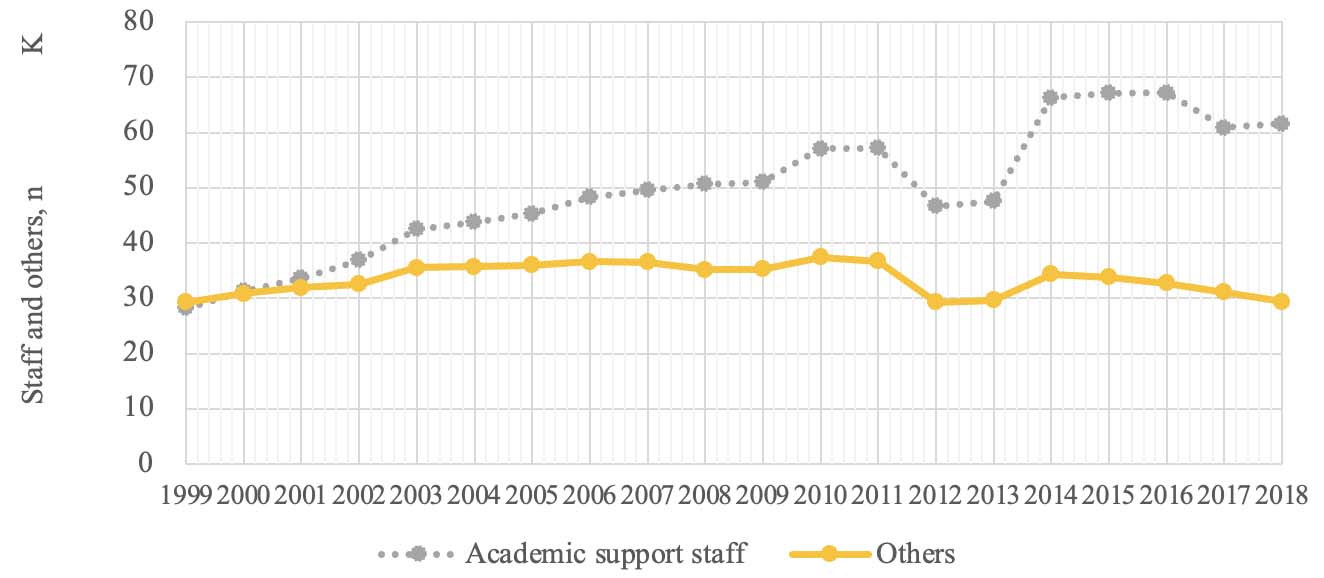
Figure 1 presents data extracted from the Open University of China’s (OUC) education statistical yearbooks spanning 1999 to 2018. The figure illustrates the imbalance in the growth of full-time teaching staff and other administrative personnel. Over this period, student enrollment surged from tens of thousands to nearly 4.57 million, and the number of full-time teachers rose to almost 61,600 by 2018—2.18 times the figure in 1999. In contrast, the number of administrative and technical staff remained virtually unchanged at approximately 29,400.
Figure 1
Number of Academic Support Staff and Others in Open University of China From 1999 to 2018
Due to data limitations, the academic support staff in Figure 1 refers only to full-time academic staff. Many part-time teachers who provide academic support are not included in the figure’s data. Conversely, some staff members who do not provide non-academic support services, such as the support team, are included in the others category. Additionally, the support services provided by the two categories of personnel in Figure 1 may overlap in practice. For example, faculty members often offer non-academic support (e.g., emotional support) to students. Therefore, these two categories cannot be strictly equated with academic and non-academic support service teams, respectively.
The research questions posed in this study are: What are the actual impacts of the different support services provided by various staff on student development? Which service is more important? Is the personnel structure reasonable?
This study sought to provide an in-depth analysis of the impact mechanisms of learning support services on student development, with a particular focus on uncovering the distinct mechanisms between academic and non-academic support services.
The concept of student development is multifaceted, with theories from sociology, psychology, and ecology contributing to the understanding of how students grow and develop (Astin, 1977, 1984; Bronfenbrenner, 1979; Sanford, 1962). These perspectives have significantly influenced student affairs in American higher education, offering theoretical frameworks for programming and student services (Renn & Li, 2008). Central to this discourse is the concept of student engagement, which explains the impact of external support environments on student development (Astin, 1977, 1984; Finn, 1989). Numerous studies have since confirmed the link between student engagement and academic success (Mih & Mih, 2013; Pierson & Connell, 1992; Reeve & Tseng, 2011; Skinner & Belmont, 1993).
Student engagement refers to the extent of students’ involvement in their learning experiences and their sense of connection to their classes, peers, and institutions (Axelson & Flick, 2010). Fredricks, Blumenfeld, and Paris (2004) highlighted engagement’s correlation with positive academic outcomes and delineated three forms of engagement: behavioral, emotional, and cognitive.
Sun and Rueda (2012) designed the Student Engagement in Distance Education (SEDE) scale, specifically for remote learning contexts. This scale evaluates student engagement across three key dimensions: behavioral, cognitive, and emotional. Behavioral engagement focuses on following online learning rules, submitting assignments on time, and reviewing errors. Cognitive engagement captures activities such as resource exploration, management, and strategic application. Emotional engagement, meanwhile, measures students’ affective responses to distance learning, including enjoyment, interest, willingness to share achievements, and feelings of boredom regarding course content.
Zhao, Shao, and Su (2022) assessed online learning support services through three dimensions: cognitive support, emotional support, and management support. Cognitive support was regarded as academic support for learners, while emotional and management support were considered as non-academic support services. The study found that all three dimensions have a positive impact on students’ online learning satisfaction.
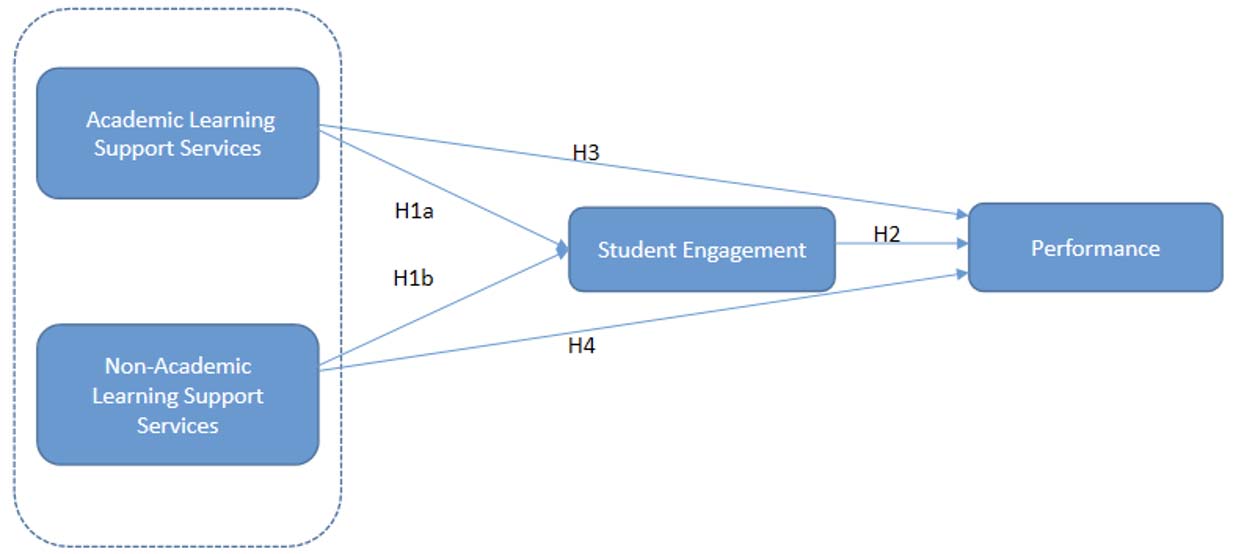
Building on these theories and findings, a conceptual model and corresponding hypotheses were proposed. Figure 2 illustrates this model, where student engagement is posited as a mediating factor between learning support services—both academic and non-academic—and their impact on academic performance. It should be specifically noted that in measuring the quality of learning support services, the student perspective was adopted in this research. In other words, the term “perceived quality” used in this text means quality as perceived by students.
Figure 2
Conceptual Model and Corresponding Hypotheses
Note. H = hypothesis.
There were four corresponding hypotheses:
H1: The perceived quality of learning support services, both academic and non-academic, significantly positively affects student engagement (shown as H1a and H1b in Figure 2).
H2: Student engagement has a significant positive effect on learning performance.
H3: The quality of academic learning support services, as perceived by the students, has a significant positive direct effect on learning performance.
H4: The quality of non-academic learning support services, as perceived by the students, has a significant positive direct effect on learning performance.
In summary, this study investigated an integrated model in which the quality of learning support services, assessed solely through students’ perceptions captured in a questionnaire, encompasses two dimensions: academic and non-academic support services. Each dimension was posited to positively influence student engagement, which in turn directly and indirectly affected the ultimate outcome—students’ academic performance.
The Open University of China has study centers across the country, and this survey was conducted at one of these study centers. A deliberate random sampling method was employed to ensure no bias towards particular cases. All willing students were eligible for participation, which was confirmed through informed consent. The research was conducted using an anonymous online questionnaire, administered mid-semester to enrolled students. Questionnaires were distributed by instructors or counselors, either in-class or via groups on the WeChat social media platform.
After thorough data screening and cleaning, a total of 1,234 usable responses were retained for analysis, representing a net response rate of 75.8%. The demographic characteristics of the sample are presented in Table 1.
Table 1
Demographic Characteristics of the Sample
| Characteristic | n | % | |
| Gender | Female | 847 | 68.6 |
| Male | 387 | 31.4 | |
| Academic level | Undergraduate program | 440 | 35.7 |
| Associate degree program | 794 | 64.3 | |
| Age | ≤ 25 | 265 | 21.5 |
| 26–35 | 641 | 51.9 | |
| 36–45 | 280 | 22.7 | |
| ≥ 46 | 48 | 3.9 | |
Note. N = 1234.
Quantitative data was collected using an online scale adapted from the United Kingdom’s National Student Survey (NSS) and Sun and Rueda’s (2012) Student Engagement in Distance Education (SEDE) scale, both translated into Chinese according to Brislin’s (1970) translation protocol. Participants completed the 23-item scale online, with informed consent obtained as part of ethical research practices.
The perceived quality of learning support services was measured using nine items that captured two dimensions: academic and non-academic support services, with four and five items respectively. Thus, learning support services are conceptualized as a formative measurement model. Student engagement was assessed with eleven items, while learning performance was measured with three items. See Appendix A for full details of the study scale.
The scale demonstrated strong reliability and validity, with a Kaiser-Meyer-Olkin (KMO) measure of 0.931 and a Cronbach’s Alpha of 0.936 for the overall scale. The Cronbach’s α coefficients for the academic and non-academic dimensions of learning support services were 0.888 and 0.936, respectively. The factors accounted for a cumulative explained variance of 77.8%. The KMO value and Cronbach’s α coefficient are used to assess validity and reliability, respectively. Generally, values above 0.9 are considered very good, while those between 0.8 and 0.9 are regarded as good.
This study involved the design and revision of scales and questionnaires, testing the reliability and validity of measurement tools, distribution and collection of questionnaires, and statistical analysis of collected data using IBM SPSS Statistics (Version 20.0), including correlation analysis, mean analysis, and regression analysis. Additionally, IBM SPSS Amos (Version 26) was used to construct the structural equation model and test the hypotheses and mediation effects.
The empirical analysis is based on a sample of 1,234 qualified responses from the questionnaire. Following Hair et al. (2017), the measurement models were first evaluated and then the structural equation model was analyzed.
First, convergent validity was evaluated through redundancy analysis for each formative construct. Most of the path coefficients linking the formative constructs with their corresponding single-item global measures exceeded the suggested threshold of 0.70 (see Appendix B), indicating that all formatively measured constructs exhibited convergent validity. Subsequently, the formative measurement models were examined for potential collinearity by reviewing the outer VIF (variance inflation factor) values. All items’ outer VIF values fell below the threshold of 5, which suggests that collinearity was not a concern in the formative measurement models. The third step involved assessing the significance and relevance of the formative indicators. The significance of the outer weights was verified, and all formative indicators proved to be significant at the 5% level.
Table 2 shows the fit indices of the structural model. The results indicate that the main indicators met the acceptable standards for the model, including SRMR, RMSEA, CFI, IFI, NFI, TLI, GFI, AGFI, and CN. These results demonstrate good fit for the structural equation model. Since the magnitude of the Chi-square (Χ2) fluctuates with the sample size (1,234 in this study), the overall model fit judgment should be comprehensively judged based on various model fit indices provided by Amos. On this basis, although the expected p-value of the Χ2 was significant, it can still be concluded that the theoretical model fits the actual data.
Table 2
Summary of Structural Equation Model Fit Indicators
| Indicators | Acceptable Range | Value | Model fit assessment |
| Model Chi-square (Χ2) | p > .05 | Χ2 = 769.591 p=0.000 | No |
| Root Mean Square Residual (RMR) | - | .066 | Smaller values indicate better fit. |
| Standardized RMR (SRMR) | < .05 | .0303 | Indicates good fit. |
| Root Mean Square Error of Approximation (RMSEA) | < .05 | .045 | Indicates good fit. |
| Goodness of Fit Index (GFI) | > .9 | .947 | Indicates good fit. |
| Adjusted GFI (AGFI) | > .9 | .933 | Indicates good fit. |
| Normed Fit Index (NFI) | > .9 | .971 | Indicates good fit. |
| Relative Fit Index (RFI) | > .9 | .966 | Indicates good fit. |
| Incremental Fit Index (IFI) | > .9 | .979 | Indicates good fit. |
| Tucker Lewis Index (TLI) | > .9 | .976 | Indicates good fit. |
| Comparative Fit Index (CFI) | > .9 | .979 | Indicates good fit. |
| Parsimonious GFI (PGFI) | > .5 | .758 | Indicates good fit. |
| Parsimonious NFI (PNFI) | > .5 | .848 | Indicates good fit. |
| Parsimonious CFI (PCFI) | > .5 | .855 | Indicates good fit. |
| Critical N (CN) | > 200 | 412 | Indicates good fit. |
| CMIN/DF | < 5a | 3.482 | Indicates acceptable fit. |
Note. a = acceptable. Model Chi-Square means the chi-square value and its p-value (a p-value greater than 0.05 indicates acceptable model fit).
Table 3 provides a summary of the path parameter estimates for the model. The table includes standardized estimates of the regression path coefficients, four sets of variables have reached a significant level with small standard errors, indicating that there are significant relationships between the variables and that the structural relationships set by the model are reasonable.
Table 3
Hypothesis Testing Results
| Hypothesis: path (X → Y) | Non-standardized loading coefficient | SE | Critical ratio | Standardized loading coefficient | Hypothesis supported? |
| H1a: Academic support services → Student engagement | 0.200 | 0.028 | 7.034 | 0.257*** | Yes |
| H1b: Non-academic support services → Student engagement | 0.551 | 0.034 | 16.252 | 0.663*** | Yes |
| H2: Student engagement → Learning performance | 1.031 | 0.093 | 11.131 | 0.840*** | Yes |
| H3: Academic support services → Learning performance | 0.118 | 0.037 | 3.167 | 0.124*** | Yes |
| H4: Non-academic support services → Learning performance | -0.079 | 0.061 | -1.301 | -0.077a | No |
Note. a indicates exact p-value of .193.
*** p < .001.
The results in Table 3 show that academic support services have a significant positive effect on student engagement. H1a is verified by the results.
Table 3 also shows that non-academic support services have a significant positive effect on student engagement. H1b is verified by the results.
The results shown in Table 3 indicate that student engagement has a significant positive effect on learning performance. H2 is verified by the results.
Table 3 shows that academic support services have a significant positive direct effect on learning performance. H3 is verified by the results.
Finally, Table 3 suggests there is no direct significant relationship between non-academic support services and learning performance, leading to the rejection of H4.
Additionally, the results suggest that non-academic support services have a greater influence on student engagement than academic support services.
This study employed latent variable mediation analysis in Amos to explore the mechanisms by which academic and non-academic support services, along with student engagement, influence learning performance. The bootstrap method was used to assess the mediation effects of the model. Table 4 presents the estimated values for the specific path effects within the mediation model.
Table 4
Mediation Effects Testing Results
| Effect path | Point estimate | Product of coefficients | Bootstrapping | ||||||
| Bias-corrected (95% CI) | Percentile (95% CI) | ||||||||
| SE | z | LL | UL | p | LL | UL | p | ||
| Total effect | |||||||||
| Academic support services → Performance | 0.324 (0.340) | 0.042 | 7.714 | 0.235 | 0.405 | .001 | 0.235 | 0.405 | .001** |
| Non-academic support services → Performance | 0.489 (0.480) | 0.044 | 11.114 | 0.404 | 0.579 | .001 | 0.401 | 0.578 | .001** |
| Indirect effect | |||||||||
| Academic support services → Performance | 0.206 | 0.044 | 4.682 | 0.134 | 0.302 | .001 | 0.133 | 0.301 | .001** |
| Non-academic support services → Performance | 0.568 | 0.083 | 6.843 | 0.431 | 0.757 | .001 | 0.432 | 0.758 | .001** |
| Direct effect | |||||||||
| Academic support services → Performance | 0.118 | 0.046 | 2.565 | 0.027 | 0.208 | .006 | 0.019 | 0.201 | .020* |
| Non-academic support services → Performance | -0.079 | 0.087 | -0.908 | -0.266 | 0.068 | .341 | -0.271 | 0.066 | .323 |
Note. CI = confidence interval; LL = lower limit; UL = upper limit. Point estimate of total effect includes unstandardized coefficients and standardized coefficients in parentheses. *p < .05. **p < .01.
Regarding academic support services, the results shown in Table 4 indicate significant direct and indirect effects on learning performance (z value > 1.96), excluding the zero effect. This suggests that student engagement partially mediates the relationship between academic support services and learning performance, with the mediating effect of student engagement accounting for 63.6% of the total effect.
For non-academic support services, the results reveal that their direct impact on learning performance is not significant (z value < 1.96, including zero), suggesting that student engagement fully mediates the relationship between non-academic support services and learning performance. See Table 4.
Additionally, the standardized total effect of academic support services on learning performance is 0.340, whereas that of non-academic support services is 0.480, indicating that non-academic support services have a greater impact on learning performance than academic support services.
The quantitative analysis confirmed the theoretical model and supported hypotheses H1 (H1a, H1b), H2, and H3, while H4 was not supported. Academic support services significantly enhance both student engagement and learning performance, whereas non-academic support services influence learning performance indirectly through student engagement.
Second, the study identified distinct mechanisms through which academic and non-academic support services influence learning performance, with two pivotal findings. For one, academic support services’ effects on learning performance are partially mediated by student engagement, which accounts for 63.6% of the total effect. In contrast, non-academic support services exert their influence entirely through student engagement, as their direct effect on learning performance is not significant. The second key finding is that non-academic support services have a greater total impact on both student engagement and learning performance compared to academic support services. This suggests that in the context of open education in China, non-academic support services are more critical, with their effects surpassing those of academic support services.
These findings can be interpreted from two perspectives. First, the influence of academic support services may be understated in this study due to the availability of standardized learning resources, which partially replace their role, enabling self-directed learning without direct teacher guidance. These resources include comprehensive explanations of complex and key concepts, integrated with student learning activities. Second, non-academic support services offer personalized support and management, which still require real-time communication and interaction. Although technology allows for some remote interaction, it has not fully satisfied the individualized needs of students, highlighting the continued importance of non-academic support services.
On the other hand, the unique pedagogy and learning framework of distance and open education demand a broad set of competencies from students, including self-directed learning, study techniques, and self-regulation. However, many students lack these essential skills due to enrollment policies, creating a notable gap between the educational system’s demands and students’ capabilities. This gap highlights the vital role of non-academic support services in bridging the divide.
This study was conducted in the unique context of OUC, which features a distinctive teaching management model and admission policies. The teaching model of OUC prioritizes student self-directed learning, with teacher guidance as a supplementary support. In some extreme cases, such as in remote areas or impoverished regions in China, students may lack access to face-to-face tutoring. To ensure high-quality learning outcomes, course resources are designed to effectively convey knowledge even without substantial teacher support. Therefore, the standardized course resources and meticulous teaching design may partially replace the role of academic support, leading to an underestimation of the role of academic support services. Additionally, the OUC provides learning opportunities for all members of society. Learners can enroll voluntarily without having to take the National College Entrance Examination, resulting in a diverse student body with varying learning abilities. Some students may struggle to adapt at the beginning of their studies, due to insufficient learning abilities. This, combined with high-quality learning resources, increases the demand for and reliance on non-academic support services among students.
Student development and learning support service theories underscore the critical role of high-quality support services in boosting student engagement and academic performance. This study further explores the impact of various learning support service aspects on student development, aiming to encourage distance education institutions to prioritize and enhance their learning support services, particularly focusing on non-academic aspects.
The study reveals that non-academic support services significantly influence students’ academic performance more than academic support services do. It aims to prompt reflection among China’s distance education institutions, encouraging a more scientific approach to resource allocation for learning support services. Additionally, it is hoped that insights from this study will benefit traditional universities offering online courses.
As Tian et al. (2023) have pointed out, research studies on learning support services are still predominantly focused on academic learning support services, with very few scholars conducting in-depth studies on non-academic learning support services. Comparative studies on academic and non-academic support services, as undertaken in this research, are currently very rare.
While this study offers valuable insights, it has limitations. Being based on research at the Open University of China, its findings are closely tied to the specific context of Chinese distance education learners and teaching models. Besides, this study was conducted at one specific study center of OUC, and the final valid data obtained met the requirements for empirical analysis. However, the response and return rates of the questionnaire survey were still influenced by students’ subjective willingness, potentially introducing self-selection bias. We are looking forward to seeing further in-depth research on this issue by scholars worldwide to explore the nuances of educational practices in their respective countries.
This study was supported with funding from the China Adult Education Association (CAEA 2023-747Y).
Astin A. W. (1977). Four critical years: Effects of college on beliefs, attitudes, and knowledge. Jossey-Bass.
Astin, A. W. (1984). Student involvement: A developmental theory for higher education. Journal of College Student Personnel, 25(4), 297-308.
Axelson, R. D., & Flick, A. (2010). Defining student engagement. Change: The Magazine of Higher Learning, 43(1), 38-43. https://doi.org/10.1080/00091383.2011.533096
Brislin, R. W. (1970). Back-translation for cross-cultural research. Journal of Cross-Cultural Psychology, 1(3), 185-216. https://doi.org/10.1177/135910457000100301
Bronfenbrenner, U. (1979). The ecology of human development: Experiments by nature and design. Harvard University Press.
Finn, J. D. (1989). Withdrawing from school. Review of Educational Research, 59(2), 117-142. https://doi.org/10.3102/00346543059002117
Fredricks, J. A., Blumenfeld, P. C., & Paris, A. H. (2004). School engagement: Potential of the concept, state of the evidence. Review of Educational Research, 74(1), 59-109. https://doi.org/10.3102/00346543074001059
Hair, J. F., Hult, G. T. M., Ringle, C. M., Sarstedt, M., & Thiele, K. O. (2017). Mirror, mirror on the wall: A comparative evaluation of composite-based structural equation modeling methods. Journal of the Academy of Marketing Science, 45, 616-632. https://doi.org/10.1007/s11747-017-0517-x
Han, Y. H. (2019). Reflections on the MOOCs construction in China and applicability of MOOCs in foreign language courses. Technology Enhanced Foreign Language, 189(05), 33-38.
Kristiana, I. F., Prihatsanti, U., Simanjuntak, E., & Widayanti, C. G. (2023). Online student engagement: The overview of HE in Indonesia. International Review of Research in Open and Distributed Learning, 24(3), 34-53. https://doi.org/10.19173/irrodl.v24i3.7125
Ludwig-Hardman, S., & Dunlap, J. C. (2003). Learner support services for online students: Scaffolding for success. International Review of Research in Open and Distance Learning, 4(1). https://doi.org/10.19173/irrodl.v4i1.131
Mih, V., & Mih, C. (2013). Perceived autonomy-supportive teaching, academic self-perceptions and engagement in learning: Toward a process model of academic achievement. Cognition, Brain, Behavior, 17(4), 61-85. https://api.semanticscholar.org/CorpusID:141964381
Pierson, L. H., & Connell, J. P. (1992). Effect of grade retention on self-system processes, school engagement, and academic performance. Journal of Educational Psychology, 84(3), 300-307. https://doi.org/10.1037/0022-0663.84.3.300
Reeve, J., & Tseng, C.-M. (2011). Agency as a fourth aspect of students’ engagement during learning activities. Contemporary Educational Psychology, 36(4), 257-267. https://doi.org/10.1016/j.cedpsych.2011.05.002
Renn, K., & Li, K. (2008). The application of student development theories in practice introduction to US’s student development theories. Journal of Higher Education, 29(3), 9.
Sanford, N. (1962). Developmental status of the entering freshman. In N. Sanford (Ed.), The American college: A psychological and social interpretation of the higher learning (pp. 253-282). John Wiley & Sons. https://doi.org/10.1037/11181-006
Schijns, J. M. C. (2021). Measuring service quality at an online university: Using PLS-SEM with archival data. Tertiary Education and Management, 27(6), 161-185. https://doi.org/10.1007/s11233-021-09071-7
Simpson, O. (2002). Supporting students in online, open and distance learning (1st ed.). Routledge. https://doi.org/10.4324/9780203417003
Skinner, E. A., & Belmont, M. J. (1993). Motivation in the classroom: Reciprocal effects of teacher behavior and student engagement across the school year. Journal of Educational Psychology, 85(4), 571-581. https://doi.org/10.1037/0022-0663.85.4.571
Sun, J. C.-Y., & Rueda, R. (2012). Situational interest, computer self-efficacy and self-regulation: Their impact on student engagement in distance education. British Journal of Educational Technology, 43(2), 191-204. https://doi.org/10.1111/j.1467-8535.2010.01157.x
Tian, M. M., Zhang, X. M., & Yi, M. (2023). A twenty-year review of research on learning support services in distance education. Journal of Guangzhou Open University, 01, 6-13, 107.
The National Student Survey. (2025, April 1). National Student Survey. National Student Survey. https://www.thestudentsurvey.com/
Wu, Y. (2022, December 9). Digital transformation for quality development of higher education [PowerPoint slides]. Ministry of Education, People’s Republic of China. https://mp.weixin.qq.com/s/8HYvpjSZnTUPphMXKOP70g
Wu, D. G., & Li, W. (2020). Phased characteristics of large-scale online teaching in Chinese universities: Empirical research based on a survey of students, faculty, and academic staff. Journal of East China Normal University (Educational Sciences), 38(07), 1-30. https://www.doi.org/10.16382/j.cnki.1000-5560.2020.07.001
Zhao, X., Shao, M., & Su, Y.-S. (2022). Effects of online learning support services on university students’ learning satisfaction under the impact of COVID-19. Sustainability, 14(17), Article 10699. https://doi.org/10.3390/su141710699
Zheng, Q. H., Qing, T., Shen, Q., Gui, Y., Zhou, X. H., Zhao, J. B., Wang, Y., & Cao, Y. M. (2020). The current situation, problems and countermeasures of online teaching during epidemic period. China Educational Technology, 2020(05), 34-43.
How satisfied are you with ... (scale ranged from 1 = very dissatisfied to 7 = very satisfied)
A. Students’ Perception of Learning Support Services
Dimension 1: Students’ perception of academic learning support services
Item Code: A1
Item Identifier: Learning resources
Teachers can offer customized learning resources to fit my study needs, enhancing my comprehension of the subject matter.
Item Code: A2
Item Identifier: Teacher’s capabilities
The teacher possesses strong professional qualities, adept at tailoring teaching strategies to students’ learning needs, effectively explaining course content, and readily answering my questions.
Item Code: A3
Item Identifier: Teacher’s tutoring
The teacher offers effective course tutoring and practical guidance with enthusiasm in both online and offline settings, aiding me in understanding the material and enhancing my skills.
Item Code: A4
Item Identifier: Teacher’s feedback and evaluation
Teachers offer prompt, detailed feedback on my homework and learning progress, which is enlightening and assists me in identifying and addressing knowledge gaps.
Dimension 2: Students’ perception of non-academic learning support services
Item Code: NA1
Item Identifier: Consultation services
I can readily access timely and effective advice when needed, including study skills and enrollment consultations.
Item Code: NA2
Item Identifier: Information services
I consistently receive crucial information like course schedules, exam timings, and grades conveniently and promptly through the school's proactive notifications.
Item Code: NA3
Item Identifier: Management services
The school offers personalized management services, including flexible course schedules and online exam options, and maintains effective communication for adjustments, which supports my self-directed learning.
Item Code: NA4
Item Identifier: Emotional support.
Homeroom teachers and staff regularly reach out to me, proactively checking in on any challenges I might face, which fosters a strong sense of belonging.
Item Code: NA5
Item Identifier: Learning facilities and environment
The school’s comprehensive software and hardware facilities significantly aid my studies, including well-maintained classrooms, ample laboratory equipment, intuitive learning platforms, and efficient information management systems. I also receive prompt assistance from support staff whenever issues arise.
B. Students’ Engagement
Dimension 1: Behavioral engagement
Item Code: B1
Item Identifier: Self-study
I am able to follow the course requirements, regularly engaging with the provided text, audio, and video materials.
Item Code: B2
Item Identifier: Participation in learning activities
I can promptly complete various learning tasks and actively participate in all activities organized by the teachers.
Item Code: B3
Item Identifier: Active interaction
I frequently engage proactively with questions, requests, and posts from both teachers and classmates.
Dimension 2: Emotional engagement
Item Code: EE1
Item Identifier: Full of interest
I am always very interested in the course content I am about to learn.
Item Code: EE2
Item Identifier: Full of anticipation
I always look forward to the upcoming course activities.
Item Code: EE3
Item Identifier: Enjoyable learning process
I enjoy participating in remote learning activities.
Item Code: EE4
Item Identifier: Willing to share
I am very happy to share my learning achievements with others.
Dimension 3: Cognitive engagement
Item Code: CE1
Item Identifier: Making a study plan
At the beginning of my studies, I usually make a reasonable study plan.
Item Code: CE2
Item Identifier: Proactively searching for information
I will endeavor to seek out additional course-related information from websites, journals, and magazines.
Item Code: CE3
Item Identifier: Good at asking questions
I ask questions to gauge my understanding of the learning material.
Item Code: CE4
Item Identifier: Regular reflection
I regularly evaluate my learning outcomes and diagnose learning issues.
C. Students’ Performance
Item Code: R1
Item Identifier: Enhancement of knowledge and skills
Studying at school has significantly enhanced my professional knowledge and skills.
Item Code: R2
Item Identifier: Enhancement of problem-solving abilities
Studying at school has helped me improve my ability to think independently and solve problems.
Item Code: R3
Item Identifier: Increased confidence
I am confident in using the knowledge I have learned to solve real-world problems.
For display convenience, items in Appendix B are labeled using Item Code or Item Identifier.
| Path (X → Y) | Non-standardized loading coefficient | SE | Critical ratio | p | Standardized loading coefficient |
| Learning resources (A1) → Academic learning support services | 0.841 | 0.027 | 30.845 | *** | 0.731 |
| Teacher’s capabilities (A2) → Academic learning support services | 0.903 | 0.025 | 36.232 | *** | 0.804 |
| Teacher’s tutoring (A3) → Academic learning support services | 0.976 | 0.024 | 40.100 | *** | 0.843 |
| Teacher’s feedback and evaluation (A4) → Academic learning support services | 1.000 | 0.897 | |||
| Consultation services (NA1) → Non-academic learning support services | 1.025 | 0.022 | 46.436 | *** | 0.890 |
| Information services (NA2) → Non-academic learning support services | 0.950 | 0.027 | 35.429 | *** | 0.779 |
| Management services (NA3) → Non-academic learning support services | 0.988 | 0.023 | 42.193 | *** | 0.853 |
| Emotional support (NA4) → Non-academic learning support services | 1.000 | 0.889 | |||
| Learning facilities and environment (NA5) → Non-academic learning support services | 1.053 | 0.021 | 49.268 | *** | 0.912 |
| Self-study (B1) → Behavioral engagement | 1.000 | 0.863 | |||
| Participation in learning activities (B2) → Behavioral engagement | 0.989 | 0.029 | 33.716 | *** | 0.805 |
| Active interaction (B3) → Behavioral engagement | 0.981 | 0.028 | 34.873 | *** | 0.842 |
| Full of interest (EE1) → Emotional engagement | 0.984 | 0.021 | 46.795 | *** | 0.882 |
| Full of anticipation (EE2) → Emotional engagement | 1.009 | 0.020 | 50.468 | *** | 0.910 |
| Enjoyable learning process (EE3) → Emotional engagement | 1.011 | 0.019 | 51.930 | *** | 0.915 |
| Willing to share (EE4) → Emotional engagement | 1.000 | 0.905 | |||
| Making a study plan (CE1) → Cognitive engagement | 0.739 | 0.029 | 25.636 | *** | 0.647 |
| Proactively searching for information (CE2) → Cognitive engagement | 1.033 | 0.024 | 43.863 | *** | 0.906 |
| Good at asking questions (CE3) → Cognitive engagement | 1.009 | 0.024 | 42.665 | *** | 0.892 |
| Regular reflection (CE4) → Cognitive engagement | 1.000 | 0.865 | |||
| Enhancement of knowledge and skills (R1) → Performance | 1.000 | 0.910 | |||
| Enhancement of problem-solving abilities (R2) → Performance | 0.989 | 0.018 | 54.087 | *** | 0.928 |
| Increased confidence (R3) → Performance | 0.986 | 0.019 | 52.045 | *** | 0.914 |
| Behavioral engagement → Students’ engagement | 1.000 | 0.838 | |||
| Emotional engagement → Students’ engagement | 0.800 | 0.043 | 18.757 | *** | 0.592 |
| Cognitive engagement → Students’ engagement | 1.049 | 0.042 | 25.193 | *** | 0.840 |
Note. ***p < .001.

Comparing Academic and Non-Academic Support Services: Mechanisms Impacting Academic Performance by Min Yang is licensed under a Creative Commons Attribution 4.0 International License.