Volume 26, Number 4
Hebatullah ElGamal and Olaf Zawacki-Richter
Carl von Ossietzky Universität Oldenburg, Germany
There is a noticeable growth in the number of systematic reviews published in open, distance, and digital education (ODDE), with a growing focus on flipped teaching and learning, particularly in higher education, emphasizing the need to consolidate evidence and findings under one comprehensive review. This umbrella review aims to thoroughly understand the current state of flipped learning in higher education and pinpoint research gaps, analyzing 23 systematic reviews published between 2018 and 2022 from three international databases: Web of Science, Education Source, and Scopus. It delves into publication and authorship patterns while synthesizing key insights. The thematic scope of the reviews reveals that many were focused on the effectiveness of flipped learning and teaching interventions, as well as learning design. The review explored theories guiding practice and research, instructional design considerations, and the application of flipped classrooms in various fields of study. It also examined the reported challenges of the flipped classroom model. As there are a scarcity of theoretical frameworks and a lack of detailed information on the pedagogical challenges of this model, recommendations are presented to enhance research and practice of flipped teaching and learning. The results of this umbrella review provide valuable insights to guide research in future and improve the quality of systematic reviews in the field of ODDE in general and flipped teaching and learning in particular.
Keywords: flipped learning, higher education, umbrella review, systematic review
According to Xiao (2023), open distance and digital education (ODDE) has gained widespread acceptance as a teaching and learning method across all levels of education. This has led to numerous reviews in ODDE to support evidence-based practice, as digital teaching methods are relatively new in mainstream education compared to the decades of research and practice in open and distance education (Zawacki-Richter & Naidu, 2016). In particular, there has been a significant surge in flipped classroom approach research, with several systematic reviews (SRs) recently published (e.g., Karabulut-Ilgu et al., 2018; Lo, 2020; Şensöz & Erdemir, 2022; ElGamal, 2022). This surge in research underscores the growing importance of the flipped (or inverted) classroom approach for educators, researchers, and practitioners, specifically in higher education (HE; Farmus et al., 2020).
The flipped classroom (FC) model is a student-centered teaching method. It prioritizes learners’ needs by allowing them to learn and review course materials before attending a class. Bergman and Sams (2012) highlighted that this approach enables students to apply and reinforce their knowledge during interactive sessions. The model extends beyond videos and homework, aiming to create a learning environment focusing on the student’s learning process. It provides meaningful activities and encourages higher-order thinking and problem-solving skills (Akçayır & Akçayır, 2018). The flexibility of this blended learning model allows for adaptation based on the teacher, technology, content, and digital resources used in different classrooms, ensuring that the needs of students are always at the forefront. Educators who embrace this model demonstrate a deep understanding and empathy for their students’ learning needs (Bagley, 2020).
Flipped learning advocates for a constructivist approach (Eppard & Rochdi, 2017) to teaching and learning, in which the role of educators is not only necessary but crucial. To create a constructivist learning environment, it is essential to employ various teaching methods, including learning tools, group work, and active learning. However, the key to this approach lies in feedback and facilitation, given the fundamentally learner-centric nature of the FC approach (Hwang et al., 2019). These elements ensure that students construct their knowledge and understanding of the subject matter (see Jonassen et al., 1995). The goal of instruction is to provide guided experiences within the zone of proximal development to support learners’ progress, making educators, researchers, and practitioners integral in this process. Innovative educational technology has enabled the flipped learning approach to empower teachers to seamlessly incorporate a variety of digital resources, such as online learning platforms, online discussion tools, and video-watching tools, into their teaching plans. The flipped learning method extends class time for active learning activities such as discussions and peer collaborations. The FC method also enables teachers to design pre-class and in-class content, activities, and assignments tailored to their students’ unique intellectual, physical, and cultural needs (Pulley, 2014).
Previous discussions about the FC have mainly focused on its impact on academic performance, as demonstrated by studies such as Park et al. (2021) and Arslan (2020). However, it is worthwhile to recognize that this approach has the potential to support a variety of 21st-century learning goals beyond just academic success (Zhou & Li, 2018). These goals generally refer to higher-order thinking skills falling into three categories: information and communication skills, thinking and problem-solving skills, and interpersonal and self-directional skills (Sahin, 2009).
The number of SRs on the flipped approach has been increasing exponentially (Lo, 2020). Staying informed about the latest findings can take time and effort. Previous SRs (e.g., Akçayır &Akçayır, 2018; Lundin et al., 2018) have found that research on the FC is widely dispersed. Different perspectives in each review may lead to varying results and new conclusions due to the selection of various studies. Each review has its unique focus, scope, and level of comprehensiveness. For instance, some reviews (e.g., Karabulut-Ilgu et al., 2018) have examined the effect of flipped learning on teaching and learning, while others have provided a comprehensive overview of research spanning a significant period (e.g., Birgili et al., 2021; ElGamal, 2022), indicating the need for a more comprehensive review of the evidence on this method (Kapur et al., 2022). Many different names refer to syntheses of existing SRs, one of which is an umbrella review (Aromataris et al., 2014) or a review of systematic reviews, according to The Joanna Briggs Institute (2014). In a recent umbrella mapping review covering 576 SRs in the field of ODDE published between 2018 and 2022 (Zawacki-Richter et al., 2025), flipped learning was one of the most popular research topics. Based on their content analysis of SRs in ODDE, the authors concluded:
Leading topics [in ODDE systematic reviews] are AI in education, game-based learning, virtual and augmented reality, blended learning, computer-assisted language learning, flipped learning, digital competencies of learners and teachers, OER, and MOOCs. They account for almost half of the reviews included. These subject areas offer a critical mass of studies which, based on this mapping, would warrant in-depth synthesis of the findings in follow-up umbrella reviews. (p. 19)
This umbrella review delivers a detailed analysis and synthesis of SRs on flipped learning based on Zawacki-Richter et al.’s umbrella mapping review (2025). The aim was to explore the FC approach from new perspectives beyond academic achievements and student views. The review also addresses research gaps associated with the FC method. By compiling and analyzing findings from flipped learning reviews, this umbrella review demonstrates how flipped-related research has evolved and exposes the interconnections needed among different disciplines to advance the field. It synthesizes SR data, highlighting information about flipped research’s progress and pattern, review types used, and topics covered by the SRs. This approach aims to identify topics related to underexplored flipped learning and provide new insights for future research. This can be particularly useful for readers, aspiring researchers, and policymakers who need well-informed decisions. The study also explored the theoretical models guiding the flipped approach, outlining design considerations relevant to the FC in higher education, and differentiating the various implementation approaches of the FC model across different subject areas, providing perceptions of the everyday challenges encountered. This review addressed the following questions:
RQ1: What are the authorship and publication patterns in systematic reviews related to flipped classrooms?
RQ2: What is the (main) research focus of systematic reviews on flipped classrooms?
RQ3: What theories guide practice and research on flipped learning and teaching?
RQ4: What are the flipped classroom’s instructional design considerations?
RQ5: What distinguishes the application of flipped classrooms in various fields of study?
RQ6: What are the reported challenges of the flipped classroom?
A systematic review aims to answer specific questions using an explicit, systematic, and replicable search strategy (Gough et al., 2017; Zawacki-Richter et al., 2020). Umbrella reviews follow a procedure similar to SRs (Aromataris et al., 2014). Therefore, the best approach to conducting an umbrella review is to adhere to the steps in the systematic process (Lee et al., 2022): (a) formulate the review question and protocols, (b) define inclusion and exclusion criteria, (c) create the search strategy and identifying information sources, (d) screen the articles based on the inclusion/exclusion criteria, (e) present the results of the search strategy in a flowchart, (f) extract relevant descriptive data from the included studies, (g) assess the quality of the included studies, and (h) synthesize the evidence collected (Zawacki-Richter et al., 2020). This systematic and transparent process helps ensure that a SR is reproducible. Grant and Booth (2009) defined an umbrella review as compiling evidence from multiple reviews into one accessible document. The focus is on a broad condition or problem with competing interventions, highlighting reviews addressing these interventions and their outcomes. As such, the umbrella review aims to tackle the issue of heterogeneity and provide a summary of the existing evidence and an in-depth synthesis.
Building upon the umbrella mapping review conducted by Zawacki-Richter and colleagues published in 2025, this umbrella review extended the same search protocol. This protocol, which included a RIS-file containing bibliographic information for all 576 articles, had been registered and published on the Open Science Framework (OSF) platform (URL_1). Zawacki-Richter et al., (2025) developed an extensive search string (see Table 1) to retrieve SRs on open, distance, and digital education (ODDE). The eligibility criteria (see Table 2) pertained to five areas for inclusion and exclusion: publication year, language, type, education level, and research methodology. Articles were collected from three international databases: Education Source, Scopus, and Web of Science. Despite concerns about peer-review processes in the scientific community (see Smith, 2006), only articles published in peer-reviewed journals were included due to their general trustworthiness in academia and rigorous review processes (Lee et al., 2022; Nicholas et al., 2015). To manage the immense growth in the number of SRs, the search was limited to 2018 to 2022, covering the most recent 5 years at the time of the study. As English is the common working language, the search was limited to publications in English. The targeted studies were those in the field of ODDE that explicitly stated in their titles or abstracts that their methodological approach was a systematic review. A subset of this included retrievals, accounting for 23 SR studies, focused on the FL method, and these were the review studies selected for synthesis.
Table 1
Search String Used in This Study
| Topic | Search terms |
| Context | (distan* OR online OR open OR technology-enhanc* OR digital) W/3 (educat* OR learn* OR teach*) |
| AND | |
| Review type | systematic W/2 review |
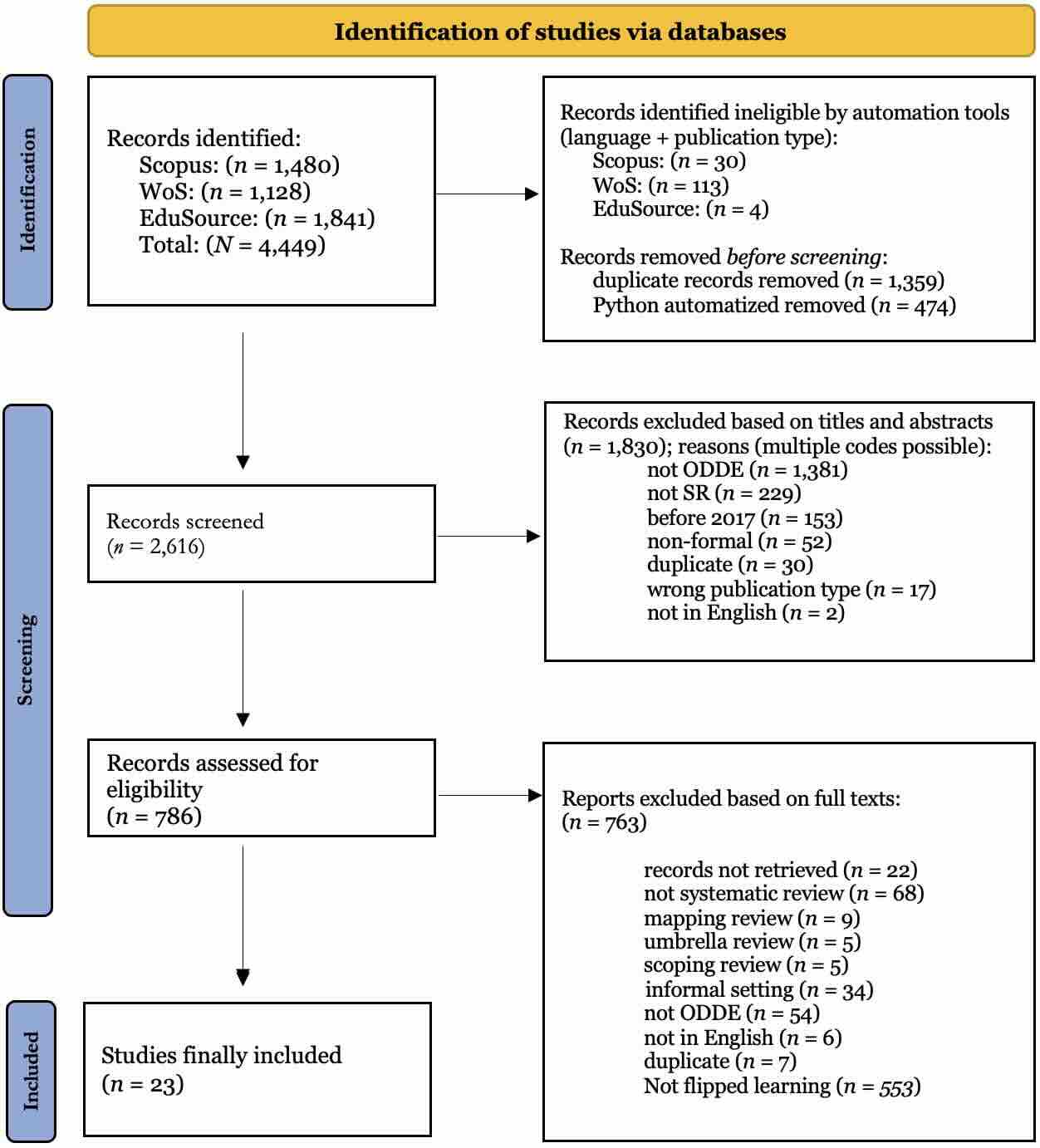
The initial search by Zawacki-Richter et al. (2025) across the above-specified databases for titles, abstracts, and keywords occurred in November 2022. It was updated in January 2023 to encompass all records from 2022. Initially, 4,449 records were identified and imported into reference management software (See Figure 1). Following the removal of 1,359 duplicates, a basic Python code was created to filter out studies that did not include the term “systematic” in their title or abstract. A total of 474 papers were excluded using the code and were subsequently manually reviewed to confirm that no papers were mistakenly rejected. The titles and abstracts of the remaining 2,616 articles were screened based on the inclusion and exclusion criteria outlined in Table 2. During the initial selection process for titles and abstracts, our priority was to maximize sensitivity rather than specificity (i.e., to include rather than exclude; Zawacki-Richter et al., 2020).
Table 2
Inclusion and Exclusion Criteria Applied to This Systematic Review Search
| Criteria | Inclusion | Exclusion |
| Publication year | 2018–2022 | before 2018 |
| Language | English | Not in English |
| Education level | Any level in ODDE, including K–12, HE, LLL, TVET | Not ODDE, informal, non-formal |
| Methodology | SR1 | Not SR |
| Publication type | Peer-reviewed academic journal article indexed in Scopus, WoS, or Education Source | Not journal article (e.g., book, editorial, note) |
Note. ODDE = open, distance, and digital education; HE = higher education; LLL = lifelong learning; TVET = technical and vocational education and training; SR = systematic review; WoS = Web of Science.
1 Papers that claim to conduct a systematic review in the title or abstract were all included.
Figure 1
PRISMA Diagram Showing Identification, Screening, and Inclusion Process of This Study
Note. PRISMA = preferred reporting items for systematic reviews and meta-analyses; WoS = Web of Science; ODDE = open, distance, and digital education; SR = systematic review. Adapted from “Preferred Reporting Items for Systematic Reviews and Meta-Analyses: The PRISMA Statement,” by D. Moher, A. Liberati, J. Tetzlaff, D. G. Altman, and PRISMA Group, 2009, PLoS Med, 6(7), p. 8 (https://doi.org/10.1371/journal.pmed.1000097). CC BY 4.0.
Inter-rater reliability. Inter-rater reliability among coders was evaluated using Fleiss’ kappa (κ). The coding consistency for including or excluding the 60 articles among the three coders was κ = .77, indicating good agreement.
From the Zawacki-Richter et al. (2025) umbrella mapping review, 23 SRs dealing with FL were included for further examination and synthesis out of 576 reviews. We used descriptive and analytical techniques to address the review questions and analyze these SRs. Initially, we established a protocol to classify the general authorship characteristics, including review type, number of included studies, educational setting, country, journal, and discipline. The data was organized using an electronic data extraction table in Microsoft Excel.
As a method for researchers to construct observations of others by expressing their views, an analytical strategy was deemed relevant to the analysis and synthesis of the findings in this umbrella review. The review included studies using different theories and empirical approaches (quantitative and qualitative), so the analysis was configurational and exploratory. The procedure used thematic and content analysis to identify, compare, and report valuable findings to education professionals. Through thorough reading and coding, themes and sub-themes were identified (Braun & Clarke, 2006) using QDA Lite software (https://provalisresearch.com/products/qualitative-data-analysis-software/freeware/). Each included SR was used as a unit of analysis. This approach was deemed suitable for summarizing and synthesizing the reviews’ findings.
The review was limited to studies published between 2018 and 2022 and only included peer-reviewed studies in English. Other languages were excluded. The review focused only on FL rather than macro strategies, such as blended learning with FL as a subtopic.
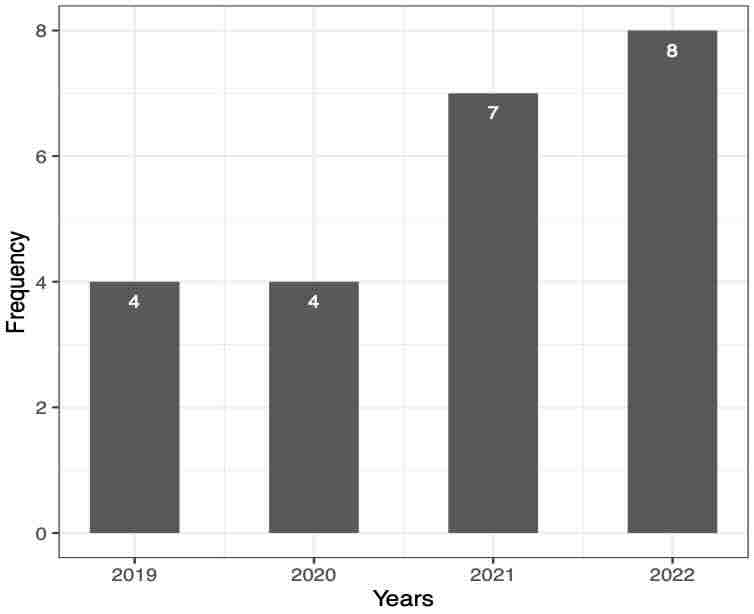
The number of papers published from 2019 onwards significantly increased. The number of included SRs on flipped learning per year grew steadily from four in 2019 and 2020 to eight in 2022 (see Figure 2).
Figure 2
Number of Included Articles Per Year (N = 23)
Systematic reviews are time- and labour-intensive. On average, it takes 67 weeks to conduct and publish a SR (Borah et al., 2017). It is therefore recommended to work in a team and divide the steps in a SR, especially the process of screening and coding, to achieve valid and reliable results. This is also apparent in the SRs included here: the median number of authors per paper is three. One SR was published by a team of nine authors (Xu et al., 2019).
The 23 SRs included in the corpus were published in 22 different journals. Two SRs on flipped learning in higher education were published in the journal Nurse Education Today (see Table 3). The majority of SRs on FC (n = 8) were published in educational technology and open, distance, and digital education (ODDE) journals such as the International Journal of Educational Technology in Higher Education, the Turkish Online Journal of Distance Education, and the journal of Computer Assisted Language Learning.
It stands out that six journals came from the field of medicine and health sciences (e.g., Nurse Education Today, BMC Medical Education, and the Journal of Dental Education), which indicates that the SR methodology is frequently applied in these fields and underscores the fact that it has its roots here (Hammersley, 2020).
Table 3
Number of Included Articles by Journal
| Journal | n |
| Nurse Education Today | 2 |
| BMC Medical Education | 1 |
| BMC Nursing | 1 |
| Computer Assisted Language Learning | 1 |
| Education & Information Technologies | 1 |
| Education Sciences | 1 |
| Educational Sciences: Theory and Practice | 1 |
| Eurasia Journal of Mathematics, Science and Technology Education | 1 |
| International Journal of Educational Technology in Higher Education | 1 |
| International Journal of Emerging Technologies in Learning | 1 |
| International Journal of Information and Education Technology | 1 |
| Journal of Dental Education | 1 |
| Journal of Language and Linguistic Studies | 1 |
| Journal of Professional Nursing | 1 |
| Journal of Statistics Education | 1 |
| Mathematics | 1 |
| Nurse Education in Practice | 1 |
| Nurse Educator | 1 |
| South African Journal of Higher Education | 1 |
| Sustainability (Switzerland) | 1 |
| Turkish Online Journal of Distance Education | 1 |
| ZDM—Mathematics Education | 1 |
| Total | 23 |
The first author’s country of origin was considered to analyze the country-wise distribution of articles (n = 14 countries). Almost 50% of the SRs on flipped learning come from only three countries: China, Canada, and Turkey.
Table 4
Distribution of Systematic Review Articles by Country and Cumulative Percentages
| Rank | Country | n | Cum % |
| 1 | China | 5 | 21.7 |
| 2 | Canada | 3 | 34.8 |
| 2 | Turkey | 3 | 47.8 |
| 3 | Germany | 2 | 56.5 |
| New Zealand | 2 | 65.2 | |
| 4 | Croatia | 1 | 69.6 |
| Indonesia | 1 | 73.9 | |
| Iran | 1 | 78.3 | |
| Korea | 1 | 82.6 | |
| Malaysia | 1 | 87.0 | |
| South Africa | 1 | 91.3 | |
| Spain | 1 | 95.7 | |
| USA | 1 | 100.0 | |
| Total | 23 |
Research reviews are essential for making academic and non-academic decisions, as they offer different perspectives (Rees & Oliver, 2012). When conducting a review, it is important to consider the research review question, assumptions, and whether the results are aggregated or configured (Gough et al., 2012). Regardless of the approach taken, various methods can synthesize the information. While the difference between quantitative and qualitative research may not always be clear-cut, it’s important to note that the aggregate/configure framework has a more specific meaning regarding the synthesis logic.
According to Gough et al. (2012), many reviews contain aggregation and configuration elements. Some focus on combining and adding up findings from similar studies, while others aim to organize the findings. Aggregative reviews concentrate on specific questions using pre-specified quantitative methods to test theories using empirical observations, which is a deductive method. Reviews with a configurative approach are more likely to ask open questions, answered with qualitative data and iterative methods. They interpret specific examples to address questions about experiences and meaning.
Our review found 21 configurative reviews and two reviews that included elements from both configurative and aggregative types. While all the reviews addressed FCs in higher education, only three addressed FCs in higher education and K–12 settings. Table 5 presents a summary of these review studies, organized by review type, number of studies included, and educational setting.
Table 5
Studies Included in the Umbrella Review by Type, Number, and Setting
| Author | Year | Review type | Studies, n | Educational setting |
| Arslan, A. | 2020 | C | 78 | K–12, HE |
| Baltaci | 2022 | C | 20 | HE |
| Banks & Kay | 2022 | C | 12 | HE |
| Cevikbas & Kaiser | 2022a | C | 97 | HE |
| Cevikbas & Kaiser | 2022b | C | 41 | HE |
| Divjak et al. | 2022 | C | 18 | HE |
| Ekici | 2021 | C | 22 | K–12, HE |
| Evans et al. | 2019 | C | 24 | HE |
| Farmus et al. | 2020 | C and A | 10 | HE |
| Fernández-Martín et al. | 2020 | C | 10 | HE |
| Fung et al. | 2021 | C | 12 | K–12, HE |
| Gerber & Eybers | 2021 | C | 167 | HE |
| Gianoni - Capenakas | 2019 | C | 8 | HE |
| Hendrik and Hamzah | 2021 | C | 32 | K–12, HE |
| Kazeminia et al. | 2022 | C | 26 | HE |
| Koh | 2019 | C | 51 | HE |
| Lo & Hew | 2022 | C | 33 | HE |
| Özbay & Cinar | 2021 | C | 24 | HE |
| Park et al. | 2021 | C | 10 | HE |
| Rasheed et al. | 2020 | C | 14 | not mentioned |
| Xu et al. | 2019 | C and A | 22 | HE |
| Youhasan et al. | 2021 | C | 27 | HE |
| Zou et al. | 2020 | C | 34 | HE |
Note. C = configurative; A = aggregative; HE = higher education.
We used the 3M Framework (Zawacki-Richter, 2009; Zawacki-richter & Bozkurt, 2023) framework to classify reviews into macro-level research (systems, theory, methods, and global perspectives), meso-level research (management and organization of institutions), and micro-level research (teaching, learning, individual learners, and teachers).
The analysis revealed an interesting result: 91.3% of the reviews focused on micro-level research, categorized into three subtopics (see Table 6). However, none of the reviews addressed the macro- or meso-level, and othersdid not specify the focus.
At the micro level, three main research areas were identified: (a) evaluating the effectiveness of the FC on academic performance and attitudes, (b) examining its design and related positive outcomes, and (c) identifying specific factors that impact its effectiveness. The reviews concluded that the FCs positively impacted learning compared to traditional learning. Most review studies focused on academic performance, satisfaction, engagement, and motivation. Few reviews (n = 8) examined the pedagogical and instructional design of the FC approach focusing on its role in enhancing the effectiveness of both learning and teaching. For example, Park et al. (2021) critically evaluated the effectiveness of pedagogical strategies for implementing FL in health professions education in South Korea. Only one review, Koh (2019), focused solely on the pedagogical design of flipped classrooms. In addition, the reviews looked at influential factors impacting the positive effects of FC on learning. These factors included subject area, duration of implementation, and the use of specific technologies to aid delivery and facilitate student learning. The results showed that the effectiveness of flipped learning varied across different subject areas.
Distinctively, few reviews within the three subcategories reflected on the implementation of the FC during the COVID-19 pandemic (e.g., Cevikbas & Kaiser, 2022a; Divjak et al., 2022; Gerber & Eybers, 2021; Lo & Hew, 2022).
Table 6
Topical Overview of the Reviews at the Micro Level (n = 21)
| Topic | Description | n | Reviews | Sample and focus |
| FC’s outcomes | Academic performance, such as test scores, course grades, and knowledge scores Attitude (satisfaction, engagement, motivation, etc.) Both | 6 | Baltaci, 2022; Banks & Kay, 2022; Fernández-Martín et al., 2020; Gianoni-Capenakas et al., 2019; Özbay & Cinar, 2021; Xu et al., 2019. | Baltaci (2022): benefits and challenges of FL instruction on student achievement and attitudes in Turkey. |
| FC’s design | Pedagogical and instruction design features Design features that enhance the outcomes | 8 | Arslan, 2020; Cevikbas & Kaiser, 2022a; Cevikbas & Kaiser, 2022b; Hendrik & Hamzah, 2021; Kazeminia et al., 2022; Koh, 2019; Park et al. 2021; Youhasan, 2021. | Cevikbas & Kaiser (2022a): using innovative technology to personalize FC instruction and improve learning outcomes. |
| Unique factors enhancing experiences in FCs | Affordance to a specific discipline Scope/mode of implementation (e.g., online FCM) | 7 | Ekici (2021); Evans et al., 2019; Farmus et al., 2020; Fung et al., 2021; Gerber and Eybers, 2021; Lo & Hew, 2022; Rasheed et al., 2020. | Ekici (2021): effectiveness of gamification on FL implementation. |
Note. FC = flipped classroom; FL = flipped learning; FCM = flipped classroom model.
It has been said that “nothing is as practical as a good theory” (Lewin, 1952, p. 169). One approach to differentiate research is by assessing the degree to which it is focused on constructing, examining, or validating theory. Limited evidence supports the positive impact of implementing the FC on students’ academic performance (Bishop & Verleger, 2013; Lo & Hew, 2017; Zuber, 2016). This limitation stems from the lack of employment of theoretical frameworks and inconsistency among methods and class activities (Lin & Hwang, 2019; Zuber, 2016). Thus, we assessed how the reviews discussed the integration of theoretical frameworks in the studies they examined, whether to analyze their research findings or guide the implementation of the FC method.
Regrettably, out of the 23 SRs, only seven discussed the theoretical frameworks reported in the studies they reviewed. Five focused on theoretical frameworks guiding flipped classrooms’ related practices and implementation approaches, stating the theoretical framework employed for the FC design. The other two incorporated theoretical frameworks to synthesize research findings and assess the impact of the FC practice. The lack of discussion on theory in the FC literature raises concerns.
The umbrella review’s coding and analysis were based on the information provided in the included SRs. Although some SRs discussed theoretical frameworks, most did not give the number of studies that used a theoretical framework. For instance, a SR by Baltaci (2022) revealed that only seven out of 20 reviewed articles explicitly mentioned their theoretical frameworks. This type of information was uncommon among the reviews, resulting in limited capacity for data aggregation regarding theoretical frameworks.
The theories that have been reviewed encompassed various approaches for understanding the specific phenomena exhibited in Table 7. Within the field of FC research, the dominant epistemological theory was constructivism. However, studies in this area have employed a range of theoretical approaches, with some emphasizing Bloom’s taxonomy for FC design. Other theoretical frameworks included active learning, cognitive load, and self-determination theories. Surprisingly, the theory of differentiated instruction was not central to discussions about the FC model, although it can significantly support teachers in optimizing the student-centered approach.
Table 7
Overview of the Reviewed Theories and Models
| Author(s) | Theories and models |
| Baltaci (2022) | Bloom’s taxonomy Constructivism Self-directed or self-regulated learning |
| Ekici (2021) | Gamified learning Self-determination Cognitive load theory Flow theory |
| Gerber & Eybers (2021) | Gamified learning Self-determination Cognitive load theory |
| Koh (2019) | Self-directed learning |
| Lo & Hew (2022) | Revised Community of Practice (RCOI) |
| Park et al. (2021) | Analysis, design, development, implementation, and evaluation (ADDIE) model |
| Zou et al. (2020) | Self-regulated learning |
In this section, we present examples of SRs that discuss the design of FC learning along with the associated theoretical framework. Gerber and Eybers (2021) thoroughly examined educational theories, including constructivist theory, active learning theory, self-determination theory, cognitive load theory, and the theory of gamified learning. These foundational theories played an influential role in shaping the design considerations derived from their findings. By integrating these theories, the researchers could outline essential design considerations for implementing flipped classrooms. Gerber and Eybers (2021) and Eciki (2021) also emphasized the self-determination theory, which focuses on human motivation when the needs for competence, connection, and autonomy are met. They also elaborated on the cognitive load theory, suggesting that learning experiences should minimize working memory load. The flow theory was also highlighted, emphasizing total concentration achieved when individuals balance perceived challenges and skills. Furthermore, the theory of gamified learning was identified, focusing on using mechanisms to promote student engagement and motivation, which has gained popularity in various contexts for encouraging specific behaviours. Meanwhile, in Baltaci (2022), it was highlighted that Bloom’s taxonomy was the most commonly used framework for designing and implementing flipped instruction. This finding is consistent with earlier reviews (e.g., Bishop & Verleger, 2013) that have supported student-centered learning and its associated theories, such as peer-assisted and collaborative learning. Similarly, Park et al. (2021) introduced the analysis, design, development, implementation, and evaluation (ADDIE) model for flipped learning, advocating for pre-learning, in-class activities, and post-class evaluation and self-assessment as the principal teaching strategies.
On the other hand, Lo and Hew (2022) identified various practical elements for online FL practice. They organized them based on the revised community of inquiry (RCOI) framework’s components: cognitive, social, teaching, and learner presence. At the same time, Zou et al. (2020) thoroughly reviewed 34 published articles on flipped classrooms in language teaching, considering various aspects, including theoretical foundations.
In summary, the results in this section help map the reviewed theoretical frameworks and suggest the theoretical base to steer insights about the pedagogical offerings of FCs that could enhance the learning outcomes. For instance, since the FC design is predominantly based on social constructivism, almost all literature reports a positive impact on cognitive learning outcomes, regardless of the underlying theoretical framework in designing the FC. However, regarding the effects of other learning outcomes, SRs that include cognitive load theory (e.g., Baltaci, 2022; Ekici, 2021) reported a positive effect on student involvement, enthusiasm, and motivation. On the other hand, SRs with active learning and gamified learning theoretical frameworks (e.g., Gerber & Eybers, 2021) reported a positive impact on student engagement and effective use of study time.
A standard operational FC model was identified in the reviewed literature, comprising three main components (Lo, 2023; Youhasan et al., 2021): pre-class, in-class, and post-class activities. While not all reviews focused solely on the design of the flipped classroom, 18 of them touched on general and specific design features and pedagogical considerations, and almost all 23 reviews described their active learning components. Several reviews explored effective design frameworks for this method (e.g., Arslan, 2020; Gerber & Eybers, 2021; Youhasan et al., 2021), and they found a number of common features. For example, the FC model involves instructional design elements and delivery tools. The primary teaching methods of the FC involve active participation, interaction, collaboration, projects, and case-based learning. Instructional design elements for flipping a course include designing content, organizing flexible physical space, creating activities to orient students, motivating an active student mindset, scaffolding, and chunking course content (Arslan, 2020). Popular delivery tools include video lectures for pre-class courses, while the learning management system (LMS) provides a platform for sharing resources and data analytics. Popular post-class strategies include instructor feedback, self-evaluation journals, and peer evaluation.
We used the four FLIP pillars—flexible environment, learning culture, intentional content, and professional educator—developed by the Flipped Learning Network in 2014 to classify the design principles and considerations (refer to Table 8) identified in the reviewed SRs. Several design recommendations stand out in specific studies. For example, Gerber and Eybers (2021) suggested breaking the FC model into mini-curricula to prevent student overwhelm and facilitate procedural fluency. In addition, Gianoni-Capenakas et al. (2019) recommended organizing materials through content chunking, which involves direct instruction and active learning strategies.
Another interesting finding by Divjak et al. (2022) was the use of a holistic learning design, aligning teaching and learning strategies with the desired learning outcomes. This should involve a combination of approaches that best match the intended learning outcomes and the needs and characteristics of the student body. Combining the FC with other innovative teaching and learning approaches such as work-based learning (WBL), problem-based learning (PBL), the use of massive open online courses (MOOCs), and game-based learning can have a more significant impact on student learning and satisfaction.
Similarly, Fung et al. (2021) examined the design and planning mechanisms of course materials and activities that assist students in overcoming their blind spots, organizing content materials, and expanding their problem-solving approaches. Instant feedback and scaffolding were also key elements extensively reviewed in most studies. Park et al. (2021) also emphasized using a self-evaluation journal to follow up on pre-class activities.
On the other hand, Ekici (2021) assessed how engagement can be fostered through a gamified FC and discovered that half the studies mentioned the use of teaching aids such as Kahoot, Socrative, and quizzes to gamify instruction.
Table 8
Overview of the Design Principles and Considerations for Flipped Classrooms
| Category | Subcategory | n | Sample review |
| Flexible environment | Learners’ space and pace | 10 | Gianoni-Capenakas et al. (2019) |
| Duration of the intervention | 1 | Gianoni-Capenakas et al. (2019) | |
| Periodic adjustments of class design | 2 | Gerber & Eybers (2021) | |
| Learning culture | Active participation | 22 | Youhasan et al. (2021) |
| Self-evaluation | 4 | Park et al. (2021) | |
| Learner-centered engaging activities | 15 | Koh (2019) | |
| Personalized learning | 2 | Cevikbas & Kaiser (2022b) | |
| Intentional content | Holistic design | 2 | Divjak et al. (2022) |
| Chunking content | 11 | Fung et al. (2021) | |
| Design of visual material | 18 | Inayah et al. (2023) | |
| Gamified teaching aids | 18 | Ekici (2021) | |
| Professional educator | Scaffolding and feedback | 17 | Baltaci (2022) |
| Monitoring and data recording | 2 | Gianoni-Capenakas et al. (2019) |
Understandin
Unfortunately, out of the analyzed SRs, only four explicitly reported the duration of the flipped intervention, while others mentioned durations as “long” or “short.” Similarly, only six SRs reported on the sample size, while others referred to “small samples” without defining them. Moreover, the implementation strategy was generally inferred rather than explicitly explained. There were two main approaches: a partial FC, where the flipped approach was used for only several sessions, and an entire FC, implemented for all or most of the meetings, that was slightly more dominant (see Hendrik & Hamzah, 2021). Evans et al. (2019) also noted variation in the implementation duration, with some studies using the approach for just one unit in a semester, while others adopted it for an entire semester or longer. This inconsistency in reporting on the pedagogical elements of the FC has led to confusion.
Table 9 presents the duration of the flipped interventions mentioned in four SRs.
Table 9
Duration of Flipped Interventions as Described in Four Systematic Reviews
| Systematic review | Studies reviewed (N) | Studies describing duration (n) | Duration |
| Ekici (2021) | 22 | 17 | 1–4 months |
| 3 | < 1 month | ||
| 2 | = 6 months | ||
| Park et al. (2021) | 10 | 10 | 1–4 months |
| Evans et al. (2019) | 24 | Not specified | 1 unit of content/semester |
| Not specified | 1 academic semester | ||
| Gianoni-Capenakas et al. (2019) | 8 | Not specified | 5–16 sessions |
Note. The variation in reporting duration among the included studies indicates the need for standardized measurement units.
The variability in reporting may be linked to the diverse research objectives of the SRs and their studies, suggesting that our findings should only be considered indicative. However, given heterogeneity and risk of bias, future studies should include a large sample size and high-quality research to confirm effectiveness (Xu et al., 2019). Therefore, ithis review recommends that research methods be thoroughly documented and high quality data collected, as Banks and Kay (2022) advocated. To improve data reporting in SRs related to flipped learning, the following factors would need to be included in all reviews:
The impact of the FC can vary depending on the subject area (Giannakos et al., 2014). For example, Lin and Hwang (2019) explored the research trends regarding the use of FCs in medical courses and found that using in-class activities was inconsistent across the studies. In FCs for medical courses, discussions, exercises, problem-based activities, and group project activities reign as the most popular in-class activities (Lin & Hwang, 2019). This indicates the significance of developing customized flipped learning designs and strategies that address the unique requirements of each subject area and, ultimately, foster a student-centered learning environment. For example, the SR by Park et al. (2021) highlighted the importance of adopting tailored approaches to flip the traditional classroom teaching model for specific courses to centre the learner in the educational environment.
After conducting an in-depth analysis of multiple SRs, it has been revealed that the FC model has been applied in various disciplines. Studies in STEM subject areas (science, technology, engineering, and mathematics), which included computing, programming, mathematics education, and information systems, were the most common areas where FL practices were conducted (n = 8). The application of the FL method in healthcare education was also found to be quite prevalent with (n = 7) reviews on medical education, dental education, and nursing being the primary focus areas. Language teaching (n = 3) was another area where flipped learning methodology was frequently implemented. Several reviews have proposed design recommendations for effectively implementing the FC model in specific fields. We have included the findings related to those three fields below.
Systematic reviews highlighting specific design recommendations were found in some studies (n = 8). For instance, the SR by Farmus et al. (2020) found that “partial flipping” may be sufficient for STEM courses such as statistics. The approach would involve breaking the content into smaller parts and facilitating applied and advanced learning during in-class discussions. However, their research also found that instructors who already incorporated active learning components into their lectures or included lab time may find the FC model innovative. Thus, they recommended flipping only the most challenging parts of the content to ease the burden of flipping a class.
Another SR by Gerber and Eybers (2021) emphasized using case-based scenarios in STEM in-class activities through which the topic content would be discussed and applied with various examples to illustrate concepts, and learners would be expected to contribute to those discussions. The research recommended post-class activities that reinforce learning through application assignments that specifically focus on aspects of the advanced in-class concepts and activities, which is part of the module’s summative assessment.
Along the same line, in a recent SR of mathematics education, Cevikbas and Kaiser (2022a) discovered that most FC instructors favoured the use of lecture explanatory videos as their primary instructional method. Nevertheless, alternative methods, such as reading texts and presentations, podcasts, lecture notes, and infographics, are also viable options. The review affirmed the widespread use of lecture videos in flipped mathematics classes, particularly those created by the instructors, and over one-third of the reviewed studies in this SR indicated that the FC pedagogy improved students’ conceptual understanding and facilitated active and continuous learning. These findings highlight the significant positive impact of the FC on students’ academic development in mathematics, with videos and quizzes emerging as the most effective elements of implementation.
Another SR conducted by Cevikbas and Kaiser (2022b) highlighted that the FC model was especially effective for tailoring engineering education to individual needs and for creating adaptive learning experiences. Various digital tools and platforms, as well as learning analytics, were used to personalize the instruction. Furthermore, the review highlighted the potential of gamification and emerging technologies, such as virtual reality (VR), machine learning, and cloud technology, in effectively personalizing instruction, especially in STEM disciplines.
On the one hand, while popular activities such as readings, online modules, self-guided exercises, assignments, and interactive tutorials can be done outside the classroom, Hendrik and Hamza (2021) have expressed concerns about the overreliance on videos for knowledge transfer in a FC. Their study suggested that readings and assignments should be used to help students develop lifelong learning skills. They stress the importance of this approach, especially in software development, where developers need to be proficient in reading e-books, manuals, and documentation related to rapidly changing technology.
Finally, other SRs delved into organizational recommendations that have the potential to yield positive outcomes. Fung et al. (2021), for example, found among their included studies that distributing videos earlier, rather than scheduling them to be accessible only on the experiment date, increased student motivation.
Generally, systematic reviews in medical and health sciences (n = 7) viewed the FC method as an effective method. The review by Youhasan et al. (2021) demonstrated that the FC learning approach enhanced nursing students’ knowledge, skills, and attitudes. The success was attributed to the students’ unrestricted access to pre-classroom materials and the interactive in-class environment. Effectively implementing flipped pedagogy requires following an instructional system design at both macro (curriculum and course level) and micro (topics or sessions) levels. Additionally, the success of the FC approach depends on consistent and stable implementation planning (Liu et al., 2024). Youhasan et al. (2021) also found that four main in-class activities optimized outcomes: dividing students into small groups, conducting diagnostic assessments, micro-teaching, and continuing integrative student-centered instructions.
Still, in the nursing field, one interesting recommendation of the SR conducted by Evans et al. (2019) was that the detailed processes used to train faculty for consistent content delivery impacted the quality of teaching in flipped nursing classes. As per research conducted by Divjak et al. (2022), the FC combined with other approaches, such as problem-based learning (PBL), game-based learning, bring your own device (BYOD), and massive open online courses (MOOCs), was shown to be successful in specific study fields, particularly in medical education. Additionally, the review highlighted that in one of the included studies, teachers expressed the opinion that the online FC would be suitable for theory-based lessons but challenging for the practical lab sessions in medical and science disciplines.
Lastly, multiple SRs (e.g., Kazeminia et al., 2022; Park et al., 2021) have documented using a fundamental motivation model in flipped classrooms for theoretical and practical learning in various medical courses. An exciting feature of this model involves prompting students to engage in a WSQ approach (watching, summarizing, and questioning) for pre-class assignments to enhance their comprehension of the theoretical material.
In the language education discipline, SRs (n = 3) referred to specific benefits of the FC method. Based on a SR by Arslan (2020), more than half the studies suggested that using flipped learning in teaching English as a Foreign Language (EFL) or English as a Second Language (ESL) effectively enhanced students’ language skills. Several studies emphasized the role of flipped learning in improving vocabulary, writing, listening, reading, and speaking skills. Researchers also argued that adopting a flexible learning approach that promotes a dynamic learning environment for students would be highly recommended in language teaching. This approach would allow students to thoroughly understand the content by enabling them to replay videos and review activities until they fully grasp the concepts. Flipped learning both enhances students’ English language proficiency through video activities and provides immediate feedback and promotes positive collaboration.
Baltaci (2022) elaborated on the importance of feedback through his review, explaining that instant assessment tools providing timely and constructive feedback can significantly enhance learners’ writing skills. Such tools can be highly beneficial in language education as they enable students to promptly identify their weaknesses and areas for improvement, allowing them to focus on those areas and make progress quickly.
According to Crompton et al. (2017), failed outcomes with the FC model are useful for understanding the situation better. Their research emphasized the significance of scrutinizing unsuccessful attempts to improve future outcomes. Nine SRs in the corpus discussed the challenges faced using the FC model. We used a categorization scheme developed by Betihavas et al. (2016) that classified the challenges of FC into three categories: student-related, faculty-related, and operational. This categorization was used to code the challenges related to FC model. Table 10 displays the list of coded challenges and sample review studies.
Table 10
Overview of the Challenges of Flipped Classrooms
| Challenge | Subcategory | Reviews (n) | Example review |
| Student-related | Not completing pre-class tasks | 7 | Baltaci (2022) |
| Disorientation | 3 | Ekici (2021) | |
| Resistance and lack of motivation | 6 | Gianoni-Capenakas et al. (2019) | |
| Time consumption and workload | 8 | Gerber & Eybers (2021) | |
| Faculty-related | Effort and workload | 8 | Youhasan et al. (2021) |
| Teacher’s preparation | 4 | Park et al. (2021) | |
| Resistance to role change | 2 | Koh (2019) | |
| Operational | Technical problems | 5 | Lo & Hew (2022) |
| Requiring adjustment time | 3 | Divjak et al. (2022) Fung et al. (2021) Inayah et al. (2023) Ekici (2022) |
Implementing the FC model can be challenging due to various factors hindering its success. One of the main obstacles is the increased workload and time required for preparation from both students and faculty. Review studies such as those conducted by Gerber & Eybers (2021), Baltaci (2022), and Divjak et al. (2022) show that the FC requires more effort and workload from the students than traditional classroom models. Some students struggle with pre-class individual learning (Cevikbas & Kaiser, 2022a). Therefore, adequate planning and preparation are necessary to ensure success. The SR by Gerber and Eybers (2021) also highlighted that some students may need help accessing flipped materials at home, hindering the practice of the approach. Another significant challenge is students’ lack of engagement with the model and failure to complete assignments. Teachers must, therefore, provide proper guidance and support to help students adapt to the new instructional model. Baltaci (2022) also emphasized that implementing an FC model requires assigning time for flipped instruction outside the classroom. This can be challenging for students with other commitments.
The FC workload is stressful for educators (Lo & Hew, 2022) as they plan lessons and create or adapt content to help students learn and prepare for class (Cevikbas & Kaiser, 2022a). Divjak et al. (2022) identified a further disadvantage of FCs, stating that teachers had to invest much time in preparation and communication. For example, carefully designing asynchronous and synchronous stages, preparing rich resources, and planning time to answer questions require substantial time from teachers. Baltaci (2022) mentioned also the lack of immediate student assistance and the need for extensive resources and material development as drawbacks of flipped instruction. This places an extra burden on teachers.
In addition, teachers’ competence and preparation are among the frequently reported faculty-related challenges. Even if a teacher is highly competent in face-to-face delivery, the quality of the video lessons he/she prepares may be poor due to insufficient instructional or technical skills, as highlighted by Gerber and Eybers (2021). They recommended using MOOCs in FCs to support with pre-class content development, especially in resource-challenged countries, keeping in mind that the use of MOOCs or online video content may pose a challenge in ensuring alignment with the overall curricula, module objectives, and outcomes. Also, technical issues could arise due to inadequate teacher training (Ekici, 2021). Some teachers may also resist the change in their teacher-centric roles, hindering the learner centrism at the core of the FC model (Koh, 2019).
Implementing flipped learning has brought challenges, mainly related to technology and infrastructure (Baltaci, 2022), including inadequate resources, limited Internet access, and insufficient technical support (Arslan, 2020; Lo & Hew, 2022). As a result, teachers and students may have difficulty accessing and sharing materials online. Ekici (2021) pointed out that the challenges of flipped learning are compounded by the fact that some students may need more equipment to participate in online learning, leading to website inaccessibility or inequality in accessing technology (digital divide). Therefore, it is crucial to ensure all students have access to the necessary resources.
Our umbrella review found that research on flipped classrooms covered various areas but could be grouped into three main categories (see Table 6). The main focus was to evaluate FCs’ effectiveness and understand how teaching strategy could be enhanced to better accommodate the FC model. There are several key factors contributing to the success of the FC model. One of these factors is the compatibility of the approach with the specific context; greater compatibility will result in more successful long-term implementation. Therefore, it is important to consider the overall instructional system design rather than just focusing on specific operational aspects. Additionally, achieving positive results in FCs requires balancing the workload of activities before, during, and after class instead of placing too much emphasis on only one phase (Youhasan et al., 2021).
However, the current focus is mainly on designing pre-class and post-class activities, with less attention to in-class time. Future research should consider using design-based methodologies (Inayah et al., 2023) and promoting action research to maximize the positive impact of in-class interventions on student learning in FCs. A consistent and holistic approach will help ensure that all activities support each other and actively engage the learners.
Flipped classrooms, particularly in higher education, have been widely adopted to support student-centered learning. However, FC has been criticized for lacking a clear theoretical framework (Inayah et al., 2023; Koh, 2019). In our analysis, we found that several reviews needed a solid theoretical foundation to support their research focus and practices. Other reviews, such as Wohlfart and Wagner (2023), identified a similar issue. The absence of explicit references to educational and learning theories and the wide range of student-centered pedagogical practices may present challenges for instructors interested in implementing FCs. These reviews do not provide sufficient evidence to demonstrate the effectiveness of strategies, which raises concerns about the current theoretical foundation of FC research. While constructivism predominantly prevails, other theories were identified in this umbrella review.Understanding the theoretical basis underlying different approaches to FCs is vital to establishing effective pedagogical strategies for replication. Hence, this umbrella review highlights the necessity of employing a clearly defined theoretical framework that aligns with contemporary learning theories to steer the development, implementation, and assessment of FCs. By contemporary learning theories, we mean theories that reflect on the dynamics of the digital era (e.g., connectivism), since FC is a model that pays great attention to the quality of interaction in the learning and teaching processes.
A growing body of evidence shows the impact of general and additional design considerations of the FC. In addition to a handful of design features commonly reported in most studies that may be related to the flipped approach’s effectiveness, the SRs we analyzed have provided insights for improving the implementation of FCs (as detailed in the results of RQ4 and RQ5). The effectiveness of the FC could be enhanced by considering the time students spend in class and the duration of the flipped intervention (Xu et al., 2019). While flipped learning studies vary in the number and type of pedagogical details they provide (Låg & Sæle, 2019), it has been challenging to identify the specific aspects of flipped learning that most influence its success. This challenge stems from a lack of systematic reporting (Låg & Sæle, 2019). Similarly, we found only a few eligible studies that provided the necessary information to analyze these variables reliably. To address this issue, future studies on the effectiveness of flipped learning need to consistently, thoroughly, and systematically report implementation details, design, and pedagogical features as suggested in this umbrella review.
Also, one possible reason for the heterogeneity and variations in the outcomes of flipped learning is the difference in context. The academic discipline may play a role in the success of flipped models. The argument is that applied STEM fields, such as engineering or the health professions, may be particularly well-suited to flipped learning (Bredow et al., 2021). Subject areas that require practicing specific skills or problem sets, such as languages and mathematics, have also been identified as suitable for this method (Bredow et al., 2021; Karabulut-Ilgu et al., 2018). Our umbrella review revealed unique recommendations for effectively implementing FCs in the most popular disciplines. Nevertheless, the prevalence of FCs in STEM disciplines has raised questions about whether the nature of these disciplines might have influenced their design. If FCs became equally popular in the social sciences, alternative design approaches might be explored (Hew et al., 2021). We strongly encourage researchers and practitioners to critically discuss and evaluate different strategies and apply them across various fields and subject areas to maximize their effectiveness.
Despite the widespread use of the FC model, its full potential has yet to be realized (Hoshang et al., 2021). Most reviews have focused on studies with short FC interventions (e.g., one academic semester or less) and have been based on small sample sizes (e.g., fewer than 100 participants), as illustrated in Table 9. This suggests that some findings regarding the opportunities offered by the FC model may need further investigation. Longitudinal studies are necessary to identify best practices for implementing the FC model and to determine whether contextual factors, such as subject areas, academic levels, the complexity of learning content, and duration of the flipped intervention, have any impact on its effectiveness (Lo & Hwang, 2018).
Another significant gap in the FC research is the need for more thorough reflections on the challenges of this model. Upon analyzing SRs investigating FCs, it was discovered that many of the same challenges are reported and repeated in existing literature (e.g., Li & Fang, 2015). However, the challenges remain general and lack specific details on how they might differ across disciplines, potentially leading to redundant efforts. Planning customized activities and FC designs without this information is challenging. The literature offers some recommendations to address these challenges, including providing sufficient training and support for teachers and students, ensuring all students have access to necessary resources, and fostering a supportive learning environment that promotes engagement and participation among students. In addition, MOOCs are suggested to complement teachers’ lack of capability to create their own videos. We also recommend using open education resources (OER) for the same purpose besides content preparation.
Regarding gaps in flipped learning research, there is a need for reviews that diverge from the typical research on flipped learning, which focuses on micro-level (teaching and learning) aspects. Studies encompassing macro-level (systems, theory, methods, global perspectives) and meso-level (institutional management and organization) aspects will broaden the base of knowledge on FL. This would offer a more comprehensive understanding of this subject matter.
Finally, it is strongly recommended that factors that can influence the implementation process and affect students’ preferences, such as students’ cultural orientations and educational traditions, be considered. Understanding cultural differences is critical for the successful and sustainable implementation of the FC method (Karagöl & Esen, 2019). For instance, some cultures may prefer strict teacher guidance and authority, which could impact the efficacy of flipped pedagogies.
This umbrella review examined the potential advantages of flipped learning in promoting student-centered learning. Flipped classrooms can be an effective method for enhancing learning results, as long as they are customized to address the particular requirements of different disciplines and situations. The review presented recent trends and patterns in FC research and practice in education. It also highlighted key challenges that need to be addressed to fully benefit from this approach, such as the limited evidence of the impact of FCs beyond general outcomes. Enhanced theorization of FC research and practice would facilitate the effective implementation of this approach. Customized design and a more profound exploration of the alignment of flipped classrooms’ design with subject areas and contexts were among the critical topics addressed in this review. In addressing these issues, we hope this umbrella review provides insights for educators and researchers seeking to optimize the use of FCs in teaching and learning environments.
(an asterisk indicates systematic reviews included in this umbrella review)
Akçayır, G., & Akçayır, M. (2018). The flipped classroom: A review of its advantages and challenges. Computers & Education, 126, 334-345. https://doi.org/10.1016/j.compedu.2018.07.021
Aromataris, E., Fernandez, R. S., Godfrey, C., Holly, C., Khalil, H., & Tungpunkom, P. (2014). Methodology for JBI umbrella reviews. In Joanna Briggs Institute Reviewers’ Manual: 2014 Edition, Supplement (pp. 1-34). The Joanna Briggs Institute. https://ro.uow.edu.au/articles/chapter/Methodology_for_JBI_umbrella_reviews/27794958?file=50564202
*Arslan, A. (2020). A systematic review on flipped learning in teaching English as a foreign or second language. Journal of Language and Linguistic Studies, 16(2), 775-797. https://doi.org/10.17263/jlls.759300
Bagley, S. (2020). The flipped classroom, lethal mutations, and the didactical contract: A cautionary tale. PRIMUS, 30(3), 243-260. https://doi.org/10.1080/10511970.2018.1555196
*Baltacı, H. S. (2022). A snapshot of flipped instruction in English Language teaching in Turkiye: A systematic review. Turkish Online Journal of Distance Education, 23(4), 255-269. https://doi.org/10.17718/tojde.1182793
*Banks, L., & Kay, R. (2022). Exploring flipped classrooms in undergraduate nursing and health science: A systematic review. Nurse Education in Practice, 64, Article 103417. https://doi.org/10.1016/j.nepr.2022.103417
Bergmann, J., & Sams, A. (2012). Flip Your Classroom: Reach Every Student in Every Class Every Day (pp. 120-190). Washington DC: International Society for Technology in Education.
Betihavas, V., Bridgman, H., Kornhaber, R., & Cross, M. (2016). The evidence for “flipping out”: A systematic review of the flipped classroom in nursing education. Nurse Education Today, 38, 15-21. https://doi.org/10.1016/j.nedt.2015.12.010
Birgili, B., Seggie, F. N., & Oğuz, E. (2021). The trends and outcomes of flipped learning research between 2012 and 2018: A descriptive content analysis. Journal of Computers in Education, 8(1), 365-394. https://doi.org/10.1007/s40692-021-00183-y
Bishop, J. L., & Verleger, M. A. (2013). The flipped classroom: A survey of the research. In 2013 ASEE annual conference and exposition, Conference proceedings. American Society for Engineering Education. https://www.researchgate.net/publication/285935974_The_flipped_classroom_A_survey_of_the_research
Bond, M. (2020). Facilitating student engagement through the flipped learning approach in K–12: A systematic review. Computers & Education, 151, Article 103819. https://doi.org/10.1016/j.compedu.2020.103819
Borah, R., Brown, A. W., Capers, P. L., & Kaiser, K. A. (2017). Analysis of the time and workers needed to conduct systematic reviews of medical interventions using data from the PROSPERO registry. BMJ Open, 7(2), Article e012545. https://doi.org/10.1136/bmjopen-2016-012545
Braun V., & Clarke V. (2006). Using thematic analysis in psychology. Qualitative Research in Psychology, 3(2), 77-101. https://doi.org/10.1191/1478088706qp063oa
Bredow, C. A., Roehling, P. V., Knorp, A. J., & Sweet, A. M. (2021). To flip or not to flip? A meta-analysis of the efficacy of flipped learning in higher education. Review of Educational Research, 91(6), 878-918. https://doi.org/10.3102/00346543211019122
Brunton, J., & Thomas, J. (2012). Information management in systematic reviews. In D. Gough, S. Oliver, & J. Thomas (Eds.), An introduction to systematic reviews (pp. 83-106). SAGE.
* Cevikbas, M., & Kaiser, G. (2022a). Can flipped classroom pedagogy offer promising perspectives for mathematics education on pandemic-related issues? A systematic literature review. ZDM Mathematics Education, 55(1), 177-191. https://doi.org/10.1007/s11858-022-01388-w
*Cevikbas, M., & Kaiser, G. (2022b). Promoting personalized learning in flipped classrooms: A systematic review study. Sustainability, 14(18), Article 11393. https://doi.org/10.3390/su141811393
Crompton, H., Burke, D., & Gregory, K. H. (2017). The use of mobile learning in PK–12 education: A systematic review. Computers & Education, 110, 51-63. https://doi.org/10.1016/j.compedu.2017.03.013
*Divjak, B., Rienties, B., Iniesto, F., Vondra, P., & Žižak, M. (2022). Flipped classrooms in higher education during the COVID-19 pandemic: Findings and future research recommendations. International Journal of Educational Technology in Higher Education, 19, Article 9. https://doi.org/10.1186/s41239-021-00316-4
El Gamal, H. (2022). Is flipped approach a panacea? A systematic review of trends, conceptions, and practices of a decade of research. Asian Journal of Distance Education, 17(2), 153-180. https://doi.org/10.5281/zenodo.7245601
*Ekici, M. (2021). A systematic review of the use of gamification in flipped learning. Education and Information Technologies, 26, 3327-3346. https://doi.org/10.1007/s10639-020-10394-y
Eppard, J., & Rochdi, A. (2017). A framework for flipped learning. In I. Arnedillo Sánchez, P. Isaias, & L. Rodrigues (Eds.), Proceedings of the International Conference on Mobile Learning 2017 (pp. 33-40). International Association for Development of the Information Society. https://www.proceedings.com/content/036/036166webtoc.pdf
*Evans L., Vanden Bosch, M. L., Harrington, S., Schoofs, N., & Coviak C. (2019). Flipping the classroom in health care higher education: A systematic review. Nurse Educator, 44(2), 74-78. https://doi.org/10.1097/NNE.0000000000000554
*Farmus, L., Cribbie, R. A., & Rotondi, M. A. (2020). The flipped classroom in introductory statistics: Early evidence from a systematic review and meta-analysis. Journal of Statistics Education, 28(3), 316-325. https://doi.org/10.1080/10691898.2020.1834475
*Fernández-Martín, F.D., Romero-Rodríguez, J.-M., Gómez-García, G., & Ramos Navas-Parejo, M. (2020). Impact of the flipped classroom method in the mathematical area: A systematic review. Mathematics, 8(12), Article 2162. https://doi.org/10.3390/math8122162
*Fung, C.-H., Besser, M., & Poon, K.-K. (2021). Systematic literature review of flipped classroom in mathematics. Eurasia Journal of Mathematics, Science and Technology Education, 17(6), Article em1974. https://doi.org/10.29333/ejmste/10900
*Gerber, A., & Eybers, S. (2021). Converting to inclusive online flipped classrooms in response to COVID-19 lockdown. South African Journal of Higher Education, 35(4), 34-57. https://doi.org/10.20853/35-4-4285
Gough, D., Oliver, S., & Thomas, J. (2017). An introduction to systematic reviews (2nd ed.). SAGE.
Gough, D., Thomas, J., & Oliver, S. (2012). Clarifying differences between review designs and methods. Systematic Reviews, 1, Article 28. https://doi.org/10.1186/2046-4053-1-28
* Gianoni-Capenakas, S., Lagravere, M., Pacheco-Pereira, C., & Yacyshyn, J. (2019). Effectiveness and Perceptions of Flipped Learning Model in Dental Education: A Systematic Review. Journal of dental education, 83(8), 935-945. https://doi.org/10.21815/JDE.019.109
Giannakos, M. N., Krogstie, J., & Chrisochoides, N. (2014). Reviewing the flipped classroom research: Reflections for computer science education. In E. Barendsen & V. Dagiené (Eds.), Proceedings: Computer Science Education Research Conference '14 (pp. 23-30). ACM. https://doi.org/10.1145/2691352.2691354
*Gianoni-Capenakas, S., Lagravere, M., Pacheco-Pereira, C., & Yacyshyn, J. (2019). Effectiveness and perceptions of flipped learning model in dental education: A systematic review. Journal of Dental Education, 83(8), 935-945. https://doi.org/10.21815/JDE.019.109
Grant, M. J., & Booth, A. (2009). A typology of reviews: An analysis of 14 review types and associated methodologies. Health Information and Libraries Journal, 26(2), 91-108. https://doi.org/10.1111/j.1471-1842.2009.00848.x
Hammersley, M. (2020). Reflections on the methodological approach of systematic reviews. In O. Zawacki-Richter, M. Kerres, S. Bedenlier, M. Bond, & K. Buntins (Eds.), Systematic reviews in educational research (pp. 23-39). Springer VS. https://doi.org/10.1007/978-3-658-27602-7_2
*Hendrik, H., & Hamzah, A. (2021). Flipped classroom in programming course: A systematic literature review. International Journal of Emerging Technologies in Learning (iJET), 16(02), 220-236. https://doi.org/10.3991/ijet.v16i02.15229
Hew, K. F., Bai, S., Huang, W., Dawson, P., Du, J., Huang, G., Jia, C., & Thankrit, K. (2021). On the use of flipped classroom across various disciplines: Insights from a second-order meta-analysis. Australasian Journal of Educational Technology, 37(2), 132-151. https://doi.org/10.14742/ajet.6475
Hoshang, S., Hilal, T. A., & Hilal, H. A. (2021). Investigating the Acceptance of Flipped Classroom and Suggested Recommendations. Procedia Computer Science, 184, 411-418. https://doi.org/10.1016/j.procs.2021.03.052
Hwang, G.-J., Yin, C., & Chu, H.-C. (2019). The era of flipped learning: Promoting active learning and higher order thinking with innovative flipped learning strategies and supporting systems. Interactive Learning Environments, 27(8), 991-994. https://doi.org/10.1080/10494820.2019.1667150
*Inayah, S., Juandi, D., Darhim, D., Prabawanto, S., & Jupri, A. (2023). The impact of flipped classroom implementation in mathematics learning at school: Systematic literature review. Journal Analisa, 9(1), 59-73. https://doi.org/10.15575/ja.v9i1.18226
Jonassen, D., Davidson, M., Collins, M., Campbell, J., & Haag, B. B. (1995). Constructivism and computer-mediated communication in distance education. American Journal of Distance Education, 9(2), 7-25. https://doi.org/10.1080/08923649509526885
Karabulut-Ilgu, A., Jaramillo Cherrez, N., & Jahren, C. T. (2018). A Systematic Review of Research on the Flipped Learning Method in Engineering Education. British Journal of Educational Technology, 49, 398-411. https://doi.org/10.1111/bjet.12548
Kapur, M., Hattie, J., Grossman, I., & Sinha, T. (2022). Fail, flip, fix, and feed—Rethinking flipped learning: A review of meta-analyses and a subsequent meta-analysis. Frontiers in Education, 7, Article 956416. https://doi.org/10.3389/feduc.2022.956416
*Karagöl, I., & Esen, E. (2019). The effect of flipped learning approach on academic achievement: A meta-analysis study. Hacettepe University Journal of Education, 34(3), 708-727. https://doi.org/10.16986/HUJE.2018046755
*Kazeminia, M., Salehi, L., Khosravipour, M., & Rajati, F. (2022). Investigation of flipped classroom effectiveness in teaching anatomy: A systematic review. Journal of Professional Nursing, 42, 15-25. https://doi.org/10.1016/j.profnurs.2022.05.007
Kirschner, P. A., Sweller, J., & Clark, R. E. (2006). Why minimal guidance during instruction does notwork: An analysis of the failure of constructivist, discovery, problem-Based, experiential, and inquiry-based teaching. Educational Psychologist, 41(2). https://doi.org/10.1207/s15326985ep4102_1
*Koh, J. H. L. (2019). Four pedagogical dimensions for understanding flipped classroom practices in higher education: A systematic review. Educational Sciences: Theory and Practice, 19(4), 14-33. https://jestp.com/menuscript/index.php/estp/article/view/756/709
Låg, T., & Sæle, R. G. (2019). Does the flipped classroom improve student learning and satisfaction? A systematic review and meta-analysis. AERA Open, 5(3), 1-17. https://doi.org/10.1177/2332858419870489
Lee, K., Zawacki-Richter, O., & Cefa Sari, B. (2022). A systematic literature review on technology in online doctoral education. Studies in Continuing Education, 46(1), 38-64. https://doi.org/10.1080/0158037X.2022.2135499
Lewin, K. (1952). Field theory in social science: Selected theoretical papers (D. Cartwright, Ed.). Harper and Brothers.
Li, S., & Fang, D. (2015). Factors of college students in the flipped classroom. In F. Khoshnoud & T. Li (Chairs), 2015 10th International Conference on Computer Science & Education (pp. 805-809). IEEE. https://doi.org/10.1109/ICCSE.2015.7250355
Lin, H.-C., & Hwang, G.-J. (2019). Research trends of flipped classroom studies for medical courses: A review of journal publications from 2008 to 2017 based on the technology-enhanced learning model. Interactive Learning Environments, 27(8), 1011-1027. https://doi.org/10.1080/10494820.2018.1467462
Liu, L., Hew, K. F., & Du, J. (2024). Design principles for supporting self-regulated learning in flipped classrooms: A systematic review. International Journal of Educational Research, 124, Article 102319. https://doi.org/10.1016/j.ijer.2024.102319
Lo, C. K. (2023). Strategies for enhancing online flipped learning: a systematic review of empirical studies during the COVID-19 pandemic. Interactive Learning Environments, 32(7), 3517-3545. https://doi.org/10.1080/10494820.2023.2184392
Lo, C. K. (2020). Systematic reviews on flipped learning in various education contexts. In O. Zawacki-Richter, M. Kerres, S. Bedenlier, M. Bond, & K. Buntins (Eds.), Systematic reviews in educational research (pp. 129-143). Springer VS. https://doi.org/10.1007/978-3-658-27602-7_8
Lo, C. K. (2023). Strategies for enhancing online flipped learning: A systematic review of empirical studies during the COVID-19 pandemic. Interactive Learning Environments, 32(7), 3517-3545. https://doi.org/10.1080/10494820.2023.2184392
*Lo, C.K., & Hew, K.F. (2022).Design principles for fully online flipped learning in health professions education: a systematic review of research during the COVID-19 pandemic. BMC Medical Education, 22(720). https://doi.org/10.1186/s12909-022-03782-0
Lo, C. K., & Hew, K. F. (2017). A critical review of flipped classroom challenges in K–12 education: Possible solutions and recommendations for future research. Research and Practice in Technology Enhanced Learning, 12(1), Article 4. https://doi.org/10.1186/s41039-016-0044-2
Lo, C. K., & Hwang, G. J. (2018). How to advance our understanding of flipped learning: Directions and a descriptive framework for future research. Knowledge Management & E-Learning, 10(4), 441-454. https://doi.org/10.34105/J.KMEL.2018.10.027
Lundin, M., Bergviken Rensfeldt, A., Hillman, T. et al. (2018). Higher education dominance and siloed knowledge: a systematic review of flipped classroom research. International Journal of Education Technology in High Education, 15(20). https://doi.org/10.1186/s41239-018-0101-6
Moher, D., Liberati, A., Tetzlaff, J., Altman, D. G., & The PRISMA Group. (2009). Preferred reporting items for systematic reviews and meta-analyses: The PRISMA statement. PLoS Med, 6(7), Article e1000097. https://doi.org/10.1371/journal.pmed.1000097
Nicholas, D., Watkinson, A., Jamali, H. R., Herman, E., Tenopir, C., Volentine, R., Allard, S., & Levine, K. (2015). Peer review: Still king in the digital age. Learned Publishing, 28(1), 15-21. https://doi.org/10.1087/20150104
*Özbay, Ö., & Çınar, S. (2021). Effectiveness of flipped classroom teaching models in nursing education: A systematic review. Nurse Education Today, 102, Article 104922. https://doi.org/10.1016/j.nedt.2021.104922
*Park, J. H., Han, W. S., Kim, J.,& Lee, H. (2021). Strategies for flipped learning in the health professions education in South Korea and their effects: A systematic review. Education Sciences, 11(1), Article 9. https://doi.org/10.3390/educsci11010009
Pulley, P. G. (2014). Blending face-to-face and technology: Implementing flipped K–12 classrooms. In L. Kyei-Blankson & E. Ntuli (Eds.), Practical applications and experiences in K–20 blended learning environments (pp. 105-119). IGI Global.
Rasheed, R. A., Kamsin, A., Abdullah, N. A., Kakudi, H. A., Ali, A. S., Musa, A. S., & Yahya, A. S. (2020). Self-regulated learning in flipped classrooms: A systematic literature review. International Journal of Information and Education Technology, 10(11), 848-853. https://doi.org/10.18178/ijiet.2020.10.11.1469
Rees, R., & Oliver, S. (2012). Stakeholder perspectives and participation in reviews. In D. Gough, S. Oliver, & J. Thomas (Eds.), An introduction to systematic reviews (pp. 17-34). Sage.
Sahin, M. C. (2009). Instructional design principles for 21st century learning skills. Procedia—Social and Behavioral Sciences, 1(1), 1464-1468. https://doi.org/10.1016/j.sbspro.2009.01.258
Şensöz, M. Z., & Erdemir, N. (2022). A systematic review of graduate studies on flipped classrooms in English language teaching in Turkey. ELT Research Journal, 1(1), 1-15.
Smith, R. (2006). Peer review: A flawed process at the heart of science and journals. Journal of the Royal Society of Medicine, 99(4), 178-182. https://doi.org/10.1258/jrsm.99.4.178
The Joanna Briggs Institute. (2014). Methodology for JBI umbrella reviews. The Joanna Briggs Institute.
Vygotsky, L. S. (1978). Mind in Society: The Development of Higher Psychological Processes. Cambridge, MA: Harvard University Press.Wohlfart, O., & Wagner, I. (2023). Teachers’ role in digitalizing education: An umbrella review. Educational Technology Research and Development, 71(2), 339-365. https://doi.org/10.1007/s11423-022-10166-0
Xiao, J. (2023). Introduction to history, theory, and research in ODDE. In O. Zawacki-Richter, & I. Jung (Eds.), Handbook of open, distance and digital education: Towards an informed approach to ODDE (pp. 15-25). Springer. https://doi.org/10.1007/978-981-19-2080-6_1
*Xu, P., Chen, Y., Nie, W., Wang, Y., Song, T., Li, H., Li, J., Yi, J., & Zhao, L. (2019). The effectiveness of a flipped classroom on the development of Chinese nursing students’ skill competence: A systematic review and meta-analysis. Nurse Education Today, 80, 67-77. https://doi.org/10.1016/j.nedt.2019.06.005
*Youhasan, P., Chen, Y., Lyndon, M., & Henning, M. A. (2021). Exploring the pedagogical design features of the flipped classroom in undergraduate nursing education: A systematic review. BMC Nursing, 20(1), Article 50. https://doi.org/10.1186/s12912-021-00555-w
Zhou, M., & Li, Z. (2018). Blended mobile learning in theatre arts classrooms in higher education. Innovations in Education and Teaching International, 56(3), 307-317. https://doi.org/10.1080/14703297.2018.1447389
Zawacki-Richter, O. (2009). Research Areas in Distance Education: A Delphi Study. The International Review of Research in Open and Distributed Learning, 10(3). https://doi.org/10.19173/irrodl.v10i3.674
Zawacki-Richter, O. & Naidu, S. (2016). Mapping Research Trends from 35 Years of Publications in "Distance Education". Distance Education, 37(3), 245-269. https://doi.org/10.1080/01587919.2016.1185079
Zawacki-Richter, O., Kerres, M., Bedenlier, S., Bond, M., & Buntins, K. (2020). Systematic reviews in educational research: Methodology, perspectives and application. Springer. http://link.springer.com/10.1007/978-3-658-27602-7
Zawacki-Richter, O., & Bozkurt, A. (2023). Research Trends in Open, Distance, and Digital Education. In O. Zawacki-Richter & I. Jung (Eds.), Handbook of Open, Distance and Digital Education (pp. 199-220). Springer Nature Singapore. https://doi.org/10.1007/978-981-19-2080-6_12
Zawacki-Richter, O., Cefa, B., & Bai, J. Y. H. (2025). Towards reproducible systematic reviews in Open, Distance, and Digital Education (ODDE) — an umbrella mapping review. Review of Education. https://doi.org/10.1002/rev3.70031
Zawacki-Richter, O., Kerres, M., Bedenlier, S., Bond, M., & Buntins, K. (Eds.). (2020). Systematic reviews in educational research: Methodology, perspectives and application. Springer. http://link.springer.com/10.1007/978-3-658-27602-7
*Zou, D., Luo, S., Xie, H., & Hwang, G.-J. (2020). A systematic review of research on flipped language classrooms: Theoretical foundations, learning activities, tools, research topics and findings. Computer Assisted Language Learning, 35(8), 1811-1837. https://doi.org/10.1080/09588221.2020.1839502
Zuber, W. J. (2016). The flipped classroom, a review of the literature. Industrial and Commercial Training, 48(2), 97-103. https://doi.org/10.1108/ICT-05-2015-0039

Insights From an Umbrella Review of Flipped Learning in Higher Education by Hebatullah ElGamal and Olaf Zawacki-Richter is licensed under a Creative Commons Attribution 4.0 International License.