Volume 26, Number 3
Mujib Ubaidillah1,2, Putut Marwoto1,*, Wiyanto1, Bambang Subali1, Arif Widiyatmoko1, and Adi Nur Cahyono3
1Doctoral Programme of Science Education, Faculty of Mathematics and Natural Science, Universitas Negeri Semarang, Indonesia; 2Department of Biology Education, Universitas Islam Negeri Siber Syekh Nurjati Cirebon, Indonesia; 3Department of Mathematics Education, Faculty of Mathematics and Natural Science, Universitas Negeri Semarang, Indonesia; *Corresponding author
Experiments are considered to be essential components of science learning. This research aimed to investigate trends in the use of science experiments in online learning. A systematic literature review was carried out, with data sourced from the Scopus and Google Scholar databases. The reviewed documents were journal articles published between 2015 and 2022, with the keywords “science practicum,” “science experiments,” “distance learning,” “online learning,” and “hands-on science.” Using Harzing’s Publish or Perish software, 970 articles were found but only 32 were reviewed. The literature review followed a procedure adapted from the preferred reporting items for systematic reviews and meta-analyses (PRISMA), with articles reviewed based on predetermined criteria such as the year of publication, article source, practicum topics, research subjects, assessment methods, technology, and experiment design in online learning. In the results, various designs for online learning models, the technology used in science experiments, topics addressed, and appropriate assessment methods were identified. Trends included the extensive use of interactive simulation models in online science experiments, the use of virtual laboratories as a crucial technology, and the use of experiment reports to assess students. The analysis showed a sharp increase in the number of publications since the pandemic (2020) and that online science experiments might be carried out effectively by considering the characteristics of the material, matching the science curriculum, and using assessments that fulfill the objectives of science experiments.
Keywords: experiment report, online learning, science experiment, simulation, virtual laboratory
COVID-19 has changed the learning paradigm from face-to-face to online formats (Andrews et al., 2020; Manca et al., 2021; Salta et al., 2022). Research has shown that the pandemic has presented substantial challenges for students in accessing science laboratories at various universities (Marinoni et al., 2020). The challenges include designing science laboratory experiments, maintaining students’ motivation, and making efficient use of online learning platforms (Müssig et al., 2020) and technology (Gya & Bjune, 2021). This transition from traditional face-to-face to online formats has required significant adaptation from teachers, particularly in conducting laboratory experiments and engaging students in a virtual environment (Kier & Johnson, 2022).
Experiments are considered to be essential components of science learning (Ha & Kim, 2020; Hofstein & Lunetta, 2004; Mamlok-Naaman & Barnea, 2012). They improve students’ confidence, scientific reasoning (Beck & Blumer, 2012), conceptual understanding (Srisawasdi & Kroothkeaw, 2014), scientific argumentation writing (Kapici et al., 2022), experimental design skills (Baker & Cavinato, 2020; Blumer & Beck, 2019), critical thinking, creativity (Malik & Ubaidillah, 2020), collaboration, and communication skills (Malik & Ubaidillah, 2021). Given their importance in developing these skills, science experiments remain a vital aspect of science education.
During COVID-19, science experiments carried out at home improved students’ conceptual understanding and laboratory skills, as well as provided meaningful laboratory experiences. Students also showed greater interest in experimental procedure design (Andrews et al., 2020) and problem-solving (Mistry & Shahid, 2021). Home-based experimental activities prioritize inquiry-based learning, allowing students to develop practical skills (Baker & Cavinato, 2020). However, these studies contradict Foo et al., (2021) whose work suggested that the proficiency level of students who engaged in problem-based distance learning was lower than those who participated in problem-based face-to-face learning. While home-based science experiments during the pandemic have shown potential to improve a variety of educational outcomes, the results validate the ongoing debate about the effectiveness of online learning compared to traditional face-to-face learning.
Research related to online learning has explored the use of virtual experiments using augmented reality (AR) within an inquiry and discovery method, which has been proven to increase students’ motivation to conduct experiments (Müssig et al., 2020). Virtual laboratory experiments also improve problem-solving skills (Prahani et al., 2020) and can be as effective as face-to-face activities (Hamed & Aljanazrah, 2020). Furthermore, virtual laboratories enable online practicum sessions, improve multiple representation skills, and assist the process of receiving information by students (Widarti et al., 2021). As a result, virtual laboratory activities offer a viable alternative to learning science at home (Gya & Bjune, 2021).
Previous reviews related to online learning have examined a variety of topics, including online teaching and learning (Martin et al., 2020), meaningful learning about e-learning environments (Tsai, Shen, & Chiang, 2013), problem-based learning in e-learning contexts (Tsai & Chiang, 2013), game-based learning in online settings (Tsai & Fan, 2013), and self-regulated learning in online environments (Tsai, Shen, & Fan, 2013). Furthermore, research has examined the use of tools and strategies in online learning (Vijayan, 2021) and the trend in using of platforms such as Google Classroom and WhatsApp in online learning (Nasution, 2022). However, further investigations are needed to examine the design of science experimental learning, subject matter, technology, and practical assessments in online learning in order to determine best practices in conducting experiments in online learning.
Literature review research has been conducted by Faulconer and Gruss (2018) by analyzing articles from 1999–2017 that discuss aspects of non-traditional laboratory terminology, non-traditional laboratory learning outcomes, and the benefits of traditional and non-traditional laboratories. However, there is a pressing need for systematic review research to provide comprehensive information on the variety of technology, instructional designs offered in non-traditional laboratories, the science materials taught, and the types of non-traditional science laboratory assessments. Our systematic literature review is crucial in filling these gaps and advancing our understanding of science education.
The COVID-19 pandemic and the development of information technology have changed the learning paradigm from face-to-face to online formats (Hasani et al., 2022). During the pandemic, some laboratory activities were carried out at home by using available materials without special equipment (Andrews et al., 2020). Alternative remote laboratory learning, such as hands-on activities at home, might be beneficial for students when carefully designed (Accettone, 2022). Students could conduct science experiments at a low cost, with the majority choosing hands-on activities over simulators or using experimental data from previous years (Larriba et al., 2021). During the pandemic, students remotely carried out science practicum activities through authentic and inclusive hands-on experiences that could improve scientific research skills (Schnell et al., 2021). Inquiry-based home experiments provided an authentic learning experience, increased practical student engagement, motivated learning, and enhanced curiosity (Gya & Bjune, 2021).
Online science experiments had been implemented before the COVID-19 pandemic as an alternative method for education. One of the important reasons for online learning is to provide flexibility and accessibility for students who cannot attend face-to-face learning. For example, Nandana and de Mel’s (2016) study showed that an integrated laboratory experiment setting could strengthen engineering education in the distance mode. Domínguez et al. (2018) found that a virtual experiment setting could complement a traditional laboratory effectively. Through a randomized control study, DeBoer et al. (2019) found that using home laboratory kits in online courses could improve students’ attitudes and achievements. At the same time, Seifan et al. (2019) found that virtual visits could be an effective introductory tool before actual visits in chemical engineering education. In addition, Donkin et al. (2019) stated that video feedback and e-learning improved laboratory skills and student engagement in medical laboratories. Based on this evidence, online science learning before the pandemic had shown potential to improve the quality of education by using digital technology. However, implementation challenges and the need for adequate infrastructure remain.
Online learning uses Internet technology that connects teachers and students, enabling learning without being limited to a physical location. Online or digital learning aims to support learning (Mayer, 2019). Teachers and students interact through online learning platforms, including the learning management system (LMS), video conferences, and discussion forums. Technologies used in online learning include multimedia on the Internet, streaming video, streaming audio, push technologies and data channels, Web whiteboarding, audio chat and voice-over-Internet protocol, and instant messaging (McGreal & Elliott, 2008). Meanwhile, online experimental learning technology can be categorized as augmented reality and virtual reality (Mayer, 2019; Sajka & Rosiek, 2021), remote laboratory (Ma & Nickerson, 2006), virtual laboratory (Ma & Nickerson, 2006; Potkonjak et al., 2016; Wieman et al., 2008), and computer simulation (Oliveira et al., 2019).
Several criteria were important for conducting experiments, including the quality of the experimental results, laboratory logistics, and feasibility, as well as students’ learning and achievement (Andrews et al., 2020). Technological integration was required for online practicum activities. For instance, science practicum activities used smartphones (Schmuck et al., 2022) in conjunction with a Google Meet video conference, and assessments based on reports that included headings such as introduction, experimental procedures, results and discussions, conclusions, as well as literature references (Larriba et al., 2021). Online learning of science experiments was carried out through video tutorials and live virtual sessions (Schnell et al., 2021). Research indicated that online experiments might be used efficiently to teach physics (Setiaji & Santoso, 2023). However, students believed that distance practicum learning through videotapes and online simulations was less valuable than direct laboratory experiences (Accettone, 2022).
Assessment is one of the important elements in online experiments since it serves as a benchmark for students’ success. The instruments used in online practicums have included practicum reports (Gya & Bjune, 2021), concept-understanding tests (Müssig et al., 2020), pre-laboratory assignments (Brevik et al., 2021), feedback (Donkin et al., 2019), quizzes, and performance assessments (Hamed & Aljanazrah, 2020). A key challenge for teachers has been to develop the right instrument to assess students’ abilities in practicums.
This research aimed to conduct a systematic review to synthesize the use of online experiments in science learning. The review examined the design of online experimental learning, the technology adopted, and the materials and assessments used in online experiments. The purpose of the literature review was to answer the questions that follow.
The inclusion criteria for the eligible articles included: (a) articles discussing online science experiments; (b) empirical articles using quantitative, mixed, and qualitative methods; (c) articles written in English; (d) articles published in peer-reviewed journals; and (e) articles published between 2015 and 2022. The exclusion criteria were: (a) non-empirical articles such as meta-analyses, literature reviews, and conceptual papers; (b) conference papers, books, book chapters, technical reports, editorials, and commentaries; and (c) articles not written in English.
The research used data obtained from the Scopus and Google Scholar journal indexing engines. Articles on the indexed database were published between 2015 and 2022, with keywords including “science practicum,” “science experiments,” “distance learning,” “online learning,” and “hands-on science.” Using the Publish or Perish software (https://harzing.com/resources/publish-or-perish), 970 articles were found, and only 32 were selected for analysis. Data meeting the inclusion criteria were coded for further analysis. The data analysis focused on the design criteria of the science practicum, the technology used, practicum assessment, and practical topics/materials in online learning. Table 1 provides details about the various sources used in our analysis.
Table 1
Distribution of Analyzed Articles by Source and Journal Ranking
| Journal | Quartile (SJR 2023) | n |
| Journal of Chemical Education | Q2 (0.51) | 10 |
| Physics Education | Q2 (0.39) | 4 |
| Biochemistry and Molecular Biology Education | Q3 (0.38) | 3 |
| Education for Chemical Engineers | Q1 (0.93) | 3 |
| TEM Journal | Q3 (0.24) | 2 |
| Ecology and Evolution | Q1 (0.86) | 2 |
| Natural Sciences Education | Q2 (0.39) | 1 |
| Journal of Research on Technology in Education | Q1 (0.87) | 1 |
| Journal of Information Technology Education: Research | Q1 (0.72) | 1 |
| International Journal of Science and Mathematics Education | Q1 (1.04) | 1 |
| Education and Information Technologies | Q1 (1.30) | 1 |
| European Journal of Engineering Education | Q1 (0.77) | 1 |
| BMC Medical Education | Q1 (0.74) | 1 |
| Asian Association of Open Universities Journal | Q1 (0.62) | 1 |
Note. SJR = scientific journal ranking.
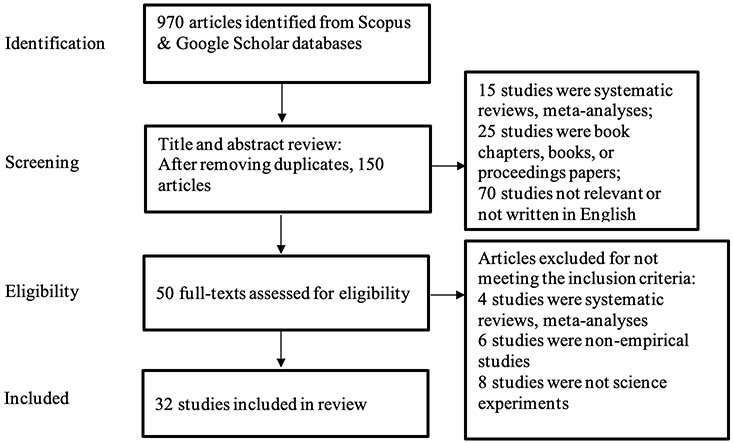
For our research method, we adopted a literature review combined with a modified systematic review and meta-analysis, following the preferred reporting items for systematic reviews and meta-analyses (PRISMA) guidelines (Page et al., 2021). The procedure consisted of identification, screening, eligibility, and inclusion, as shown in Figure 1.
Figure 1
Research Procedure for a Systematic Literature Review on Science Experiments in Online Learning Environments Using PRISMA Guidelines
Note. PRISMA = preferred reporting items for systematic reviews and meta-analyses.
The analysis of the reviewed articles showed a variety of practicum models. Science practicum that combines hands-on activities with cognitive engagement could still be effectively conducted in online learning. These science experiments activities prioritized the development of scientific knowledge, skills, and attitudes. Students were assigned independent tasks to conduct experiments in their respective homes, and the model for the online learning experiments is presented in Table 2.
Table 2
Pedagogical Approaches to Science Experiments in Online Learning Environments
| Study | Pedagogical approach |
| Ali et al. (2022); Brevik et al. (2021); Damopolii et al. (2022); Domínguez et al. (2018); Hamed & Aljanazrah (2020); Kader et al. (2020); Kapici et al. (2020) | Simulations |
| Baldock et al. (2021) | Problem-solving |
| Andrews et al. (2020) | Inquiry-based learning, discovery learning at home |
| Larriba et al. (2021) | Autonomous learning, cooperative learning |
| Gya & Bjune (2021) | Do-it-yourself (DIY) experiments, inquiry-based laboratories |
| Nandana & de Mel (2016) | Integrated laboratories experiment setup (ILES) |
| Schnell et al. (2021) | Course-based research |
| Müssig et al. (2020) | Inquiry-based learning, discovery learning |
| Vasiliadou (2020) | Inquiry-based virtual laboratories |
| Papaneophytou (2020) | Straightforward approach-online delivery |
| Sherrer (2020) | Discussion, experiments design lab, hybrid learning |
| Ishafit, Indratno, et al. (2019); Ishafit, Mundilarto, et al. (2020) | Online experiments in remote laboratories |
| Ametepe & Khan (2020) | Online live demonstration |
| Accettone (2022) | Chemistry laboratory delivery models |
| Pratidhina et al. (2022); Schmidt et al. (2021); Schultz et al. (2020); Selco (2020) | Hands-on experiments, video recorded and reported in the LMS |
| Koretsky (2020) | Re-flipping in the remote classroom, computer-based learning |
| Seifan et al. (2019) | Virtual field trip |
| Cesin-AbouAtme et al. (2021) | Demonstration, hands-on practicum at home video recorded |
| Kapici et al. (2022) | Inquiry-based virtual experiments |
| Casaburo (2021) | Physics experiments |
| Donkin et al. (2019) | Blended learning (face-to-face and e-learning) |
| DeBoer et al. (2019) | DIY “do-it-yourself” remote lab |
| Schmidt et al. (2021) | Hands-on experiment with remote learning modules |
Note. LMS = learning management system.
Online experiments are practical activities carried out through digital platforms to facilitate the distance learning of science. Selco (2020) emphasized direct experiments in online chemistry teaching to improve the fundamental understanding of concepts. Hand-on experiments involved technology; students recorded practical activities in video and reported video recordings on the LMS (Selco, 2020). Schultz et al. (2020) developed a kitchen practicum as a valuable solution for online science learning involving LMS devices and video recordings.
Individual online and traditional laboratory experiments differ significantly in methods, resources, and interactions. The individual online experiment approach is usually conducted at home or through virtual simulations, while traditional laboratory experiments involve complete laboratory facilities and direct interaction with instruments and chemicals. Selco (2020) stated that chemistry experiments conducted from home allow students to gain practical experience even though they are not in the laboratory. Students use materials that are readily available at home to conduct experiments. Schultz et al. (2020) stated that hands-on experiments from home provide practical experience despite limited tools and materials. Meanwhile, Herer (2020) stated that individual practicums using the virtual photosynthesis laboratory module cannot replace more in-depth expertise and the use of actual laboratory equipment. Online individual experiments offer greater flexibility and accessibility in emergencies such as pandemics but have limitations regarding depth of knowledge and interaction with laboratory equipment. In contrast, traditional laboratory experiments provide a more in-depth and comprehensive experience, although they require extensive facilities and resources. The combination of both approaches can provide more holistic and adaptive learning.
Do-it-yourself (DIY) experiments could increase students’ interaction with experimental items and systems, develop practical skills, increase motivation and theoretical knowledge, as well as provide authentic experiences (Gya & Bjune, 2021). At-home experiments improved learning results, motivation, and interest in science, as well as provided opportunities for students to develop at their own pace (Zulirfan et al., 2018). The germination experiment with a DIY approach was designed using simple equipment at home and locally accessible plants (Gya & Bjune, 2021). Students completed the modules provided by teachers, submitted hypotheses for testing, designed and carried out experiments, as well as recorded the results on the provided observation sheet. Additionally, they collected and shared observation data online for the benefit of the entire class and wrote a practical report. Students also attached the observational data to the report and discussed the results of the practicum online.
Inquiry-based virtual laboratories learning included conducting virtual experiments using various platforms, particularly Go-Lab (https://premium.golabz.eu/about/projects/go-lab-project.html). Prospective science teachers designed and used experimental activities as well as wrote arguments on an online platform, guided by teachers through online worksheets. Teachers were responsible for carrying out the main task of guiding students on using virtual learning technology. At the end of the activity, students submitted their written results, which were analyzed by teachers (Kapici et al., 2022).
During COVID-19, inquiry-based experiments could be designed and adapted for home settings. Home laboratory designs focused on four main elements, including: (a) avoiding security problems, (b) not requiring special equipment, (c) providing a genuine chemical laboratory experience, and (d) directly interacting with the concepts of pH, acid-base titrations, buffers, solubility, phase equilibria, and thermodynamics (Andrews et al., 2020). Autonomous and cooperative learning was adopted in science practicum activities, with students independently conducting experiments at home (Larriba et al., 2021) and collaboratively writing the practicum report in small groups.
Inquiry-based learning enhanced by AR technology was used to teach chemistry. Students could carry out the learning using this particular technology from home. There were six steps. First, students completed an online test with 10 multiple-choice questions to determine their prior knowledge, with a time limit of 20 minutes. Second, teachers provided multiple-choice test questions related to chemistry. Third, students watched videos provided by the teachers online, which showed step-by-step laboratory activities and how to use AR. Fourth, students were given a brief explanation before experimenting. Fifth, students downloaded and installed an AR app on an Android or Apple device, conducted experiments, and took pictures of the results. The experimental activities were carried out for a maximum of 2 hours. Finally, students uploaded their experimental reports and accompanying photos to the available platforms (Andrews et al., 2020).
The subject matter of practical experiments was quite diverse, covering the fields of physics, chemistry, and biology. In order for any experiment to be conducted in a student’s home, suitable materials would have to be easily found around the home or through a virtual laboratory. For instance, in the articles we reviewed, photosynthesis was taught in a virtual laboratory, Ohm’s law was practiced through simulation, and acid-base chemistry experiments were easily conducted at home. The trends we discovered in our study are shown in Table 3.
Table 3
Subject Matter of Science Experiments
| Subject area | Study | Subject matter |
| Physics | Kapici et al. (2022) | Electric circuits, Archimedes’ principle |
| Kapici et al. (2020) | Electric circuits | |
| Pratidhina et al. (2022) | Ohm’s law | |
| Hamed & Aljanazrah (2020) | Measures the acceleration of gravity (g), the half-life of a draining water column, RC circuit | |
| Ishafit, Mundilarto, et al. (2020) | Malus law | |
| Ametepe & Khan (2020) | Principles of physics | |
| Ishafit, Indratno, et al. (2019) | Magnetic field | |
| Casaburo (2021) | Gravitational acceleration | |
| Nandana & de Mel (2016) | Mechanics | |
| Biology | Gya & Bjune (2021); Schnell et al. (2021) | Plant biology |
| Damopolii et al. (2022) | Coordination systems | |
| Brevik et al. (2021) | Microbiology, soil chemistry | |
| Sherrer (2020) | Photosynthesis | |
| Baldock et al. (2021) | Biochemistry | |
| DeBoer et al. (2019) | Neuroscience | |
| Donkin et al. (2019) | Tissue morphology | |
| Chemistry | Larriba et al. (2021) | Thermal engineering chemistry, separation process |
| Andrews et al. (2020) | pH, acid-base titration, buffers, solubility, phase equilibrium, and thermodynamics | |
| Kapici et al. (2022) | Mole, molarity, acid-base, pH | |
| Papaneophytou (2020) | Enzyme test, kinetics laboratories | |
| Müssig et al. (2020) | Crystal structure | |
| Schultz et al. (2020) | Acid-base materials | |
| Kader et al. (2020) | Forensic chemistry | |
| Cesin-AbouAtme et al. (2021); Domínguez et al. (2018) | Electrochemistry | |
| Selco (2020) | Acid−base chemistry, exothermic processes, endothermic | |
| Koretsky (2020) | Chemometrics | |
| Schmidt et al. (2021) | Polymer synthesis, intermolecular interactions, thermomechanical properties, structure-function relationships, and molecular design | |
| Ali et al. (2022) | Oxalic acid solution | |
| Accettone (2022) | Chemical reactions |
Note. RC = remote control.
The topics of science experiments had different characteristics and levels of difficulty. In virtual laboratory experiments, the chemical topics explored consisted of mole, molarity, acid-base, pH (Kapici et al., 2022), enzyme tests, kinetics laboratories (Papaneophytou, 2020), and photosynthesis (Sherrer, 2020). Meanwhile, chemical topics related to pH, acid-base titration, buffers, solubility, phase equilibrium, thermodynamics, and electrochemistry were carried out through hands-on experiments (Andrews et al., 2020; Cesin-AbouAtme et al., 2021). Physics topics such as electric circuits, Ohm’s law, acceleration of gravity, and Archimedes’ law could be simulated using virtual laboratories (Hamed & Aljanazrah, 2020; Kapici et al., 2020, 2022). Biological experiments, including plant biology (Gya & Bjune, 2021) and microbiological materials (Brevik et al., 2021), were conducted using both hands-on activities and virtual laboratories.
Technology has played an essential role in the learning process and has been fundamental to online learning. Trends in the articles we analyzed showed that there were various technologies used by teachers to achieve the effectiveness and efficiency of practical learning. Table 4 presents the technologies found in the publications we examined.
Table 4
Technologies Used in Science Experiments in Online Learning Environments
| Study | Technology |
| Domínguez et al. (2018); Kapici et al. (2020, 2022); Papaneophytou (2020); Vasiliadou (2020) | Virtual laboratory |
| Ametepe & Khan (2020) | Virtual laboratory, video recording, online live demonstration |
| Baldock et al. (2021) | iPads apps, video recording, Zoom, quizzes |
| Damopolii et al. (2022) | Augmented reality |
| Müssig et al. (2020) | Augmented reality, video tutorial |
| Accettone (2022); Andrews et al. (2020); Koretsky (2020); Schultz et al. (2020) | Video record |
| Larriba et al. (2021) | 3D printed, Google Meet |
| Gya & Bjune (2021) | Video conference |
| Sherrer (2020) | Virtual laboratories, Zoom |
| Nandana & de Mel (2016) | Multimedia demonstration |
| Ishafit, Indratno, et al. (2019); Ishafit, Mundilarto, et al. (2020) | Remote laboratory |
| Selco (2020) | LMS, video |
| Kader et al. (2020) | Web virtual reality |
| Seifan et al. (2019) | Virtual field trip |
| Cesin-AbouAtme et al. (2021) | Real laboratory-kit laboratories |
| Hamed & Aljanazrah (2020) | Virtual laboratories, online video integrated within Moodle |
| Pratidhina et al. (2022) | Arduino and block programming language |
| Casaburo (2021) | Arduino |
| Brevik et al. (2021) | Video, virtual laboratories |
| Ali et al. (2022) | Virtual chemistry laboratories |
| Schmidt et al. (2021) | Remote learning module |
| Schnell et al. (2021) | Video tutorial, live virtual |
| Donkin et al. (2019) | LMS, video recording of the practicum |
| DeBoer et al. (2019) | MOOC conducted RCT |
Note. LMS = learning management system; MOOC = massive open online course; RCT = randomized control trial.
AR technology was a trend seen in many science experiments activities. To use the technology, students would first download and install an application on a smartphone. Students would then need to print the available markers and use the AR app to scan the markers with their devices (Müssig et al., 2020). Using the virtual laboratory in a science practicum, learners performed simulations independently according to the instructions on the worksheet (Ametepe & Khan, 2020). Remote laboratory technology, also known as virtual reality, allowed students to perform real, practical work remotely by using Web technology with real practicum equipment (Ishafit et al., 2019; Kader et al., 2020). In practical activities, including video recordings, students watched tutorial videos provided by teachers and then carried out the experiments independently at home (Andrews et al., 2020). However, distance practicum learning using video recordings and online simulations failed to provide meaningful experiences (Accettone, 2022). The use of practicum activities was followed up by presenting the experimental results through online discussion platforms, particularly on Zoom (Gya & Bjune, 2021). Combining hands-on and virtual laboratories was more effective in increasing students’ knowledge and developing inquiry skills (Kapici et al., 2019). The research has not yet shown trends toward integrating artificial intelligence (AI) in online science experiments learning.
AI technology is currently experiencing rapid development and has been used in various levels of education and disciplines. In online science practicum learning, there are AI applications such as ChatGPT with AI Chatbots. Research has shown that AI could be integrated into blended learning environments (Park & Doo, 2024). The technology has the potential to facilitate communication between teachers and students (van Leeuwen, 2019), change learning processes, improve performance (Huang et al., 2023), and develop positive affective results (Troussas et al., 2020).
Teachers use assessment in science experiments to evaluate the effectiveness of experiments. This assessment assesses aspects of cognition, skills, and attitudes. The literature review identified several assessment methods, including performance assessment, comprehension tests through quizzes, experimental reports, pre-experiment tests, and research papers. Trends in the assessment of science experiments in online learning environments are shown in Table 5.
Table 5
Trends of Assessment in Science Experiments in Online Learning Environments
| Study | Assessment method |
| Andrews et al. (2020); Gya & Bjune (2021); Kader et al. (2020); Larriba et al. (2021); Papaneophytou (2020); Sherrer (2020); Vasiliadou (2020) | Experiment reports assessment |
| Hamed & Aljanazrah (2020) | Performance assessment, experiment reports, achievement test |
| Selco (2020) | Performance assessment |
| Schnell et al. (2021) | Research paper |
| Brevik et al. (2021) | Online homework assignments (pre-labs) |
| Müssig et al. (2020) | Concept understanding test |
| DeBoer et al. (2019) | Survey self-efficacy, self-concept |
| Kapici et al. (2022) | Scientific argument |
| Baldock et al. (2021) | Online quiz, homework |
| Koretsky (2020) | Homework |
| Ametepe & Khan (2020) | Quiz |
| Donkin et al. (2019) | Practical examination, feedback from a peer, video feedback |
| Nandana & de Mel (2016) | Assignments marked by tutors, continuous assessment tests, daily school, and final exams. |
The assessment of science experiments generally evaluated cognitive aspects, skills, and attitudes. Cognitive aspects were assessed through multiple-choice questions and essay tests, while skills were assessed using observation sheets. On the other hand, attitude aspects were evaluated using observation sheets and questionnaires. Performance assessment was carried out by recording practicum activities, with video footage submitted through the LMS (Hamed & Aljanazrah, 2020). Furthermore, assessments were carried out before and after the practicum, as evidenced by Baldock et al. (2021) and Brevik et al. (2021). Experiment reports, which were considered a form of product research, were submitted through the LMS platform provided by the institution (Andrews et al., 2020). Specifically, assessment through research papers included students preparing papers based on the results of their experiments. The research paper would consist of an abstract, introduction, methods, results and discussion, conclusion, as well as references (Schnell et al., 2021).
Experiment reports were prepared similarly, adopting a structure containing an introduction, experimental procedure, results and discussion, conclusions, and literature references. Reports were collected 10 days after the completion of the practicum and were weighted at 60% of the assessment (Larriba et al., 2021). Students collaborated on writing these reports, thereby reaching a consensus on the results and conclusions. This group activity in working on experiment reports was intended to enhance students’ transversal competence.
Learning design trends in science experiments was varied, using both hands-on and minds-on methods. Interactive simulations have arisen as a popular trend, and virtual laboratories have become an essential technology in science learning. The topics addressed in science practicums were varied, including a wide range of experimental methods. In terms of assessment, experiment reports were the most common method used in online learning.
The implications of this research suggest that virtual laboratories and interactive simulations could be effectively used and adapted for both online and face-to-face experiments. Online experiments enhance interaction between teachers and students, which tends to improve students' analytical and practical skills while fostering critical and creative skills. Virtual laboratories have significant potential to expand access to conducting science experiments, especially for those with limited opportunities to conduct direct experiments. The use of technology, including AI, could improve the effectiveness and efficiency of science learning.
The variety of practicum materials covered several topics and experimental methods. The predominance of practicum report assessments signifies the importance of teachers designing comprehensive rubrics in accordance with learning objectives. These assessments could provide in-depth information on students’ mastery of science concepts and their use of knowledge.
Online science labs cannot wholly replace traditional laboratory-based labs. Online hands-on experiments at home can be an alternative to traditional labs in school laboratories. Traditional science labs in the laboratory provide meaningful learning experiences for students and improve their technical skills while applying theories learned in class. Meanwhile, online science labs do not always provide enough training in essential laboratory skills. Carefully designed online science labs can be an alternative to science lab activities.
The research results for learning theory imply that online science practicums can support constructivist theory, which emphasizes the importance of hands-on experience and minds-on thinking. Curricula that cover various topics and experimental methods must be continuously updated to ensure relevance to the latest developments in science and technology. Research recommendations for policymakers include providing policy support that enables and encourages educational institutions to adopt online science learning by providing adequate funding, teacher training, and infrastructure.
The research was funded by the Directorate of Research, Technology, and Community Service, Directorate General of Higher Education, Research and Technology, Ministry of Education, Culture, Research, and Technology, under Contract Number: 070/E5/PG.02.00.PL/2024, dated June 11, 2024.
Accettone, S. L. W. (2022). Student perceptions of remote chemistry laboratory delivery models. Journal of Chemical Education, 99(2), 654-668. https://doi.org/10.1021/acs.jchemed.1c00757
Ali, N., Ullah, S., & Khan, D. (2022). Minimization of students’ cognitive load in a virtual chemistry laboratory via contents optimization and arrow-textual aids. Education and Information Technologies, 27, 7629-7652. https://doi.org/10.1007/S10639-022-10936-6
Ametepe, J. D., & Khan, N. (2020). Teaching physics during COVID-19 pandemic: Implementation and report of teaching strategies to support student learning. Physics Education, 56(6), Article 065030. https://www.doi.org/10.1088/1361-6552/ac266f
Andrews, J. L., de Los Rios, J. P., Rayaluru, M., Lee, S., Mai, L., Schusser, A., & Mak, C. H. (2020). Experimenting with at-home general chemistry laboratories during the COVID-19 pandemic. Journal of Chemical Education, 97(7), 1887-1894. https://doi.org/10.1021/acs.jchemed.0c00483
Baker, L. A., & Cavinato, A. G. (2020). Teaching analytical chemistry in the time of COVID-19. Analytical Chemistry, 92(15), 10185-10186. https://doi.org/10.1021/acs.analchem.0c02981
Baldock, B. L., Fernandez, A. L., Franco, J., Provencher, B. A., & McCoy, M. R. (2021). Overcoming the challenges of remote instruction: Using mobile technology to promote active learning. Journal of Chemical Education, 98(3), 833-842. https://doi.org/10.1021/acs.jchemed.0c00992
Beck, C. W., & Blumer, L. S. (2012). Inquiry-based ecology laboratory courses improve student confidence and scientific reasoning skills. Ecosphere, 3(12), Article 112. https://doi.org/10.1890/es12-00280.1
Blumer, L. S., & Beck, C. W. (2019). Laboratory courses with guided-inquiry modules improve scientific reasoning and experimental design skills for the least-prepared undergraduate students. CBE Life Sciences Education, 18(1), Article 2. https://doi.org/10.1187/cbe.18-08-0152
Brevik, E. C., Ulery, A., & Muise, A. S. (2021). Pivoting to online laboratories due to COVID-19 using the Science of Agriculture digital tools: A case study. Natural Sciences Education, 50(1), Article e20045. https://doi.org/10.1002/nse2.20045
Casaburo, F. (2021). Teaching physics by Arduino during COVID-19 pandemic: The free falling body experiment. Physics Education, 56(6), Article 063001. https://doi.org/10.1088/1361-6552/ac1b39
Cesin-AbouAtme, T., Lopez-Almeida, C. G., Molina-Labastida, G., & Ibanez, J. G. (2021). Light-emitting diodes as voltage generators: Demonstrating the fuel cell principle with low-cost, magnetically enhanced, homemade solar electrolysis. Journal of Chemical Education, 98(9), 3045-3049. https://doi.org/10.1021/acs.jchemed.1c00093
Damopolii, I., Paiki, F. F., & Nunaki, J. H. (2022). The development of comic book as marker of augmented reality to raise students’ critical thinking. TEM Journal, 11(1), 348-355. https://doi.org/10.18421/TEM111-44
DeBoer, J., Haney, C., Atiq, S. Z., Smith, C., & Cox, D. (2019). Hands-on engagement online: Using a randomised control trial to estimate the impact of an at-home lab kit on student attitudes and achievement in a MOOC. European Journal of Engineering Education, 44(1-2), 234-252. https://doi.org/10.1080/03043797.2017.1378170
Domínguez, J. C., Miranda, R., González, E. J., Oliet, M., & Alonso, M. V. (2018). A virtual lab as a complement to traditional hands-on labs: Characterization of an alkaline electrolyzer for hydrogen production. Education for Chemical Engineers, 23, 7-17. https://doi.org/10.1016/j.ece.2018.03.002
Donkin, R., Askew, E., & Stevenson, H. (2019). Video feedback and e-learning enhances laboratory skills and engagement in medical laboratory science students. BMC Medical Education, 19(1), Article 310. https://doi.org/10.1186/s12909-019-1745-1
Faulconer, E. K., & Gruss, A. B. (2018). A review to weigh the pros and cons of online, remote, and distance science laboratory experiences. International Review of Research in Open and Distributed Learning, 19(2), 155-168. https://doi.org/10.19173/irrodl.v19i2.3386
Foo, C.-c., Cheung, B., & Chu, K.-m. (2021). A comparative study regarding distance learning and the conventional face-to-face approach conducted problem-based learning tutorial during the COVID-19 pandemic. BMC Medical Education, 21(1), Article 141. https://doi.org/10.1186/s12909-021-02575-1
Gya, R., & Bjune, A. E. (2021). Taking practical learning in STEM education home: Examples from do-it-yourself experiments in plant biology. Ecology and Evolution, 11(8), 3481-3487. https://doi.org/10.1002/ece3.7207
Ha, S., & Kim, M. (2020). Challenges of designing and carrying out laboratory experiments about Newton’s second law: The case of Korean gifted students. Science and Education, 29(5), 1389-1416. https://doi.org/10.1007/s11191-020-00155-1
Hamed, G., & Aljanazrah, A. (2020). The effectiveness of using virtual experiments on students’ learning in the general physics lab. Journal of Information Technology Education: Research, 19, 977-996. https://doi.org/10.28945/4668
Hasani, L. M., Santoso, H. B., & Junus, K. (2022). Designing asynchronous online discussion forum interface and interaction based on the community of inquiry framework. The International Review of Research in Open and Distributed Learning, 23(2), 191-213. https://doi.org/10.19173/irrodl.v23i2.6016
Hofstein, A., & Lunetta, V. N. (2004). The laboratory in science education: Foundations for the twenty-first century. Science Education, 88(1), 28-54. https://doi.org/10.1002/sce.10106
Huang, A. Y. Q., Lu, O. H. T., & Yang, S. J. H. (2023). Effects of artificial intelligence-enabled personalized recommendations on learners’ learning engagement, motivation, and outcomes in a flipped classroom. Computers & Education, 194, Article 104684. https://doi.org/10.1016/j.compedu.2022.104684
Ishafit, I., Indratno, T. K., & Prabowo, Y. D. (2019). Arduino and LabVIEW-based remote data acquisition system for magnetic field of coils experiments. Physics Education, 55(2), Article 025003. https://doi.org/10.1088/1361-6552/ab5ed6
Ishafit, Mundilarto, & Surjono, H. D. (2020). Development of light polarization experimental apparatus for remote laboratory in physics education. Physics Education, 56(1), Article 015008. https://doi.org/10.1088/1361-6552/abc4da
Kader, S. N., Ng, W. B., Tan, S. W. L., & Fung, F. M. (2020). Building an interactive immersive virtual reality crime scene for future chemists to learn forensic science chemistry. Journal of Chemical Education, 97(9), 2651-2656. https://doi.org/10.1021/acs.jchemed.0c00817
Kapici, H. O., Akcay, H., & de Jong, T. (2019). Using hands-on and virtual laboratories alone or together―which works better for acquiring knowledge and skills? Journal of Science Education and Technology, 28(3), 231-250. https://doi.org/10.1007/s10956-018-9762-0
Kapici, H. O., Akcay, H., & de Jong, T. (2020). How do different laboratory environments influence students’ attitudes toward science courses and laboratories? Journal of Research on Technology in Education, 52(4), 534-549. https://doi.org/10.1080/15391523.2020.1750075
Kapici, H. O., Akcay, H., & Koca, E. E. (2022). Comparison of the quality of written scientific arguments in different laboratory environments. International Journal of Science and Mathematics Education, 20(1), 69-88. https://doi.org/10.1007/s10763-020-10147-w
Kier, M. W., & Johnson, L. L. (2022). Exploring how secondary STEM teachers and undergraduate mentors adapt digital technologies to promote culturally relevant education during COVID-19. Education Sciences, 12(1), Article 48. https://doi.org/10.3390/educsci12010048
Koretsky, M. D. (2020). Re-flipping in the remote classroom: The surprising uptake of video-recorded worked examples. Journal of Chemical Education, 97(9), 2754-2759. https://doi.org/10.1021/acs.jchemed.0c00711
Larriba, M., Rodríguez-Llorente, D., Cañada-Barcala, A., Sanz-Santos, E., Gutiérrez-Sánchez, P., Pascual-Muñoz, G., Álvarez-Torrellas, S., Águeda, V. I., Delgado, J. A., & García, J. (2021). Lab at home: 3D printed and low-cost experiments for thermal engineering and separation processes in COVID-19 time. Education for Chemical Engineers, 36, 24-37. https://doi.org/10.1016/j.ece.2021.02.001
Ma, J., & Nickerson, J. V. (2006). Hands-on, simulated, and remote laboratories: A comparative literature review. ACM Computing Surveys, 38(3), Article 7-es. https://doi.org/10.1145/1132960.1132961
Malik, A., & Ubaidillah, M. (2020). Students critical-creative thinking skill: A multivariate analysis of experiments and gender. International Journal of Cognitive Research in Science, Engineering and Education, 8(Special issue), 49-58. https://doi.org/10.23947/2334-8496-2020-8-SI-49-58
Malik, A., & Ubaidillah, M. (2021). Multiple skill laboratory activities: How to improve students’ scientific communication and collaboration skills. Jurnal Pendidikan IPA Indonesia, 10(4), 585-595. https://doi.org/10.15294/jpii.v10i4.31442
Mamlok-Naaman, R., & Barnea, N. (2012). Laboratory activities in Israel. Eurasia Journal of Mathematics, Science and Technology Education, 8(1), 49-57. https://doi.org/10.12973/eurasia.2012.816a
Manca, S., Persico, D., & Raffaghelli, J. E. (2021). Editorial. Emergency remote education: Methodological, technological, organizational and policy issues. Italian Journal of Educational Technology, 29(2), 3-9. https://doi.org/10.17471/2499-4324/1251
Marinoni, G., van’t Land, H., & Jensen, T. (2020). The impact of COVID-19 on higher education around the world: IAU global survey report. International Association of Universities. https://www.iau-aiu.net/IMG/pdf/iau_covid19_and_he_survey_report_final_may_2020.pdf
Martin, F., Sun, T., & Westine, C. D. (2020). A systematic review of research on online teaching and learning from 2009 to 2018. Computers and Education, 159, Article 104009. https://doi.org/10.1016/j.compedu.2020.104009
Mayer, R. E. (2019). Thirty years of research on online learning. Applied Cognitive Psychology, 33(2), 152-159. https://doi.org/10.1002/acp.3482
McGreal, R., & Elliott, R. (2008). Technologies of online learning (e-learning). In Theory and practice of online learning (pp. 143-165). https://doi.org/10.15215/aupress/9781897425084.01
Mistry, N., & Shahid, N. (2021). Design and delivery of virtual inquiry-based organic chemistry experiments. Journal of Chemical Education, 98(9), 2952-2958. https://doi.org/10.1021/acs.jchemed.1c00571
Müssig, J., Clark, A., Hoermann, S., Loporcaro, G., Loporcaro, C., & Huber, T. (2020). Imparting materials science knowledge in the field of the crystal structure of metals in times of online teaching: A novel online laboratory teaching concept with an augmented reality application. Journal of Chemical Education, 97(9), 2643-2650. https://doi.org/10.1021/acs.jchemed.0c00763
Nandana, W. A. R., & de Mel, W. R. (2016). Integrated laboratory experiment setup to empower the engineering education in distance mode. Asian Association of Open Universities Journal, 11(1), 13-23. https://doi.org/10.1108/AAOUJ-06-2016-0007
Nasution, A. K. P. (2022). Education technology research trends in Indonesia during the COVID-19 pandemic. Asia Pacific Journal of Educators and Education, 36(2), 65-76. https://doi.org/10.21315/apjee2021.36.2.4
Oliveira, A., Feyzi Behnagh, R., Ni, L., Mohsinah, A. A., Burgess, K. J., & Guo, L. (2019). Emerging technologies as pedagogical tools for teaching and learning science: A literature review. Human Behavior and Emerging Technologies, 1(2), 149-160. https://doi.org/10.1002/hbe2.141
Page, M. J., McKenzie, J. E., Bossuyt, P. M., Boutron, I., Hoffmann, T. C., Mulrow, C. D., Shamseer, L., Tetzlaff, J. M., Akl, E. A., Brennan, S. E., Chou, R., Glanville, J., Grimshaw, J. M., Hróbjartsson, A., Lalu, M. M., Li, T., Loder, E. W., Mayo-Wilson, E., McDonald, S., ... Moher, D. (2021). The PRISMA 2020 statement: An updated guideline for reporting systematic reviews. PLOS Medicine, 18(3), Article e1003583. https://doi.org/10.1371/journal.pmed.1003583
Papaneophytou, C. (2020). A distance learning enzyme assay and kinetics laboratory in the time of COVID-19. Biochemistry and Molecular Biology Education, 48(5), 430-432. https://doi.org/10.1002/bmb.21364
Park, Y., & Doo, M. Y. (2024). Role of AI in blended learning: A systematic literature review. The International Review of Research in Open and Distributed Learning, 25(1), 164-196. https://doi.org/10.19173/irrodl.v25i1.7566
Potkonjak, V., Gardner, M., Callaghan, V., Mattila, P., Guetl, C., Petrović, V. M., & Jovanović, K. (2016). Virtual laboratories for education in science, technology, and engineering: A review. Computers and Education, 95, 309-327. https://doi.org/10.1016/j.compedu.2016.02.002
Prahani, B. K., Ramadani, A. H., Kusumawati, D. H., Suprapto, N., Munasir, Madlazim, M., Jatmiko, B., Supardi, Z. A. I., Mubarok., H., Safitri, N. S., & Deta, A. U. (2020). ORNE learning model to improve problem-solving skills of physics bachelor candidates: An alternative learning in the Covid-19 pandemic. Jurnal Penelitian Fisika Dan Aplikasinya (JPFA), 10(01), 71-80. https://doi.org/10.26740/jpfa.v10n1.p71-80
Pratidhina, E., Rosana, D., & Kuswanto, H. (2022). Designing physics hands-on experiment for distance learning using Arduino and block-based programing language. TEM Journal, 11(1), 374-378. https://doi.org/10.18421/TEM111-47
Sajka, M., & Rosiek, R. (2021). Analysis of aspects of visual attention when solving multiple-choice science problems. In Applying Bio-Measurements Methodologies in Science Education Research (pp. 185-215). Springer. https://doi.org/10.1007/978-3-030-71535-9_10
Salta, K., Paschalidou, K., Tsetseri, M., & Koulougliotis, D. (2022). Shift from a traditional to a distance learning environment during the COVID-19 Pandemic: University students’ engagement and interactions. Science and Education, 31(1), 93-122. https://doi.org/10.1007/s11191-021-00234-x
Schmidt, S., Wright, Z. M., Eckhart, K. E., Starvaggi, F., Vickery, W., Wolf, M. E., Pitts, M., Warner, T., Taofik, T., Ng, M., Colliver, C., & Sydlik, S. A. (2021). Hands-on laboratory experience using adhesives for remote learning of polymer chemistry. Journal of Chemical Education, 98(10), 3153-3162. https://doi.org/10.1021/acs.jchemed.0c01374
Schmuck, V. D. E., Romine, I. C., Sisley, T. A., Immoos, C. E., Scott, G. E., Zigler, D. F., & Martinez, A. W. (2022). At-home microscale paper-based quantitative analysis activity with external standards. Journal of Chemical Education, 99(2), 1081-1086. https://doi.org/10.1021/acs.jchemed.1c01042
Schnell, L. J., Simpson, G. L., Suchan, D. M., Quere, W., Weger, H. G., & Davis, M. C. (2021). An at-home laboratory in plant biology designed to engage students in the process of science. Ecology and Evolution, 11(24), 17572-17580. https://doi.org/10.1002/ece3.8441
Schultz, M., Callahan, D. L., & Miltiadous, A. (2020). Development and use of kitchen chemistry home practical activities during unanticipated campus closures. Journal of Chemical Education, 97(9), 2678-2684. https://doi.org/10.1021/acs.jchemed.0c00620
Seifan, M., Dada, D., & Berenjian, A. (2019). The effect of virtual field trip as an introductory tool for an engineering real field trip. Education for Chemical Engineers, 27, 6-11. https://doi.org/10.1016/j.ece.2018.11.005
Selco, J. I. (2020). Using hands-on chemistry experiments while teaching online. Journal of Chemical Education, 97(9), 2617-2623. https://doi.org/10.1021/acs.jchemed.0C00424
Setiaji, B., & Santoso, P. H. (2023). An online physics laboratory delivered through live broadcasting media: A COVID-19 teaching experience. The International Review of Research in Open and Distributed Learning, 24(1), 47-65. https://doi.org/10.19173/irrodl.v24i1.6684
Sherrer, S. M. (2020). A virtual laboratory module exploring photosynthesis during COVID-19. Biochemistry and Molecular Biology Education, 48(6), 659-661. https://doi.org/10.1002/bmb.21464
Srisawasdi, N., & Kroothkeaw, S. (2014). Supporting students’ conceptual development of light refraction by simulation-based open inquiry with dual-situated learning model. Journal of Computers in Education, 1(1), 49-79. https://doi.org/10.1007/s40692-014-0005-y
Troussas, C., Krouska, A., & Sgouropoulou, C. (2020). Collaboration and fuzzy-modeled personalization for mobile game-based learning in higher education. Computers & Education, 144, Article 103698. https://doi.org/10.1016/j.compedu.2019.103698
Tsai, C.-W., & Chiang, Y.-C. (2013). Research trends in problem-based learning (PBL) research in e-learning and online education environments: A review of publications in SSCI-indexed journals from 2004 to 2012. British Journal of Educational Technology, 44(6), E185-E190. https://doi.org/10.1111/bjet.12038
Tsai, C. W., & Fan, Y. T. (2013). Research trends in game-based learning research in online learning environments: A review of studies published in SSCI-indexed journals from 2003 to 2012. British Journal of Educational Technology, 44(5), 115-119. https://doi.org/10.1111/bjet.12031
Tsai, C.-W., Shen, P.-D., & Chiang, Y.-C. (2013). Research trends in meaningful learning research on e-learning and online education environments: A review of studies published in SSCI-indexed journals from 2003 to 2012. British Journal of Educational Technology, 44(6), E179-E184. https://doi.org/10.1111/bjet.12035
Tsai, C.-W., Shen, P.-D., & Fan, Y.-T. (2013). Research trends in self-regulated learning research in online learning environments: A review of studies published in selected journals from 2003 to 2012. British Journal of Educational Technology, 44(5), E107-E110. https://doi.org/10.1111/bjet.12017
van Leeuwen, A. (2019). Teachers’ perceptions of the usability of learning analytics reports in a flipped university course: When and how does information become actionable knowledge? Educational Technology Research and Development, 67(5), 1043-1064. https://doi.org/10.1007/s11423-018-09639-y
Vasiliadou, R. (2020). Virtual laboratories during coronavirus (COVID-19) pandemic. Biochemistry and Molecular Biology Education, 48(5), 482-483. https://doi.org/10.1002/bmb.21407
Vijayan, R. (2021). Teaching and learning during the COVID-19 pandemic: A topic modeling study. Education Sciences, 11(7), 347. https://doi.org/10.3390/educsci11070347
Widarti, H. R., Rokhim, D. A., Muchson, M., Budiasih, E., Sutrisno, Pratama, R. W., & Hakim, M. I. (2021). Developing integrated triplet multi-representation virtual laboratory in analytic chemical materials. International Journal of Interactive Mobile Technologies, 15(8), 119-135. https://doi.org/10.3991/ijim.v15i08.21573
Wieman, C. E., Adams, W. K., & Perkins, K. K. (2008). Physics. PhET: Simulations that enhance learning. Science, 322(5902), 682-683. https://doi.org/10.1126/science.1161948
Zulirfan, Iksan, Z. H., Osman, K., & Salehudin, S. N. M. (2018). Take-home-experiment: Enhancing students’ scientific attitude. Journal of Baltic Science Education, 17(5), 828-837. https://files.eric.ed.gov/fulltext/EJ1346817.pdf

A Systematic Literature Review on Trends in the Use of Science Experiments in Online Learning Environments by Mujib Ubaidillah, Putut Marwoto, Wiyanto, Bambang Subali, Arif Widiyatmoko, and Adi Nur Cahyono is licensed under a Creative Commons Attribution 4.0 International License.