Volume 26, Number 2
Ahmad Faza1,* and Ilyana Agri Lestari2
1Department of Information Systems, Universitas Multimedia Nusantara, Indonesia; 2Department of Social Welfare, University of Indonesia, Indonesia; *Corresponding author
When students enter higher education, self-regulated learning (SRL) involving goal setting, planning, monitoring, and reflection is crucial for academic success. This study systematically reviews SRL strategies, supporting technologies, and their impacts, especially with the shift to online learning due to the COVID-19 pandemic. Following Kitchenham’s guidelines, 121 articles from ScienceDirect and Scopus were reviewed. Key SRL strategies include goal setting, cognitive and metacognitive processes, time management, self-reflection, help-seeking, and monitoring. Technologies such as learning management systems (LMS), massive open online courses (MOOCs), artificial intelligence (AI), collaborative platforms, and learning analytics support SRL by providing personalized feedback and facilitating autonomous learning. Benefits include improved performance, motivation, and engagement, while challenges involve limited access to digital resources, technical issues, resistance to change, and inadequate instructor training. Addressing these barriers is essential for optimizing SRL implementation, guiding future research and educational practice.
Keywords: self-regulated learning strategies, self-directed learning strategies, educational technologies, systematic literature review
When students enter higher education, accountability in thoughts and actions is crucial for realizing potential and achieving academic success (Latipah et al., 2021). Planning learning activities, collaborating, working in teams, and conveying ideas through physical and digital media enhance academic achievement (Tadesse et al., 2022). These skills are integral components of self-regulated learning (SRL), where students independently set goals, reflect on their progress, and evaluate their learning. SRL is not only critical for academic success but also fosters lifelong learning (Tekkol & Demirel, 2018) and prepares students for future challenges, such as competitiveness in the job market (Latipah et al., 2021; Muwonge et al., 2020; Nguyen & Zarra-Nezhad, 2023).
Technological advancements have significantly transformed the landscape of education. Traditional learning is now often digital, accelerated by the COVID-19 pandemic, which required social distancing and remote learning (Anthonysamy et al., 2021; Nguyen & Zarra-Nezhad, 2023). Online learning reduces social interactions, especially in instruction and feedback, necessitating strong SRL skills to maintain motivation and prevent dropout (Domínguez et al., 2021).
While previous research has identified various SRL strategies, supporting technologies, benefits, and implementation challenges (Araka et al., 2020; Heikkinen et al., 2023; Su et al., 2023), these aspects have typically been examined separately, often lacking a unified framework. Moreover, existing literature reviews tend to focus on specific components of SRL or on particular educational settings, such as traditional classrooms or fully online environments, without providing a comprehensive overview that addresses the integration of SRL strategies, technologies, and challenges in hybrid and evolving digital learning contexts. This study distinguishes itself from prior reviews by offering a holistic synthesis that not only covers all four aspects of SRL but also highlights their interdependencies within diverse digital learning environments.
By addressing these gaps, this study aims to advance the understanding of SRL by systematically reviewing and synthesizing existing research on SRL strategies, supporting technologies, benefits, and challenges in digital education. This integrated approach provides a more comprehensive framework for educators and policymakers to implement effective SRL practices tailored to the nuances of digital learning. The research questions are as follows:
The findings will help students effectively use SRL strategies and technologies, understanding their benefits and challenges.
Self-regulated learning (SRL) is an active, constructive process where learners set goals and regulate their cognition, motivation, and behavior to achieve these goals (Turan et al., 2022). It involves setting goals, devising strategies, and monitoring effectiveness (Kesuma et al., 2020), with dimensions such as goal setting, help-seeking, self-learning, managing the environment, and effort regulation (Amiruddin et al., 2023). Learners autonomously set their own goals, manage time, select strategies, and evaluate progress (Karrenbauer et al., 2023; Saiyad et al., 2020). Comprehensive models by Winne and Hadwin (1998) include stages such as task definition, planning, enactment, and evaluation (Liang et al., 2023; Pintrich, 2000). SRL includes monitoring processes such as goal orientation, environment structuring, time management, task strategies, help-seeking, and self-evaluation (Hidayatullah & Csíkos, 2023), crucial for online learning success (Yeh et al., 2019). Supported by cognitive and metacognitive processes (Brusilovsky et al., 2015; Cook et al., 2015; Kay et al., 2022; Kay & Lum, 2005; Panadero, 2017; Tise et al., 2023; Upton & Kay, 2009; Zimmerman, 2008), effective SRL requires accurate metacognition (Cervin-Ellqvist et al., 2021; Wild & Neef, 2023). Promoting learner autonomy involves empowering students to set goals, make decisions, and monitor progress (Kay et al., 2022; Schunk & Ertmer, 2000; Zimmerman & Moylan, 2009). The cyclical interaction of cognitive and metacognitive activities fosters lifelong learning and professional skills development (Biggs, 1999; Kay et al., 2022; Wong et al., 2019).
Several previous studies have identified various strategies, supporting technologies, benefits, and challenges related to the implementation of SRL, using systematic literature reviews, scoping reviews, and meta-analyses. Key strategies identified include cognitive and metacognitive strategies, affective strategies, motivational regulation strategies, behavioral and contextual regulation strategies, time management, effort regulation, and planning and goal setting (Ballouk et al., 2022; Doo et al., 2023; Edisherashvili et al., 2022; Heikkinen et al., 2023; Lee et al., 2019; Su et al., 2023; Xu et al., 2023). Additionally, tools such as the Learning Tracker prototype, learning analytics, the Online Self-Regulated Learning Questionnaire, and the Motivated Strategies for Learning Questionnaire have been highlighted as supporting the implementation of SRL (Araka et al., 2020; Heikkinen et al., 2023; Lee et al., 2019). The benefits of SRL implementation noted in previous research include enhanced academic success, better engagement with course materials, improved study habits, and sustained motivation and autonomy (Ballouk et al., 2022; Cheng et al., 2023; Doo et al., 2023; Heikkinen et al., 2023; Su et al., 2023; Xu et al., 2023). Despite these benefits, challenges remain, particularly in measuring students’ ability to apply SRL in e-learning environments (Araka et al., 2020). Table 1 provides a summary of these previous research articles, showing their methods, magnitude, and main focus.
Table 1
Summary of Previous Reviews and Analyses on Self-Regulated Learning
| Review | Method | Studies reviewed, n | Focus |
| Su et al. (2023) | Systematic review | 20 | SRL strategies and SRL benefits |
| Lee et al. (2019) | Systematic review | 21 | SRL strategies and SRL supporting technologies |
| Heikkinen et al. (2023) | Systematic review | 56 | SRL supporting tools and SRL benefits |
| Edisherashvili et al. (2022) | Systematic review | 38 | SRL strategies |
| Xu et al. (2023) | Scoping review | 163 | SRL strategies and SRL benefits |
| Doo et al. (2023) | Meta-analysis | 14 | SRL strategies and SRL benefits |
| Cheng et al. (2023) | Meta-analysis | 27 | SRL benefits |
| Araka et al. (2020) | Systematic review | 30 | SRL supporting technologies and SRL challenges |
| Ballouk et al. (2022) | Scoping review | 44 | SRL strategies and SRL benefits |
From Table 1, it can be concluded that studies have identified four aspects related to the implementation of SRL: (a) strategies, (b) supporting technologies, (c) benefits, and (d) challenges. However, these four aspects have been individually examined in separate studies. This research has synthesized all four aspects into a single study.
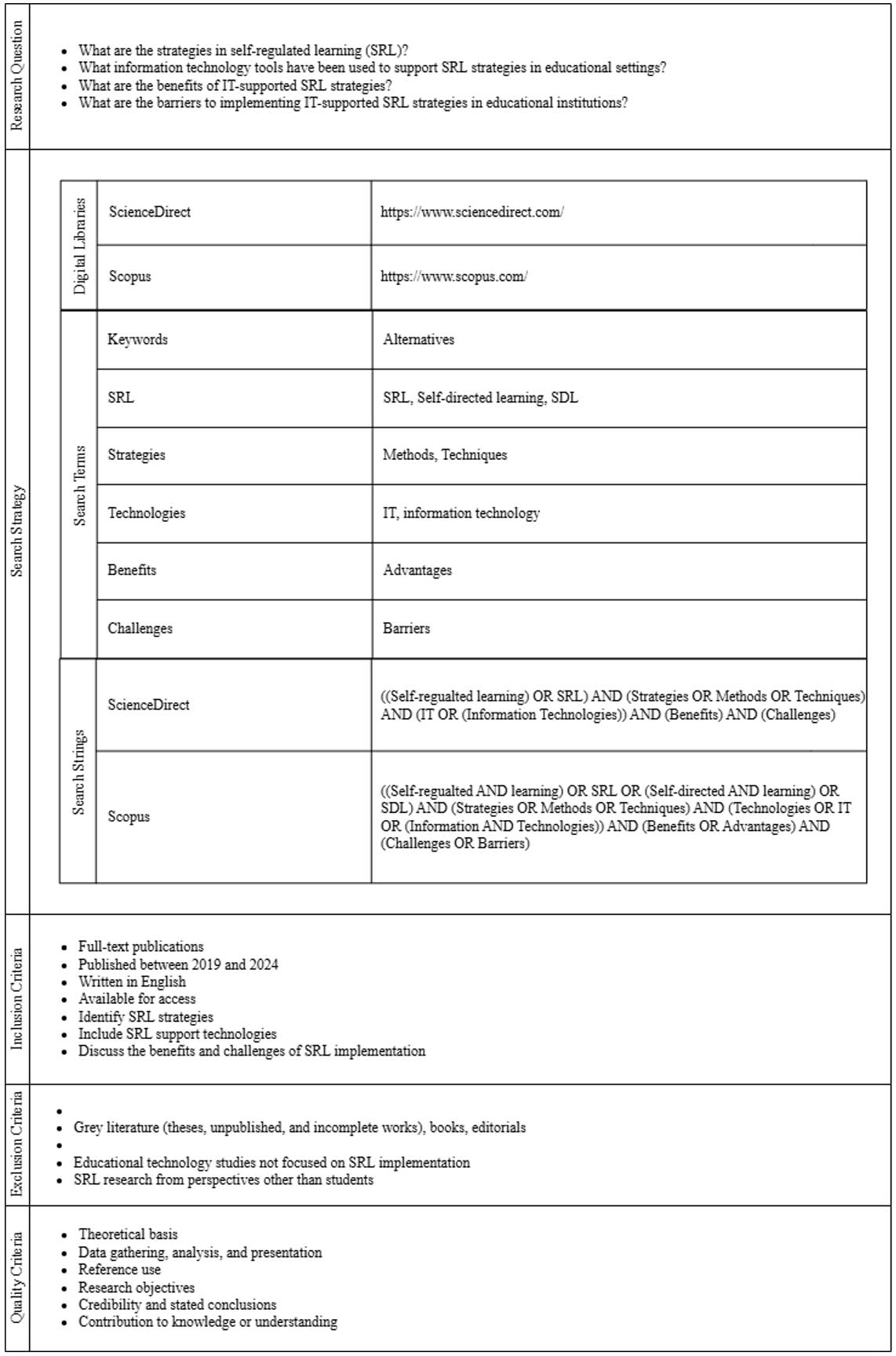
This systematic literature review followed Kitchenham’s guidelines, comprising three stages: (a) planning, (b) conducting the review, and (c) reporting (Kitchenham, 2004; Kitchenham, et al., 2009; Kitchenham et al., 2015). In the planning stage, a comprehensive research protocol was developed, which defined the research questions, search strategy, and inclusion, exclusion, and quality criteria, as illustrated in Figure 1.
The inclusion and exclusion criteria were meticulously applied to ensure that only high-quality and relevant articles were selected for the review. This rigorous selection process was designed to maintain the integrity and relevance of the review. For the literature search, ScienceDirect and Scopus databases were selected due to their extensive coverage of peer-reviewed journals across various disciplines relevant to the study and their strong reputation for high-impact publications. The keywords used for the literature search, along with their alternatives, are also presented in Figure 1. These keywords were chosen to ensure a well-defined approach to capturing relevant studies. Due to the Boolean operator limit in ScienceDirect (maximum of eight), two separate search strings were used to ensure that the search was both exhaustive and precise, maximizing the retrieval of relevant articles while minimizing irrelevant results.
Figure 1
Research Protocol
After the research protocol was developed, the next step was to initiate the search and collection of journal articles. Table 2 summarizes the stages of the search and collection process, along with the number of articles at each stage. To further enrich the review, a snowballing technique was applied to the selected articles after a thorough examination of their abstracts and findings. A total of 121 articles were included after all stages were completed.
To minimize bias and maintain rigor, each article was evaluated against the inclusion and exclusion criteria by two independent reviewers. This approach helped ensure that the selection process was both valid and reliable, reducing the likelihood of subjective bias in the study selection. Any discrepancies between reviewers were discussed and resolved through consensus, further enhancing the reliability of the selection process.
Table 2
Number of Articles Included After Each Stage of the Search and Collection Process
| Source | Stage | |||
| Preliminary search | Post inclusion | Post exclusion | Post screening of abstract and findings | |
| ScienceDirect | 1,946 | 500 | 120 | 34 |
| Scopus | 101 | 70 | 50 | 39 |
| Snowballing | 48 | |||
| Total | 2,047 | 570 | 170 | 121 |
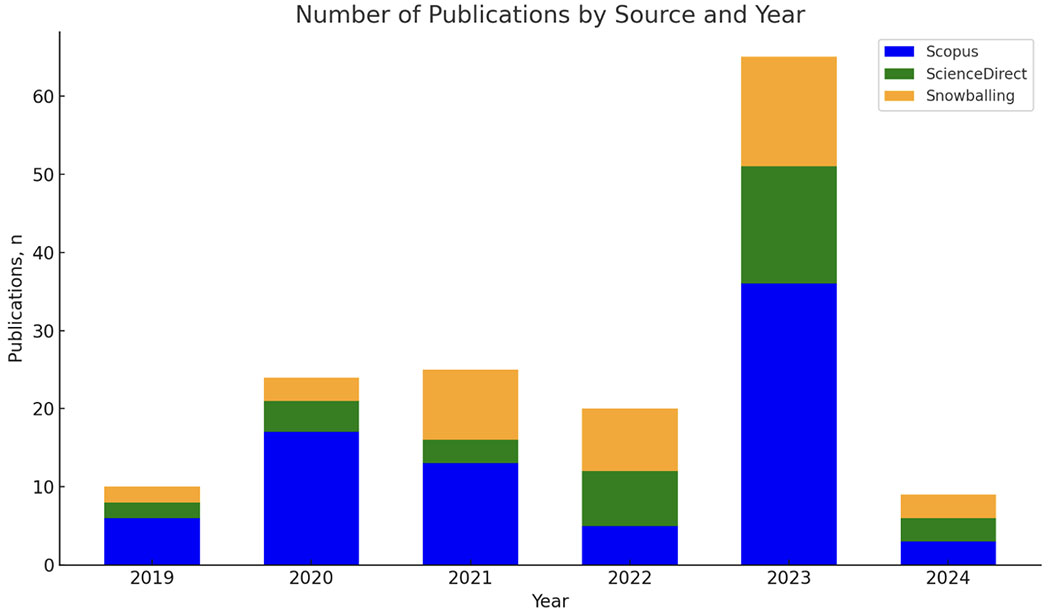
Figure 2 provides a summary of the articles used for analysis, categorized by year of publication and database. The data reveal that 2023 had the highest number of publications, totaling 36 research articles, with 15 articles from ScienceDirect, 14 from Scopus, and 7 obtained through the snowballing process. Conversely, 2024 had the lowest number of publications, with a total of 6 articles, equally distributed between ScienceDirect and Scopus, each contributing 3 articles. However, as the year 2024 is still in progress, this is expected to change.
Figure 2
Number of Publications per Year by Database
The following section discusses the identified strategies, technological support, benefits, and challenges of self-regulated learning (SRL).
In SRL, goal setting is crucial for organizing thoughts, emotions, and actions to achieve objectives, including goal clarity, planning, and behavior adaptation based on feedback (Mapuya, 2022; Omar et al., 2023; Zimmerman & Schunk, 2011). Pintrich (1999) identified three goal orientations: mastery, performance, and comparison, where mastery goals enhance SRL strategies and learning, while performance and comparison goals may have negative effects (Jivet et al., 2020). Effective goal setting involves specific, measurable objectives, timelines, continuous assessment, and adjustments (Chen, 2023; Funa et al., 2023; Kay et al., 2022; Kesuma et al., 2020).
Cognitive and metacognitive processes are central to SRL, enabling learners to monitor, control, and adapt their cognitive activities (Cervin-Ellqvist et al., 2021; Fleur et al., 2023; Kesuma et al., 2020). Metacognition involves higher-order processes such as self-checking and evaluating cognitive activities (Cervin-Ellqvist et al., 2021; Mapuya, 2022; Yeh et al., 2019). Cognitive strategies such as rehearsal, elaboration, organization, and critical thinking aid in planning, monitoring, and adjusting learning processes (Kay et al., 2022; Tise et al., 2023).
Time management in SRL involves allocating study time, monitoring progress, and maintaining motivation, especially in online environments (Jivet et al., 2020; Osakwe et al., 2023; Wong et al., 2021). Effective time management includes setting goals, efficient time allocation, monitoring progress, and adjusting schedules (Apridayani et al., 2023; Bećirović et al., 2022; Huber & Helm, 2020; Oinas et al., 2022; Yeh et al., 2019). Time management interventions reduce anxiety and improve academic balance (Apridayani et al., 2023; Huber & Helm, 2020; Oinas et al., 2022; Osakwe et al., 2023).
Self-reflection and evaluation are vital for reviewing performance, assessing progress, identifying strengths and weaknesses, and adjusting strategies (Kesuma et al., 2020; Khalid et al., 2024; Tise et al., 2023; Xu et al., 2022). Reflective writing and technological tools support these processes, allowing students to track learning progression and make adjustments (Kay et al., 2022).
Help-seeking in SRL involves seeking assistance or resources when facing learning challenges, fostering self-awareness and adaptive strategies (Chen, 2023; Hidayatullah & Csíkos, 2023). Effective help-seeking requires knowing when to seek help, whom to ask, and how to evaluate the received assistance (Xu et al., 2022). Self-regulated instruction includes seeking assistance from peers, parents, or instructors (Ismail et al., 2023). AI technologies and open learner models (OLMs) support help-seeking by providing personalized assistance and performance metrics (Bodily & Verbert, 2017).
Monitoring in SRL involves continuously tracking progress, evaluating strategies, and making necessary adjustments to achieve learning goals. Portfolio assessments further support independent monitoring and improvement of academic performance, promoting learner autonomy (Ismail et al., 2023). Technological tools like OLMs facilitate monitoring by displaying mastery levels and performance metrics (Kay et al., 2022).
Task management in SRL involves organizing and planning activities to achieve learning goals, using both cognitive and metacognitive strategies (Funa et al., 2023). Effective task strategies predict personal course goals and learning gains, with perceived autonomy enhancing task management and problem-solving abilities (Hidayatullah & Csíkos, 2023). Table 3 presents various SRL strategies identified in the literature, along with supporting source references.
Table 3
Self-Regulated Learning Strategies and Source References
| Strategy | References |
| Goal setting | Alotumi, 2021; Al-Shaye, 2021; Chen, 2023; Darvishi et al., 2024; Funa et al., 2023; Habók et al., 2024; Huang et al., 2021; Ingkavara et al., 2022; Jeon & Lee, 2023; Jivet et al., 2020; Kay et al., 2022; Kesuma et al., 2020; Lukes et al., 2020; Mapuya, 2022; Nufus et al., 2024; Omar et al., 2023; Osakwe et al., 2023; Reyes-Millán et al., 2023; Su et al., 2023; Tao et al., 2023; Tran & Phan Tran, 2021; Zarestky et al., 2022 |
| Cognitive and metacognitive | Anthonysamy et al., 2021; Cervin-Ellqvist et al., 2021; Fleur et al., 2023; Hidayatullah & Csíkos, 2023; Karrenbauer et al., 2023; Kay et al., 2022; Kesuma et al., 2020; Khalid et al., 2024; Nguyen & Zarra-Nezhad, 2023; Latipah et al., 2021; Liang et al., 2023; Lukes et al., 2020; Mapuya, 2022; Muwonge et al., 2020; Oinas et al., 2022; Omar et al., 2023; Tise et al., 2023; Wild & Neef, 2023; Yeh et al., 2019 |
| Time management | Apridayani et al., 2023; Bećirović et al., 2022; Darvishi et al., 2024; Fleur et al., 2023; Hidayatullah & Csíkos, 2023; Jivet et al., 2020; Khalid et al., 2024; Kong & Lin, 2023; Mapuya, 2022; Oinas et al., 2022; Omar et al., 2023; Osakwe et al., 2023; Patiño-Toro et al., 2023; Reyes-Millán et al., 2023; Su et al., 2023; Wong et al., 2021; Yavuzalp & Bahcivan, 2021 |
| Self-reflection and evaluation | Imhof et al., 2024; Ingkavara et al., 2022; Ismail et al., 2023; Kay et al., 2022; Kesuma et al., 2020; Khalid et al., 2024; Tise et al., 2023; Wong et al., 2021; Xu et al., 2022; Yeh et al., 2019; Zhou et al., 2021 |
| Help-seeking | Alhalafawy & Zaki, 2022; Bacher-Hicks et al., 2021; Briones et al., 2023; Chen, 2023; Darvishi et al., 2024; Hidayatullah & Csíkos, 2023; Ismail et al., 2023; Kay et al., 2022; Tadesse et al., 2022; Xu et al., 2022 |
| Monitoring | Huang et al., 2021; Imhof et al., 2024; Ingkavara et al., 2022; Ismail et al., 2023; Karrenbauer et al., 2023; Kay et al., 2022; Martin et al., 2022; Su et al., 2023 |
| Task management | Funa et al., 2023; Hidayatullah & Csíkos, 2023; Liang et al., 2023; Matsuyama et al., 2019; Wild & Neef, 2023; Yeh et al., 2019; Zhou et al., 2021 |
Learning management systems (LMS) are essential for accessing course materials, interacting with peers and instructors, and managing learning activities (Abduvakhidov et al., 2021; Reyes-Millán et al., 2023). These systems play a significant role in facilitating self-regulated learning (SRL) by organizing educational resources, tracking learner progress, and implementing strategies that promote self-regulation (Kong & Lin, 2023). Additionally, a LMS can be customized to provide personalized learning experiences that align with individual learner preferences, further enhancing the effectiveness of SRL (Han et al., 2021; Khalid et al., 2024).
Similarly, massive open online courses (MOOCs) contribute to SRL by allowing learners to manage their learning processes independently, set goals, and monitor progress (Wong et al., 2021). However, while MOOCs offer flexibility and broad access to educational resources, they are often challenged by high dropout rates, which can be mitigated through better engagement strategies (Mehrabi et al., 2020; White et al., 2020). Learning analytics dashboards (LADs) within MOOCs offer valuable feedback on study habits and progress, enhancing SRL by helping learners adjust their strategies as needed (Fleur et al., 2023).
Artificial intelligence (AI) further enhances SRL by providing personalized learning paths and real-time support (Ingkavara et al., 2022; Markauskaite et al., 2022). AI tools such as ChatGPT provide tailored assistance, feedback, and scaffolding that enhance learner engagement and self-efficacy (Dai et al., 2023; Darvishi et al., 2024; Jeon & Lee, 2023; Milano et al., 2023). These tools are particularly effective in supporting goal setting, time management, and help-seeking behaviors through dynamic feedback and assessments (Darvishi et al., 2024; Deeva et al., 2021).
In addition to individual learning tools, collaborative platforms are essential for supporting SRL by fostering interaction and collaboration among students and instructors (Núñez et al., 2019, 2023). These platforms facilitate group discussions, resource sharing, and collaborative projects, promoting active engagement and peer support, which are critical components of effective SRL (Fructuoso et al., 2023; Liang et al., 2023). Tools such as Blackboard, Skype, or discussion boards promote active engagement and peer support (Briones et al., 2023; Mapuya, 2022).
Mobile learning (m-learning) enhances SRL by providing accessible and interactive learning resources through mobile applications (Khalid et al., 2024). The use of mobile devices has been shown to improve both self-regulation and learning outcomes (Nikolopoulou, 2023). Additionally, mobile applications support engagement, flexibility, and collaboration in both classroom and no-classroom settings (Elkot & Ali, 2020; Reyes-Millán et al., 2023). Therefore, it is critical for online course designers to ensure mobile accessibility to effectively support SRL (Briones et al., 2023).
Learning analytics (LA) involves the collection and analysis of learner data to optimize educational outcomes (Baek & Doleck, 2023; Fleur et al., 2023; Tao et al., 2023; Zheng et al., 2021). LA tools provide visual data representations, enabling students to assess their performance and engage in self-reflection (Jivet et al., 2020). By offering insights into progress and areas for improvement, these tools effectively support self-regulated learning (Ingkavara et al., 2022). LA dashboards help learners set goals, self-monitor, and self-evaluate, which enhances motivation and participation (Fleur et al., 2023; Jivet et al., 2020). Effective LA interventions largely depend on the design of dashboards that facilitate meaningful data interpretation. Additionally, while LA can support help-seeking behaviors by providing progress insights, dashboard design must account for how learners interact with these tools to optimize SRL support (Jivet et al., 2020).
Task strategies, such as digital note-taking, also play an essential role in enhancing learning gains and SRL (Mapuya, 2022; Su et al., 2023). Apps that track goals or facilitate digital journaling help in self-reflection and evaluation, supporting continuous learning (Anthonysamy et al., 2021; Zarestky et al., 2022). Teacher observation and personalized feedback further support these processes (Ismail et al., 2023).
Technology-based educational tools promote self-regulatory behaviors through features such as virtual tutors, instant feedback, and adaptive technology (Khalid et al., 2024). Interactive tools such as OLMs provide personalized learning experiences and encourage learner autonomy (Kay et al., 2022). Reading quizzes, screencast feedback, digital platform-based gamification (DPBG) and similar tools support SRL by enhancing cognitive and metacognitive processes (Alhalafawy & Zaki, 2022; Inan-Karagul & Seker, 2021; Karrenbauer et al., 2023; Lukes et al., 2020). Platforms such as Microsoft Forms, Mentimeter, and Poll Everywhere also aid formative assessment and engagement (Fructuoso et al., 2023). Moreover, intelligent learning systems facilitate personalized learning by incorporating learner preferences and individual data (Han et al., 2021; Ingkavara et al., 2022; Rodríguez et al., 2022; Troussas et al., 2020; Xie et al., 2019).
Digital resources and repositories are valuable for SRL, providing vast and accessible materials that support personalized learning and autonomy (Tise et al., 2023). These resources play a key role in flipped classroom instruction by making learning materials readily available to students (Raviv et al., 2023). By expanding access to materials and tools, digital resources further support SRL and personalized learning (Tise et al., 2023). Additionally, they facilitate cultural exchanges and promote digital literacy among mentors, enriching the learning experience (Abdullah et al., 2022; Carvalho & Santos, 2022; Chauncey & McKenna, 2023; Kay et al., 2022; Riatun & Alvin, 2023).
Finally, video conferencing tools enable synchronous communication and collaborative learning, enhancing SRL (Khalid et al., 2024). Tools such as Google Meet and Zoom facilitate interactions between teachers and students, promoting engagement and participation in virtual settings (Al-Shaye, 2021; Briones et al., 2023; Mapuya, 2022). These tools also support active engagement and collaboration among virtual students (Briones et al., 2023). Table 4 presents the various technologies supporting SRL identified in the literature, along with supporting source references.
Table 4
Self-Regulated Learning Support Technologies and Source References
| Support technology | References |
| Learning management system | Abduvakhidov et al., 2021; Fructuoso et al., 2023; Han et al., 2021; Ingkavara et al., 2022; Karrenbauer et al., 2023; Khalid et al., 2024; Kong & Lin, 2023; Omar et al., 2023; Reyes-Millán et al., 2023; Rodríguez et al., 2022; Tise et al., 2023; Troussas et al., 2020; Zarestky et al., 2022 |
| MOOC | Fleur et al., 2023; Günther, 2021; Lambert, 2020; Lee et al., 2019; Lu, 2021; Mehrabi et al., 2020; Patiño-Toro et al., 2023; Paudyal et al., 2019; Khan et al., 2020; Rodríguez et al., 2022; White et al., 2020; Wong et al., 2019; Wong et al., 2021 |
| AI and chatbot | Alqahtani et al., 2023; Chauncey & McKenna, 2023; Dai et al., 2023; Darvishi et al., 2024; Deeva et al., 2021; HolonIQ, 2022; Ingkavara et al., 2022; Jeon & Lee, 2023; Markauskaite et al., 2022; Milano et al., 2023; Yan et al., 2023 |
| Collaborative platforms | Briones et al., 2023; Fructuoso et al., 2023; Khalid et al., 2024; Liang et al., 2023; Mapuya, 2022; Núñez et al., 2019, 2023 |
| Mobile educational application | Anthonysamy et al., 2021; Briones et al., 2023; Elkot & Ali, 2020; Khalid et al., 2024; Nikolopoulou, 2023; Omar et al., 2023; Reyes-Millán et al., 2023 |
| Learning analytics and dashboards | Baek & Doleck, 2023; Fleur et al., 2023; Günther, 2021; Ingkavara et al., 2022; Jivet et al., 2020; Tao et al., 2023; Zheng et al., 2021 |
| Digital note-taking | Anthonysamy et al., 2021; Ismail et al., 2023; Mapuya, 2022; Su et al., 2023; Zarestky et al., 2022 |
| Learning interactivity tools | Alhalafawy & Zaki, 2022; Fructuoso et al., 2023; Han et al., 2021; Inan-Karagul & Seker, 2021; Ingkavara et al., 2022; Karrenbauer et al., 2023; Kay et al., 2022; Khalid et al., 2024; Kong & Lin, 2023; Lukes et al., 2020; Rodríguez et al., 2022 |
| Digital resources and repositories | Abdullah et al., 2022; Bravo-Agapito et al., 2021; Carvalho & Santos, 2022; Chauncey & McKenna, 2023; Kay et al., 2022; Kim et al., 2022; Núñez et al., 2023; Raviv et al., 2023; Tise et al., 2023 |
| Video conferencing tools | Al-Shaye, 2021; Briones et al., 2023; Khalid et al., 2024; Mapuya, 2022 |
SRL is essential for academic success and is closely linked to higher achievements (Heirweg et al., 2020; Oinas et al., 2022; van Alten et al., 2020). SRL involves independent planning, managing, and assessing learning to achieve goals, significantly boosting performance, especially in online learning (Hidayatullah & Csíkos, 2023; Yeh et al., 2019). While explicit reading strategies combined with SRL have been shown to enhance performance, the absence of SRL strategies leads to significant challenges for students, including reduced engagement and higher dropout rates (Irvine et al., 2021; ter Beek et al., 2019). High SRL skills predict better academic performance and online learning success (Hidayatullah & Csíkos, 2023; Lee et al., 2021). Personal involvement and motivation are key for success (Apridayani et al., 2023). SRL is crucial not only for understanding and improving performance but also for predicting engagement and performance in online courses and impacting long-term retention and skills (Guo et al., 2022; Imhof et al., 2024; Martin et al., 2022).
Engagement in learning involves interacting with content to achieve goals. Learners tend to prefer active environments and collaboration (Bećirović et al., 2022; Lin & Dai, 2022; Matsuyama et al., 2019). Although self-reflection and feedback tools have been shown to enhance engagement and motivation, their impact can be limited if not properly aligned with the learning objectives and student needs (Fructuoso et al., 2023; Su et al., 2023). SRL is vital for engagement and course completion, particularly in online learning environments (Amiruddin et al., 2023; Kesuma et al., 2020; Wong et al., 2021). SRL strategies help maintain motivation by fostering supportive learning behaviors, especially in online contexts (Alotumi, 2021; Li et al., 2023; Omar et al., 2023). Student-centered approaches in learning systems support SRL, fostering skills for language learning and 21st-century skills (Omar et al., 2023). Moreover, engaging learning environments play a key role in boosting motivation and self-regulation (Khalid et al., 2024), and transitioning to a learner-centered model significantly increases both engagement and SRL (Matsuyama et al., 2019).
Autonomous learners are accountable for their learning decisions and responsible for their education (Ismail et al., 2023). Autonomy enhances self-organization and involves deciding one’s learning plan and choosing mentors (Matsuyama et al., 2019; Zhou et al., 2021). Authentic assessments promote autonomy by making learners responsible for their education (Ismail et al., 2023). Self-regulated learning (SRL) enhances interest and engagement through autonomy, fostering academic ownership via technology (Khalid et al., 2024; Nikolopoulou, 2023). SRL involves goal setting, strategy planning, and progress monitoring (Ingkavara et al., 2022; Karrenbauer et al., 2023). Online learning environments support needs like competence and relatedness, enhancing motivation and autonomy (Xu et al., 2022). Gamification and digital applications engage students through autonomous learning (Alhalafawy & Zaki, 2022; Bećirović et al., 2022). Mentor support and reflection on learning experiences further enhance autonomy (Carvalho & Santos, 2022; Matsuyama et al., 2019). Overall, SRL empowers learners to control their learning, increasing motivation, engagement, and independence (Omar et al., 2023; Su et al., 2023).
Motivation is key in the learner-centered approach. SRL learners with metacognitive abilities are highly motivated and perform better academically (Kesuma et al., 2020; Muwonge et al., 2020). Motivation and self-efficacy are closely linked to engagement and SRL behaviors; however, fostering these traits requires a nuanced understanding of each student’s individual goals and contexts (Wong et al., 2021). Individual goals and motivation impact SRL strategies, with perceived autonomy linked to online SRL and greater motivation (Hidayatullah & Csíkos, 2023; Kong & Lin, 2023). SRL combines academic learning with self-control, leading to improved motivation (Nufus et al., 2024). Mobile applications supporting SRL strategies have also been shown to increase motivation (Elkot & Ali, 2020). Overall, motivation plays a crucial role in fostering both engagement and SRL behaviors.
Self-efficacy, defined as learners’ beliefs in their ability to succeed, is crucial for academic success in SRL. High self-efficacy leads to persistence, effective learning behaviors, and personal goal achievement in online environments, enhancing confidence and resilience (Wong et al., 2021). Strategies promoting self-efficacy enhance belief in abilities, impacting academic success (Khalid et al., 2024). Emphasizing self-observation and self-judgment fosters academic self-efficacy, improving achievement (Kesuma et al., 2020). However, overemphasis on self-judgment without adequate feedback can lead to negative self-assessment and reduced motivation, highlighting the need for balanced instructional strategies. High self-efficacy learners display persistence, task interest, and effective emotion management, contributing to frequent SRL strategy use (Lee et al., 2021; Martin et al., 2022). Building confidence in executing strategies and achieving outcomes enhances motivation and persistence (Tise et al., 2023). Positive reinforcement and task value reinforce this confidence, enhancing resilience and performance (Wong et al., 2021).
Personalized learning experiences, achieved through individual goal setting and tailored strategies, facilitate the shift toward a learner-centered model (Matsuyama et al., 2019; Zhou et al., 2020). Nonetheless, personalization must be carefully calibrated to avoid information overload or misalignment with broader curricular objectives. Portfolio assessments reflect progress and areas for improvement, while authentic assessments develop skills through real-world situations (Ismail et al., 2023). Personalized SRL systems enhance learning through goal setting and tailored paths (Ingkavara et al., 2022). Personalized advice on SRL strategies fosters learning (Lim et al., 2023). Personalized feedback helps learners understand strengths and areas for improvement, promoting SRL (Ingkavara et al., 2022; Khalid et al., 2024; Osakwe et al., 2023). Digital teaching strategies ensure personalized learning through structured experiences and reflective practices (Al-Shaye, 2021), while online courses allow self-paced study, enhancing SRL and overall competence (Raviv et al., 2023).
Feedback ranges from basic formats, including grades, to more comprehensive methods such as comments and rubrics (Lukes et al., 2020). A learner-centered approach requires personalized feedback to meet diverse needs (Matsuyama et al., 2019). Instructors must provide timely support and feedback, especially to students struggling with reflection, to promote in-depth reflection and effective goal-setting (Li et al., 2023). Individualized, narrative feedback from mentors significantly promotes professional identity formation (PIF; Matsuyama et al., 2019). Personalized training encourages strategy adoption (Inan-Karagul & Seker, 2021), and students use feedback to manage time and resources efficiently (Su et al., 2023). Table 5 presents the various benefits of implementing SRL identified in the literature, along with supporting source references.
Table 5
Self-Regulated Learning Benefits and Source References
| Benefit | References |
| Support academic achievements | Al-Shaye, 2021; Apridayani et al., 2023; Bećirović et al., 2022; Chen & Li, 2021; Elkot & Ali, 2020; Fructuoso et al., 2023; Guo et al., 2022; Heirweg et al., 2020; Hidayatullah & Csíkos, 2023; Imhof et al., 2024; Irvine et al., 2021; Karrenbauer et al., 2023; Lee et al., 2021; Liang et al., 2023; Lukes et al., 2020; Martin et al., 2022; Núñez et al., 2023; Oinas et al., 2022; Reparaz et al., 2020; Su et al., 2023; Tao et al., 2023; ter Beek et al., 2019; van Alten et al., 2020; Wang et al., 2019; Yeh et al., 2019 |
| Increase engagement | Alotumi, 2021; Al-Shaye, 2021; Amiruddin et al., 2023; Bećirović et al., 2022; Briones et al., 2023; Elkot & Ali, 2020; Fructuoso et al., 2023; Guo et al., 2022; Imhof et al., 2024; Inan-Karagul & Seker, 2021; Ismail et al., 2023; Kesuma et al., 2020; Khalid et al., 2024; Li et al., 2023; Lin & Dai, 2022; Matsuyama et al., 2019; Nikolopoulou, 2023; Omar et al., 2023; Su et al., 2023; Tadesse et al., 2022; Wong et al., 2021; Yeh et al., 2019 |
| Promote autonomy | Alhalafawy & Zaki, 2022; Bećirović et al., 2022; Carvalho & Santos, 2022; Inan-Karagul & Seker, 2021; Ingkavara et al., 2022; Ismail & Abdul Hamid, 2024; Karrenbauer et al., 2023; Khalid et al., 2024; Lin & Dai, 2022; Matsuyama et al., 2019; Nikolopoulou, 2023; Omar et al., 2023; Su et al., 2023; Tise et al., 2023; Xu et al., 2022; Zhou et al., 2021 |
| Foster motivation | Bećirović et al., 2022; Elkot & Ali, 2020; Hidayatullah & Csíkos, 2023; Ismail et al., 2023; Kesuma et al., 2020; Kong & Lin, 2023; Matsuyama et al., 2019; Muwonge et al., 2020; Nufus et al., 2024; Omar et al., 2023; Su et al., 2023; Wong et al., 2021; Yeh et al., 2019 |
| Increase self-efficacy | Al-Shaye, 2021; Elkot & Ali, 2020; Ingkavara et al., 2022; Ismail et al., 2023; Kesuma et al., 2020; Khalid et al., 2024; Nguyen & Zarra-Nezhad, 2023; Lee et al., 2021; Martin et al., 2022; Raviv et al., 2023; Tise et al., 2023; Wong et al., 2021; Yavuzalp & Bahcivan, 2021 |
| Personalized learning experienced | Al-Shaye, 2021; Chen, 2023; Ingkavara et al., 2022; Ismail et al., 2023; Karrenbauer et al., 2023; Khalid et al., 2024; Lim et al., 2023; Matsuyama et al., 2019; Osakwe et al., 2023; Raviv et al., 2023; Tadesse et al., 2022; Zhou et al., 2021 |
| Personalized feedback | Inan-Karagul & Seker, 2021; Li et al., 2023; Lukes et al., 2020; Matsuyama et al., 2019; Su et al., 2023 |
Appropriate infrastructure, digital resources, support, and cooperation are crucial for sustaining blended learning, particularly SRL (Nikolopoulou, 2023). Access to technology is vital for SRL, but limited access can hinder it and impact learning outcomes (Gutiérrez-Pelaez & Ellis, 2020; Ingkavara et al., 2022; Khalid et al., 2024; Núñez et al., 2023; Sevnarayan, 2022). This issue is significant for students facing barriers to digital resources and online tools, affecting their success in online courses. For instance, students in rural areas or underfunded schools often face difficulties accessing reliable Internet and digital devices, which restricts their ability to engage with online learning platforms and use digital tools essential for SRL (Reyes-Millán et al., 2023; Zarestky et al., 2022). Ensuring equitable access to technology requires not only the provision of devices but also digital literacy training to enhance online learning readiness (Carvalho & Santos, 2022; Kay et al., 2022).
Technical challenges, such as connectivity issues, can impede student participation. For example, students participating in synchronous online classes may experience frequent disruptions due to unstable Internet connections, making it difficult for them to stay engaged and keep up with the course content (Inan-Karagul & Seker, 2021; Tadesse et al., 2022). Similarly, asynchronous learners with poor Internet connections may struggle to download necessary materials or submit assignments on time, leading to gaps in learning (Briones et al., 2023). Effective SRL and e-learning depend on access to information, communication, and technology (ICT) equipment and reliable Internet connections (Abbasi et al., 2020; Almaiah et al., 2020; Choong, 2020; Looi, 2023; Wang et al., 2020). Addressing these challenges requires inclusive strategies to ensure equitable access and strengthen digital infrastructure (Dai et al., 2023; Nikolopoulou, 2023).
Clear instructional design is essential for SRL, promoting goal setting, strategy planning, and adaptive learning (Ingkavara et al., 2022). In practical terms, this means educators need to provide clear guidelines and scaffolding to help students set realistic goals and develop personalized learning plans. Without proper guidance, students may struggle with self-control in online environments (Ingkavara et al., 2022). Clear instructions and scaffolding tools support SRL by providing guidance on self-regulatory processes (Matcha, Ahmad Uzir, et al., 2019; Matcha, Gašević, et al., 2019; Osakwe et al., 2023). Quality instructional materials ensure learners understand tasks and expectations, which is crucial for facilitating self-regulation (Chen, 2023). Teacher guidance and personalized feedback significantly enhance learning outcomes by fostering self-reflection and self-assessment, essential components of metacognitive strategies (Nikolopoulou, 2023; Tzimas & Demetriadis, 2024; Yavuzalp & Bahcivan, 2021). Timely and specific feedback can help students adjust their learning strategies and improve their self-regulation skills, yet in many cases, such feedback is delayed or generic, reducing its effectiveness (Yavuzalp & Bahcivan, 2021).
Resistance to change can impede new SRL methods, necessitating supportive strategies (Khalid et al., 2024). This resistance is common during the transition to online models (Almaiah et al., 2020; Gutiérrez-Pelaez & Ellis, 2020; Looi, 2023; Núñez et al., 2019). Teacher education often prioritizes content knowledge over SRL principles, leading to resistance. For instance, teachers may resist integrating SRL strategies such as self-reflection, goal setting, and help-seeking into their curricula due to a lack of familiarity or confidence in these methods (Faza et al., 2024; Omar et al., 2023; Robbins et al., 2020). Educators need competencies to support self-directed learners, but the lack of SRL emphasis in teacher preparation programs may limit the integration of mobile educational apps, hindering academic success (Omar et al., 2023). In practice, this means that even when mobile apps are available, they are underused or not used to their full potential because educators lack the necessary skills to integrate them effectively into their teaching practices.
The pandemic highlighted significant gaps in instructor training for online teaching impacting SRL outcomes, student success, and attitudes toward online education (Bećirović et al., 2022; Karrenbauer et al., 2023; Khalid et al., 2024; Patiño-Toro et al., 2023; Reyes-Millán et al., 2023). Many instructors were unprepared to facilitate online learning effectively, lacking training in essential SRL strategies such as time management, self-reflection, and monitoring, which are critical for supporting student learning in virtual environments (Chen, 2023). Instructors who are not well-versed in these strategies may find it challenging to foster a self-regulated learning environment conducive to online learning success.
Limited access to learning materials poses significant obstacles to SRL, especially for students lacking resources like international study opportunities or internships (Gutiérrez-Pelaez & Ellis, 2020; Núñez et al., 2023). These challenges can affect students’ ability to engage in SRL and manage their learning. For instance, students from low-income backgrounds may have limited access to textbooks or online subscriptions, making it difficult for them to engage fully in their studies and apply SRL strategies effectively (Funa et al., 2023; Funa & Talaue, 2021). To overcome these barriers, employing strategies such as help-seeking and proactive resource management can enhance students’ capacity to navigate limited resources and still achieve their learning goals (Almaiah et al., 2020; Looi, 2023; Zhou et al., 2020). Access to digital resources enhances instructional benefits and accessibility, improving SRL outcomes (Khalid et al., 2024).
Students often face time management difficulties in distance education, impacting their ability to use online resources effectively (Anthonysamy et al., 2021; Turan et al., 2022). For example, juggling multiple deadlines without the structure of a physical classroom environment can lead to procrastination or incomplete tasks, affecting learning outcomes (Osakwe et al., 2023; Reyes-Millán et al., 2023). Despite these constraints, SRL strategies such as self-monitoring and adaptive planning can help students manage time and workload effectively (Omar et al., 2023). The setup of online learning influences task completion, underscoring the importance of SRL (Adnan & Anwar, 2020; Funa et al., 2023).
Students’ lack of prior knowledge of motivational regulation strategies highlights the need for university training to enhance SRL self-efficacy (Alotumi, 2021; Howlett et al., 2021; Kryshko et al., 2020; Wang et al., 2021; Zhang et al., 2020). In practice, training on SRL strategies can help students use self-regulated motivation (SRM) effectively, particularly in EFL contexts (Alotumi, 2021; Teng et al., 2020).
Digital competencies are essential for leveraging technological tools in SRL, enabling students to navigate online resources, collaborate effectively, and use learning management systems proficiently (Chen, 2023; Ingkavara et al., 2022; Karrenbauer et al., 2023; Tise et al., 2023). Online learning readiness depends on digital competencies, which are assessed using tools such as the Online Learning Readiness Questionnaire (OLRQ; Reyes-Millán et al., 2023). Students unfamiliar with digital tools may struggle to access online resources or participate in collaborative online projects, hindering their ability to fully engage in SRL (Chen, 2023). Developing digital competencies also involves understanding and applying metacognitive strategies, such as monitoring one’s own learning progress and seeking feedback, which are vital for successful SRL in digital environments. Table 6 presents various challenges in implementing SRL identified in the literature, along with supporting source references.
Table 6
Self-Regulated Learning Challenges and Source References
| Challenge | References |
| Limited access to technology | Abbasi et al., 2020; Almaiah et al., 2020; Briones et al., 2023; Carvalho & Santos, 2022; Choong, 2020; Dai et al., 2023; Elkot & Ali, 2020; Gutiérrez-Pelaez & Ellis, 2020; Inan-Karagul & Seker, 2021; Ingkavara et al., 2022; Kay et al., 2022; Khalid et al., 2024; Looi, 2023; Nikolopoulou, 2023; Núñez et al., 2023; Omar et al., 2023; Reyes-Millán et al., 2023; Sevnarayan, 2022; Tadesse et al., 2022; Wang et al., 2020; Zarestky et al., 2022 |
| Instruction clarity | Bećirović et al., 2022; Chen, 2023; Ingkavara et al., 2022; Mapuya, 2022; Matcha et al., 2019; Nikolopoulou, 2023; Omar et al., 2023; Osakwe et al., 2023; Tzimas & Demetriadis, 2024; Yavuzalp & Bahcivan, 2021 |
| Resistance to change | Almaiah et al., 2020; Chen, 2023; Gutiérrez-Pelaez & Ellis, 2020; Khalid et al., 2024; Looi, 2023; Matsuyama et al., 2019; Núñez et al., 2023; Omar et al., 2023; Robbins et al., 2020; Turan et al., 2022 |
| Instructor lack of training | Bećirović et al., 2022; Chen, 2023; Karrenbauer et al., 2023; Khalid et al., 2024; Omar et al., 2023; Park & Kim, 2023; Patiño-Toro et al., 2023; Reyes-Millán et al., 2023 |
| Limited access to learning material | Almaiah et al., 2020; Funa et al., 2023; Funa & Talaue, 2021; Gutiérrez-Pelaez & Ellis, 2020; Khalid et al., 2024; Looi, 2023; Núñez et al., 2023; Zhou et al., 2020 |
| Time and workload constraints | Adnan & Anwar, 2020; Anthonysamy et al., 2021; Chauncey & McKenna, 2023; Funa et al., 2023; Omar et al., 2023; Osakwe et al., 2023; Reyes-Millán et al., 2023; Turan et al., 2022 |
| Student lack of knowledge | Alotumi, 2021; Howlett et al., 2021; Kryshko et al., 2020; Teng et al., 2020; Wang et al., 2021; Zhang et al., 2020 |
| Digital competencies | Chen, 2023; Ingkavara et al., 2022; Karrenbauer et al., 2023; Reyes-Millán et al., 2023; Tise et al., 2023 |
This study highlights the pivotal role of self-regulated learning (SRL) in fostering academic success. By incorporating SRL strategies such as goal setting, cognitive and metacognitive processes, time management, self-reflection, and help-seeking, students can effectively manage their learning processes. Integrating these strategies with technological tools such as learning management systems (LMS), massive open online courses (MOOCs), and artificial intelligence (AI) significantly enhances students’ ability to set and achieve goals, monitor progress, and stay engaged, particularly in online and blended learning environments. Technological advancements have revolutionized education, making robust SRL skills essential for maintaining motivation and preventing dropout in digital learning contexts. AI and collaborative platforms offer personalized learning paths and support, while mobile learning and learning analytics provide accessible, interactive resources and enable continuous self-monitoring and strategy adjustment. However, implementing IT-supported SRL strategies faces challenges, including limited access to technology, the need for digital literacy, effective time management, resistance to change, and inadequate instructor training. Overcoming these barriers is crucial for creating inclusive and effective educational environments. Ensuring equitable access to technology, offering digital literacy training, and enhancing digital infrastructure are necessary steps.
This study also advances the SRL theoretical framework by integrating strategies with modern technology, emphasizing accountability, planning, collaboration, and communication. It provides a comprehensive understanding of improving SRL through digital means, illustrating its importance for lifelong learning and job market readiness. The research highlights the shift in educational paradigms due to technological advancements and the COVID-19 pandemic, emphasizing the need for robust SRL skills in online learning.
For educators, this research offers insights into implementing SRL strategies using IT tools, helping design practices that foster accountability, planning, collaboration, and communication. Policymakers can promote digital literacy and SRL training in educational programs, addressing barriers such as technology availability and digital capability to create inclusive environments. The research underscores supporting students in developing strong SRL skills to maintain motivation and prevent dropout, especially in online learning contexts.
Despite the insightful findings of this study, several limitations must be acknowledged, primarily stemming from the restricted scope of the journal databases used. First, the study’s reliance on only two journal databases may have limited the comprehensiveness of the literature review. This constraint could result in potential biases, as important studies and diverse perspectives from other relevant databases may have been overlooked. Consequently, the findings and recommendations might not fully capture the breadth of existing research on SRL and its integration with technological tools.
Furthermore, the rapidly evolving nature of technology means that some studies included in the database might already be outdated, failing to account for the latest advancements in AI, mobile learning, and learning analytics. This temporal limitation could impact the relevance and applicability of the findings to current educational contexts. As technology continues to advance at a rapid pace, ongoing research is necessary to keep pace with these changes and to validate the continued relevance of the findings presented in this study.
Future research should explore the perspectives and experiences of various educational stakeholders, such as faculty members and administrators, to understand better the implementation and efficacy of SRL strategies. Examining these insights can refine SRL interventions and ensure their practical applicability in diverse educational settings. Empirical testing of SRL strategies and supporting technologies is essential to substantiate their benefits and identify obstacles. Studies should evaluate the effectiveness of SRL strategies integrated with tools such as LMSs, MOOCs, and AI in different learning environments. This research will help understand the impact of these strategies on student performance, engagement, retention, and academic achievement. Additionally, future research should investigate challenges related to digital literacy, equitable access to technology, and instructor training in implementing IT-supported SRL strategies. By examining these factors, researchers can help develop targeted interventions and professional development programs to enhance digital literacy among students and educators. Identifying best practices for overcoming resistance to change and fostering continuous improvement in educational institutions is crucial for adopting SRL strategies.
Thanks are given to Universitas Multimedia Nusantara for support in completing the research.
Abbasi, S., Ayoob, T., Malik, A., & Memon, S. I. (2020). Perceptions of students regarding e-learning during Covid-19 at a private medical college: Perceptions of students regarding e-learning. Pakistan Journal of Medical Sciences, 36(COVID19-S4), S57-S61. https://doi.org/10.12669/pjms.36.COVID19-S4.2766
Abdullah, S. I. N. W., Arokiyasamy, K., Goh, S. L., Culas, A. J., & Manaf, N. M. A. (2022). University students’ satisfaction and future outlook towards forced remote learning during a global pandemic. Smart Learning Environments, 9, Article 15. https://doi.org/10.1186/s40561-022-00197-8
Abduvakhidov, A. M., Mannapova, E. T., & Akhmetshin, E. M. (2021). Digital development of education and universities: Global challenges of the digital economy. International Journal of Instruction, 14(1), 743-760. https://doi.org/10.29333/iji.2021.14145a
Adnan, M., & Anwar, K. (2020). Online learning amid the COVID-19 pandemic: Students’ perspectives. Journal of Pedagogical Sociology and Psychology, 2(1), 45-51. https://doi.org/10.33902/JPSP.2020261309
Alhalafawy, W. S., & Tawfiq Zaki, M. Z. (2022). How has gamification within digital platforms affected self-regulated learning skills during the COVID-19 pandemic? Mixed-methods research. International Journal of Emerging Technologies in Learning (IJET), 17(6), 123-151. https://doi.org/10.3991/ijet.v17i06.28885
Almaiah, M. A., Al-Khasawneh, A., & Althunibat, A. (2020). Exploring the critical challenges and factors influencing the e-learning system usage during COVID-19 pandemic. Education and Information Technologies, 25(6), 5261-5280. https://doi.org/10.1007/s10639-020-10219-y
Alotumi, M. (2021). EFL college junior and senior students’ self-regulated motivation for improving English speaking: A survey study. Heliyon, 7(4), Article e06664. https://doi.org/10.1016/j.heliyon.2021.e06664
Alqahtani, T., Badreldin, H. A., Alrashed, M., Alshaya, A. I., Alghamdi, S. S., bin Saleh, K., Alowais, S. A., Alshaya, O. A., Rahman, I., Al Yami, M. S., & Albekairy, A. M. (2023). The emergent role of artificial intelligence, natural language processing, and large language models in higher education and research. Research in Social and Administrative Pharmacy, 19(8), 1236-1242. https://doi.org/10.1016/j.sapharm.2023.05.016
Al-Shaye, S. (2021). Digital storytelling for improving critical reading skills, critical thinking skills, and self-regulated learning skills. Kıbrıslı Eğitim Bilimleri Dergisi, 16(4), 2049-2069, https://doi.org/10.18844/cjes.v16i4.6074
Amiruddin, A., Baharuddin, F. R., Takbir, T., Setialaksana, W., & Hasim, M. (2023). Pedagogy-andragogy continuum with cybergogy to promote self-regulated learning: A structural equation model approach. European Journal of Educational Research, 12(2), 811-824. https://doi.org/10.12973/eu-jer.12.2.811
Anthonysamy, L., Ah Choo, K., & Soon Hin, H. (2021). Investigating self-regulated learning strategies for digital learning relevancy. Malaysian Journal of Learning and Instruction, 18(1), 29-64. https://doi.org/10.32890/mjli2021.18.1.2
Apridayani, A., Han, W., & Waluyo, B. (2023). Understanding students’ self-regulated learning and anxiety in online English courses in higher education. Heliyon, 9(6), Article e17469. https://doi.org/10.1016/j.heliyon.2023.e17469
Araka, E., Maina, E., Gitonga, R., & Oboko, R. (2020). Research trends in measurement and intervention tools for self-regulated learning for e-learning environments—Systematic review (2008–2018). Research and Practice in Technology Enhanced Learning, 15, Article 6. https://doi.org/10.1186/s41039-020-00129-5
Bacher-Hicks, A., Goodman, J., & Mulhern, C. (2021). Inequality in household adaptation to schooling shocks: Covid-induced online learning engagement in real time. Journal of Public Economics, 193, Article 104345. https://doi.org/10.1016/j.jpubeco.2020.104345
Baek, C., & Doleck, T. (2023). Educational data mining versus learning analytics: A review of publications from 2015 to 2019. Interactive Learning Environments, 31(6), 3828-3850. https://doi.org/10.1080/10494820.2021.1943689
Ballouk, R., Mansour, V., Dalziel, B., McDonald, J., & Hegazi, I. (2022). Medical students’ self-regulation of learning in a blended learning environment: A systematic scoping review. Medical Education Online, 27(1), Article 2029336. https://doi.org/10.1080/10872981.2022.2029336
Bećirović, S., Ahmetović, E., & Skopljak, A. (2022). An examination of students online learning satisfaction, interaction, self-efficacy and self-regulated learning. European Journal of Contemporary Education, 11(1), 16-35. https://doi.org/10.13187/ejced.2022.1.16
Biggs, J. (1999). What the student does: Teaching for enhanced learning. Higher Education Research and Development, 18, 57-75. https://doi.org/10.1080/07294360.2012.642839
Bodily, R., & Verbert, K. (2017). Review of research on student-facing learning analytics dashboards and educational recommender systems. IEEE Transactions on Learning Technologies, 10(4), 405-418. https://doi.org/10.1109/TLT.2017.2740172
Bravo-Agapito, J., Romero, S. J., & Pamplona, S. (2021). Early prediction of undergraduate student’s academic performance in completely online learning: A five-year study. Computers in Human Behavior, 115, Article 106595. https://doi.org/10.1016/j.chb.2020.106595
Briones, M. R., Prudente, M., & Errabo, D. D. (2023). Characteristics of Filipino online learners: A survey of science education students’ engagement, self-regulation, and self-efficacy. Education Sciences, 13(11), Article 1131. https://doi.org/10.3390/educsci13111131
Brusilovsky, P., Somyürek, S., Guerra, J., Hosseini, R., & Zadorozhny, V. (2015). The value of social: Comparing open student modeling and open social student modeling. In F. Ricci, K. Bontcheva, O. Conlan, & S. Lawless (Eds.), User Modeling, Adaptation and Personalization. UMAP 2015 (pp. 44-55). Springer. https://doi.org/10.1007/978-3-319-20267-9_4
Carvalho, A. R., & Santos, C. (2022). Developing peer mentors’ collaborative and metacognitive skills with a technology-enhanced peer learning program. Computers and Education Open, 3, Article 100070. https://doi.org/10.1016/j.caeo.2021.100070
Cervin-Ellqvist, M., Larsson, D., Adawi, T., Stöhr, C., & Negretti, R. (2021). Metacognitive illusion or self-regulated learning? Assessing engineering students’ learning strategies against the backdrop of recent advances in cognitive science. Higher Education, 82(3), 477-498. https://doi.org/10.1007/s10734-020-00635-x
Chauncey, S. A., & McKenna, H. P. (2023). A framework and exemplars for ethical and responsible use of AI Chatbot technology to support teaching and learning. Computers and Education: Artificial Intelligence, 5, Article 100182. https://doi.org/10.1016/j.caeai.2023.100182
Chen, K. Z., & Li, S. C. (2021). Sequential, typological, and academic dynamics of self-regulated learners: Learning analytics of an undergraduate chemistry online course. Computers and Education: Artificial Intelligence, 2, Article 100024. https://doi.org/10.1016/j.caeai.2021.100024
Chen, L. H. (2023). Moving forward: International students’ perspectives of online learning experience during the pandemic. International Journal of Educational Research Open, 5, Article 100276. https://doi.org/10.1016/j.ijedro.2023.100276
Cheng, Z., Zhang, Z., Xu, Q., Maeda, Y., & Gu, P. (2023, October 10). A meta-analysis addressing the relationship between self-regulated learning strategies and academic performance in online higher education. Journal of Computing in Higher Education, 1-30. https://doi.org/10.1007/s12528-023-09390-1
Choong, P. Y. (2020, May 8). COVID-19: Impact on the tertiary education sector in Malaysia. Crisis assessment. Penang Institute. https://penanginstitute.org/wp-content/uploads/2020/05/IMPACT-ON-THE-TERTIARY-EDUCATION-SECTOR-IN-MALAYSIA.pdf
Cook, R., Kay, J., & Kummerfeld, B. (2015). MOOClm: User modelling for MOOCs. In F. Ricci, K. Bontcheva, O. Conlan, & S. Lawless (Eds.), User Modeling, Adaptation and Personalization. UMAP 2015 (pp. 80-91). Springer. https://doi.org/10.1007/978-3-319-20267-9_7
Dai, Y., Liu, A., & Lim, C. P. (2023). Reconceptualizing ChatGPT and generative AI as a student-driven innovation in higher education. Procedia CIRP, 119, 84-90. https://doi.org/10.1016/j.procir.2023.05.002
Darvishi, A., Khosravi, H., Sadiq, S., Gašević, D., & Siemens, G. (2024). Impact of AI assistance on student agency. Computers & Education, 210, Article 104967. https://doi.org/10.1016/j.compedu.2023.104967
Deeva, G., Bogdanova, D., Serral, E., Snoeck, M., & De Weerdt, J. (2021). A review of automated feedback systems for learners: Classification framework, challenges and opportunities. Computers & Education, 162, Article 104094. https://doi.org/10.1016/j.compedu.2020.104094
Domínguez, C., Garcia-Izquierdo, F. J., Jaime, A., Pérez, B., Rubio, A. L., & Zapata, M. A. (2021). Using process mining to analyze time distribution of self-assessment and formative assessment exercises on an online learning tool. IEEE Transactions on Learning Technologies, 14(5), 709-722. https://doi.org/10.1109/TLT.2021.3119224
Doo, M. Y., Zhu, M., & Bonk, C. J. (2023). Influence of self-directed learning on learning outcomes in MOOCs: A meta-analysis. Distance Education, 44(1), 86-105. https://doi.org/10.1080/01587919.2022.2155618
Edisherashvili, N., Saks, K., Pedaste, M., & Leijen, Ä. (2022). Supporting self-regulated learning in distance learning contexts at higher education level: Systematic literature review. Frontiers in Psychology, 12, Article 792422. https://doi.org/10.3389/fpsyg.2021.792422
Elkot, M. A., & Ali, R. (2020). Enhancing self-regulated learning strategy via handheld devices for improving English writing skills and motivation. International Journal of Information and Education Technology, 10(11), 805-812. https://doi.org/10.18178/ijiet.2020.10.11.1462
Faza, A., Santoso, H. B., & Putra, P. O. H. (2024). Navigating online learning challenges and opportunities: Insights from small group of lecturers during pandemic. Procedia Computer Science, 234, 1164-1174. https://doi.org/10.1016/j.procs.2024.03.112
Fleur, D. S., van den Bos, W., & Bredeweg, B. (2023). Social comparison in learning analytics dashboard supporting motivation and academic achievement. Computers and Education Open, 4, Article 100130. https://doi.org/10.1016/j.caeo.2023.100130
Fructuoso, I. N., Robalino, P. E., & Ahmedi, S. (2023). The flexibility of the flipped classroom for the design of mediated and self-regulated learning scenarios. RIED. Revista Iberoamericana de Educación a Distancia, 26(2), 155-173. https://doi.org/10.5944/ried.26.2.36035
Funa, A. A., Gabay, R. A. E., Deblois, E. C. B., Lerios, L. D., & Jetomo, F. G. J. (2023). Exploring Filipino preservice teachers’ online self-regulated learning skills and strategies amid the COVID-19 pandemic. Social Sciences & Humanities Open, 7(1), Article 100470. https://doi.org/10.1016/j.ssaho.2023.100470
Funa, A. A., & Talaue, F. T. (2021). Constructivist learning amid the COVID-19 pandemic: Investigating students’ perceptions of biology self-learning biology modules. International Journal of Learning, Teaching, and Educational Research, 20(3), 250-264. https://doi.org/10.26803/ijlter.20.3.15
Günther, S. A. (2021). The impact of social norms on students’ online learning behavior: Insights from two randomized controlled trials. In M. Scheffel, N. Dowell, S. Joksimovic, & G. Siemens (Chairs), LAK21: 11th International Learning Analytics and Knowledge Conference (pp. 12-21). ACM. https://doi.org/10.1145/3448139.3448141
Guo, J., King, R. B., Ding, Q., & Fan, M. (2022). Measuring and promoting self-regulation for equity and quality of online learning: New evidence from a multi-institutional survey during COVID-19. Education Sciences, 12(7), Article 465. https://doi.org/10.3390/educsci12070465
Gutiérrez-Peláez, M., & Ellis, K. (2020). Aprendizaje intercultural. Collaborative Online International Learning (COIL) Experiences between Universidad del Rosario and the American University in Cairo Egypt. Reflexiones Pedagógicas, 23, 1-7. https://doi.org/10.48713/10336_25855
Habók, A., Oo, T. Z., & Magyar, A. (2024). The effect of reading strategy use on online reading comprehension. Heliyon, 10(2), Article: e24281. https://doi.org/10.1016/j.heliyon.2024.e24281
Han, J., Kim, K. H., Rhee, W., & Cho, Y. H. (2021). Learning analytics dashboards for adaptive support in face-to-face collaborative argumentation. Computers & Education, 163, Article 104041. https://doi.org/10.1016/j.compedu.2020.104041
Heikkinen, S., Saqr, M., Malmberg, J., & Tedre, M. (2023). Supporting self-regulated learning with learning analytics interventions—A systematic literature review. Education and Information Technologies, 28(3), 3059-3088. https://doi.org/10.1007/s10639-022-11281-4
Heirweg, S., De Smul, M., Merchie, E., Devos, G., & Van Keer, H. (2020). Mine the process: Investigating the cyclical nature of upper primary school students’ self-regulated learning. Instructional Science, 48, 337-369. https://doi.org/10.1007/s11251-020-09519-0
Hidayatullah, A., & Csíkos, C. (2023, November 11). Association between psychological need satisfaction and online self-regulated learning. Asia Pacific Education Review, 2023, 1-11. https://doi.org/10.1007/s12564-023-09910-9
HolonIQ. (2022, February 2). Global education economy: 2022 global education outlook. https://www.holoniq.com/notes/2022-global-education-outlook
Howlett, M. A., McWilliams, M. A., Rademacher, K., O’Neill, J. C., Maitland, T. L., Abels, K., Demetriou, C., & Panter, A. T. (2021). Investigating the effects of academic coaching on college students’ metacognition. Innovative Higher Education, 46, 189-204. https://doi.org/10.1007/s10755-020-09533-7
Huang, L., Li, S., Poitras, E. G., & Lajoie, S. P. (2021). Latent profiles of self‐regulated learning and their impacts on teachers’ technology integration. British Journal of Educational Technology, 52(2), 695-713. https://doi.org/10.1111/bjet.13050
Huber, S. G., & Helm, C. (2020). COVID-19 and schooling: Evaluation, assessment and accountability in times of crises—Reacting quickly to explore key issues for policy, practice and research with the school barometer. Educational Assessment, Evaluation and Accountability, 32, 237-270. https://doi.org/10.1007/s11092-020-09322-y
Imhof, M., Worthington, D., Burger, J., & Bellhäuser, H. (2024). Resilience and self-regulated learning as predictors of student competence gain in times of the COVID 19 pandemic—Evidence from a binational sample. Frontiers in Education, 9, Article 1293736. https://doi.org/10.3389/feduc.2024.1293736
Inan-Karagul, B., & Seker, M. (2021, December 16). Improving language learners’ use of self-regulated writing strategies through screencast feedback. Sage Open, 11(4). https://doi.org/10.1177/21582440211064895
Ingkavara, T., Panjaburee, P., Srisawasdi, N., & Sajjapanroj, S. (2022). The use of a personalized learning approach to implementing self-regulated online learning. Computers and Education: Artificial Intelligence, 3, Article 100086. https://doi.org/10.1016/j.caeai.2022.100086
Irvine, S., Williams, B., Smallridge, A., Solomonides, I., Gong, Y. H., & Andrew, S. (2021). The self-regulated learner, entry characteristics and academic performance of undergraduate nursing students transitioning to university. Nurse Education Today, 105, Article 105041. https://doi.org/10.1016/j.nedt.2021.105041
Ismail, I., & Abdul Hamid, F. Z. (2024). The extent of big data analysis by external auditors: A study of practices and prospects in Palestine. Management & Accounting Review (MAR), 23(1), 133-164. https://doi.org/10.24191/MAR.V23i01-05
Ismail, S. M., Nikpoo, I., & Prasad, K. D. V. (2023). Promoting self-regulated learning, autonomy, and self-efficacy of EFL learners through authentic assessment in EFL classrooms. Language Testing in Asia, 13(1), Article 27. https://doi.org/10.1186/s40468-023-00239-z
Jeon, J., & Lee, S. (2023). Large language models in education: A focus on the complementary relationship between human teachers and ChatGPT. Education and Information Technologies, 28, 15873-15892. https://doi.org/10.1007/s10639-023-11834-1
Jivet, I., Scheffel, M., Schmitz, M., Robbers, S., Specht, M., & Drachsler, H. (2020). From students with love: An empirical study on learner goals, self-regulated learning and sense-making of learning analytics in higher education. The Internet and Higher Education, 47, Article 100758. https://doi.org/10.1016/j.iheduc.2020.100758
Karrenbauer, C., Brauner, T., König, C. M., & Breitner, M. H. (2023). Design, development, and evaluation of an individual digital study assistant for higher education students. Educational Technology Research and Development, 71(5), 2047-2071. https://doi.org/10.1007/s11423-023-10255-8
Kay, J., Bartimote, K., Kitto, K., Kummerfeld, B., Liu, D., & Reimann, P. (2022). Enhancing learning by Open Learner Model (OLM) driven data design. Computers and Education: Artificial Intelligence, 3, Article 100069. https://doi.org/10.1016/j.caeai.2022.100069
Kay, J., & Lum, A. (2005). Exploiting readily available web data for scrutable student models. In C.-K. Looi, G. McCalla, B. Bredeweg, & J. Breuker (Eds.), Proceedings of the 2005 conference on Artificial Intelligence in Education: Supporting learning through intelligent and socially informed technology (pp. 338-345). ACM. https://dl.acm.org/doi/10.5555/1562524.1562573
Kesuma, A. T., Harun, Zamroni, Putranta, H., & Kistoro, H. C. A. (2020). Evaluation of the self-regulated learning model in high schools: A systematic literature review. Universal Journal of Educational Research, 8(10), 4792-4806. https://doi.org/10.13189/ujer.2020.081051
Khalid, N., Zapparrata, N., & Phillips, B. C. (2024). Theoretical underpinnings of technology-based interactive instruction. Teaching and Learning in Nursing, 19(1), e145-e149. https://doi.org/10.1016/j.teln.2023.10.004
Khan, K. A., & Rafi, S. M. T. (2020). Online education & MOOCs: Teacher self-disclosure in online education and a mediating role of social presence. South Asian Journal of Management Sciences, 14(1), 142-158. https://doi.org/10.21621/sajms.2020141.08
Kim, S., Jeong, S. H., Kim, H. S., & Jeong, Y. J. (2022). Academic success of online learning in undergraduate nursing education programs in the COVID-19 pandemic era. Journal of Professional Nursing, 38, 6-16. https://doi.org/10.1016/j.profnurs.2021.10.005
Kitchenham, B. (2004). Procedures for Performing Systematic Reviews (Keele University Technical Report TR/SE-0401 and NICTA Technical Report 0400011T.1). Keele University & Empirical Software Engineering Australia. http://www.inf.ufsc.br/~aldo.vw/kitchenham.pdf
Kitchenham, B., Brereton, O. P., Budgen, D., Turner, M., Bailey, J., & Linkman, S. (2009). Systematic literature reviews in software engineering—A systematic literature review. Information and Software Technology, 51(1), 7-15. https://doi.org/10.1016/j.infsof.2008.09.009
Kitchenham, B., Budgen, D., & Brereton, P. (2015). Evidence-based software engineering and systematic reviews. Taylor & Francis. https://doi.org/10.1201/b19467
Kong, S. C., & Lin, T. (2023). Developing self-regulated learning as a pedagogy in higher education: An institutional survey and case study in Hong Kong. Heliyon, 9(11), Article e22115. https://doi.org/10.1016/j.heliyon.2023.e22115
Kryshko, O., Fleischer, J., Waldeyer, J., Wirth, J., & Leutner, D. (2020). Do motivational regulation strategies contribute to university students’ academic success? Learning and Individual Differences, 82, Article 101912. https://doi.org/10.1016/j.lindif.2020.101912
Lambert, S. R. (2020). Do MOOCs contribute to student equity and social inclusion? A systematic review 2014–18. Computers & Education, 145, Article 103693. https://doi.org/10.1016/j.compedu.2019.103693
Latipah, E., Kistoro, H. C. A., & Putranta, H. (2021). How are the parents involvement, peers and agreeableness personality of lecturers related to self-regulated learning? European Journal of Educational Research, 10(1), 413-425. https://doi.org/10.12973/eu-jer.10.1.413
Lee, D., Allen, M., Cheng, L., Watson, S., & Watson, W. (2021). Exploring relationships between self-efficacy and self-regulated learning strategies of English language learners in a college setting. Journal of International Students, 11(3), 567-585. https://doi.org/10.32674/jis.v11i3.2145
Lee, D., Watson, S. L., & Watson, W. R. (2019). Systematic literature review on self-regulated learning in massive open online courses. Australasian Journal of Educational Technology, 35(1), 28-41. https://doi.org/10.14742/ajet.3749
Li, Y., Raković, M., Dai, W., Lin, J., Khosravi, H., Galbraith, K., & Chen, G. (2023). Are deeper reflectors better goal-setters? AI-empowered analytics of reflective writing in pharmaceutical education. Computers and Education: Artificial Intelligence, 5, Article 100157. https://doi.org/10.1016/j.caeai.2023.100157
Liang, Y., Ren, L., Wei, C., & Shi, Y. (2023). The influence of internet-specific epistemic beliefs on academic achievement in an online collaborative learning context for college students. Sustainability, 15(11), Article 8938. https://doi.org/10.3390/su15118938
Lim, L., Bannert, M., van der Graaf, J., Singh, S., Fan, Y., Surendrannair, S., & Gašević, D. (2023). Effects of real-time analytics-based personalized scaffolds on students’ self-regulated learning. Computers in Human Behavior, 139, Article 107547. https://doi.org/10.1016/j.chb.2022.107547
Lin, X., & Dai, Y. (2022). An exploratory study of the effect of online learning readiness on self-regulated learning. International Journal of Chinese Education, 11(2). https://doi.org/10.1177/2212585X221111938
Looi, K. H. (2023). Future preferred mode of learning of business undergraduates and its implications. Knowledge Management & E-Learning, 15(2), 253-268. https://doi.org/10.34105/j.kmel.2023.15.014
Lu, J.-L. (2021). Research on the ideological and political teaching mode of dual system curriculum in colleges and universities based on MOOC. In W. Fu, S. Liu, & J. Dai (Eds.), E-Learning, E-Education, and Online Training. eLEOT 2021 (pp. 231-242). Springer. https://doi.org/10.1007/978-3-030-84383-0_20
Lukes, L. A., Jones, J. P., & McConnell, D. A. (2020). Self-regulated learning: Overview and potential future directions in geoscience. Journal of Geoscience Education, 69(1), 14-26. https://doi.org/10.1080/10899995.2020.1820828
Mapuya, M. (2022). Promoting self-regulated learning among first-year accounting-student teachers: A student empowerment pedagogical framework. International Journal of Learning, Teaching and Educational Research, 21(5), 64-83. https://www.doi.org/10.26803/ijlter.21.5.4
Markauskaite, L., Marrone, R., Poquet, O., Knight, S., Martinez-Maldonado, R., Howard, S., & Siemens, G. (2022). Rethinking the entwinement between artificial intelligence and human learning: What capabilities do learners need for a world with AI? Computers and Education: Artificial Intelligence, 3, Article 100056. https://doi.org/10.1016/j.caeai.2022.100056
Martin, H., Craigwell, R., & Ramjarrie, K. (2022). Grit, motivational belief, self-regulated learning (SRL), and academic achievement of civil engineering students. European Journal of Engineering Education, 47(4), 535-557. https://doi.org/10.1080/03043797.2021.2021861
Matcha, W., Uzir, N. A., Gašević, D., & Pardo, A. (2019). A systematic review of empirical studies on learning analytics dashboards: A self-regulated learning perspective. IEEE Transactions on Learning Technologies, 13(2), 226-245. https://doi.org/10.1109/TLT.2019.2916802
Matcha, W., Gašević, D., Uzir, N. A., Jovanović, J., & Pardo, A. (2019). Analytics of learning strategies: Associations with academic performance and feedback. In D. Azcona & R. Chung (Eds.), Proceedings of the 9th International Conference on Learning Analytics & Knowledge (pp. 461-470). ACM. https://doi.org/10.1145/3303772.3303787
Matsuyama, Y., Nakaya, M., Okazaki, H., Lebowitz, A. J., Leppink, J., & van der Vleuten, C. (2019). Does changing from a teacher-centered to a learner-centered context promote self-regulated learning: A qualitative study in a Japanese undergraduate setting. BMC Medical Education, 19, Article 152.
Mehrabi, M., Safarpour, A. R., & Keshtkar, A. A. (2020). Massive open online courses (MOOCs) dropout rate in the world: A systematic review protocol. Research Square. https://doi.org/10.21203/rs.3.rs-99449/v1
Milano, S., McGrane, J. A., & Leonelli, S. (2023). Large language models challenge the future of higher education. Nature Machine Intelligence, 5, 333-334. https://doi.org/10.1038/s42256-023-00644-2
Muwonge, C. M., Ssenyonga, J., Kibedi, H., & Schiefele, U. (2020). Use of self-regulated learning strategies among teacher education students: A latent profile analysis. Social Sciences & Humanities Open, 2(1), Article 100037. https://doi.org/10.1186/s12909-019-1550-x
Nguyen, H.L., & Zarra-Nezhad, M. (2023). Enhancing sustainable lifelong learning in higher education for uncertain transitions: A mixed method investigation into Vietnamese undergraduates’ strategies. International Journal of Lifelong Education, 42(4), 389-405. https://doi.org/10.1080/02601370.2023.2226346
Nikolopoulou, K. (2023). Self-regulated and mobile-mediated learning in blended tertiary education environments: Student insights from a pilot study. Sustainability, 15(16), Article 12284. https://doi.org/10.3390/su151612284
Nufus, H., Muhandaz, R., Nurdin, E., Ariawan, R., Fineldi, R. J., Hayati, I. R., & Situmorang, D. D. B. (2024). Analyzing the students’ mathematical creative thinking ability in terms of self-regulated learning: How do we find what we are looking for? Heliyon, 10(3), Article: e24871. https://doi.org/10.1016/j.heliyon.2024.e24871
Núñez, M. E., García, P. M., & Abbas, A. (2023). The mediating role of self-regulation between emotional intelligence and student performance in online global classroom-based collaborative international online learning (COIL): Empirical evidence from four partner universities of Latin America. Research in Globalization, 7, Article 100178. https://doi.org/10.1016/j.resglo.2023.100178
Núñez, M. E., Rojas, J.-C., & Rodríguez-Paz, M. X. (2019). Real-time distance courses to improve satisfaction and competence—A case study on the performance of students observing their grades. In A. K. Ashmawy & S. Schreiter (Eds.), 2019 IEEE Global Engineering Education Conference (EDUCON) (pp. 519-525). IEEE. https://doi.org/10.1109/EDUCON.2019.8725235
Oinas, S., Hotulainen, R., Koivuhovi, S., Brunila, K., & Vainikainen, M. P. (2022). Remote learning experiences of girls, boys and non-binary students. Computers & Education, 183, Article 104499. https://doi.org/10.1016/j.compedu.2022.104499
Omar, S., Hussein, N. H., Hanapi, N. H., Abdullah, Y. S., Mohd Noor, A. L., & Saidi, B. (2023). Self-efficacy and self-regulated learning among undergraduate in learning Arabic as a foreign language via online. Issues in Language Studies, 12(2), 227-245. https://doi.org/10.33736/ils.v12i2
Osakwe, I., Chen, G., Fan, Y., Rakovic, M., Li, X., Singh, S., & Gašević, D. (2023). Reinforcement learning for automatic detection of effective strategies for self-regulated learning. Computers and Education: Artificial Intelligence, 5, Article 100181. https://doi.org/10.1016/j.caeai.2023.100181
Panadero, E. (2017). A review of self-regulated learning: Six models and four directions for research. Frontiers in Psychology, 8, Article 422. https://doi.org/10.3389/fpsyg.2017.00422
Park, H. J., & Kim, S. (2023). Relationship between super-leadership and self-directed learning ability in online nursing education: The mediating effects of self-leadership and self-efficacy perceptions. Heliyon, 9(6), Article e17416 https://doi.org/10.1016/j.heliyon.2023.e17416
Patiño-Toro, O. N., Valencia-Arias, A., Fernández-Toro, A., Jiménez-Guzmán, A., & Gil, C. A. P. (2023). Proposed methodology for designing and developing MOOCs for the deaf community. Heliyon, 9(10), Article e20456. https://doi.org/10.1016/j.heliyon.2023.e20456
Paudyal, P., Banerjee, A., Hu, Y., & Gupta, S. (2019). DAVEE: A deaf accessible virtual environment for education. In S. Dow & M. L. Maher (Chairs), C&C ’19: Proceedings of the 2019 Creativity and Cognition (pp. 522-526). ACM. https://doi.org/10.1145/3325480.3326546
Pintrich, P. R. (1999). The role of motivation in promoting and sustaining self-regulated learning. International Journal of Educational Research, 31(6), 459-470. https://doi.org/10.1016/S0883-0355(99)00015-4
Pintrich, P. R. (2000). Chapter 14: The role of goal orientation in self-regulated learning. In M. Boekaerts, P. R. Pintrich, & M. Zeidner (Eds.), Handbook of self-regulation (pp. 451-502). Academic Press. https://doi.org/10.1016/B978-012109890-2/50043-3
Raviv, A., Amasha, M., & Bader, N. (2023). Arab and Jewish students in the post-Covid-19 era: Learning patterns as a trigger for dropout intent. Social Sciences & Humanities Open, 8(1), Article 100637. https://doi.org/10.1016/j.ssaho.2023.100637
Reparaz, C., Aznarez-Sanado, M., & Mendoza, G. (2020). Self-regulation of learning and MOOC retention. Computers in Human Behavior, 111, Article 106423. https://doi.org/10.1016/j.chb.2020.106423
Reyes-Millán, M., Villareal-Rodríguez, M., Murrieta-Flores, M. E., Bedolla-Cornejo, L., Vázquez-Villegas, P., & Membrillo-Hernández, J. (2023). Evaluation of online learning readiness in the new distance learning normality. Heliyon, 9(11), Article e22070. https://doi.org/10.1016/j.heliyon.2023.e22070
Riatun & Alvin, S. (2023). Empowering education: Developing an e-learning course for introduction to communication studies at UMN. International Journal of Educational Review, Law & Social Science, 3(3), 1006-1016. https://radjapublika.com/index.php/IJERLAS/article/view/882
Robbins, M. M., Onodipe, G. O., & Marks, A. (2020). Reflective writing and self-regulated learning in multi-disciplinary flipped classrooms. Journal of the Scholarship of Teaching and Learning, 20(3), 20-32. https://doi.org/10.14434/josotl.v20i3.27541
Rodríguez, M. F., Nussbaum, M., Yunis, L., Reyes, T., Alvares, D., Joublan, J., & Navarrete, P. (2022). Using scaffolded feedforward and peer feedback to improve problem-based learning in large classes. Computers & Education, 182, Article 104446. https://doi.org/10.1016/j.compedu.2022.104446
Saiyad, S., Virk, A., Mahajan, R., & Singh, T. (2020). Online teaching in medical training: Establishing good online teaching practices from cumulative experience. International Journal of Applied and Basic Medical Research, 10(3), 149-155. https://doi.org/10.4103/ijabmr.ijabmr_358_20
Schunk, D. H., & Ertmer, P. A. (2000). Self-regulation and academic learning self-efficacy enhancing interventions. In M. Boekaerts, P. Pintrich, & M. Zeidner (Eds.), Handbook of self-regulation (pp. 631-649). Academic Press. https://doi.org/10.1016/B978-012109890-2/50043-3
Sevnarayan, K. (2022). Reimaging eLearning technologies to support students: On reducing transactional distance at an open and distance eLearning institution. E-Learning and Digital Media, 19(4), 421-439. https://doi.org/10.1177/20427530221096535
Su, L., Noordin, N., & Jeyaraj, J. J. (2023). Effectiveness of self-regulated learning intervention on foreign language learning at tertiary level: A systematic review. World Journal of English Language, 13(5), 403-411. https://doi.org/10.5430/wjel.v13n5p403
Tadesse, T., Asmamaw, A., Getachew, K., Ferede, B., Melese, W., Siebeck, M., & Fischer, M. R. (2022). Self-regulated learning strategies as predictors of perceived learning gains among undergraduate students in Ethiopian universities. Education Sciences, 12(7), Article 468. https://doi.org/10.3390/educsci12070468
Tao, X., Hanif, H., & Ebrahim, N. A. (2023). Emerging trends of self-regulated learning: A comprehensive bibliometric analysis. World Journal of English Language, 13(6), 252-269. https://doi.org/10.5430/wjel.v13n6p252
Tekkol, İ. A., & Demirel, M. (2018). An investigation of self-directed learning skills of undergraduate students. Frontiers in Psychology, 9, Article 2324. https://doi.org/10.3389/fpsyg.2018.02324
Teng, L. S., Yuan, R. E., & Sun, P. P. (2020). A mixed-methods approach to investigating motivational regulation strategies and writing proficiency in English as a foreign language contexts. System, 88, Article 102182. https://doi.org/10.1016/j.system.2019.102182
ter Beek, M., Opdenakker, M.-C., Spijkerboer, A. W., Brummer, L., Ozinga, H. W., & Strijbos, J.-W. (2019). Scaffolding expository history text reading: Effects on adolescents’ comprehension, self-regulation, and motivation. Learning and Individual Differences, 74, Article 101749. https://doi.org/10.1016/j.lindif.2019.06.003
Tise, J. C., Hernandez, P. R., & Schultz, P. W. (2023). Mentoring underrepresented students for success: Self-regulated learning strategies as a critical link between mentor support and educational attainment. Contemporary Educational Psychology, 75, Article 102233. https://doi.org/10.1016/j.cedpsych.2023.102233
Tran, T. Q., & Phan Tran, T. N. (2021). Vietnamese EFL high school students’ use of self-regulated language learning strategies for project-based learning. International Journal of Instruction, 14(1), 459-474. https://doi.org/10.29333/iji.2021.14127a
Troussas, C., Krouska, A., & Sgouropoulou, C. (2020). Collaboration and fuzzy-modeled personalization for mobile game-based learning in higher education. Computers & Education, 144, Article 103698. https://doi.org/10.1016/j.compedu.2019.103698
Turan, Z., Kucuk, S., & Karabey, S. C. (2022). The university students’ self-regulated effort, flexibility and satisfaction in distance education. International Journal of Educational Technology in Higher Education, 19, Article 35. https://doi.org/10.1186/s41239-022-00342-w
Tzimas, D. E., & Demetriadis, S. N. (2024). Impact of learning analytics guidance on student self-regulated learning skills, performance, and satisfaction: A mixed methods study. Education Sciences, 14(1), Article 92. https://doi.org/10.3390/educsci14010092
Upton, K., & Kay, J. (2009). Narcissus: Interactive activity mirror for small groups. In G.-J. Houben, G. McCalla, F. Pianesi, & M. Zancanaro (Eds.), UMAP09, User Modeling, Adaptation and Personalisation (pp. 54-65.) Springer. https://doi.org/10.1007/978-3-642-02247-0_8
van Alten, D. C. D., Phielix, C., Janssen, J., & Kester, L. (2020). Self-regulated learning support in flipped learning videos enhances learning outcomes. Computers & Education, 158, 1-16, Article 104000. https://doi.org/10.1016/j.compedu.2020.104000
Wang, C., Cheng, Z., Yue, X.-G., & McAleer, M. (2020). Risk management of COVID-19 by universities in China. Journal of Risk and Financial Management, 13(2), Article 36. https://doi.org/10.3390/jrfm13020036
Wang, H., Yang, J., & Li, P. (2021). How and when goal-oriented self-regulation improves college students’ well-being: A weekly diary study. Current Psychology, 41(11), 7532-7543. https://doi.org/10.1007/s12144-020-01288-w
Wang, J., King, R. B., & Rao, N. (2019). The role of social-academic goals in Chinese students’ self-regulated learning. European Journal of Psychology of Education, 34(3), 579-600. https://doi.org/10.1007/s10212-018-0404-y
White, S., White, S., & Borthwick, K. (2020). MOOCs, learning designers and the unbundling of educator roles in higher education. Australasian Journal of Educational Technology, 36(5), 71-84. https://doi.org/10.14742/ajet.6111
Wild, S., & Neef, C. (2023). Analyzing the associations between motivation and academic performance via the mediator variables of specific mathematic cognitive learning strategies in different subject domains of higher education. International Journal of STEM Education, 10(1), Article 32. https://doi.org/10.1186/s40594-023-00423-w
Winne, P. H., & Hadwin, A. F. (1998). Studying as self-regulated engagement in learning. In D. J. Hacker, J. Dunlosky, & A. C. Graesser (Eds.), Metacognition in educational theory and practice (pp. 277-304). Routledge.
Wong, J., Baars, M., Davis, D., Van Der Zee, T., Houben, G. J., & Paas, F. (2019). Supporting self-regulated learning in online learning environments and MOOCs: A systematic review. International Journal of Human-Computer Interaction, 35(4-5), 356-373. https://doi.org/10.1080/10447318.2018.1543084
Wong, J., Baars, M., He, M., de Koning, B. B., & Paas, F. (2021). Facilitating goal setting and planning to enhance online self-regulation of learning. Computers in Human Behavior, 124, Article 106913. https://doi.org/10.1016/j.chb.2021.106913
Xie, H., Chu, H.-C., Hwang, G.-J., & Wang, C.-C. (2019). Trends and development in technology-enhanced adaptive/personalized learning: A systematic review of journal publications from 2007 to 2017. Computers & Education, 140, Article 103599. https://doi.org/10.1016/j.compedu.2019.103599
Xu, Z., Zdravkovic, A., Moreno, M., & Woodruff, E. (2022). Understanding optimal problem-solving in a digital game: The interplay of learner attributes and learning behavior. Computers and Education Open, 3, Article 100117. https://doi.org/10.1016/j.caeo.2022.100117
Xu, Z., Zhao, Y., Liew, J., Zhou, X., & Kogut, A. (2023). Synthesizing research evidence on self-regulated learning and academic achievement in online and blended learning environments: A scoping review. Educational Research Review, 39, Article 100510. https://doi.org/10.1016/j.edurev.2023.100510
Yan, L., Sha, L., Zhao, L., Li, Y., Martinez-Maldonado, R., Chen, G., & Gašević, D. (2023). Practical and ethical challenges of large language models in education: A systematic scoping review. British Journal of Educational Technology, 55(1), 90-112. https://doi.org/10.1111/bjet.13370
Yavuzalp, N., & Bahcivan, E. (2021). A structural equation modeling analysis of relationships among university students’ readiness for e-learning, self-regulation skills, satisfaction, and academic achievement. Research and Practice in Technology Enhanced Learning, 16, Article 15. https://doi.org/10.1186/s41039-021-00162-y
Yeh, Y.-C., Kwok, O.-M., Chien, H.-Y., Sweany, N. W., Baek, E., & McIntosh, W. A. (2019). How college students’ achievement goal orientations predict their expected online learning outcome: The mediation roles of self-regulated learning strategies and supportive online learning behaviors. Online Learning, 23(4), 23-41. https://doi.org/10.24059/olj.v23i4.2076
Zarestky, J., Bigler, M., Brazile, M., Lopes, T., & Bangerth, W. (2022). Reflective writing supports metacognition and self-regulation in graduate computational science and engineering. Computers and Education Open, 3, Article 100085. https://doi.org/10.1016/j.caeo.2022.100085
Zhang, X., Dai, S., & Ardasheva, Y. (2020). Contributions of (de)motivation, engagement, and anxiety to English listening and speaking. Learning and Individual Differences, 79, Article 101856. https://doi.org/10.1016/j.lindif.2020.101856
Zheng, J., Huang, L. Y., Li, S., Lajoie, S. P., Chen, Y. X., & Hmelo-Silver, C. E. (2021). Self-regulation and emotion matter: A case study of instructor interactions with a learning analytics dashboard. Computers & Education, 161, Article 104061. https://doi.org/10.1016/j.compedu.2020.104061
Zhou, L., Li, F., Wu, S., & Zhou, M. (2020). School’s out, but class’s on: The largest online education in the world today: Taking China’s practical exploration during the COVID-19 epidemic prevention and control as an example. Best Evidence of Chinese Education, 4(2), 501-519. https://doi.org/10.15354/bece.20.ar023
Zhou, X., Chai, C. S., Jong, M. S.-Y., & Xiong, X. B. (2021). Does relatedness matter for online self-regulated learning to promote perceived learning gains and satisfaction? The Asia-Pacific Education Researcher, 30(3), 205-215. https://doi.org/10.1007/s40299-021-00579-5
Zimmerman, B. J. (2008). Investigating self-regulation and motivation: Historical background, methodological developments, and future prospects. American Educational Research Journal, 45(1), 166-183. https://www.jstor.org/stable/30069464
Zimmerman, B. J., & Moylan, A. R. (2009). Self-regulation: Where metacognition and motivation intersect. In D. J. Hacker, J. Dunlosky, & A. C. Graesser (Eds.), Handbook of metacognition in education (pp. 299-315). Routledge/Taylor & Francis Group. https://doi.org/10.4324/9780203876428
Zimmerman, B. J., & Schunk, D. H. (2011). Self-regulated learning and performance: An introduction and an overview. In D. H. Schunk & B. Zimmerman (Eds.), Handbook of self-regulation of learning and performance (1st ed., pp. 1-12). Routledge. https://doi.org/10.4324/9780203839010

Self-Regulated Learning in the Digital Age: A Systematic Review of Strategies, Technologies, Benefits, and Challenges by Ahmad Faza and Ilyana Agri Lestari is licensed under a Creative Commons Attribution 4.0 International License.